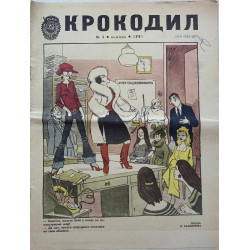


1982 Krokodil Magazine No. 20: Soviet Satire and Caricatures from USSR
- Brand: Pravda Publishing House
- Product Code: SKM11
- Availability: In Stock
-
Shipping
- International tracked shipping
- Carefully packed & bubble wrapped
- Worldwide delivery: 7–22 business days
- Ships from Ukraine
-
Returns
- 30-day returns: damaged or not as described
- Full refund after inspection
- Contact us before returning
- Learn more about our return policy →
-
Before You Buy
- Every item is a genuine Soviet-era original — no replicas, no reproductions
- Condition is detailed in the product description
- Customs duties may apply — buyer's responsibility
- Questions? Contact us before purchasing →
$10.00Only 1 left
Krokodil Magazine No. 20 (1982)
Published in 1982, Krokodil Magazine No. 20 presents a vivid collection of investigative journalism, social satire and original Soviet caricatures devoted to one of the magazine's favorite themes—the distance between official responsibility and everyday reality. Rather than concentrating on international affairs, this issue turns its attention to local administrators, factory directors, collective farms and ordinary citizens, exposing inefficiency, misplaced ambition and bureaucratic thinking through sharp humor and documentary reporting.
Balancing serious investigations with literary satire and expressive illustrations, this issue demonstrates why Krokodil remained the Soviet Union's most influential satirical weekly. Each article is rooted in real events while using irony to encourage practical solutions rather than simple criticism.
Leadership Without Calling
One of the issue's most memorable reports, "Чтобы колос стал...", visits agricultural enterprises in the Volgograd Region and introduces readers to managers who openly admit that promotion has taken them away from the work they truly understand. A district agricultural administrator dreams of returning to his former position as a state farm director, while an experienced agronomist, now promoted to farm director, quietly wishes to become an agronomist once again.
Through these conversations the magazine raises an unusual question: does promotion always mean greater usefulness? The article argues that real success depends not on rank but on placing capable people where their knowledge and experience bring the greatest benefit.
When Bureaucracy Becomes a Game
Another striking investigation, "Playing Kindergarten", tells the story of a kindergarten building that had been completed but remained unopened for years because of endless correspondence, postponed deadlines and contradictory official promises. As local authorities repeatedly announced new opening dates, the building itself was occupied by administrative offices instead of children.
Presented with restrained humor rather than anger, the report illustrates how excessive paperwork and the absence of personal responsibility could transform a simple public project into an absurd bureaucratic drama.
Justice, Temper and Human Nature
The literary centerpiece of the issue is a brilliantly written feuilleton describing an ordinary neighborhood argument that gradually turns into something resembling a Hollywood western. What begins as a dispute between two women waiting in line quickly escalates after their relatives become involved, ending with knives, an axe and police intervention.
Using the language and imagery of classic western films, the author humorously contrasts cinematic heroism with the foolishness of everyday violence, reminding readers that pride and uncontrolled emotions often destroy common sense far more quickly than any weapon.
When Satire Changes Reality
The regular section "Krokodil Helped" demonstrates one of the magazine's unique characteristics. Rather than merely publishing criticism, the editorial staff follows the consequences of earlier investigations. This issue reports practical improvements inspired by previous articles, including better livestock feeding in the Pskov Region, modernization of facilities at the Kharkiv Central Market, environmental measures in Georgian fish farms and revised construction plans protecting valuable agricultural land.
These follow-up reports reveal the magazine's unusual role in Soviet public life, where satirical journalism could occasionally contribute to real administrative reforms.
Illustrations That Tell Their Own Stories
As expected from Krokodil, Issue No. 20 contains dozens of original cartoons and humorous drawings by leading Soviet artists. Rather than serving merely as decoration, many illustrations expand the written articles with visual jokes about agriculture, public administration, construction, trade and everyday behavior. Their expressive style and concise captions make them valuable examples of Soviet graphic art from the early 1980s.
Highlights of This Issue
- Feature report on leadership and management in Soviet agriculture.
- Investigative article about the unfinished kindergarten project.
- Classic courtroom-style feuilleton inspired by an everyday street conflict.
- Follow-up reports documenting the real impact of earlier Krokodil investigations.
- Articles on farming, trade, construction and public administration.
- Original Soviet caricatures and editorial illustrations.
- Humorous observations of everyday life across the USSR.
A Valuable Historical Record
More than forty years after publication, Krokodil Magazine No. 20 (1982) remains a fascinating document of Soviet society. Instead of presenting idealized success stories, the magazine openly discusses management mistakes, bureaucratic inefficiency and the everyday experiences of ordinary people through humor, investigative reporting and memorable visual satire.
Whether collected for its artwork, journalism or historical significance, this original issue offers an authentic glimpse into the editorial style that made Krokodil one of the most widely read illustrated magazines of the Soviet era.
No questions answered yet — be the first comrade to ask.
Related Products
- No. 352 Only 1 leftIn stock

- No. 345 Only 1 leftIn stock
- No. 341 Only 1 leftIn stock
- No. 397 Only 1 leftIn stock
- No. 405 Only 1 leftIn stock
- No. 354 Only 1 leftIn stock
- No. 347 Only 1 leftIn stock

- No. 407 Only 1 leftIn stock