

The Hunchback: Inside the 1MChZ Caliber 2608, a Central-Seconds Cousin of the Pobeda 2602
"And now — the hunchback! One arched bridge, and a movement that makes you take the whole watch apart to change a broken stem. Sturdy as a vault, and twice as much trouble to open."
— A bench watchmaker's aside
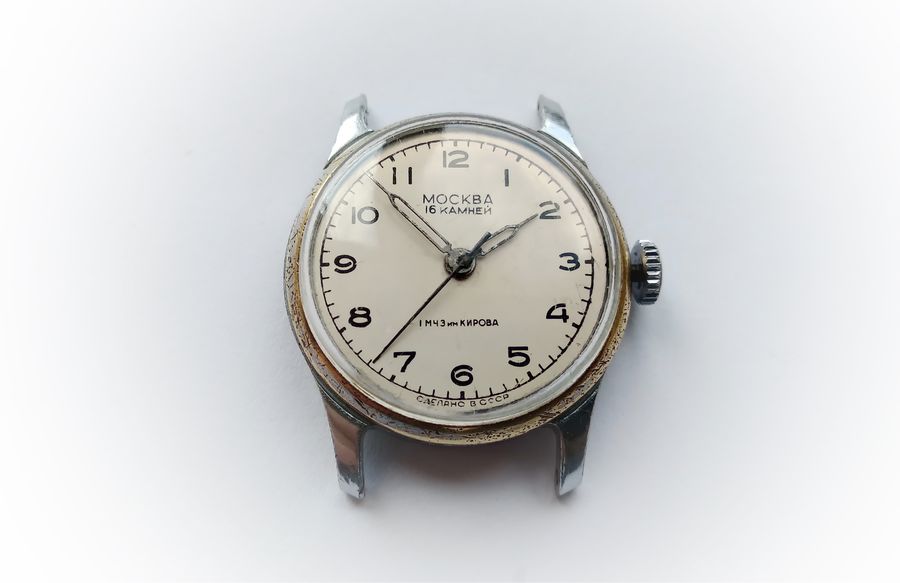
Soviet horology produced a long line of movements descended from the Pobeda 2602, and most of them are familiar territory for anyone who has serviced a few. The 2608 is the odd one out. Built by the First Moscow Watch Factory named for Kirov (1MChZ), it carries sixteen jewels and a center seconds hand, and it earns its workshop nickname — the "hunchback" — from a single, unmistakable feature: a high, arched going-train bridge that rises over the wheels like a vaulted roof. That arch dictates everything about how the movement is taken apart, and not in the watchmaker's favor.
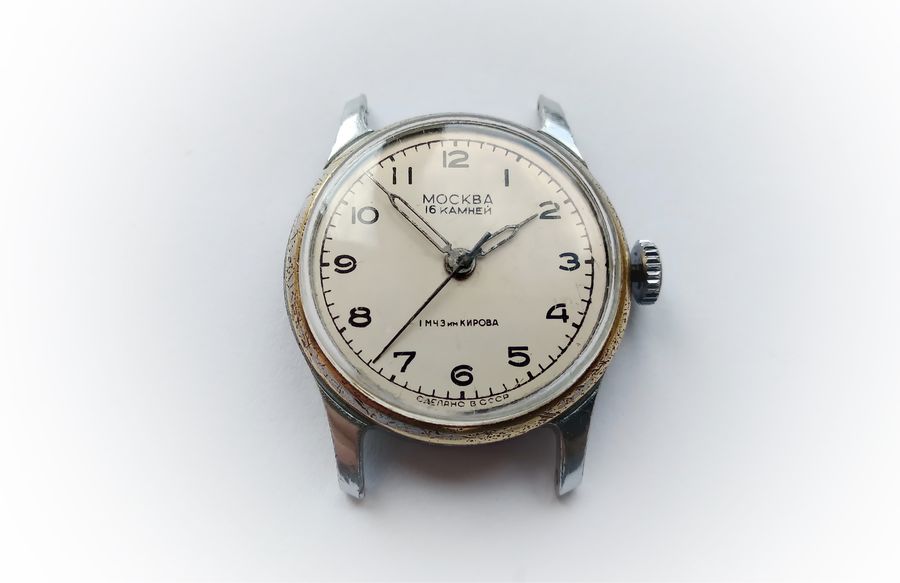
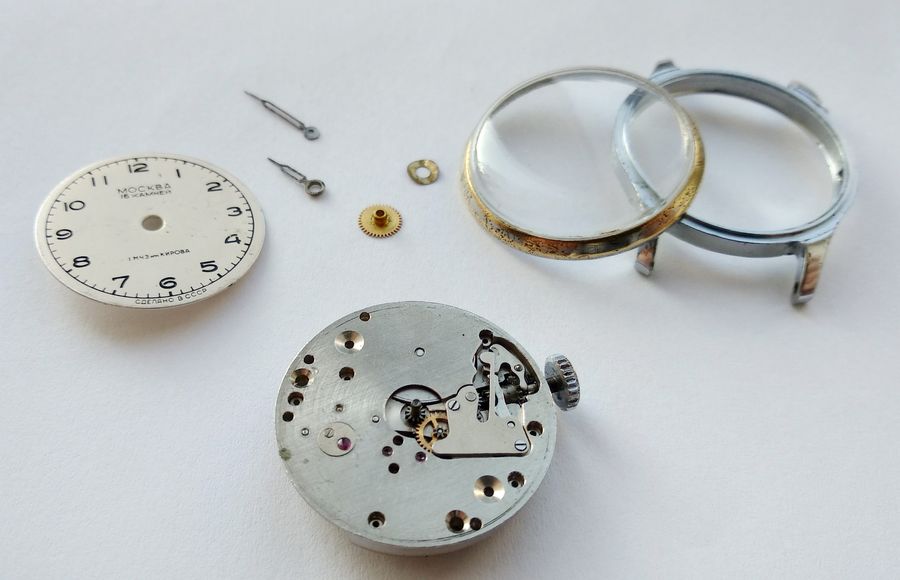
This is the watch itself: a modest "Moskva" dial, sixteen jewels, 1MChZ of Kirov, with a sweep seconds hand.
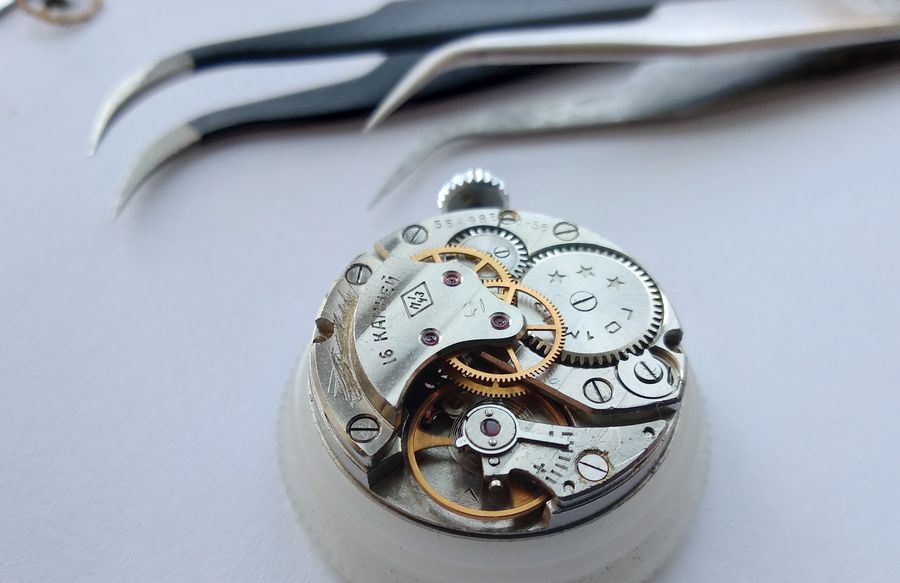
And here is the movement that lives inside it.
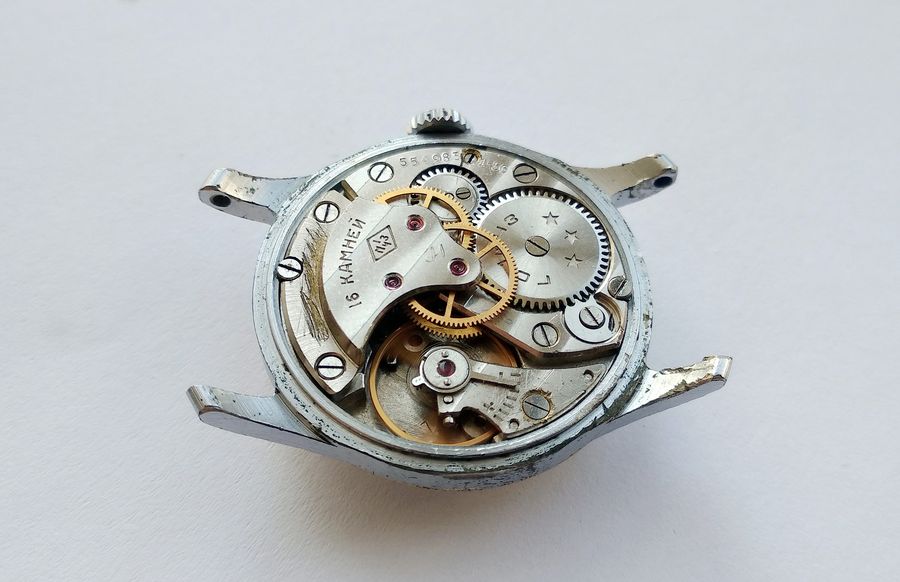
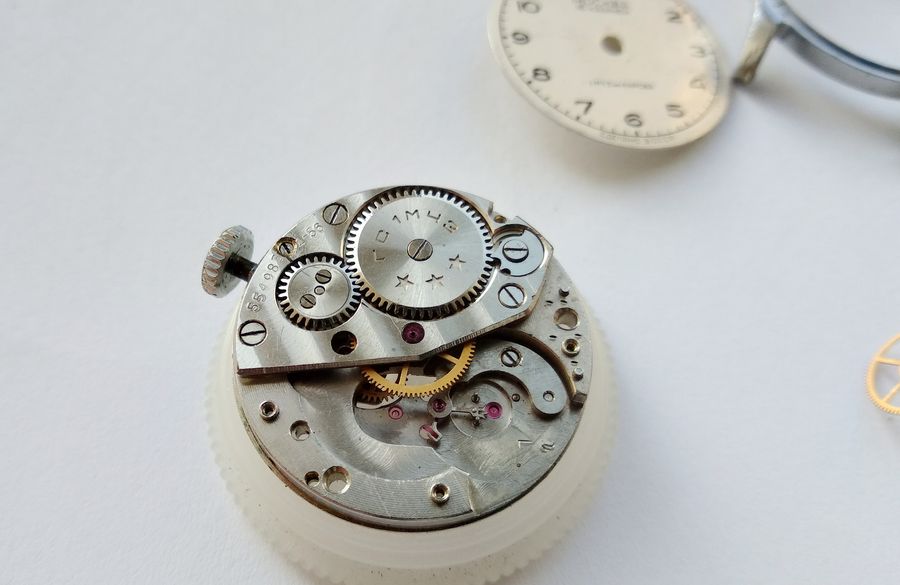
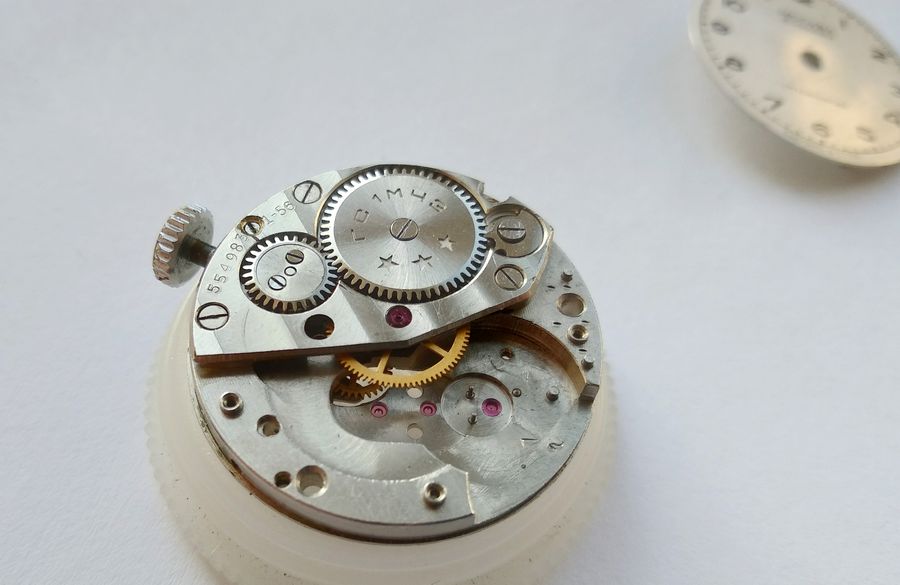
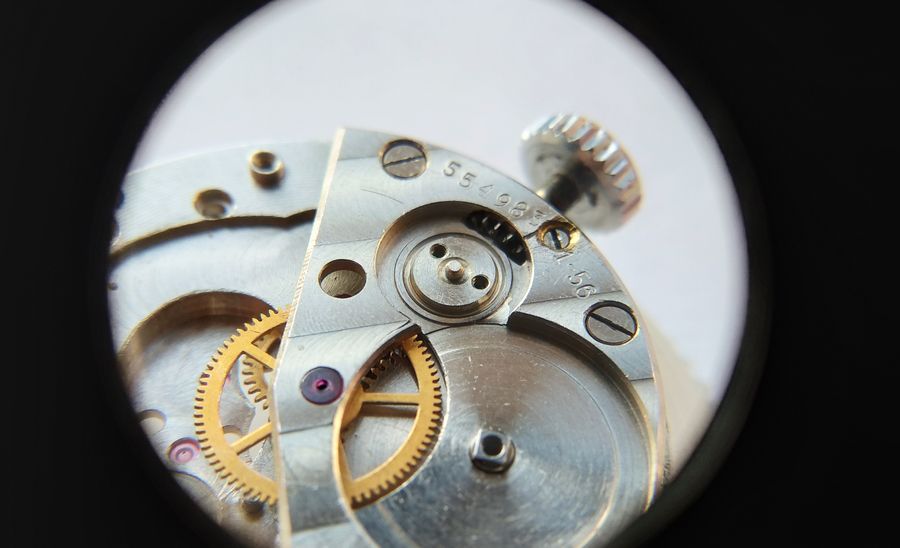
The caliber's layout and markings read clearly here. The keyless works is of the older pattern: the intermediate setting lever, or yoke, is released by loosening a retaining screw rather than by a push button. The button comes later, on the "Sportivnye."
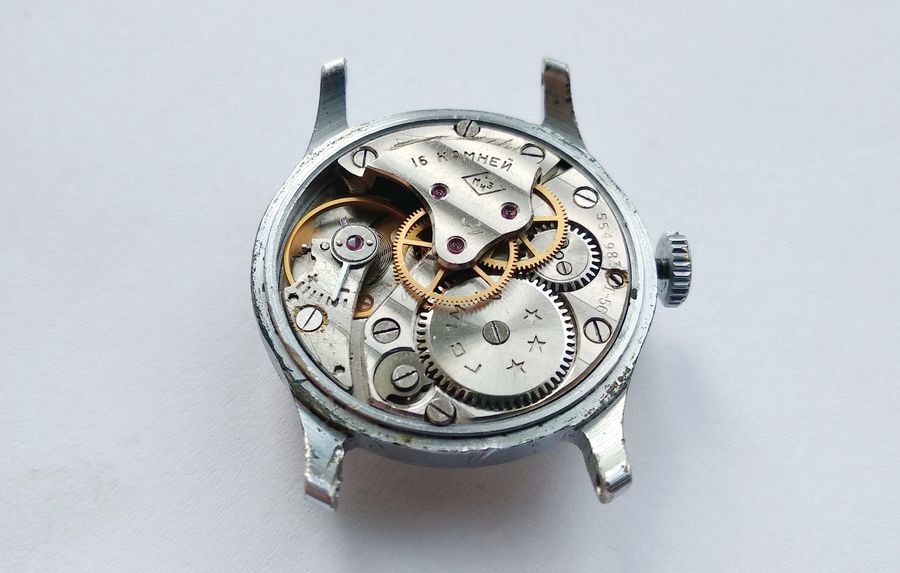
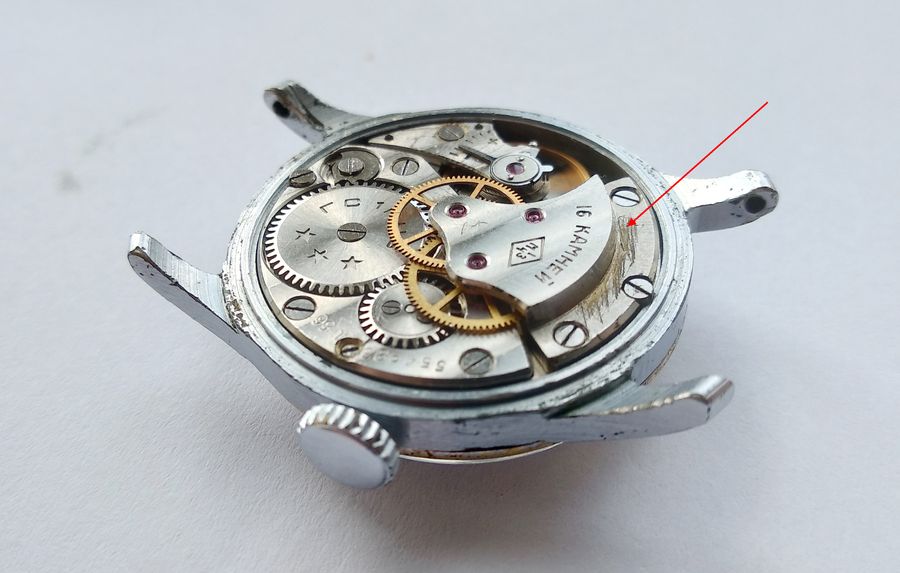
From this angle the "hump" itself is in plain view — the raised going-train bridge. Someone, regrettably, has scratched it badly; hunting for gold, no doubt, where there was none to find.
Opening the Movement
We begin without ceremony: remove the hands, lift the movement from the case, and take off the dial. The procedure asks for no special tricks — it is exactly as on the Pobeda 2602 or the Raketa 2603. The dial, or "slow," side of the main plate is likewise indistinguishable from the 2602.
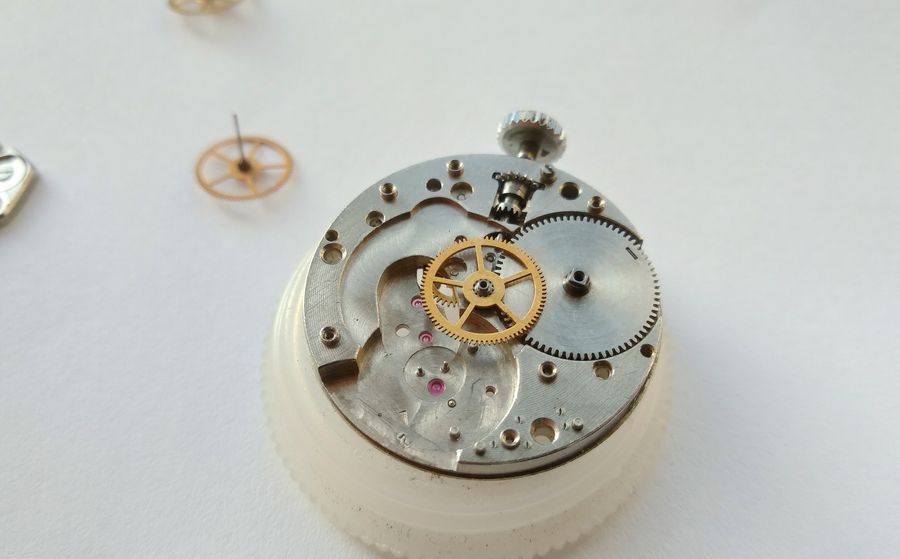
The "fast" side, however, is a different animal, and so is the milling of the plate itself. We lift off the balance and the hunchbacked train bridge, and there it is: a new wheel arrangement. The first thing to strike you is the consequence of this design — to reach the mainspring motor, the entire going train must be dismantled, every wheel of it. Notice, too, how tall the wheel pivots are and how deeply the escape wheel is buried. Once again, no thought was spared for the ordinary watchmaker who must put a dozen of these right in a day. Want to replace a broken winding stem? Strip the watch entirely. On a 2602 or 2603 you need only lift the barrel bridge. But there is no use complaining — only noting the fact — so we press on.
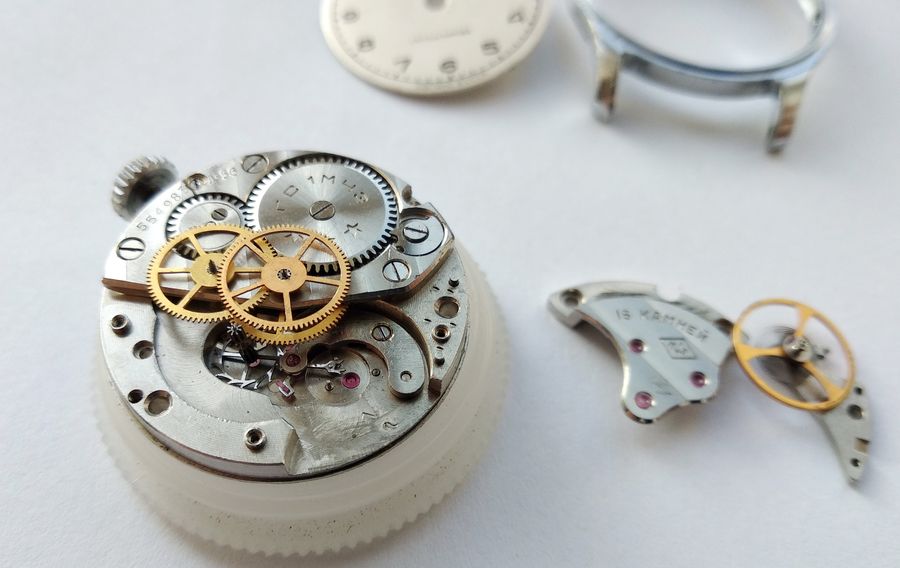
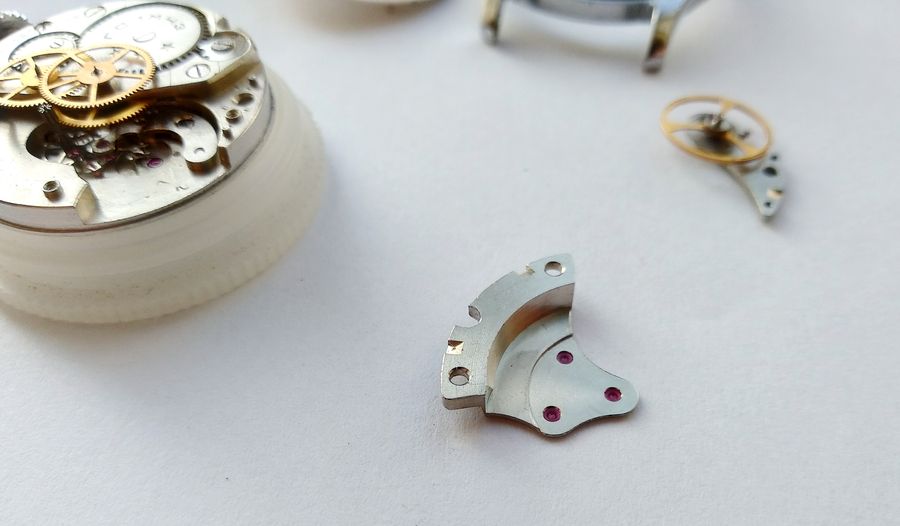
Here is that celebrated curved train bridge on its own.
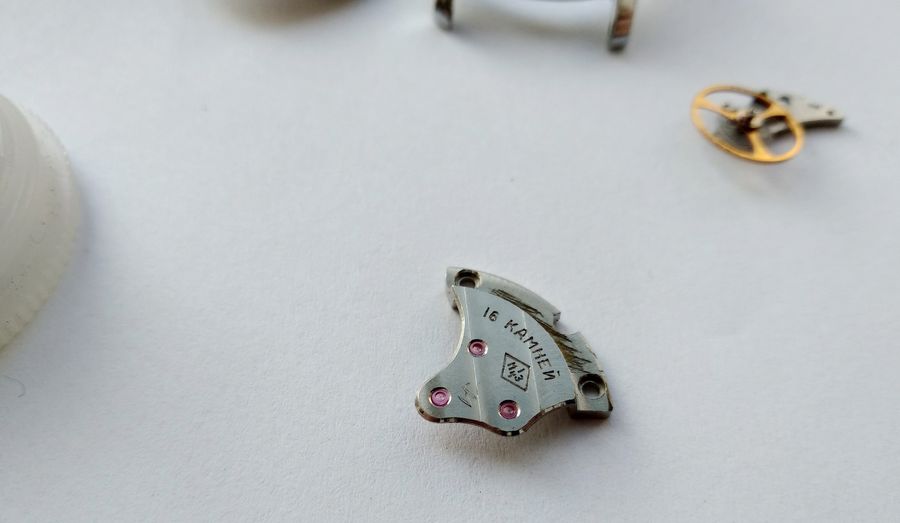
And the same bridge from its underside.
Now we take out the wheels — seconds, intermediate, and escape.
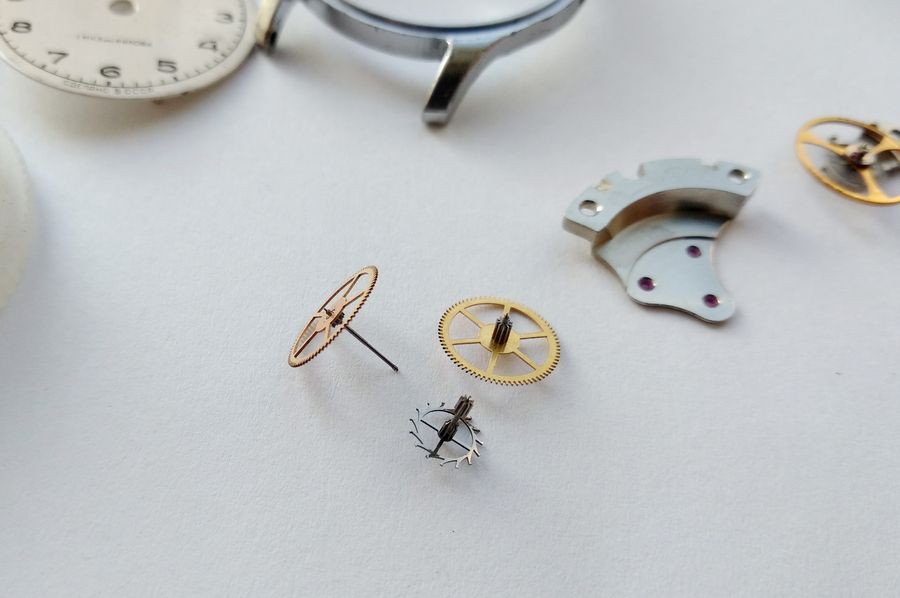
Only now do we gain access to the barrel bridge and the motor beneath it. A confession: I left the pallet fork in place, carried away by the work — shame on me, I might easily have broken it. But it survived. We take it out now.
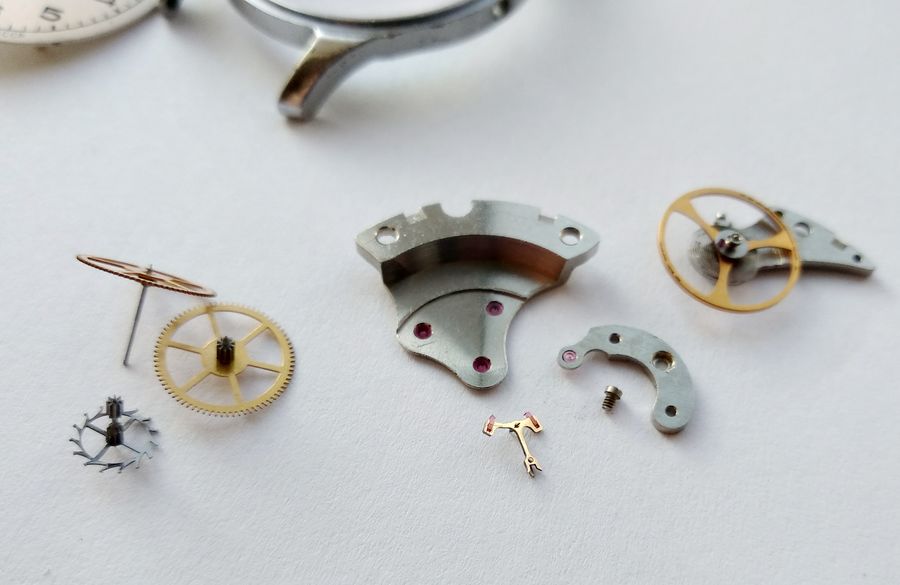
The train wheels, the bridge, the pallet fork and the balance now lie before us — the whole honest company. Is the balance worth dwelling on? It is the ordinary standard 2602 balance, without shock protection. That protection arrives in the next development, the "Sportivnye."
The Mainspring Motor
Now the mainspring motor can come apart.
We remove the ratchet (barrel) wheel.
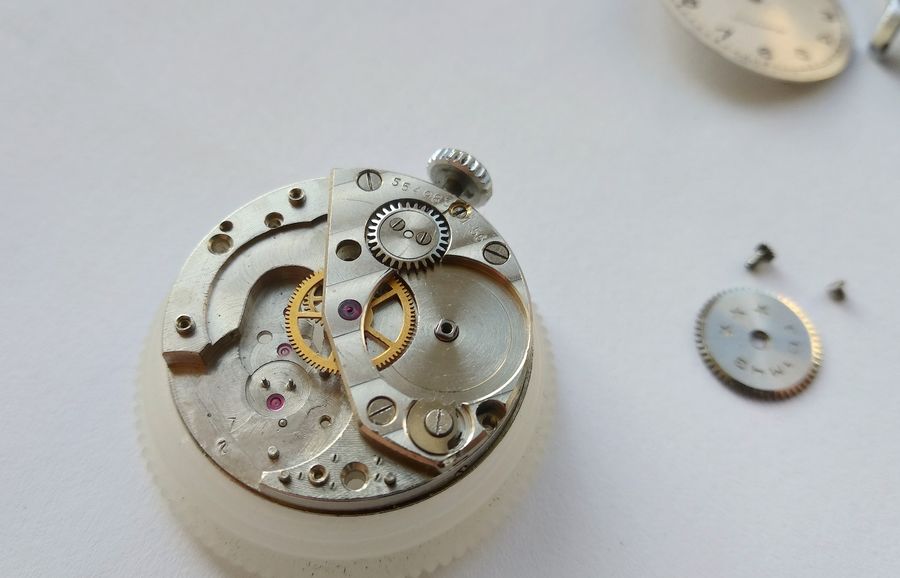
Then — no, wait. While the barrel bridge is still in place and holding the center wheel captive, let us slip over to the slow side and pull the cannon pinion off the arbor of the center, or minute, wheel. As is proper in movements of this kind, it sits on a tight, biting friction fit.
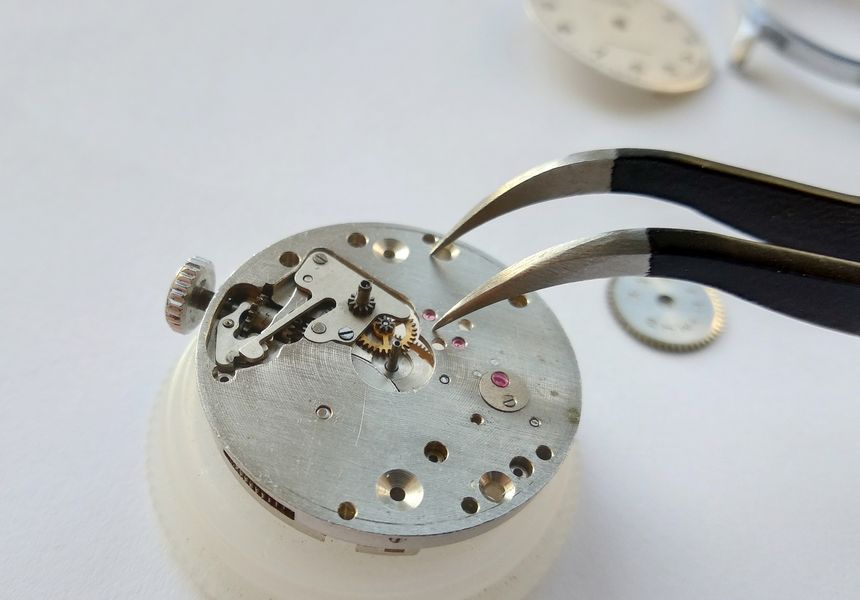
There. Now back to the bridge. Beneath the barrel bridge sit the barrel with its spring and the center wheel.
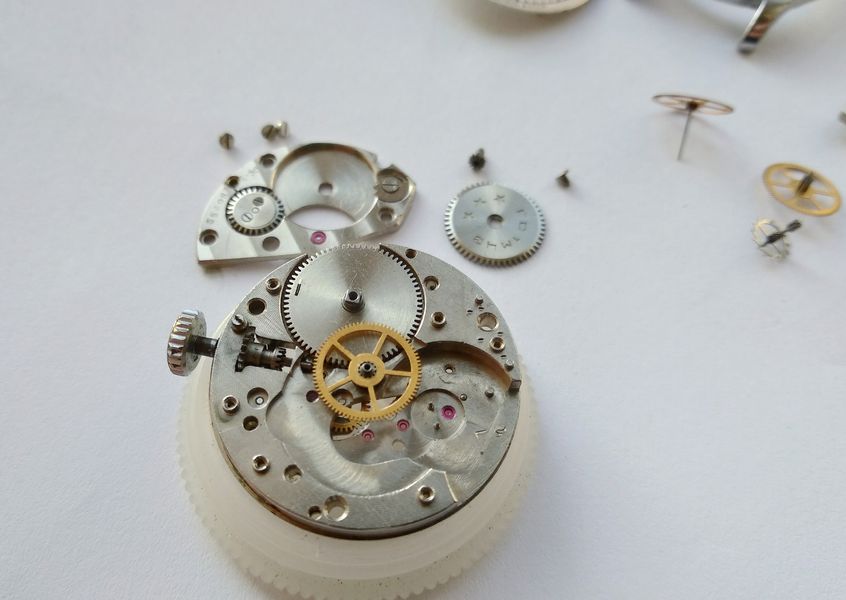
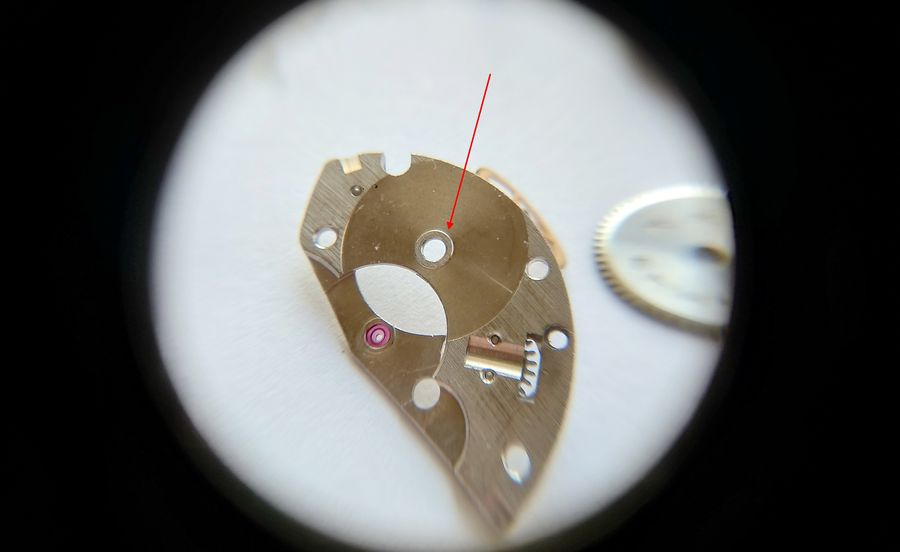
The construction of the barrel bridge deserves a word. There is no hard-alloy bushing for the barrel arbor, but there is a notably tall boss instead — the considerable height of the movement allows it — so the bridge is more than a millimeter thick at this point. A solid bearing. And see: zero wear. The plate is reinforced the same way. A strong, honest, well-made structure. There is also a jewel set under the heel of the center wheel — excellent — and although there is no counter-jewel in the plate, the body there is no less than a millimeter thick, so it is acceptable.
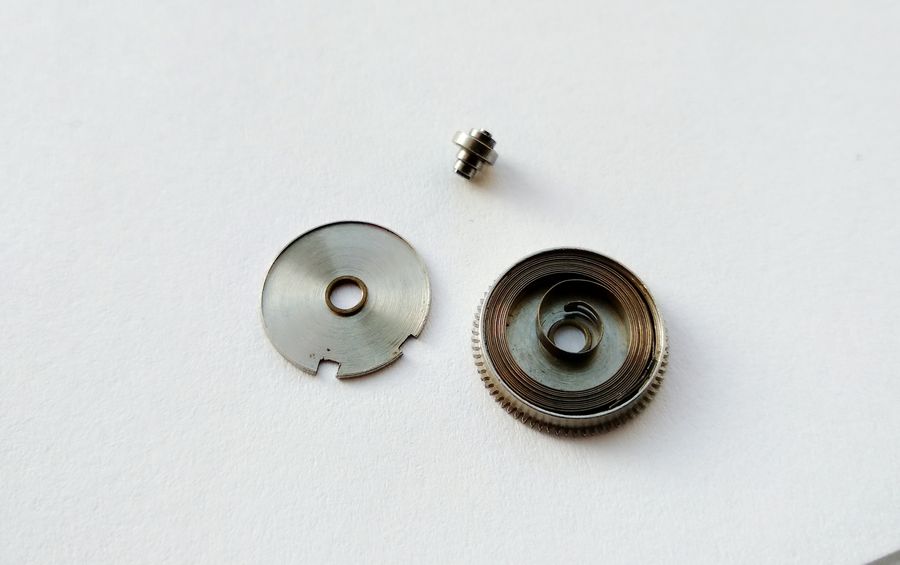
The motor's parts are now before us.
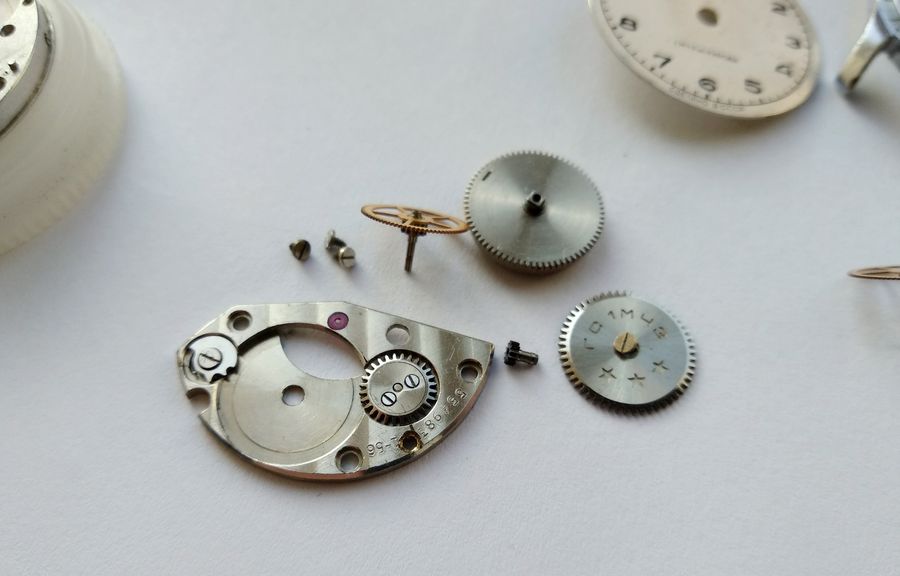
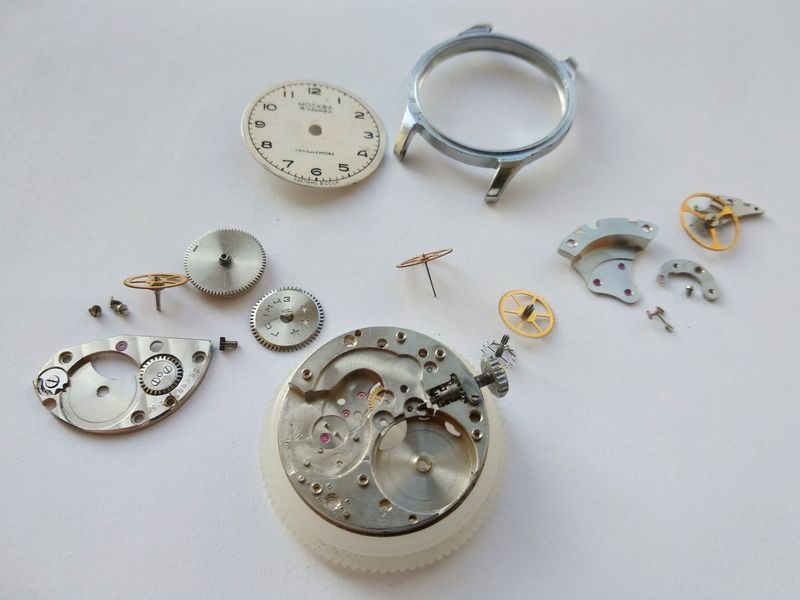
And so the watch is fully apart.
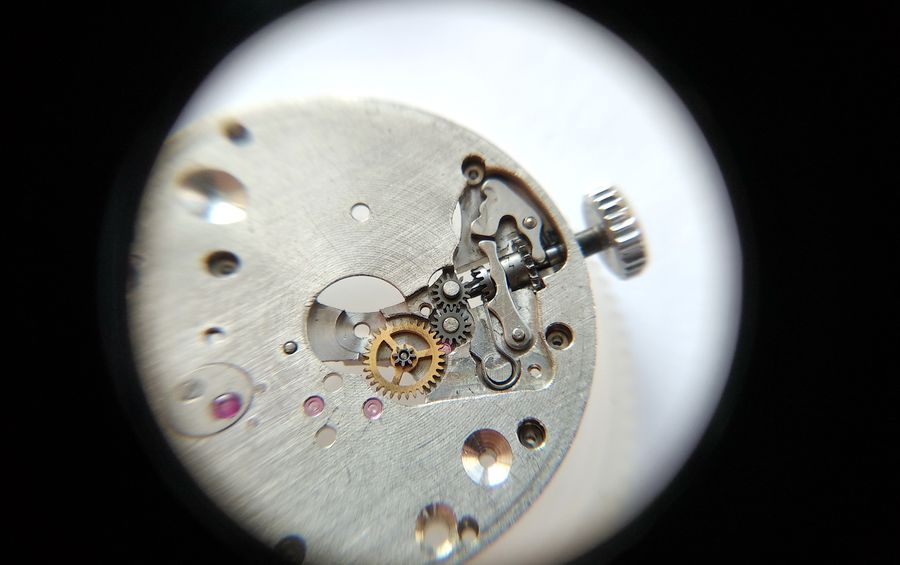
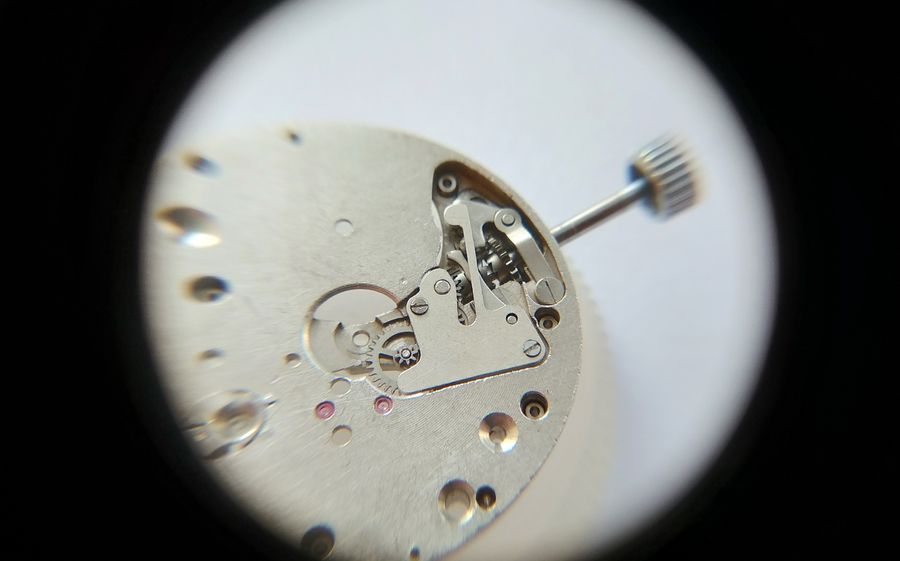
I did not take the keyless works apart; I will simply show it assembled, since it differs in no way from that of the 2602, so a general view will do. The one thing to keep in mind is that the shaft of the intermediate-wheel jewel hides beneath the large setting wheel. That jewel must therefore be oiled before the keyless works is assembled, so it need not be taken apart again afterward.
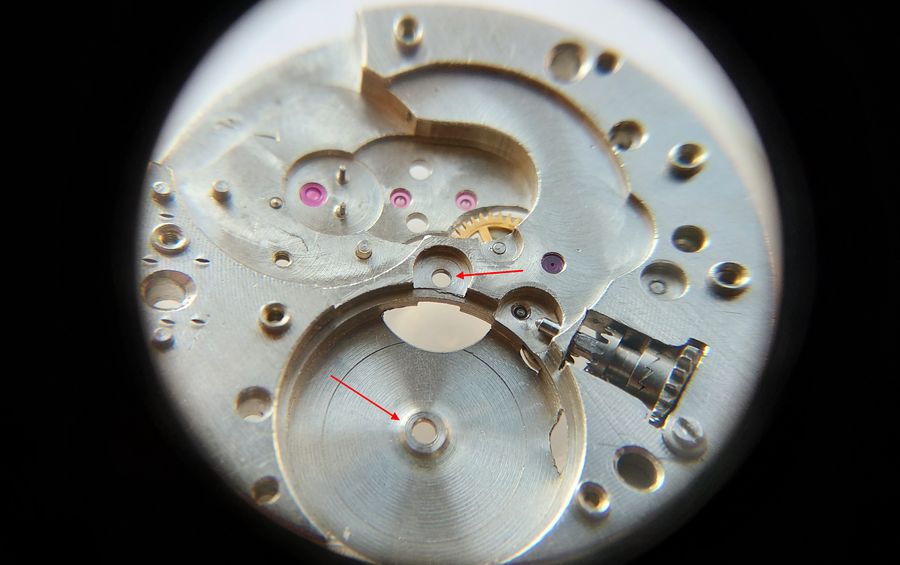
The plate is worth a close look. I spoke earlier of the boss under the barrel arbor; now see how strongly the seat is reinforced — and not a trace of wear, like new. And this is 1956, mind you. Look, too, at the seat for the center wheel: as if straight from the factory. The designers did their work well. One more curiosity: notice the crescent-shaped recess milled into the plate. Here it serves no real purpose, but it was cut deliberately, with an eye to the future — to what? We will speak of the "Sportivnye" a little below, and it is there that this recess earns its keep.
Two words about the spring. Nothing remarkable: the ordinary standard 2602 barrel with a coiled spiral mainspring. No S-shaped springs were fitted to watches yet in those days.
Reassembly: The Motor First
So we have taken it apart, washed it, and made the acquaintance of a relatively little-known movement. Time to put it back together. With the keyless works already assembled, we go straight to the motor. We install the center wheel and the barrel. The wheel's arbor is oiled with MBP-12, and the barrel arbor with B-1.
We prepare the barrel bridge for fitting. The center wheel's support jewel gets MBP-12, and a drop of B-1 goes into the barrel-arbor hole.
We cover the barrel and service the crown wheel.
We clean the running track with pithwood and oil it with B-1…
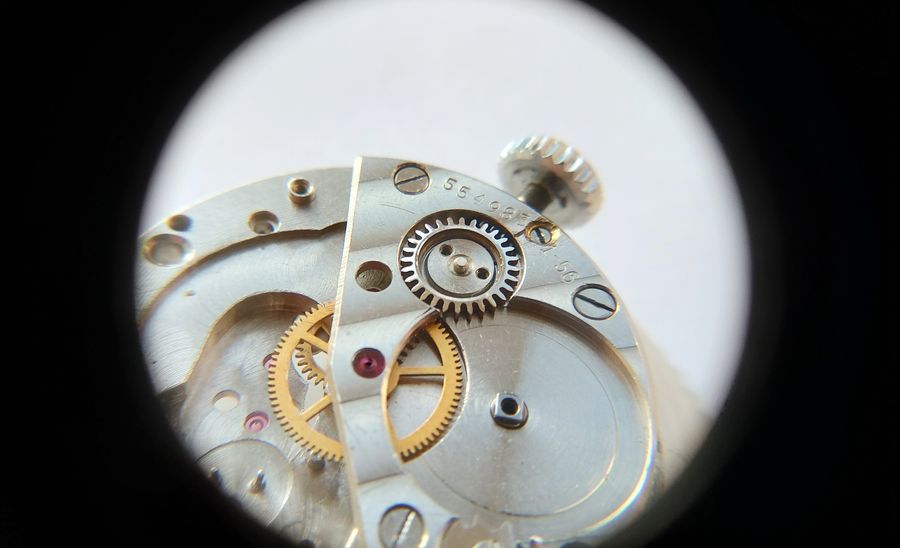
…and assemble the unit. Note that there is no left-hand-thread screw here yet; two small screws secure the wheel.
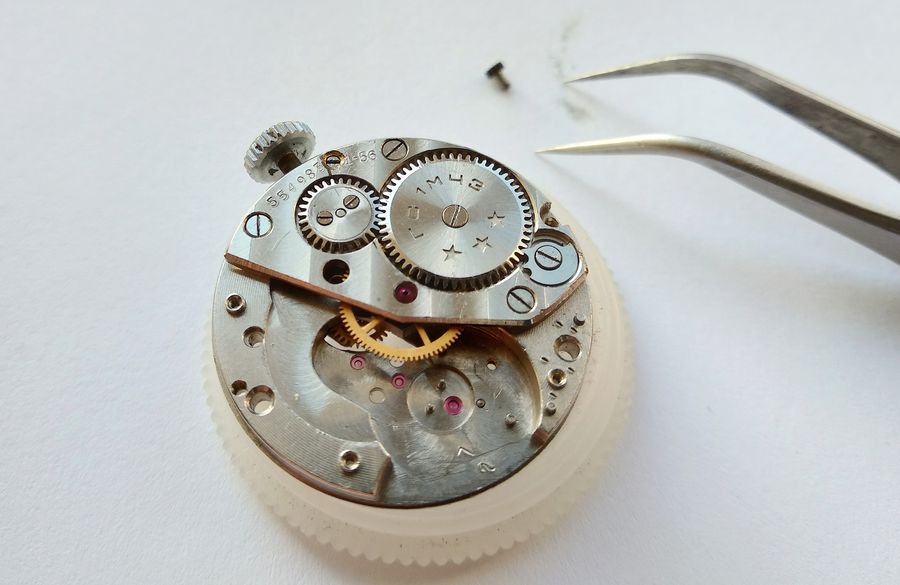
Now we fit the cannon pinion. With that, the easy work is done. Next comes the train.
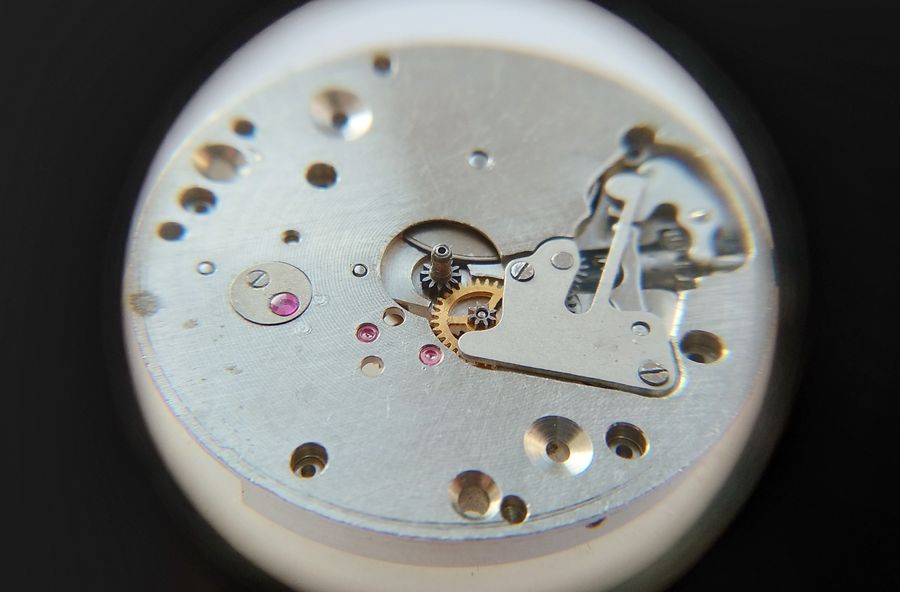
I can imagine the words watchmakers reserved for the designers of this caliber while assembling the wheel train. It took me nearly an hour. Just look at the length of the pivots and all becomes clear. On top of that, reaching the deeply buried escape wheel to guide it into place is no trivial task. Be that as it may, I got it together.
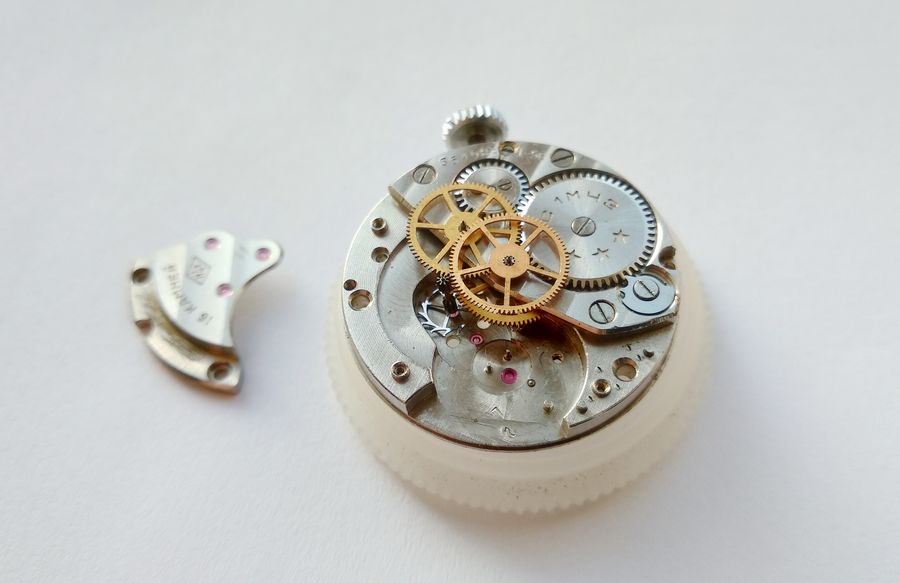
And our caliber comes back to life.
The finish line.
The Sportivnye and Its Stop-Seconds
And now, the promised short account of the 2609 movement — with central seconds and a shock-protected balance — found in the "Sportivnye," carrying a stop-seconds complication. This movement is built on the basis of the 2603 caliber: it has a shock-protected balance and an updated keyless works with a push-button stem release. Beyond that, a cap jewel was added to the escape wheel, raising the jewel count to seventeen. Here is that development before us, after repair. The work, besides routine servicing, included replacing the seconds-wheel jewel in the train bridge — something I have not yet described, so a fuller account of it follows below.
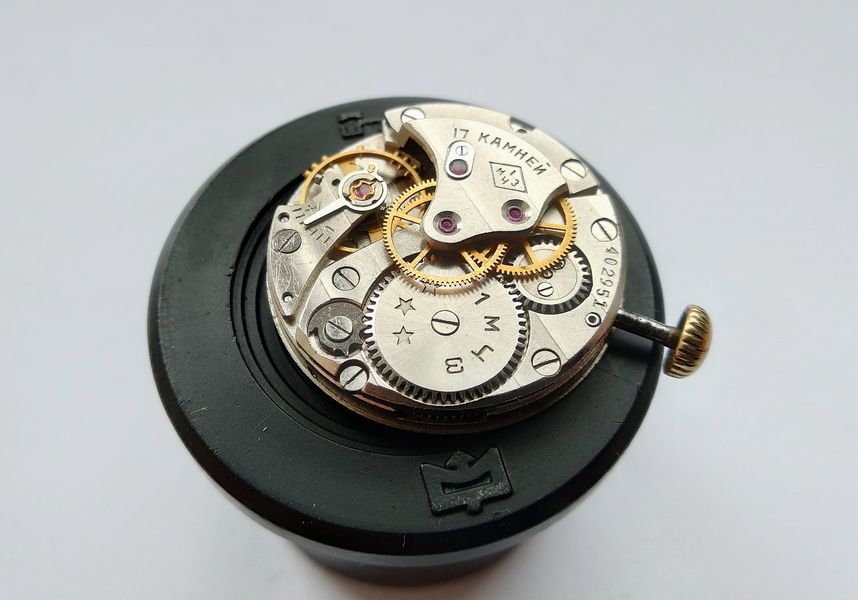
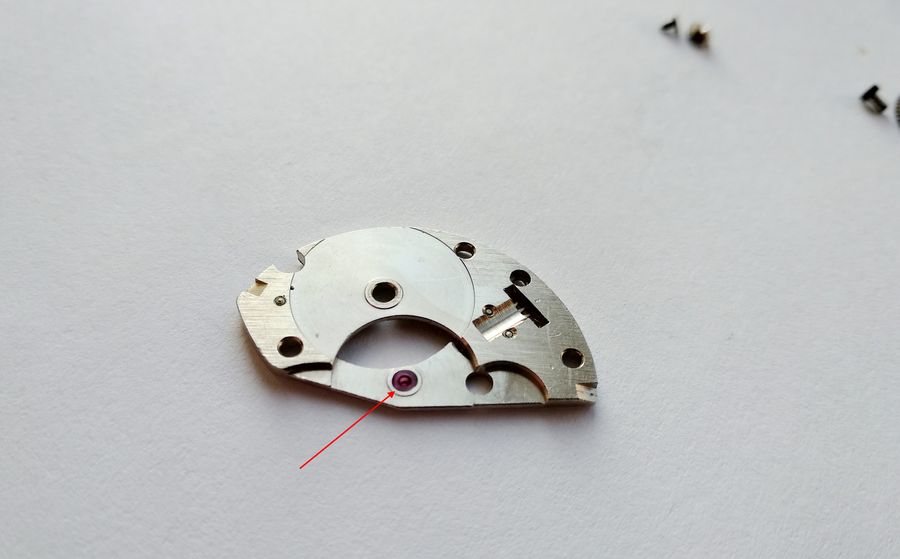
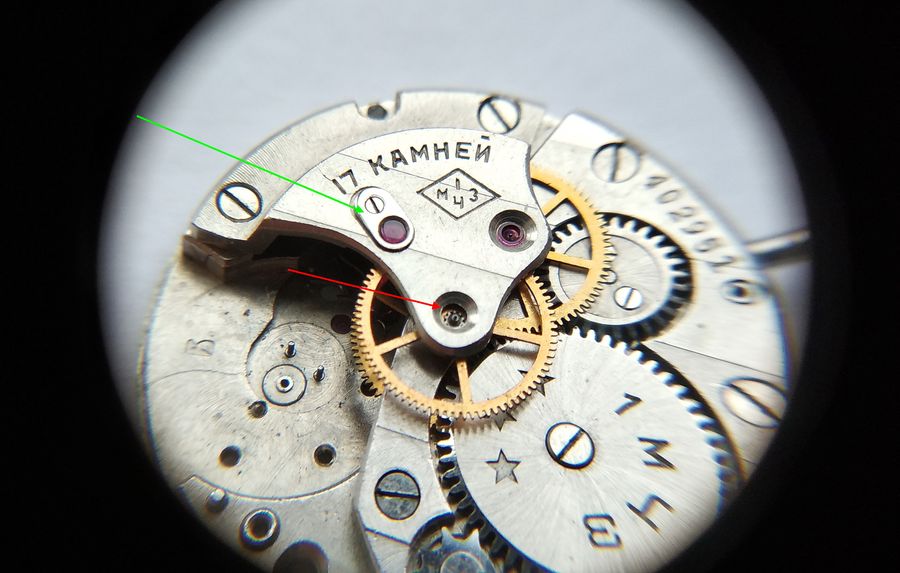
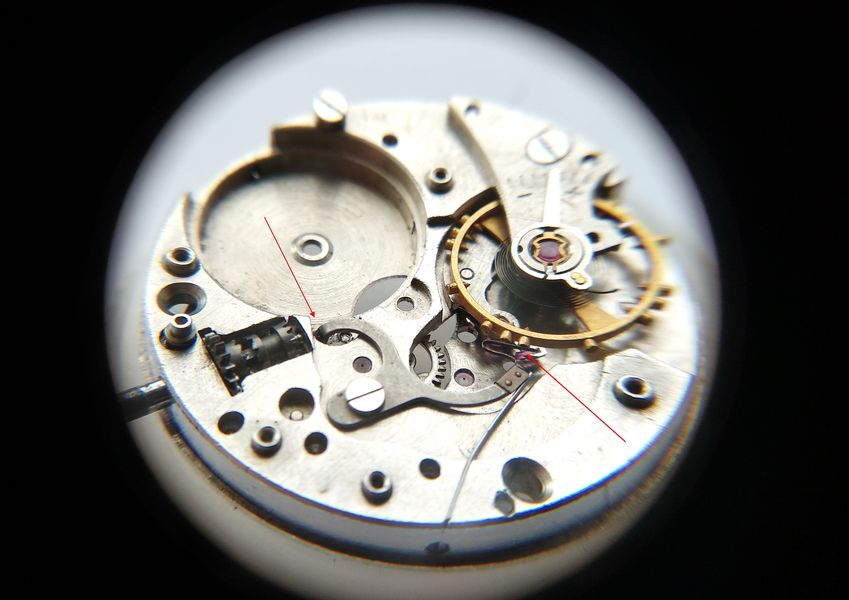
As I said, the caliber was refined relative to the one examined above. A cap jewel appeared on the escape wheel (green arrow), and the winding stem is released by pressing a button. But in the example that came to me the center-wheel jewel is missing. That, however, is fixable.
Re-Jeweling the Seconds Wheel
First we look for somewhere to take a jewel from. The jewels are the same as those used in the 2602 and 2603 calibers, and I keep faulty bridges from these calibers in my stores. The bridge is bent, but the jewels are sound. We will extract one. I have no press, so we use a wooden stick sharpened to the diameter of the jewel with a flat end, working it like a punch. We lay the bridge on a staking block and gently push the jewel out toward the inner side of the bridge.
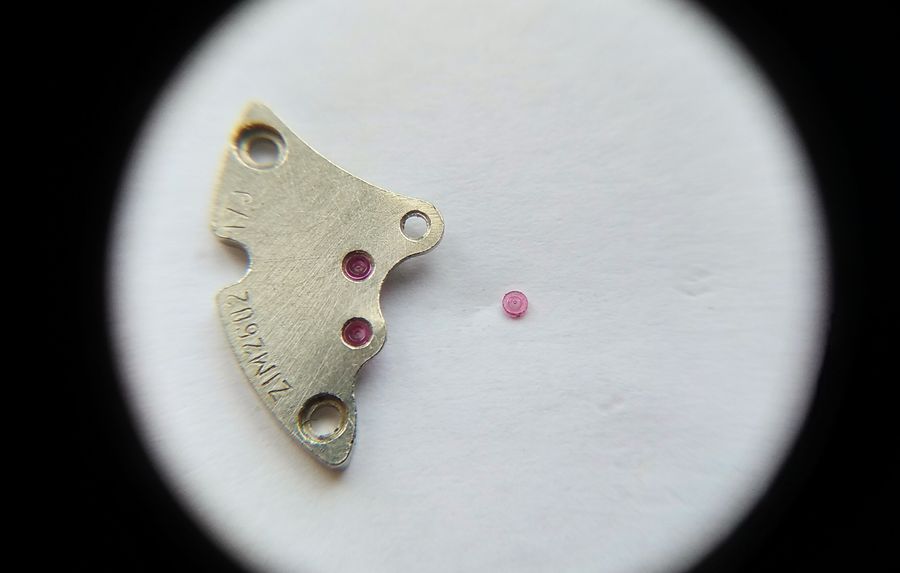
Excellent. The jewel has come out of its setting. The main thing is not to overdo it and to work carefully.
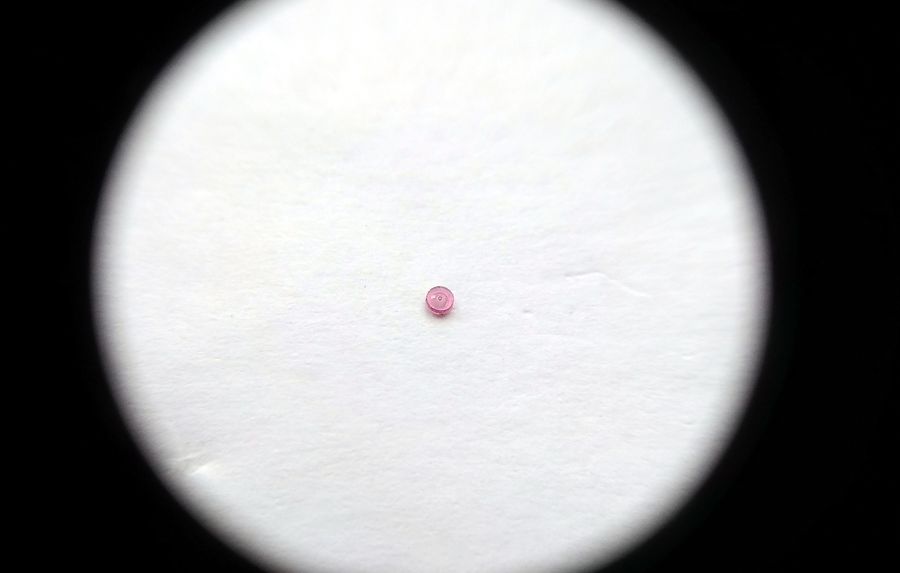
Now the reverse procedure. The jewel must be set in place of the missing one, and with the wooden punch we send it into its seat.
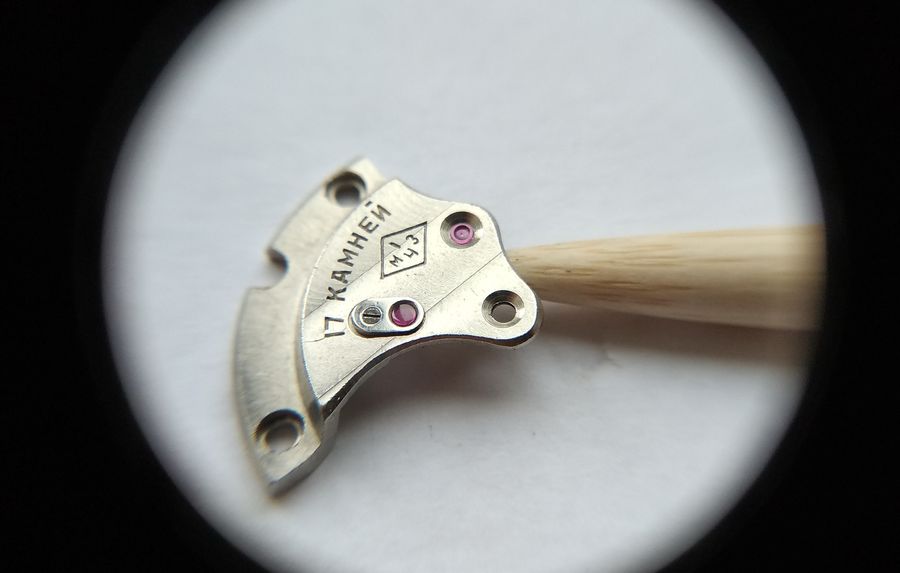
It remains only to set the jewel to the correct height, so that it neither pinches the arbor nor leaves too large a gap between the jewel's face and the shoulder of the seconds wheel. Lacking a micrometer, we do this by eye, judging by how the pivot emerges from the jewel and by the freedom of the train. It worked!
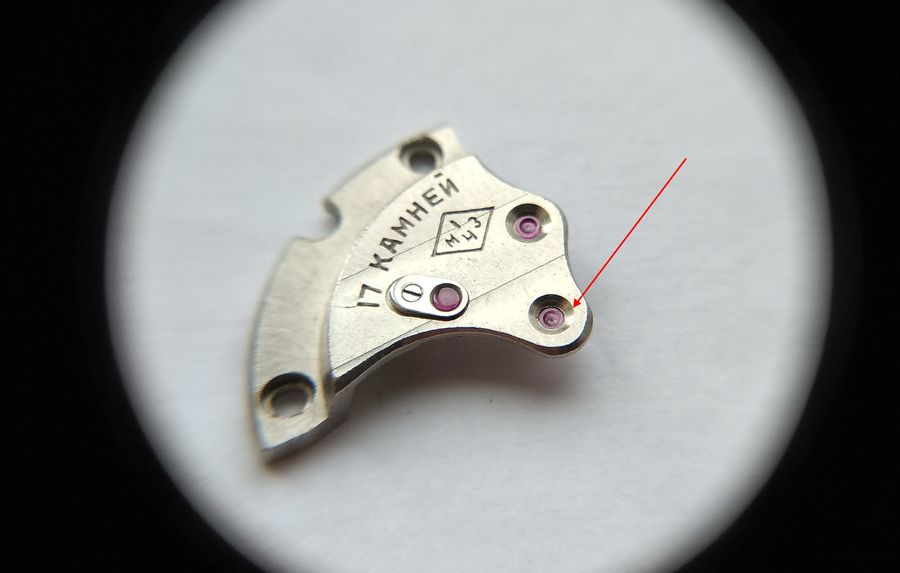
The Captive Lyre Spring
The bridge can go back in place. Done! And one more thing. Remember I spoke of how the "lyre" — the shock-protection spring that retains the balance bouchon — is permanently fixed in these movements and is not lost during disassembly? Let us see how that is achieved in practice.
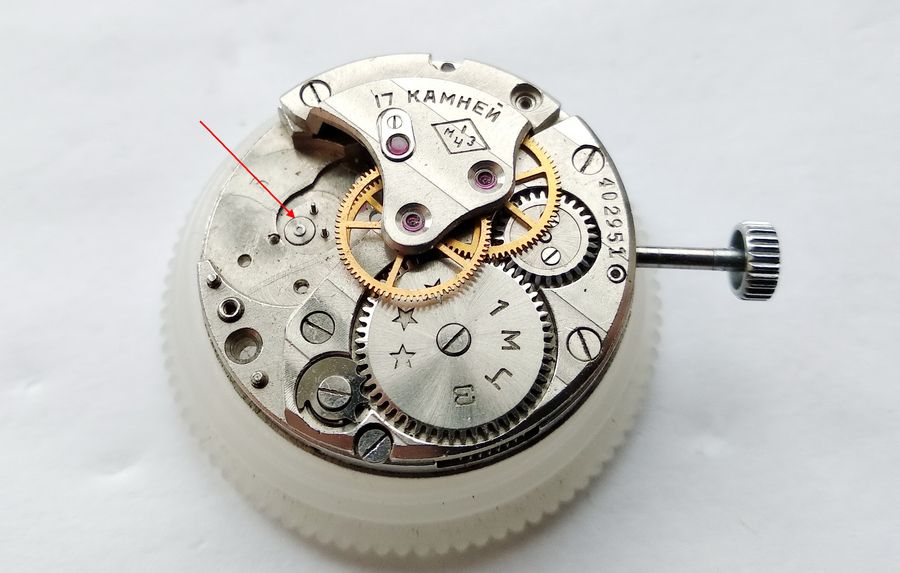
To do so we take the bouchon setting out of the plate and examine it from the reverse side. There it is. See the special grooves machined into this part, into which the arms of the "lyre" engage. The spring is thus held securely and is not lost when the movement is taken apart. This assembly can be opened as often as you like with no fear of losing the little spring. How sorely this is missed in the Raketa 2609.NA!
The Stop-Seconds Mechanism
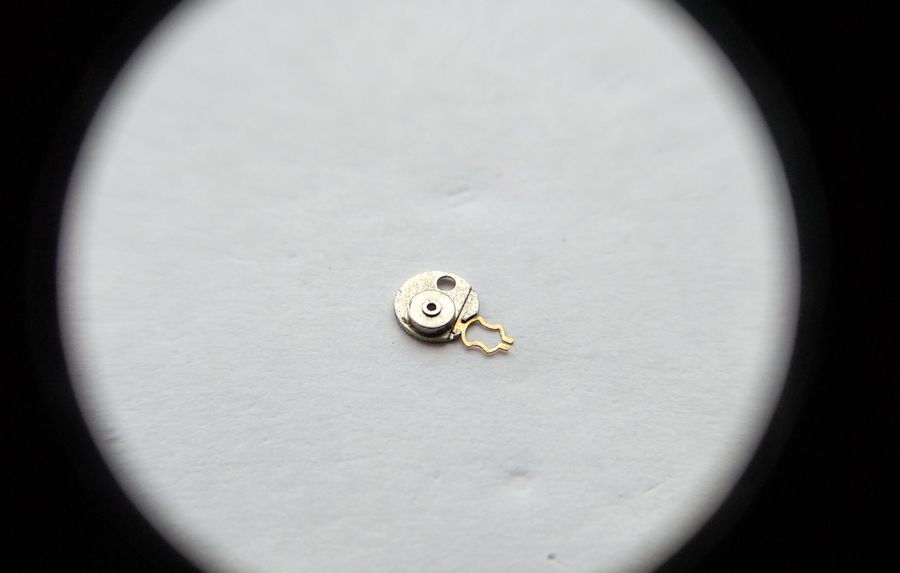
"And now…" — no, no, not the hunchback this time — now, the stop-seconds! This is how the movement's hacking device is built. Two parts have been added: a stop lever with a spring finger, and a flat spring for that stop lever. The lever is controlled by the tail of the winding stem. When the stem is in the winding position, its tail emerges from its seat and presses on the heel of the stop lever, and the spring finger pulls away from the balance wheel, allowing the balance to run. When the stem is moved to the time-setting position, the tail withdraws into its tunnel, freeing the stop lever, which under its flat spring shifts toward the balance and presses the spring finger against the balance wheel, arresting it. The balance stops, the watch stops. Returning the stem to its normal position swings the lever back, drawing the finger away, and the watch runs again.
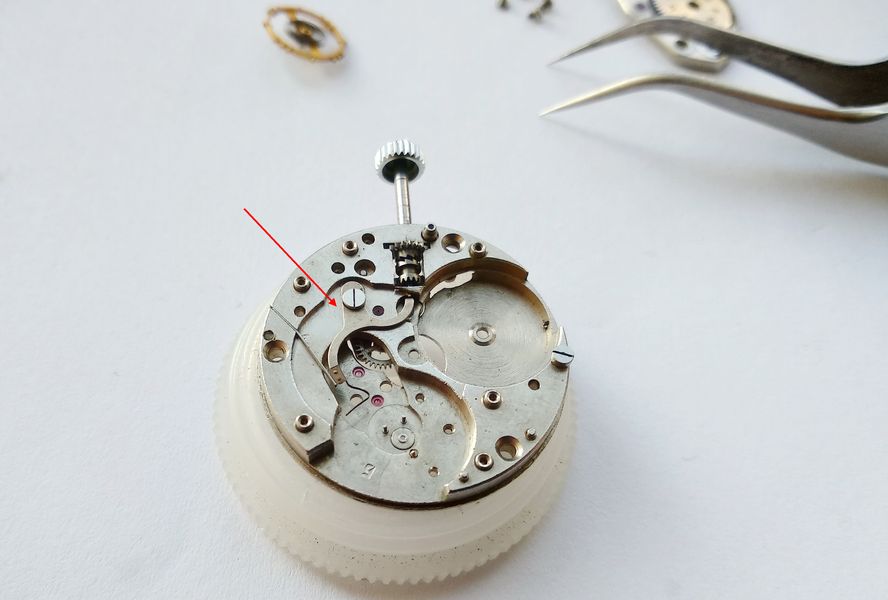
Let us watch it happen. In the picture the movement is in the running state. The winding stem is in the winding position. We can see the spring finger, the lever's flat spring, and the stem's tail emerged from its tunnel, bearing against the heel of the stop lever.
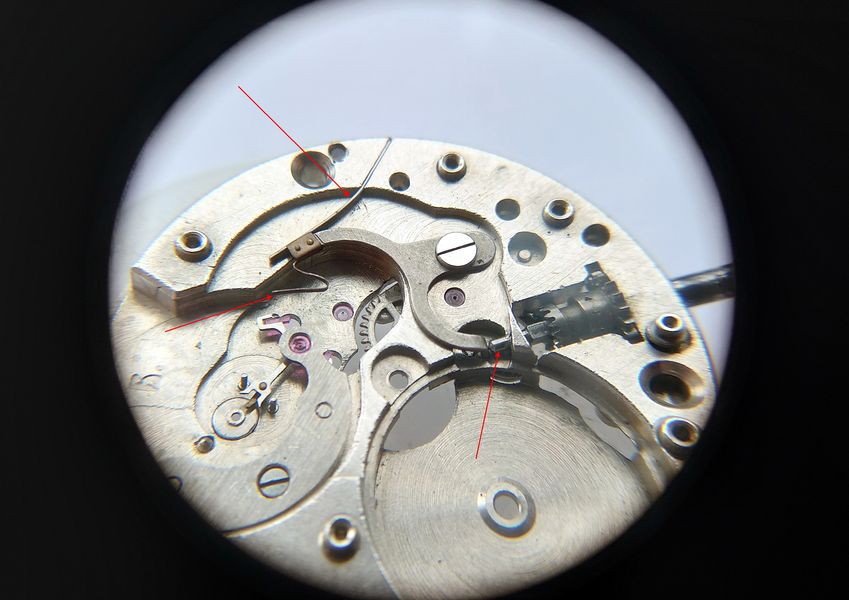
This picture shows clearly that, with the stem and stop lever in this position, the balance is not braked and is free to run.
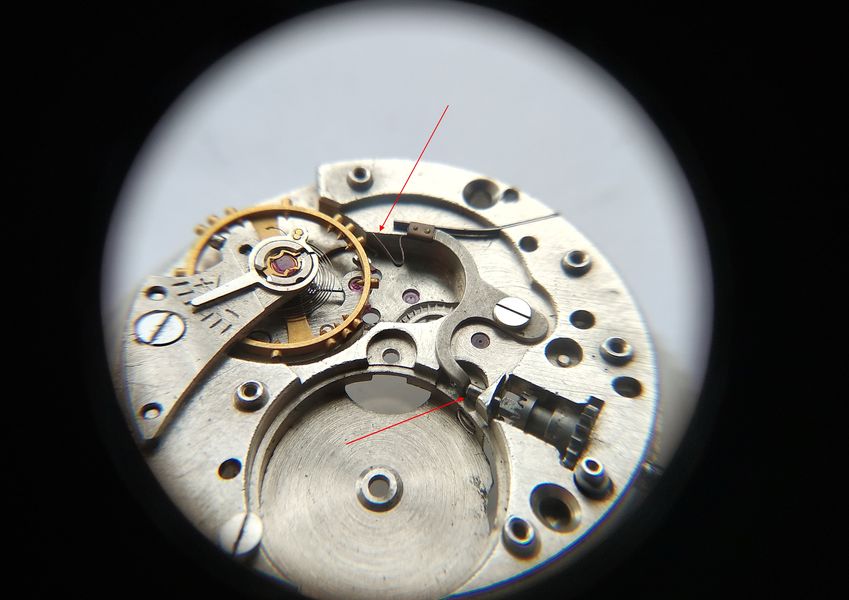
For clarity, the mechanism from another angle.
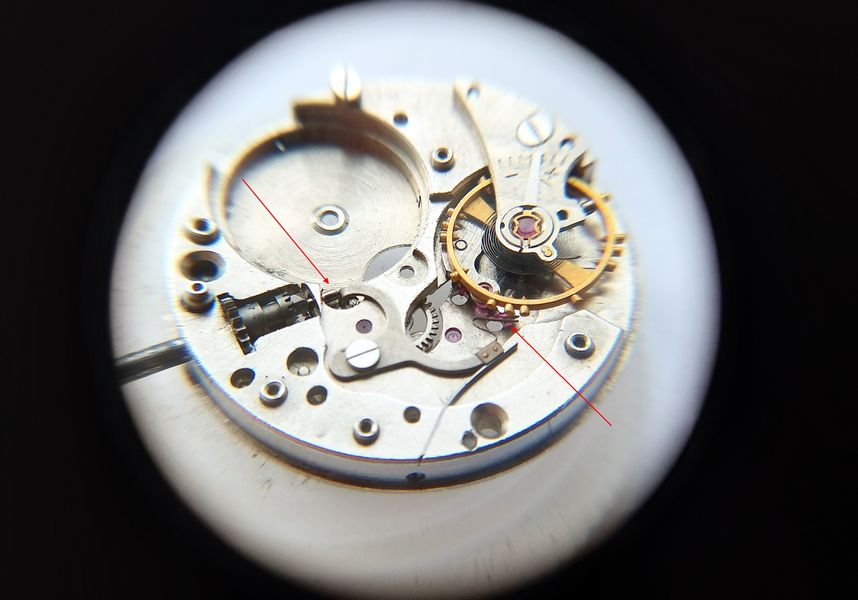
Now we move the winding stem into the hand-setting position and pull it out. As we see, the stem's tail has retreated into its tunnel, and the stop lever has carried the spring finger toward the balance.
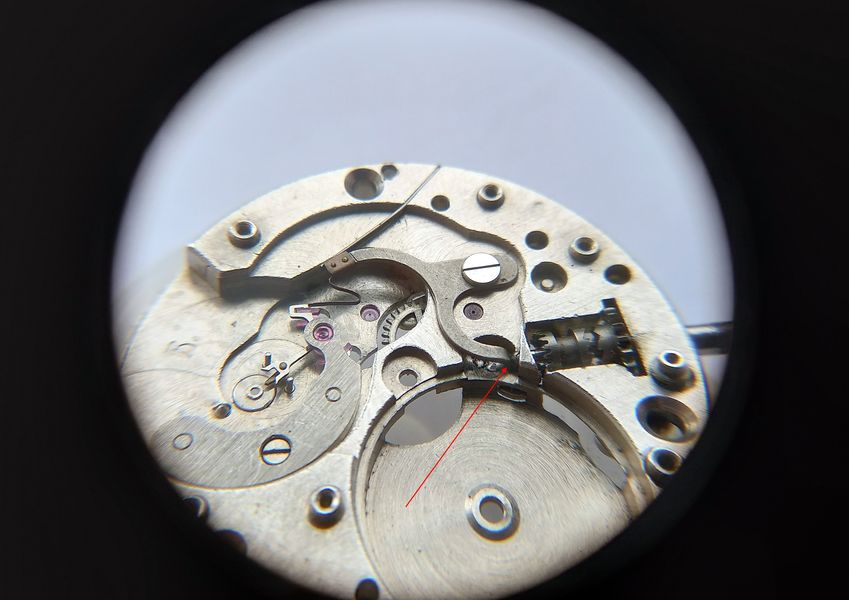
And here we see plainly that, in this position, the finger touches the balance wheel, brakes the balance, and stops the watch.
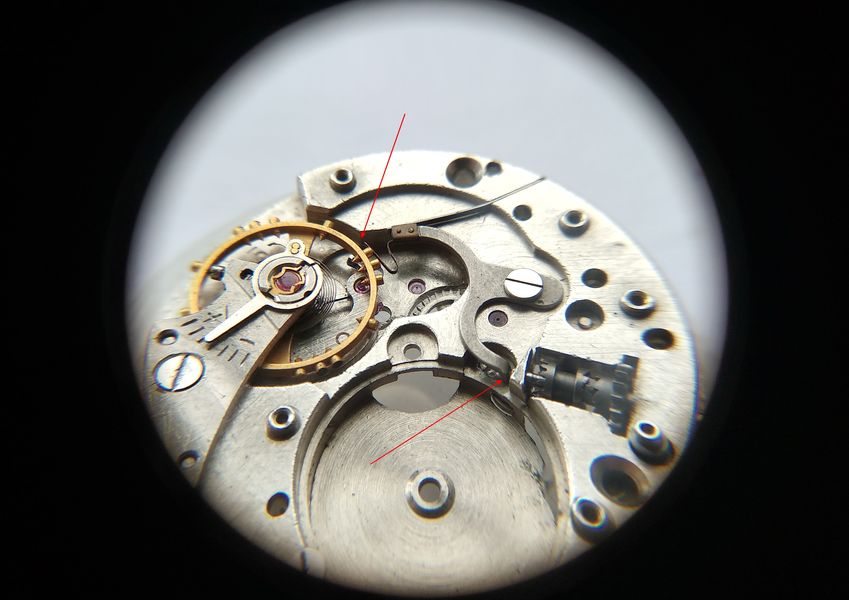
And from another angle.
An interesting complication, then. In all honesty, to my mind it is a fairly debatable one. The central idea was to let the watch be used as a stopwatch and to make it possible to synchronize several identical watches together. The caliber turned out reliable enough, but not especially convenient to work on. If I am not mistaken — and correct me if I am — it was this mechanism, in the "Shturmanskie," that Gagarin took into space. And successfully. Yet the movement's excessive height and its wholly unprotected wheel train left no room for further development of the design. On the other hand, as we can see, these calibers remain repairable and keep working to this day. And one last thing — let me show the keyless works, so the complete analogy with the 2603 caliber is plain to see.
Comments
Write a comment