


Cart
Your shopping cart is empty!
It's never too late to make things right :)


"The fundamentals sometimes receive less attention than the complexities, yet owners encounter them far more frequently..."
— Notes on accessible horology
Learning how to regulate a mechanical watch movement is among the most practical skills for vintage watch enthusiasts. Whether adjusting a Soviet-era Raketa, fine-tuning an old Poljot, or correcting the timing on a vintage Vostok, the fundamental procedures remain consistent across mechanical watch designs. This guide explains mechanical watch regulation for beginners, demonstrating how to adjust watch accuracy without expensive professional equipment.
Much attention goes to complete movement service: disassembly, cleaning, lubrication, and reassembly. Yet the adjustments owners most frequently need require no disassembly at all. Rate correction and beat error adjustment represent the everyday maintenance that keeps a properly serviced watch performing within specification. Understanding these procedures empowers owners to regulate vintage mechanical watches between professional services.
This discussion addresses timing adjustment at the practical level, avoiding deep theoretical complexities in favor of actionable guidance. The goal is accessible competence: understanding which controls affect which parameters, how to observe results, and how to achieve acceptable performance using commonly available tools. The techniques apply equally to servicing old mechanical watches from any manufacturer, though examples draw from Soviet watch movements that remain popular among collectors.

Consider a pendulum clock. The pendulum swings left, then right, each swing covering equal distance from the center position. This symmetrical oscillation, where displacement in each direction matches precisely, represents synchronized beat. The pendulum spends equal time on each side of its rest position.
The balance wheel in a wristwatch operates on the same principle, though it rotates rather than swings. The hairspring returns the balance through its center position, allowing it to rotate equally in each direction. During this oscillation, the impulse jewel mounted on the balance staff interacts with the pallet fork, exchanging energy between the balance and the escapement. For optimal performance, this interaction should occur symmetrically: the balance should travel equal angles clockwise and counterclockwise from its rest position before the pallet fork delivers each impulse.
When the balance oscillates asymmetrically, covering more angle in one direction than the other, the condition is called beat error. The pallet fork no longer sits centered between its banking pins at rest. This asymmetry affects the watch in several ways: the movement may require more mainspring tension before starting, and rate stability across different mainspring states may suffer.
In practice, modest beat error has limited impact on daily timekeeping. A watch with noticeable beat error may start after five or six crown turns rather than two or three, but once running will typically perform within specification. The effect becomes more apparent as mainspring tension varies through the power reserve cycle. Still, eliminating beat error improves overall consistency and represents proper adjustment practice.
Opening the case back reveals the balance assembly with two distinct lever mechanisms. Understanding which lever controls which function prevents the frustration of adjusting the wrong parameter repeatedly. This knowledge is essential for anyone learning how to adjust balance on mechanical watch movements.
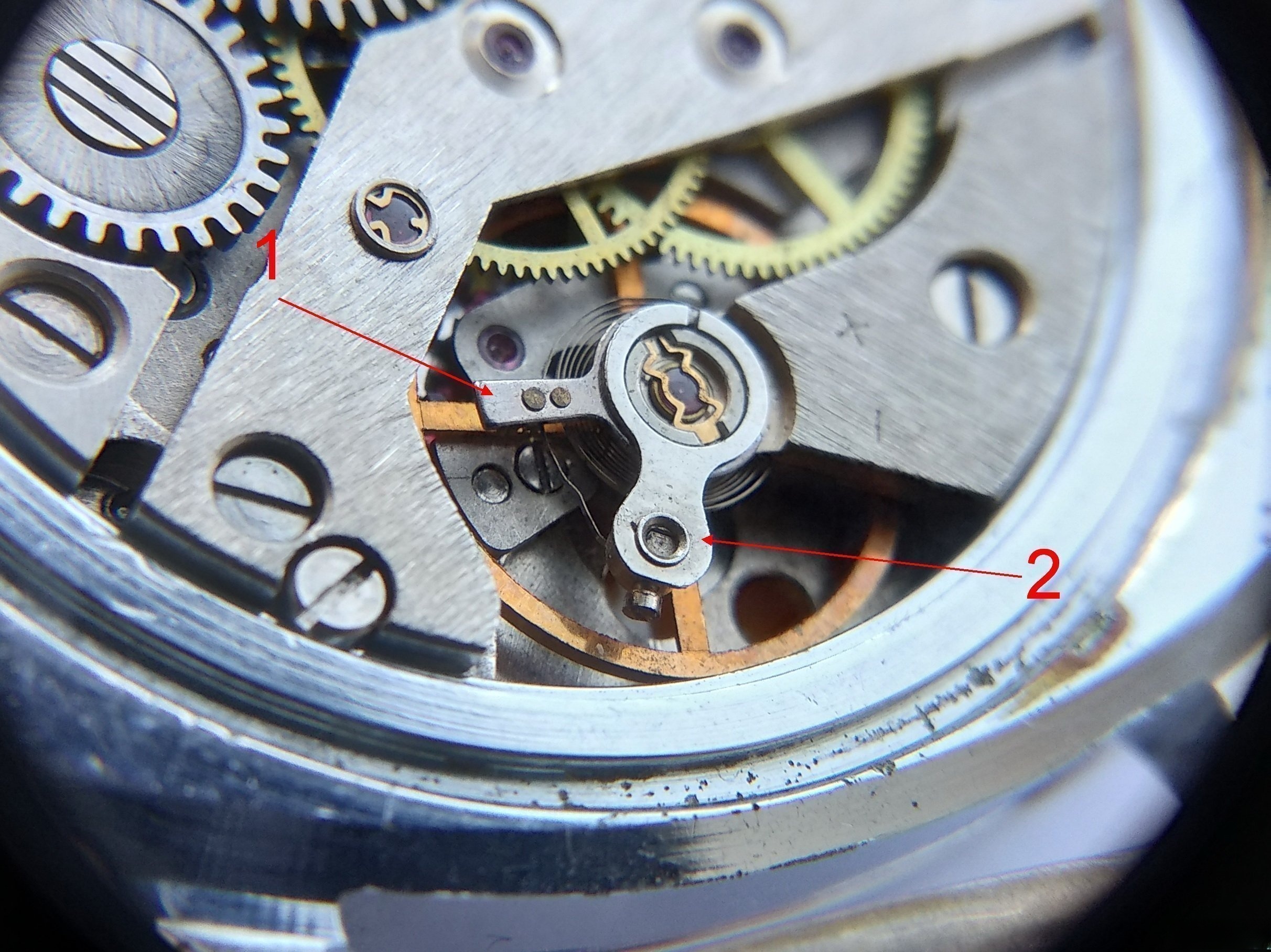
The lever marked "1" in the illustration is the regulator index, sometimes called simply the regulator. This mechanism adjusts the effective length of the hairspring, thereby controlling the oscillation frequency of the balance wheel. Moving the regulator changes the rate: whether the watch runs fast or slow.
The lever marked "2" carries the hairspring stud, the point where the outer end of the hairspring attaches to the balance cock. Moving this stud carrier rotates the entire hairspring assembly relative to the pallet fork, changing the relationship between the balance rest position and the fork's centered position. This adjustment corrects beat error.
Not all movements provide a movable stud carrier. Some designs fix the stud position, requiring manipulation of the hairspring collet on the balance staff to correct beat error. Such adjustment demands specialized tools and skills beyond typical owner capability. The following procedures apply specifically to movements with movable stud carriers, which fortunately represent the majority of designs intended for consumer service. This includes most calibers encountered when regulating old mechanical watch examples and adjusting old watch movement designs.
Meaningful adjustment requires observation of results. Professional watch timing machines display rate and beat error directly, but these instruments exceed typical home workshop budgets. Fortunately, smartphone applications now provide adequate capability for basic timing work, allowing owners to regulate watch without timegrapher equipment.
The application Clock Tuner, available for Android devices, analyzes the tick sounds of a mechanical watch through the phone's microphone. The free version displays a timing graph sufficient for the adjustments described here. The paid version adds numerical readouts of rate and beat error, enabling more precise work.
The timing graph displays two parallel traces when beat error exists. These traces represent the tick and tock sounds occurring at unequal intervals. When beat error reaches zero, the two traces merge into a single line. The slope of this line indicates rate: horizontal means the watch is running at the correct frequency, upward slope indicates the watch is running slow, and downward slope indicates fast running.
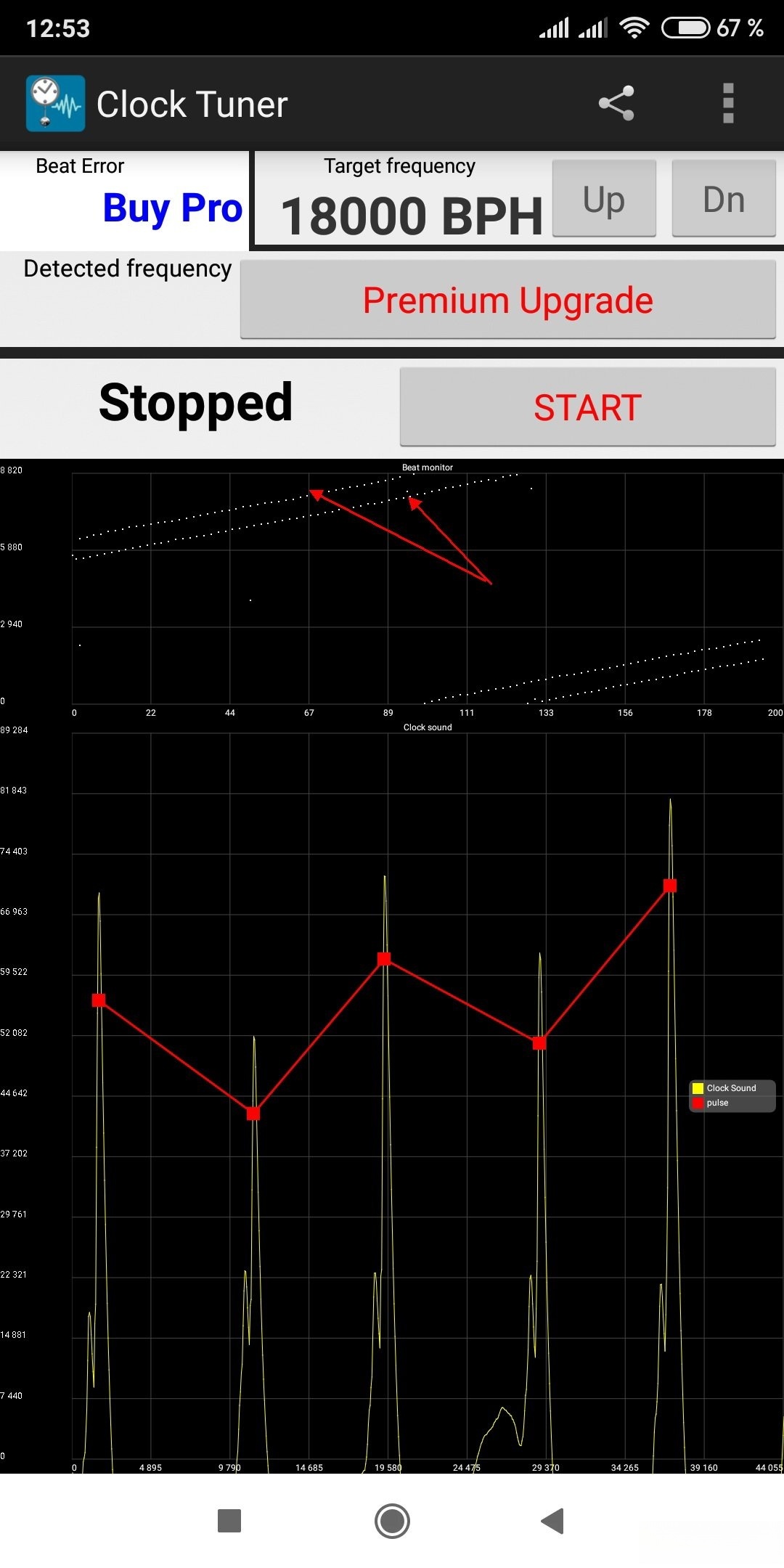
The two adjustments interact with each other. Changing rate slightly affects beat error, and vice versa. The practical approach addresses beat error first, then rate, then verifies beat error again.
Begin by observing the current condition. Place the watch near the phone microphone and allow the timing application to display a stable trace. Note whether two traces appear (indicating beat error) and whether the slope runs upward (slow) or downward (fast).
To correct beat error, gently move the stud carrier using a wooden or plastic tool. Metal tools risk magnetizing the balance, creating new problems. The direction of movement is determined empirically: move slightly, observe whether the traces converge or diverge, and continue in whichever direction brings them together. Small movements produce significant effects. This technique for mechanical watch beat error adjustment applies universally across calibers.

Continue adjusting until the two traces merge into a single line, indicating zero or near-zero beat error.
Next, address rate. If the single trace slopes upward, the watch runs slow and requires the regulator to be moved toward the plus or advance position. If the trace slopes downward, the watch runs fast and the regulator should move toward the minus or retard position. The goal is a horizontal trace.
After adjusting rate, verify that beat error remains acceptable. The rate adjustment may have introduced slight beat error requiring minor correction. Iterate between the two adjustments until both parameters satisfy.
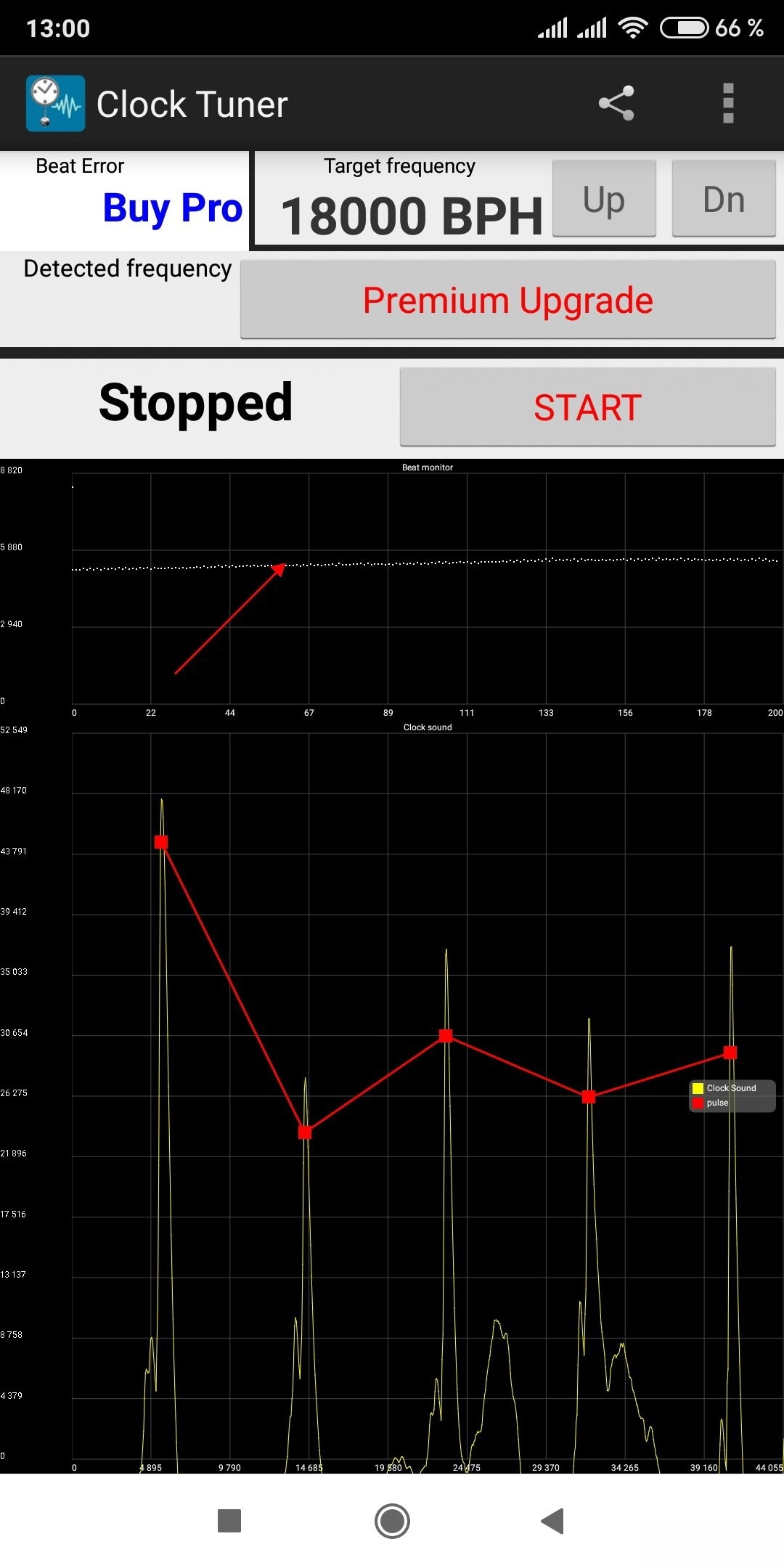
The paid version of Clock Tuner displays rate numerically in seconds per day and shows beat error in milliseconds. These readings enable more precise assessment of adjustment quality.

A horizontal trace with merged lines indicates excellent adjustment at the moment of measurement. However, this single-position result does not guarantee identical performance throughout daily wear. Positional variation, where rate changes depending on whether the watch lies flat or hangs vertically, affects real-world accuracy. Temperature changes likewise influence rate. The mainspring delivers different torque when fully wound versus nearly depleted, causing rate variation across the power reserve.
These factors explain why professional watchmakers retain watches for a day or two following service, monitoring performance and making final adjustments based on extended observation rather than a single timing measurement. For home adjustment purposes, achieving a horizontal merged trace represents success; actual daily performance will vary somewhat from this ideal indication.
While smartphone timing applications provide remarkable capability for their cost, they cannot fully replace professional timing equipment. The application Clock Tuner does not allow setting the lift angle specific to each caliber, instead using an assumed average value, likely around fifty-two degrees. This affects the accuracy of displayed rate values somewhat.
More significantly, these applications cannot measure amplitude, the total angular displacement of the balance during oscillation. Amplitude provides critical diagnostic information: low amplitude suggests the movement needs service, while excessively high amplitude indicates other problems. Professional timing machines display amplitude prominently; consumer applications cannot measure it at all.
For the purpose of basic rate and beat error adjustment, these limitations matter little. The graphical display shows whether adjustments move parameters in the desired direction, which is the essential requirement. The absolute accuracy of displayed values becomes secondary when the goal is relative improvement.
Horological terminology distinguishes between regulation and adjustment, though the terms sometimes blur in casual usage. Understanding the distinction clarifies the scope of owner-accessible maintenance. This section helps explain mechanical watch regulation explained in proper technical context.
Regulation encompasses the procedures that establish fundamental operating parameters during manufacture or overhaul. Setting escapement geometry, adjusting banking pin positions, correcting hairspring defects, and similar operations fall under regulation. These procedures require specialized tools, gauges, and training. Once properly regulated, a movement should not need these parameters revisited unless damaged or significantly worn.
Adjustment refers to the periodic correction of parameters that change during normal operation. Rate drifts as lubricants age; beat error may shift following shock or handling. The regulator index and stud carrier exist specifically to enable adjustment without disturbing the underlying regulation. These are the owner-accessible controls, making mechanical watch accuracy adjustment possible without professional intervention.
The procedures described here constitute adjustment: using the provided controls to optimize current performance. Should adjustment prove insufficient to achieve acceptable performance, the movement likely requires professional regulation, or more fundamentally, service addressing the underlying cause of malfunction.
For owners wishing to fine tune mechanical watch performance between professional services, the essential points are these:
Two adjustment mechanisms appear on most balance assemblies, including those in vintage Soviet watches like Raketa, Poljot, Vostok, and Slava calibers. The regulator index controls rate, determining whether the watch runs fast or slow. The stud carrier controls beat error, affecting starting reliability and rate consistency. Both require only gentle pressure with a non-metallic tool to operate. These same controls appear on old mechanical watches from virtually all manufacturers.
Smartphone timing applications provide adequate observation capability for regulating watch timing without a professional timegrapher. The graphical display indicates beat error through the presence of dual traces, and rate through trace slope. Both adjustments aim to produce a single horizontal line. This approach works equally well for adjusting vintage mechanical watches regardless of origin.
The adjustments interact, requiring iteration. Correct beat error first, then rate, then verify beat error again. Small movements produce significant effects; patience and careful observation yield better results than aggressive manipulation. This principle applies whether servicing Soviet watch movement calibers or any other vintage mechanical design.
A perfect timing trace does not guarantee perfect daily performance. Positional variation, temperature effects, and mainspring torque changes all influence real-world accuracy. The timing trace represents performance in one position at one moment; actual use involves many positions across varying conditions.
When adjustment cannot achieve acceptable performance, or when performance degrades rapidly following adjustment, the movement likely requires professional attention addressing root causes rather than symptoms. For vintage mechanical watches showing persistent problems despite correct adjustment technique, professional service may be needed to address worn components or degraded lubricants before timing adjustments can be effective.


