Cart
Your shopping cart is empty!
It's never too late to make things right :)


"Time is fleeting, yet some instruments for measuring it achieve a kind of permanence..."
— Workshop reflections
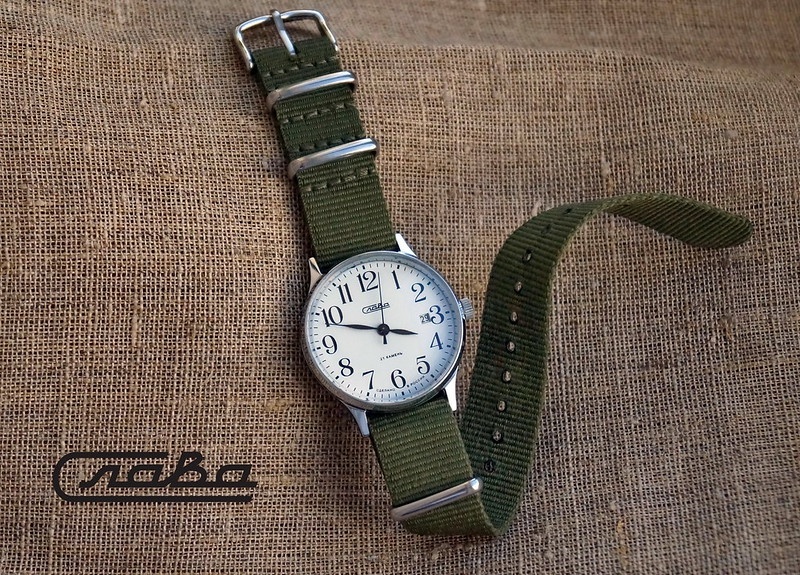
Certain watches embody their era with particular clarity. The Slava 2414 represents one such timepiece: a dress watch of understated elegance produced in the Russian Federation during the transitional years of the early 1990s. Its three-piece round case houses a movement of genuine technical interest, while the dial presents an aesthetic vocabulary that contemporary observers might recognize as Bauhaus-influenced minimalism. Finding one in unworn condition requires patience, as these were working watches meant for daily use rather than collector speculation.
The specimen examined here remained in its original box for approximately three decades, extracted periodically by its owner who would attempt to wind it, confirm that it did not run, and return it to storage. Such neglected watches frequently arrive at the bench with nothing fundamentally wrong beyond dried lubricants and minor contamination. This example proved no exception. What follows is a complete service documentation, including observations on the caliber's distinctive engineering characteristics and certain period-specific construction details that merit attention.
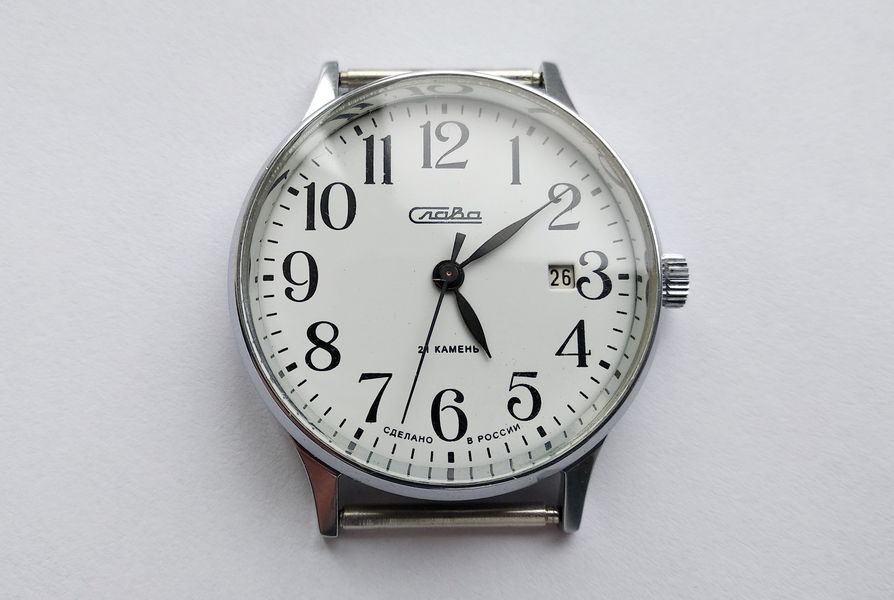
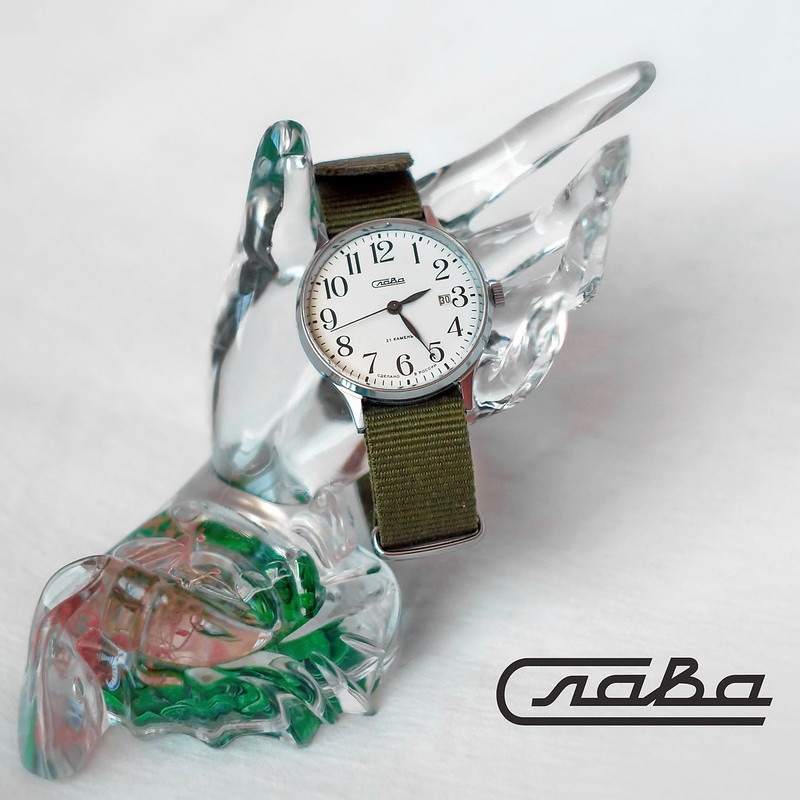
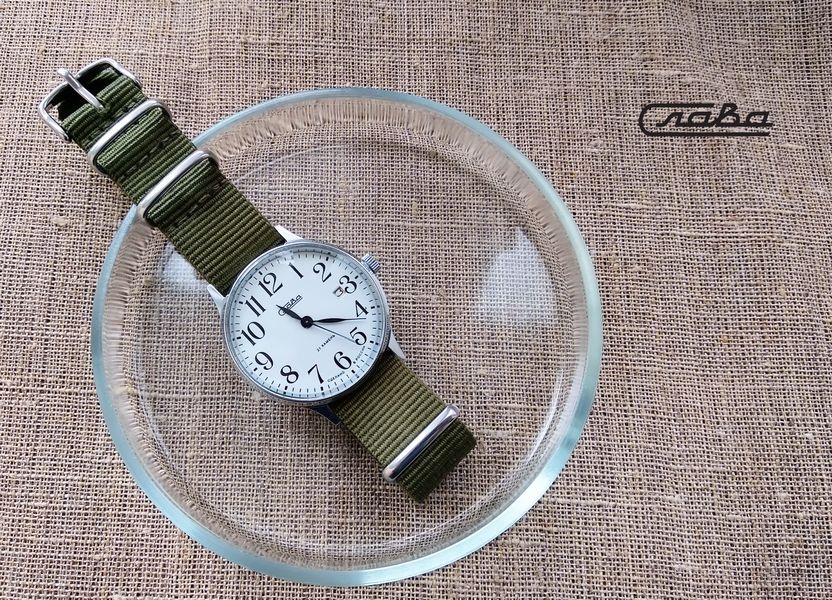
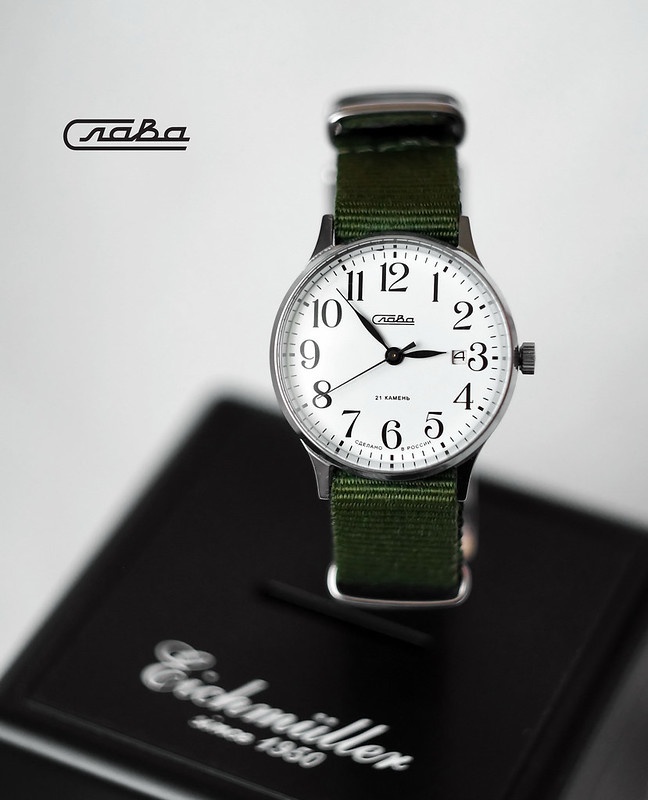
The case measures thirty-six millimeters in diameter with a height of ten millimeters, proportions well-suited to dress wear without excessive visual weight. Construction employs chrome-plated brass throughout, with eighteen-millimeter lug width accommodating standard straps. The overall impression suggests what one might term a Russian interpretation of Bauhaus principles: functional geometry without ornamental excess, the form determined entirely by purpose.
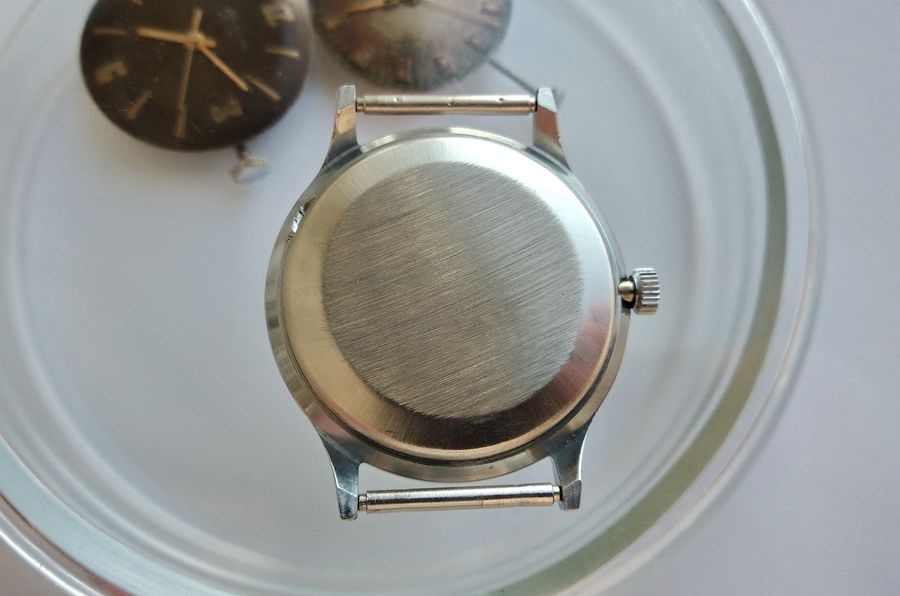
The crown assembly incorporates a collar system worth noting. A sleeve fitted into the case tube engages with a corresponding recess in the crown itself, creating an overlap that impedes dust and moisture ingress. This construction offers reasonable protection for office and social environments without pretending to water resistance suitable for immersion.
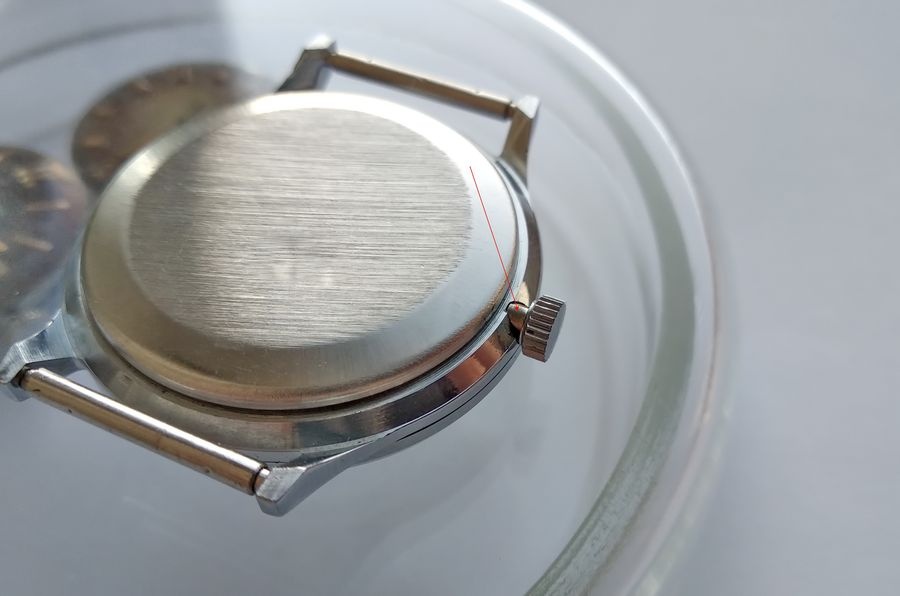
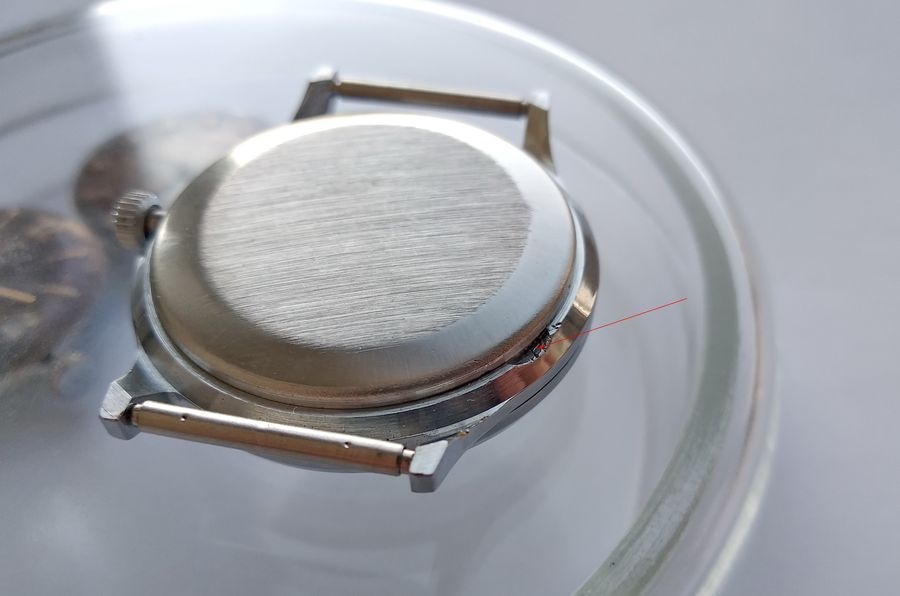
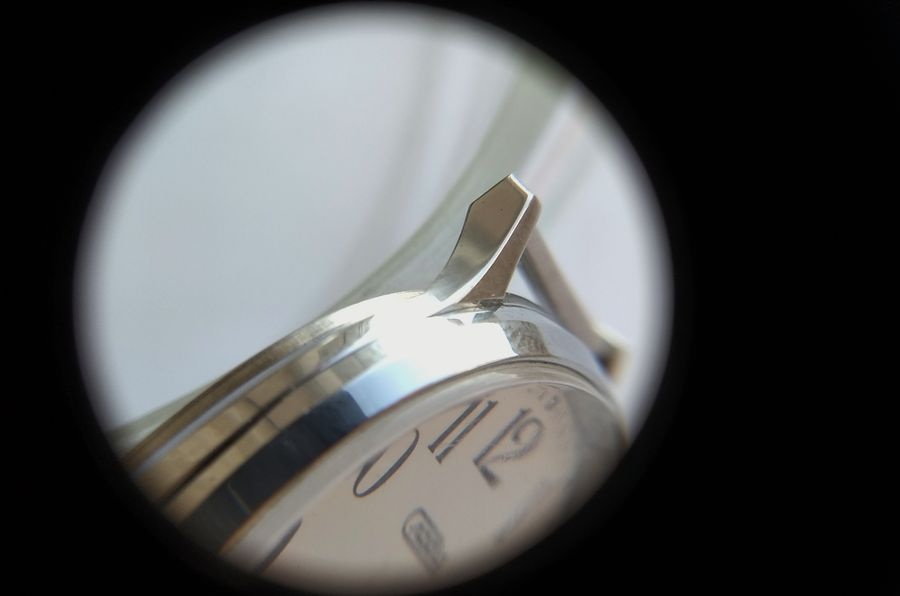
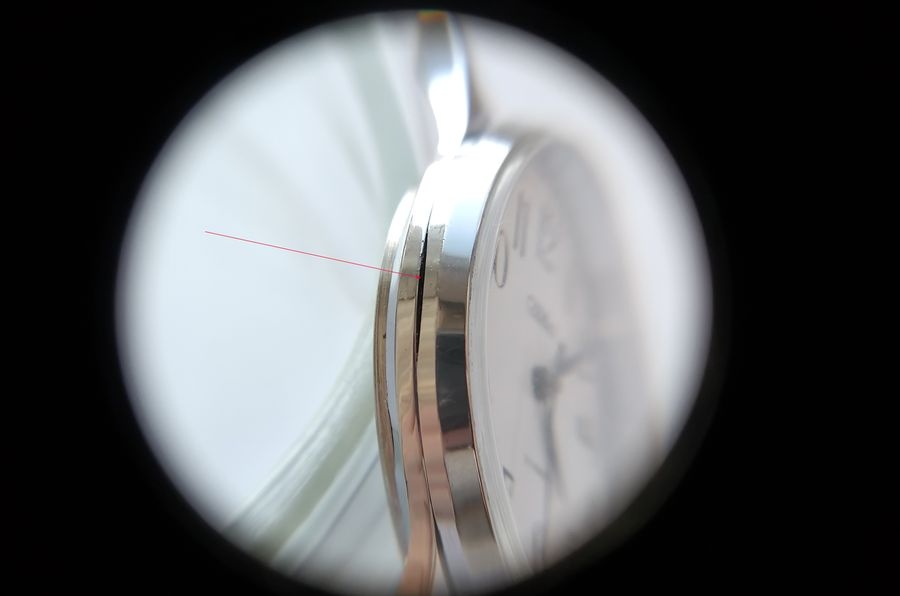
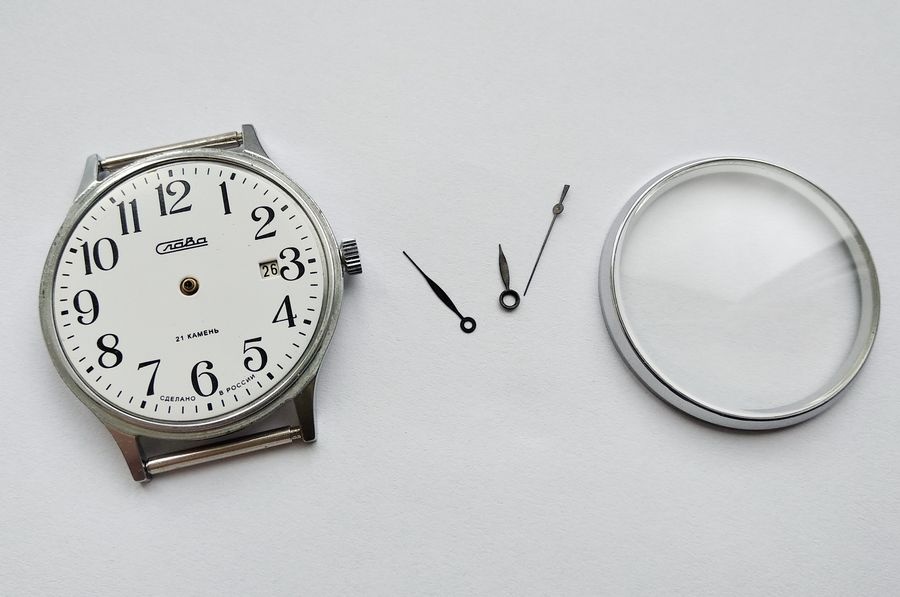
The crystal assembly deserves particular mention. A tension ring secures the domed acrylic crystal to the case middle, with access provided via a small pry notch. The ring's interior surface carries a polished, angled reflector that creates an optical effect suggesting greater dial depth than the case height physically permits. This technique, while not original to Slava, demonstrates attention to perceived quality beyond mere technical function.
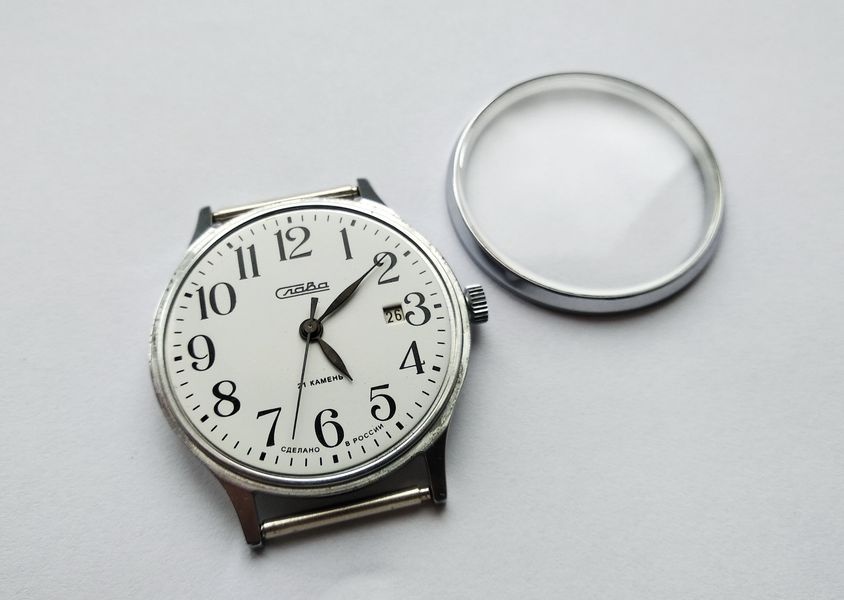
The dial presents an immaculate white surface devoid of applied indices or markers beyond the date aperture at three o'clock. Printed hour positions provide the sole visual reference for time indication. This extreme minimalism places considerable responsibility on the hands themselves, which employ a shaped profile that introduces just enough visual interest to enliven the composition while facilitating rapid reading.
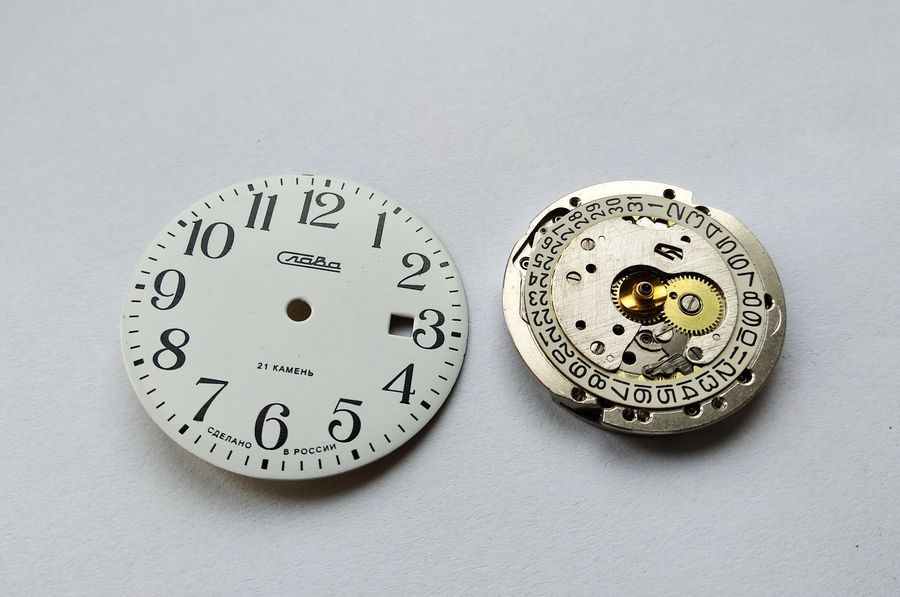
Beneath the dial resides the Slava caliber 2414, a movement of considerable technical sophistication within the Soviet watchmaking tradition. This caliber incorporates central seconds, an instantaneous date calendar, and a dual-barrel mainspring system distributing power through a summing differential. The twenty-one jewel count reflects comprehensive bearing support throughout the gear train and escapement.
The 2414 occupies an interesting position within the Slava caliber family. The base caliber 2409 provides time-only function without calendar. The 2428 adds a complete calendar with independent date correction via a pusher. The 2414 represents an intermediate solution: date display without the additional mechanism complexity of pusher correction. Date setting requires advancing the hands through the change period, a compromise that reduces parts count and movement height while adding slight inconvenience during initial setup.
The caliber's designers mitigated this limitation through thoughtful engineering. The minute wheel incorporates spring loading to reduce stress during repeated hand advancement. More significantly, the date change mechanism operates between nine o'clock in the evening and midnight, requiring only three hours of hand movement rather than a full twelve-hour cycle to advance the date. Proper technique involves full mainspring wind before beginning date correction to ensure reliable mechanism function.
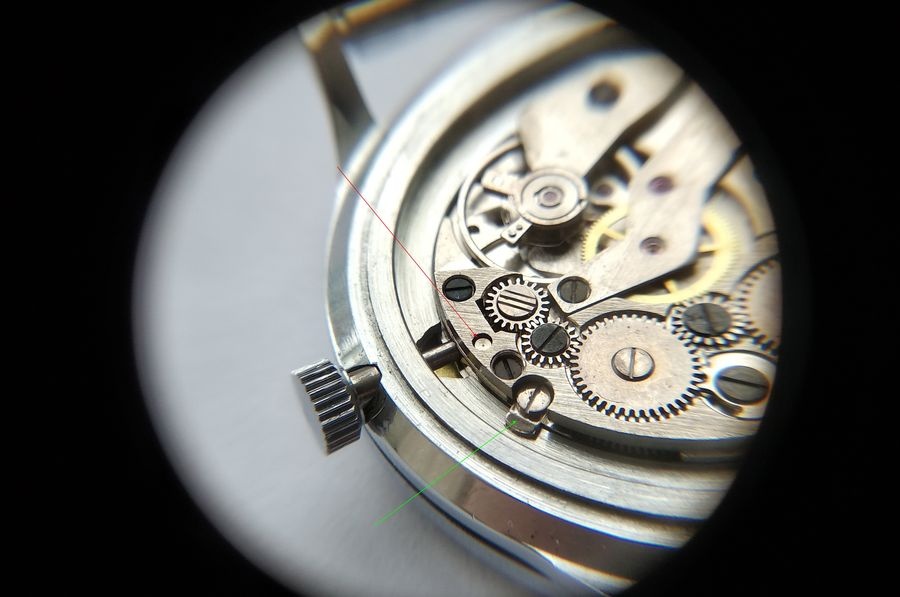
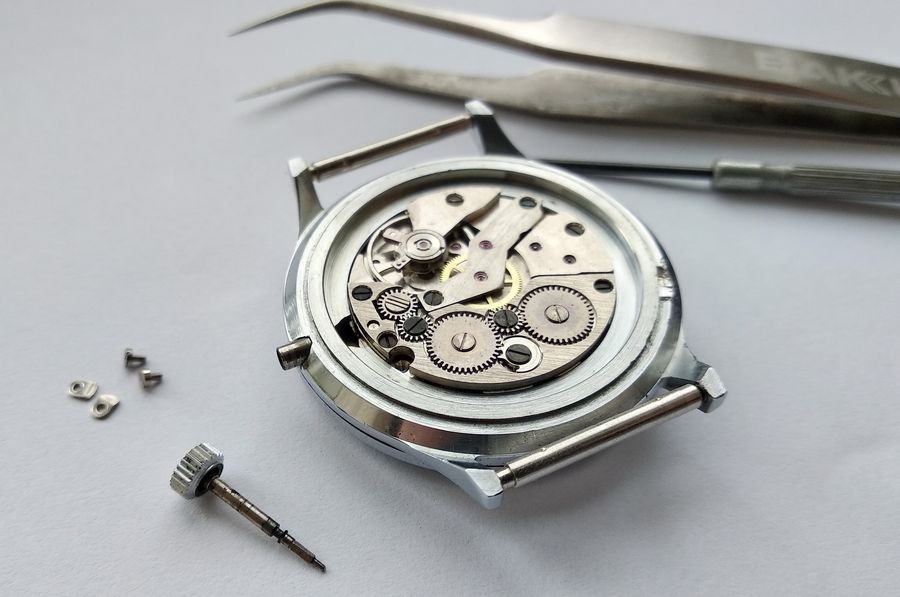
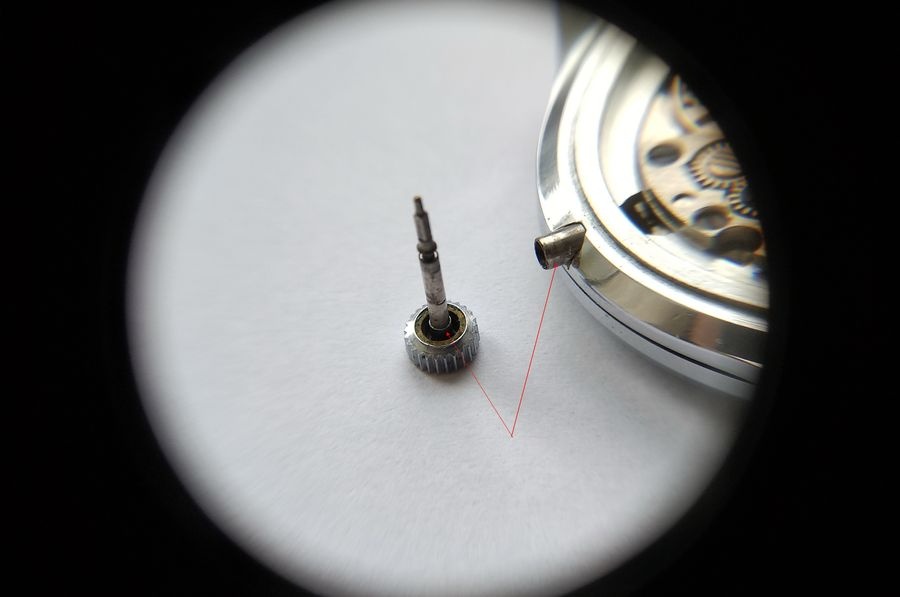
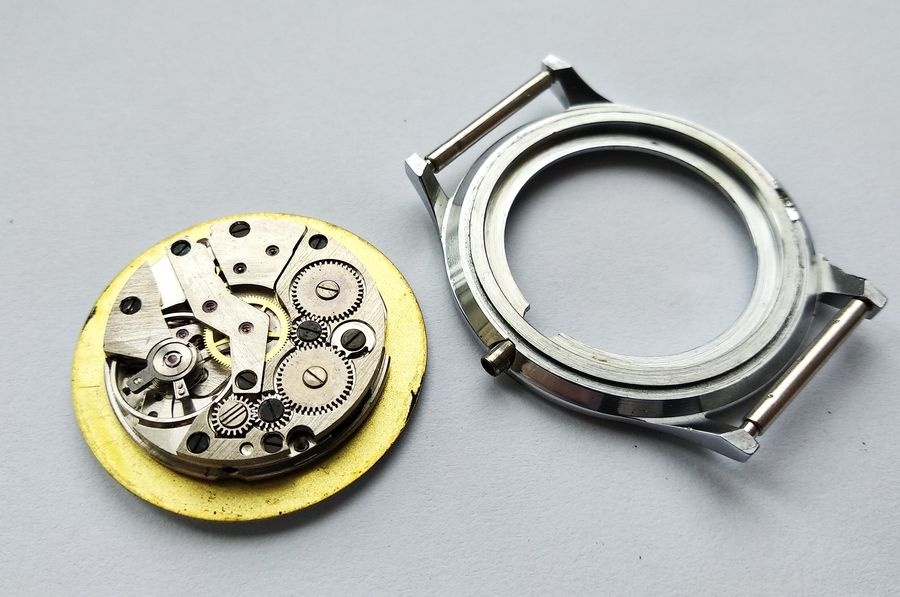
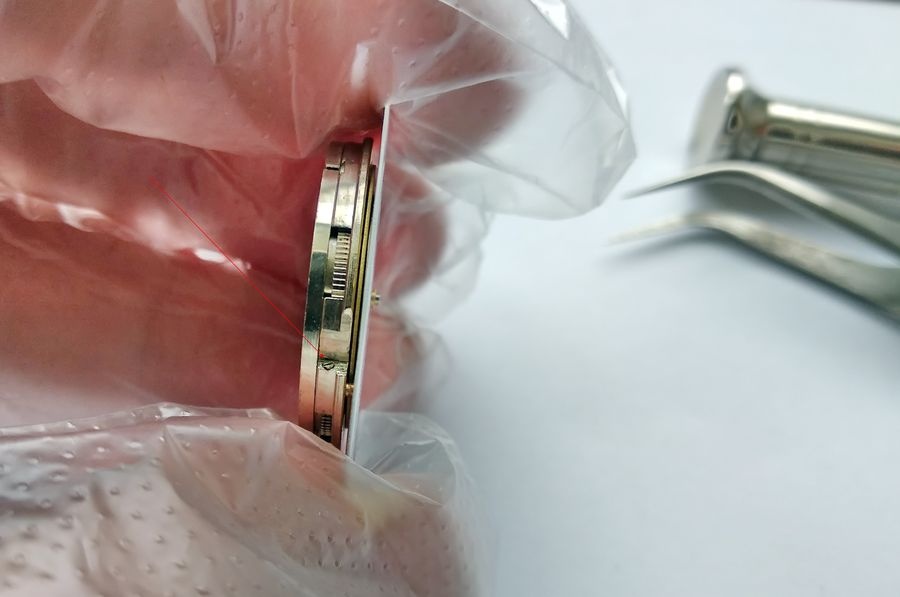
Service begins with dial removal, accomplished by loosening the dial foot screws at the plate periphery. These screws require only partial withdrawal to release the dial, after which they should be re-tightened into the plate to prevent loss. The white dial surface demands handling with clean gloves to avoid contamination from skin oils.
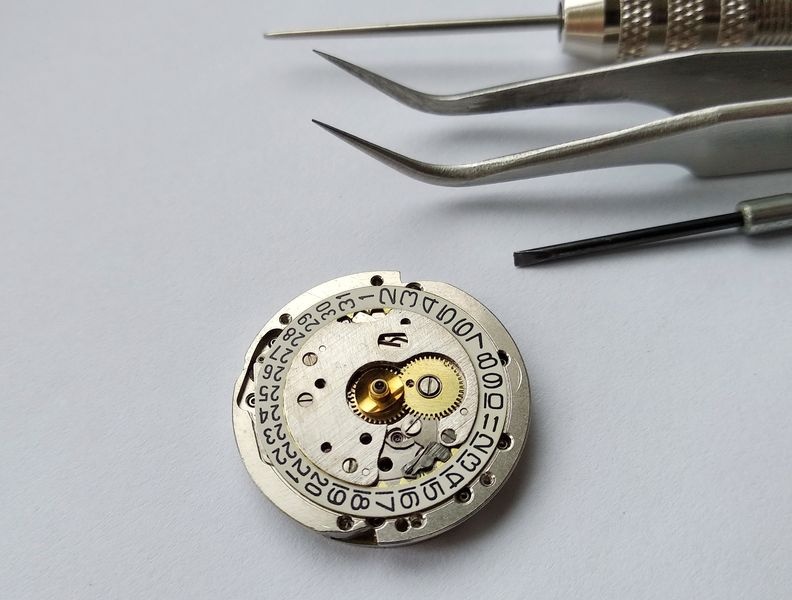
With the dial removed, the hour wheel and its critical spring washer become accessible. This seemingly insignificant washer maintains proper engagement between the hour wheel and the motion works beneath. Its absence permits the hour wheel to float free of the intermediate wheel, rendering the time display inoperative. Small components of this nature merit careful tracking throughout service.
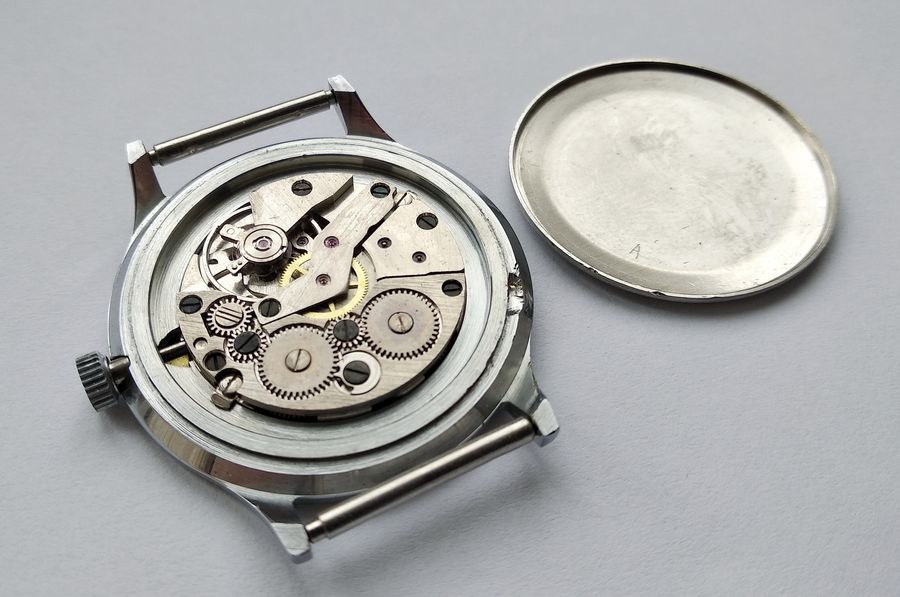
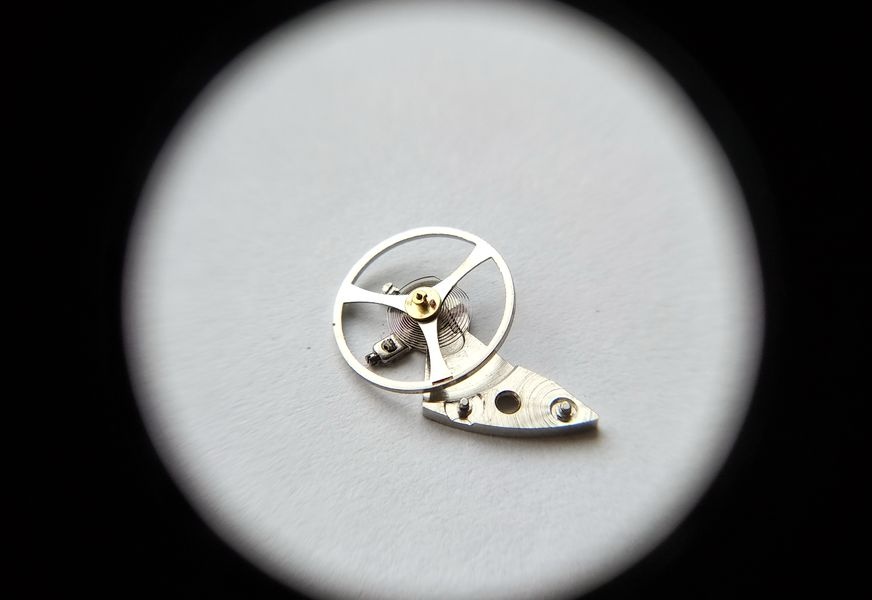
Attention now turns to the movement's regulating components. The balance wheel in this caliber employs a smooth rim without timing screws, a construction choice that simplifies production at some cost to adjustment flexibility. The shock protection system uses star-shaped retaining springs for the cap jewels, a standard Soviet configuration shared across multiple caliber families.
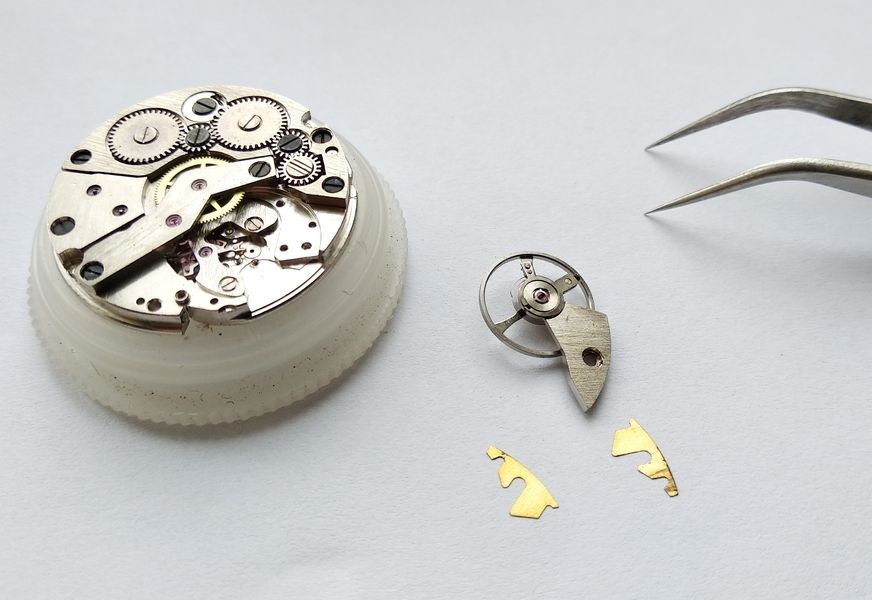
The pallet fork follows, housed beneath its own bridge secured by two screws. This assembly receives only brief benzine immersion during cleaning to prevent adhesive failure of the impulse jewel, a lesson learned through experience with similar calibers where prolonged solvent exposure dislodged the small ruby from its setting.
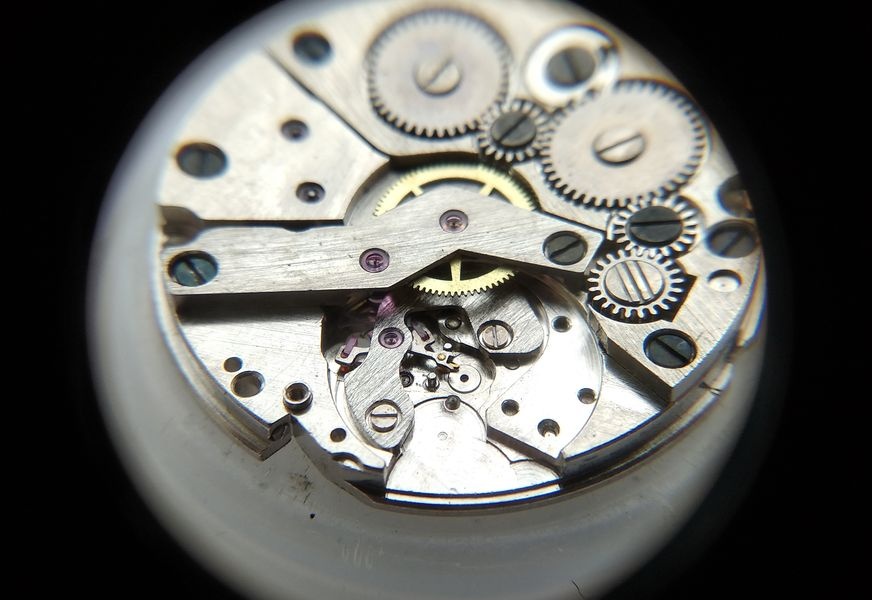
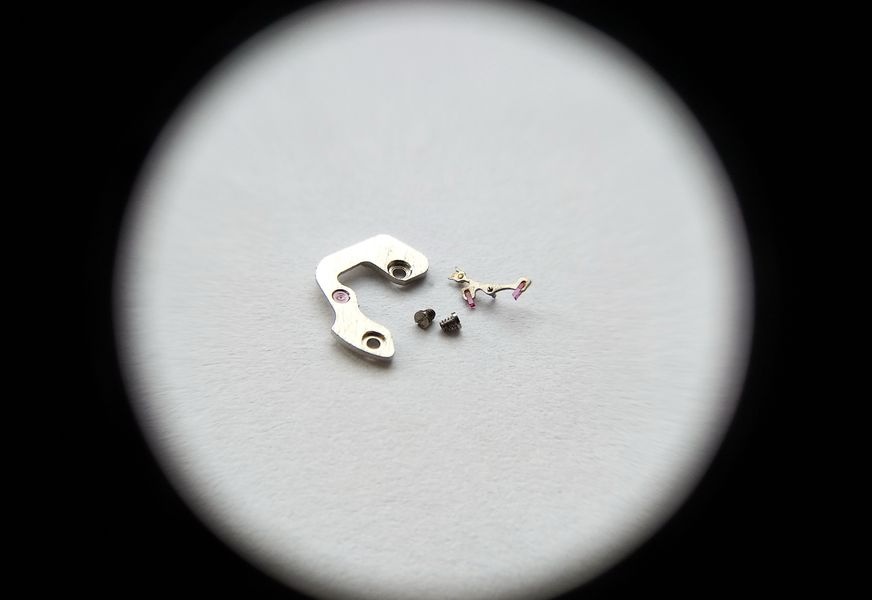
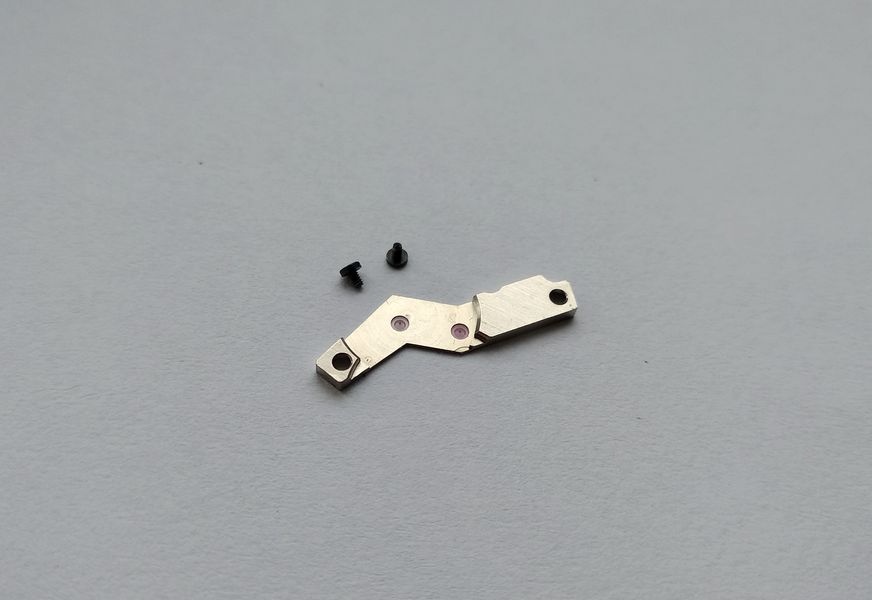
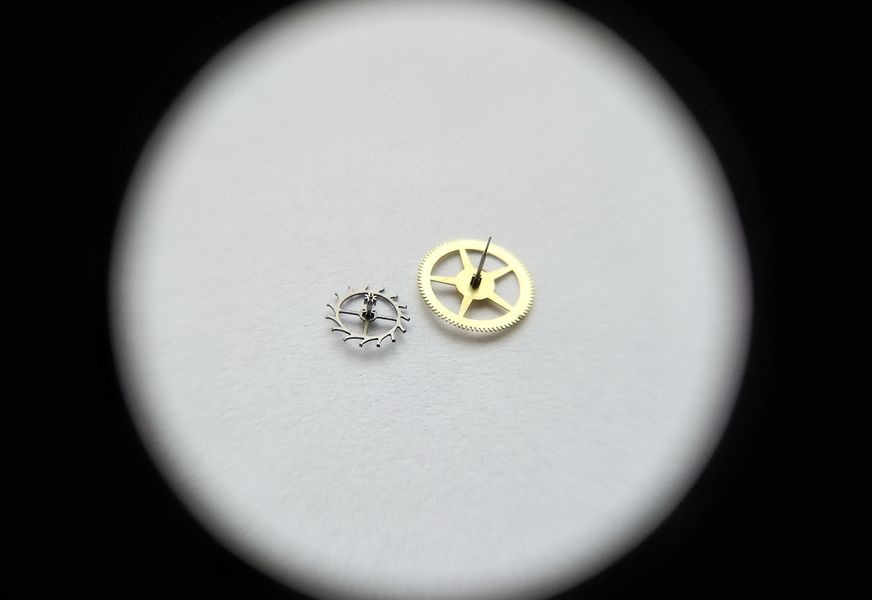
The gear train in the 2414 employs a split-bridge architecture that facilitates service. A smaller upper bridge carries the seconds wheel and escape wheel, while a larger lower bridge supports the remaining train wheels and the distinctive summing pinion that connects the dual mainspring barrels.
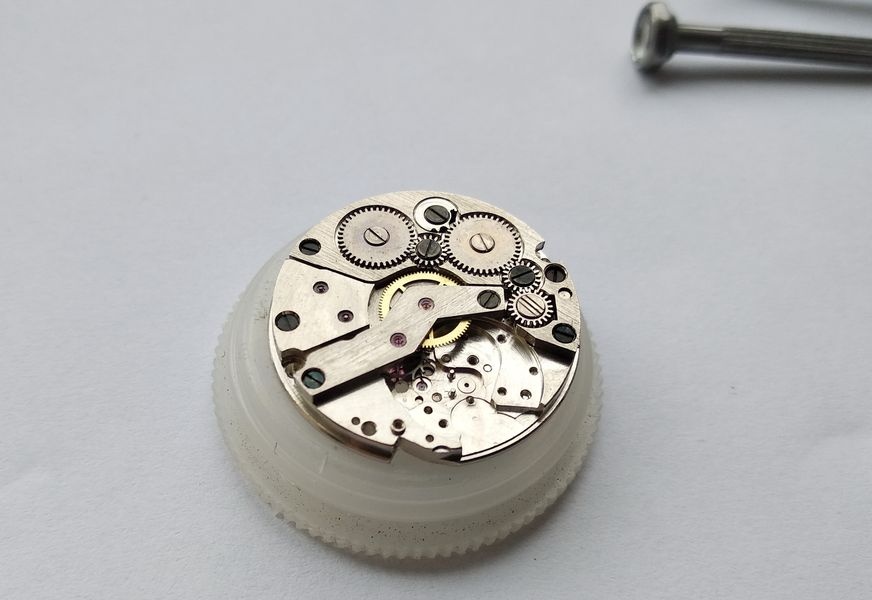
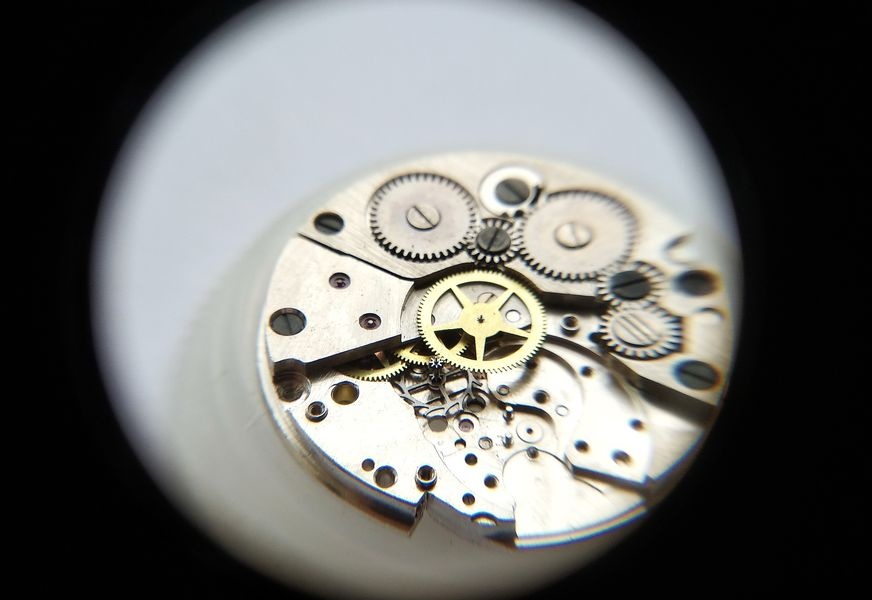
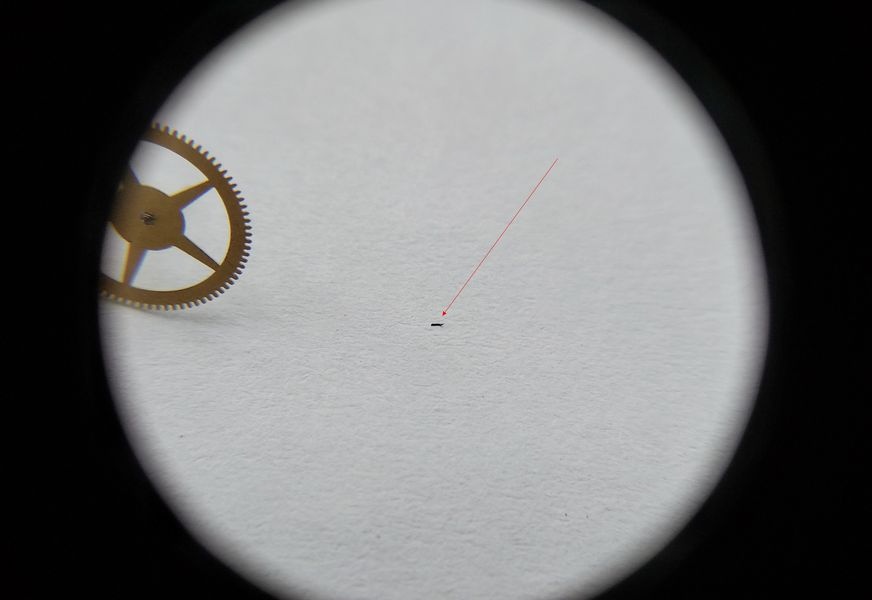
During inspection of the seconds wheel, a small foreign particle was discovered adhering to the wheel teeth, with visible discoloration of the underlying metal suggesting prolonged contact. This contamination proved sufficient to impede gear train operation, explaining the watch's non-running condition. Removal required careful mechanical cleaning without damaging the wheel teeth.
Access to the lower train bridge requires prior removal of the mainspring motor assembly. The 2414's dual-barrel configuration adds complexity here, with a thirteen-component winding train linking the crown to both barrels through the summing differential.
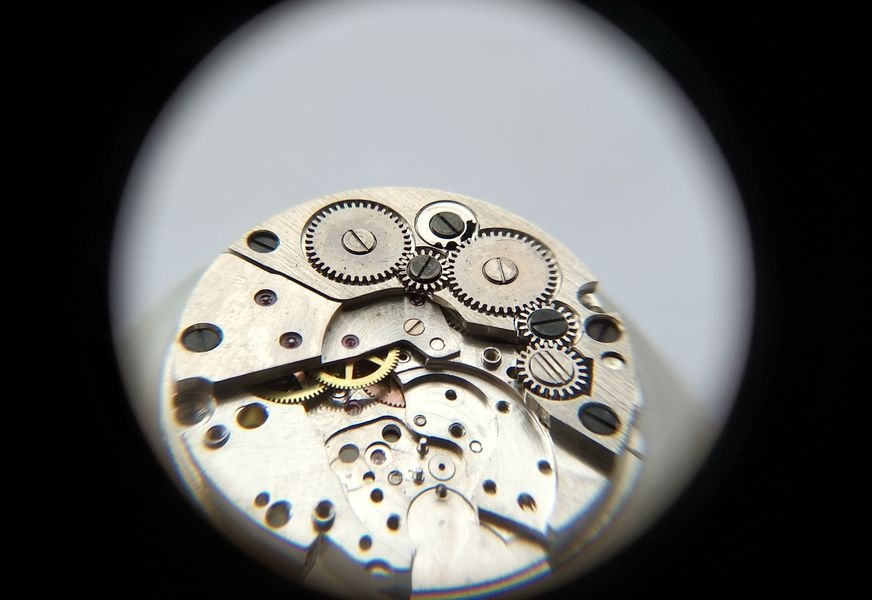
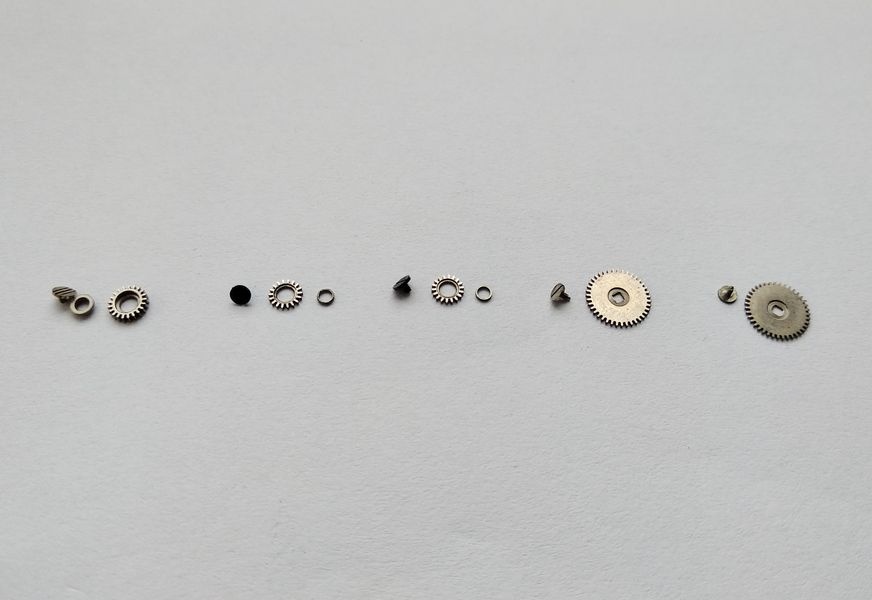
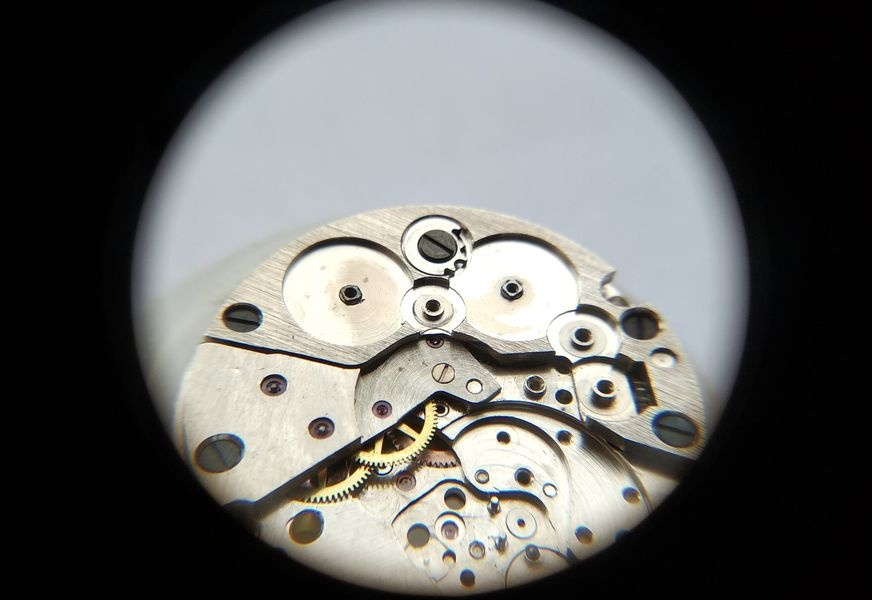
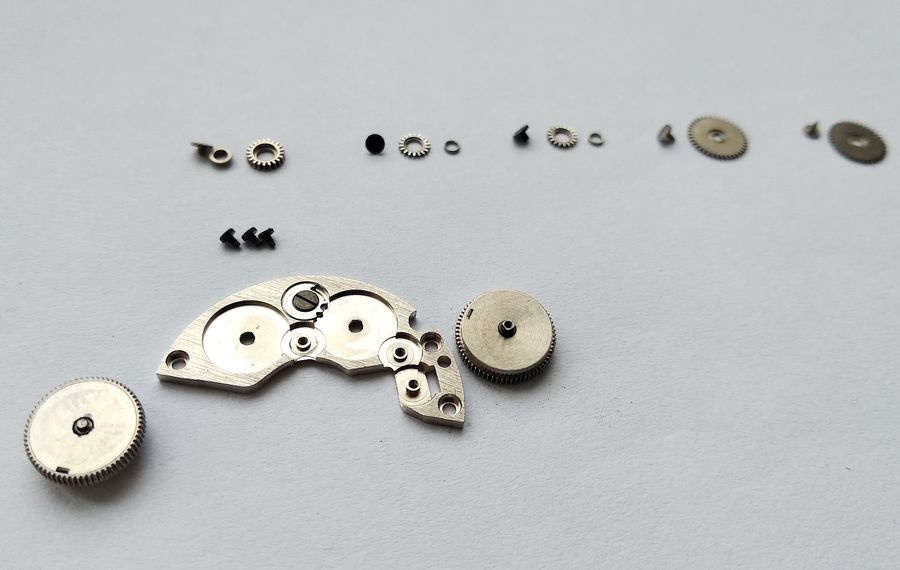
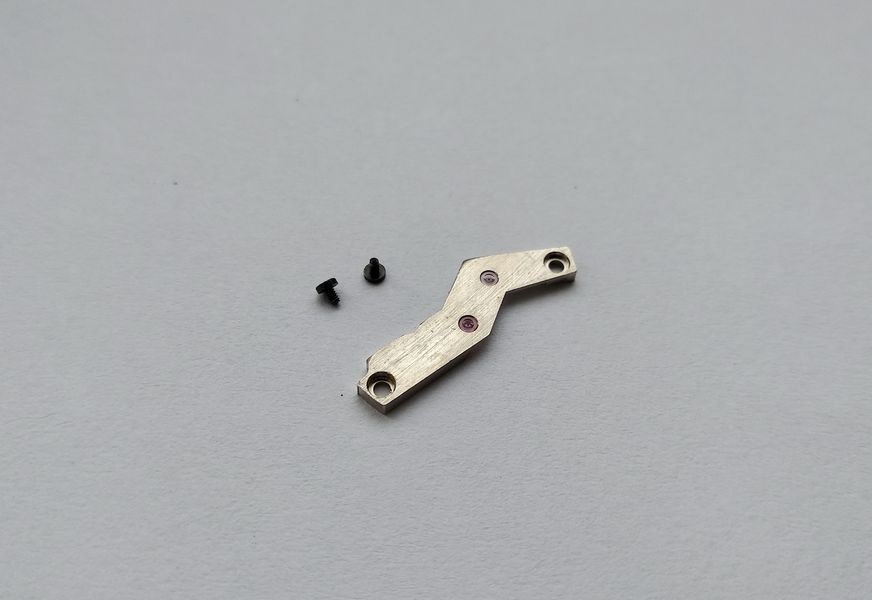
With the motor removed, the lower train bridge becomes accessible. Note that this bridge employs two different screw sizes, with one notably smaller than its companion. Losing this unique screw during service creates significant difficulty, as replacement requires finding an exact match from donor movements.
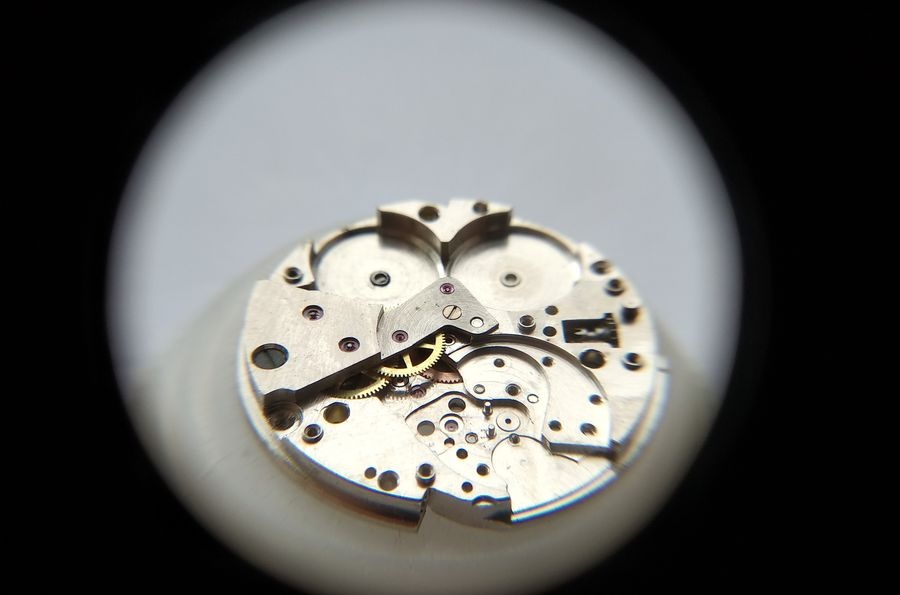
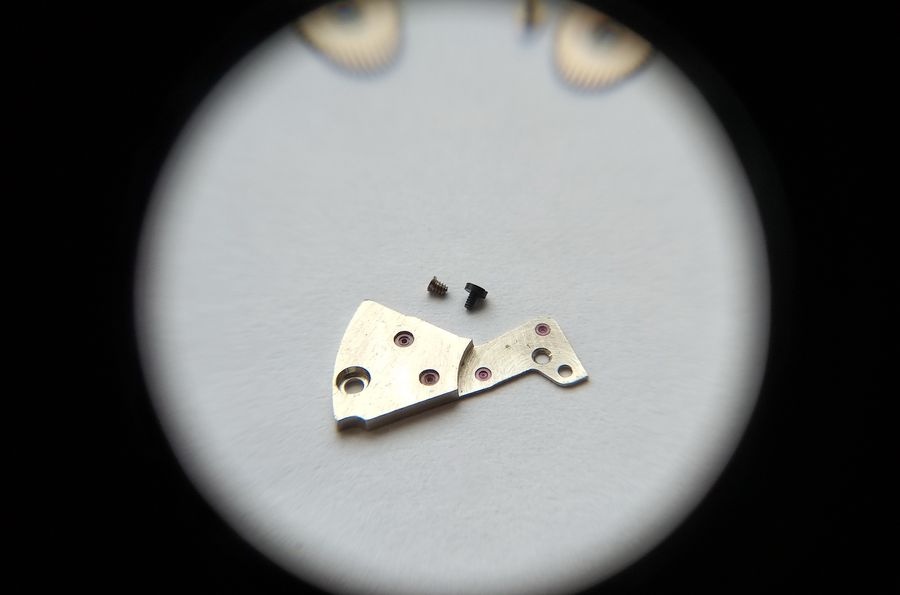
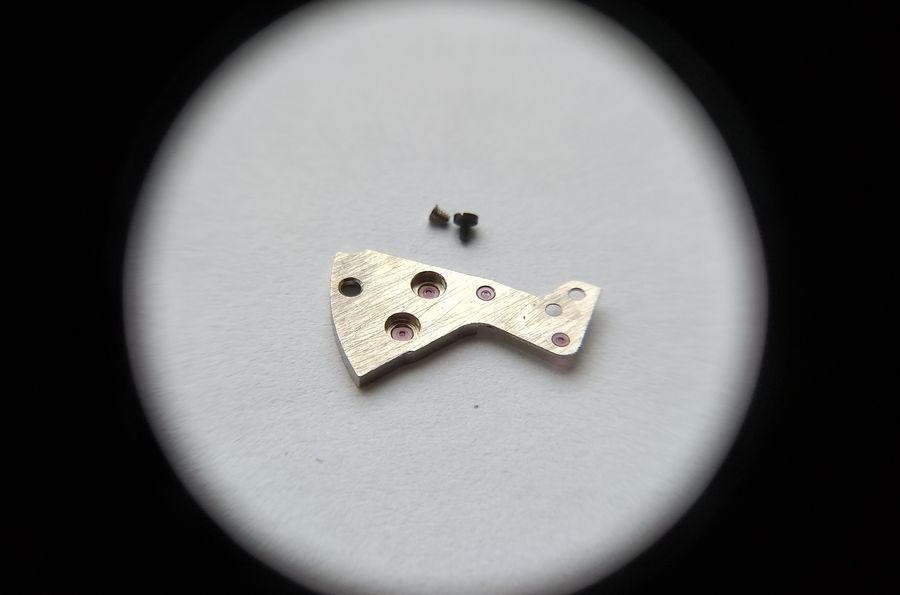
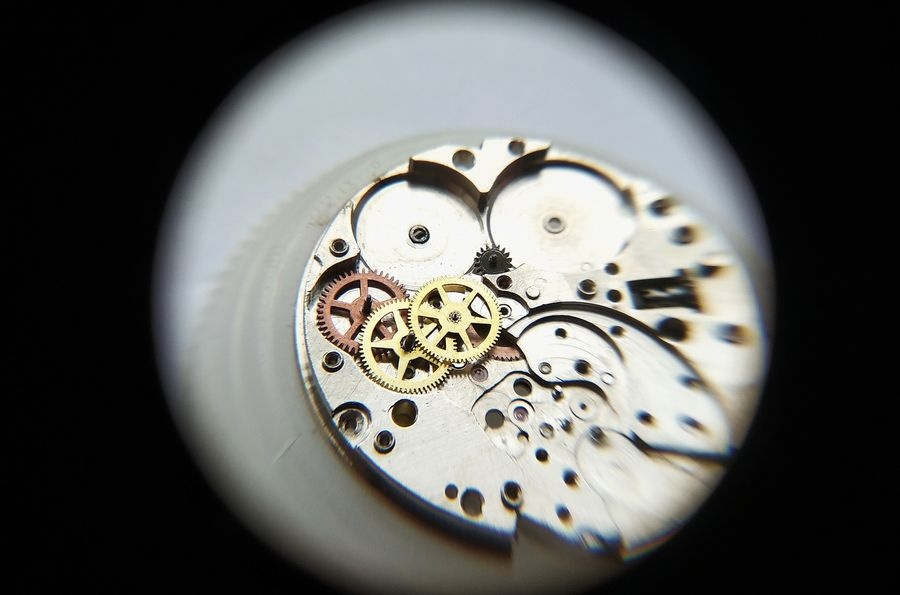
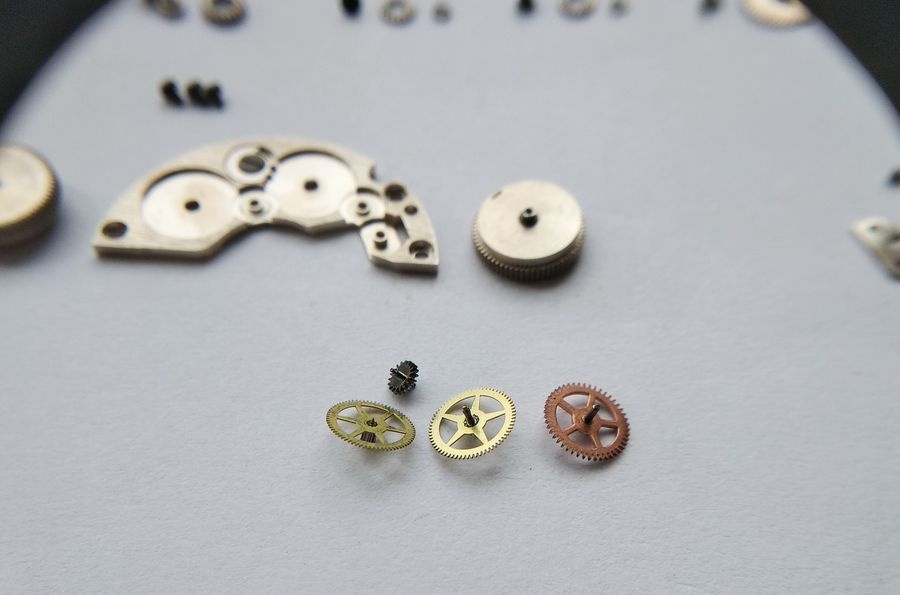
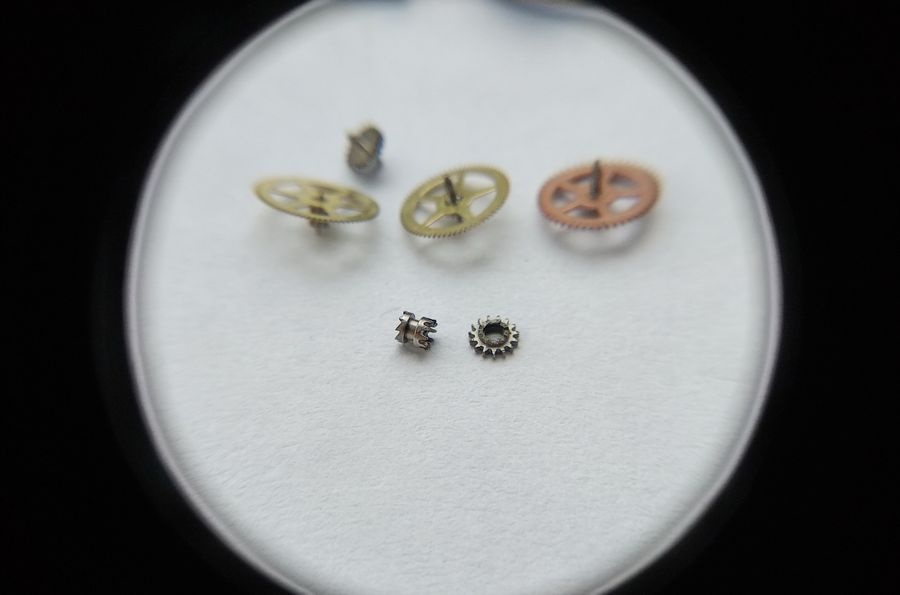
Examination of individual train wheels reveals construction details characteristic of this caliber family. The first intermediate wheel, engaging directly with the barrel, employs material of notably different appearance than subsequent wheels, likely a harder alloy selected for durability at this high-torque position.
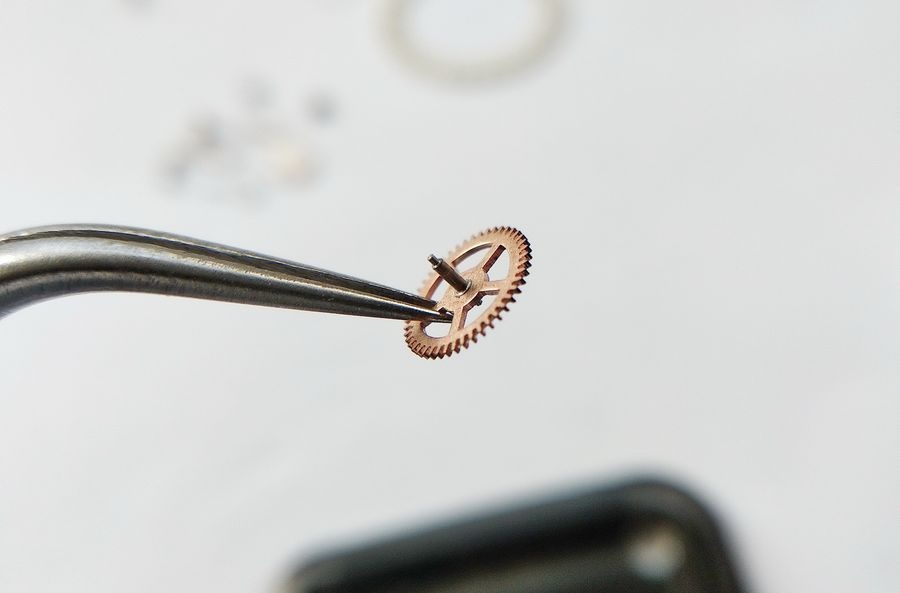
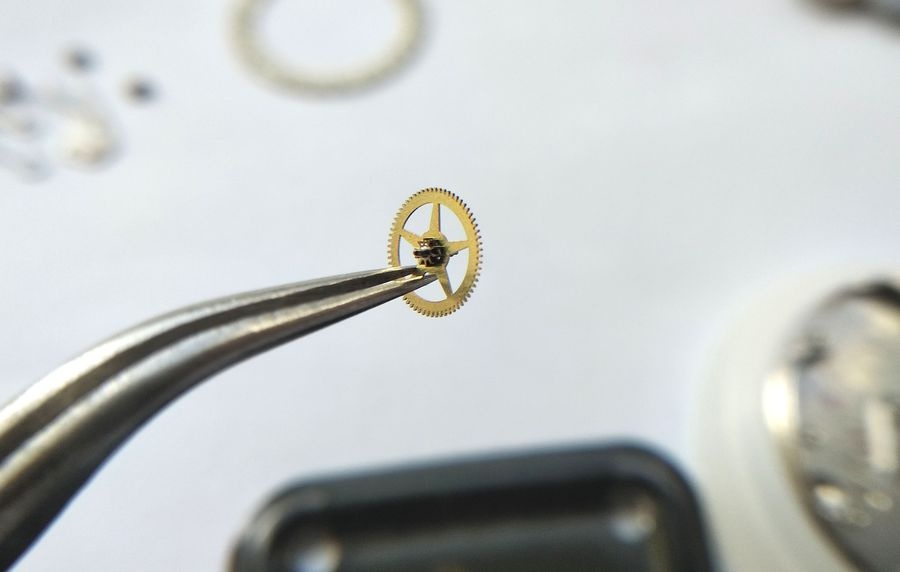
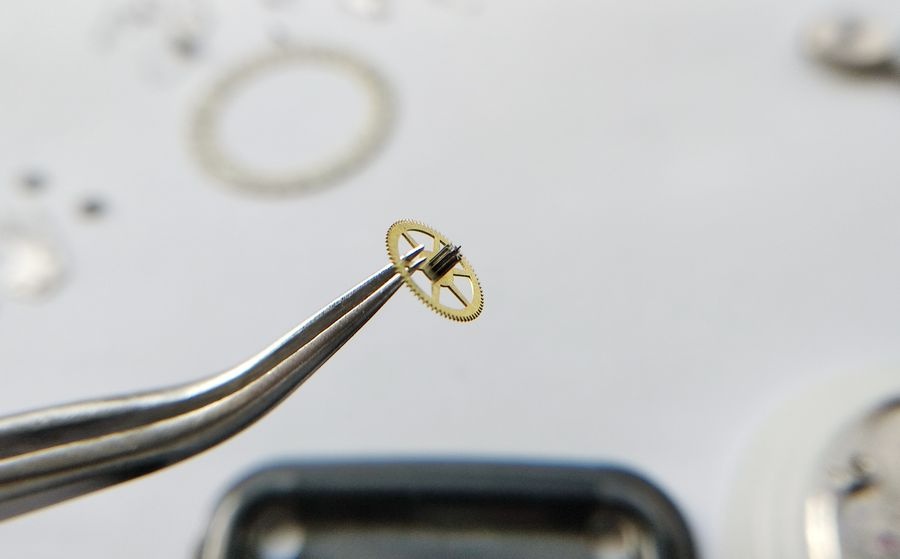
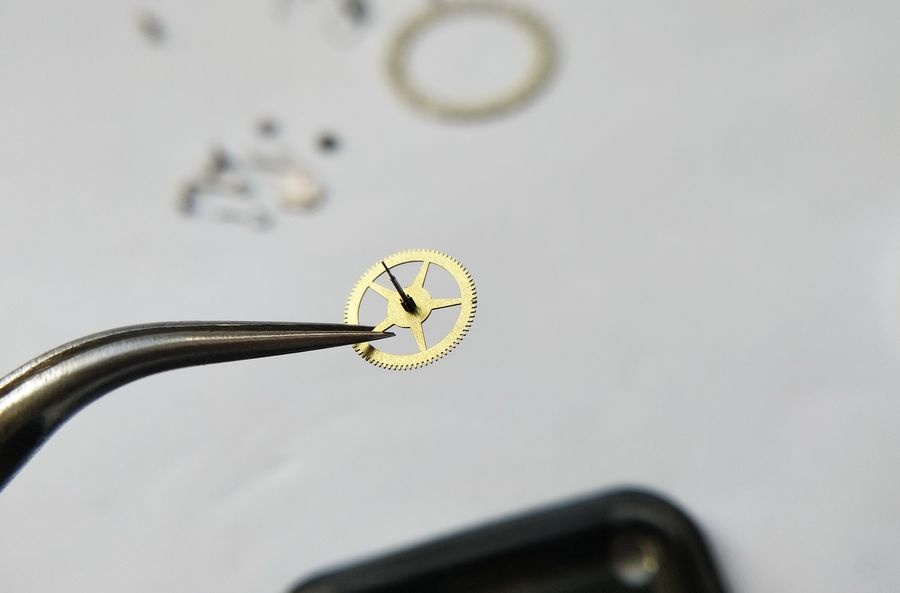
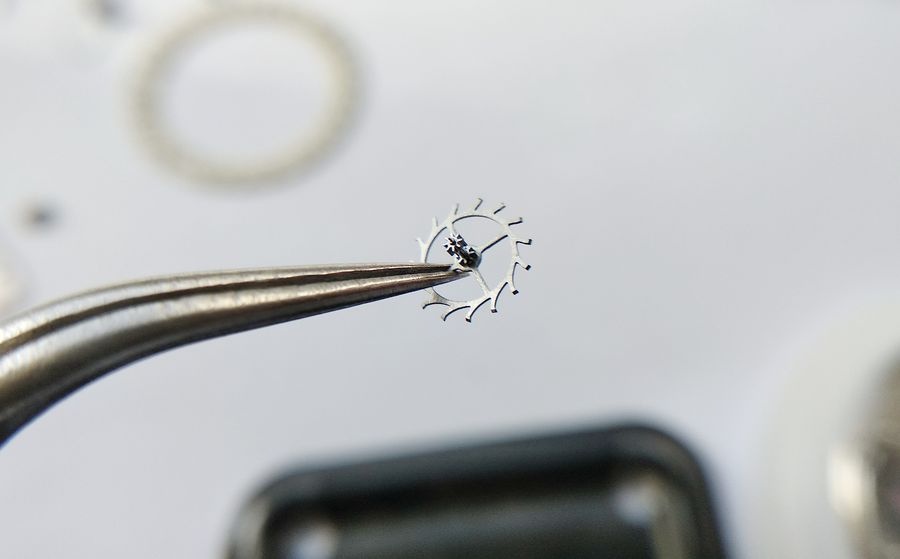
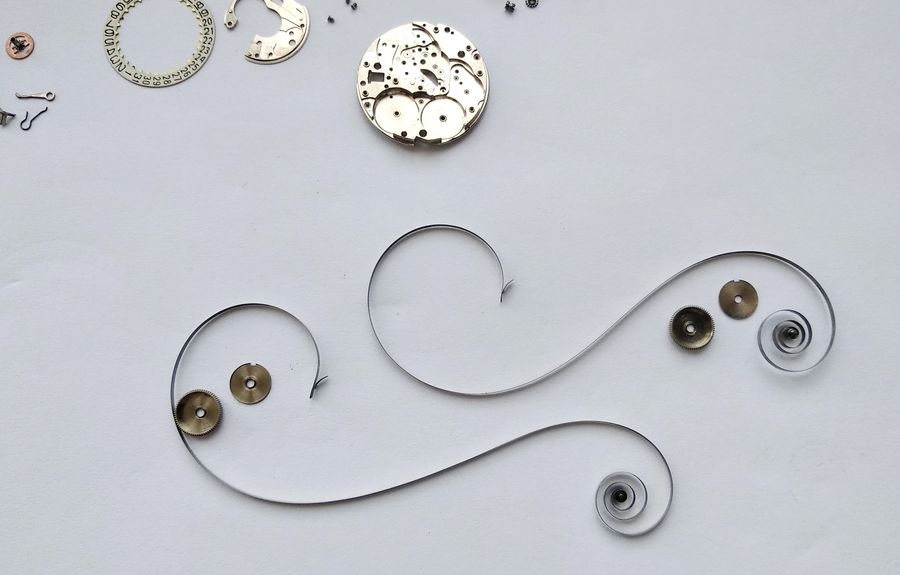
The summing pinion merits particular attention as a component unique to dual-barrel calibers. This gear combines the output of both mainspring barrels, delivering their combined torque to the gear train while permitting independent winding of each barrel. The arrangement extends power reserve beyond what a single barrel of equivalent diameter could provide.
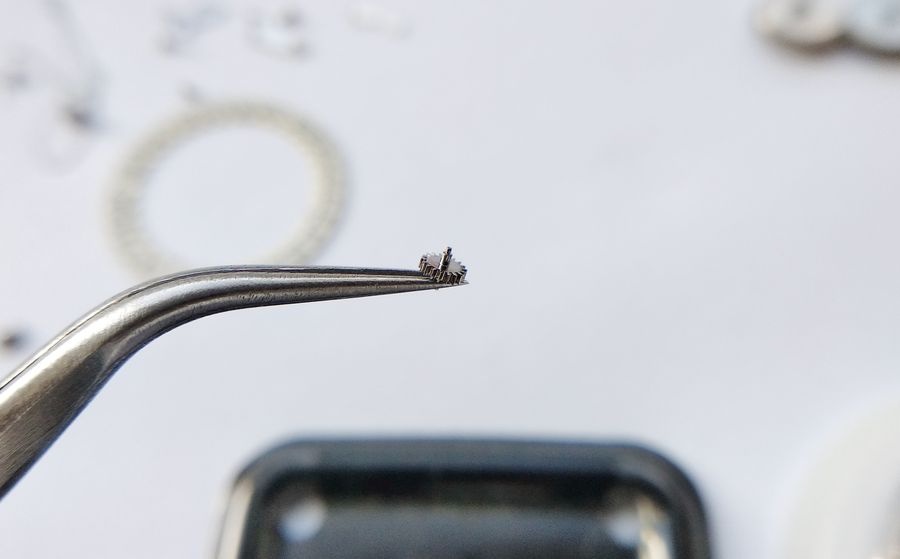
The instantaneous date calendar represents another distinguishing feature of the 2414. Unlike gradual-change calendars that take hours to advance through the date transition, instantaneous mechanisms store energy and release it suddenly, producing a crisp snap from one date to the next. Swiss manufacturers typically identify this complication explicitly in their marketing, though Soviet production treated it as unremarkable.
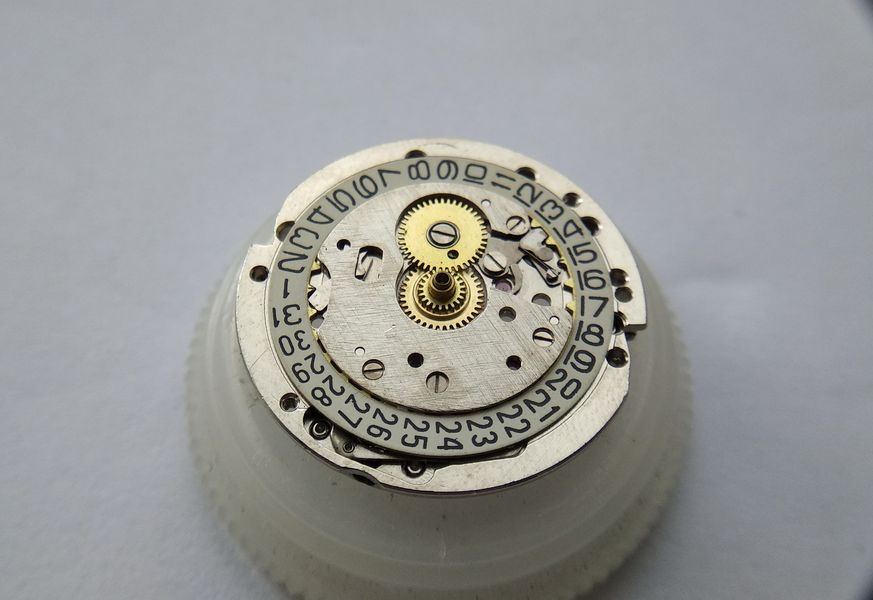
Removing the calendar bridge requires care to capture the spring-loaded components beneath. Covering the area with thin film before lifting helps prevent small parts from escaping. The date detent and its V-shaped spring are particularly prone to launching if not controlled.
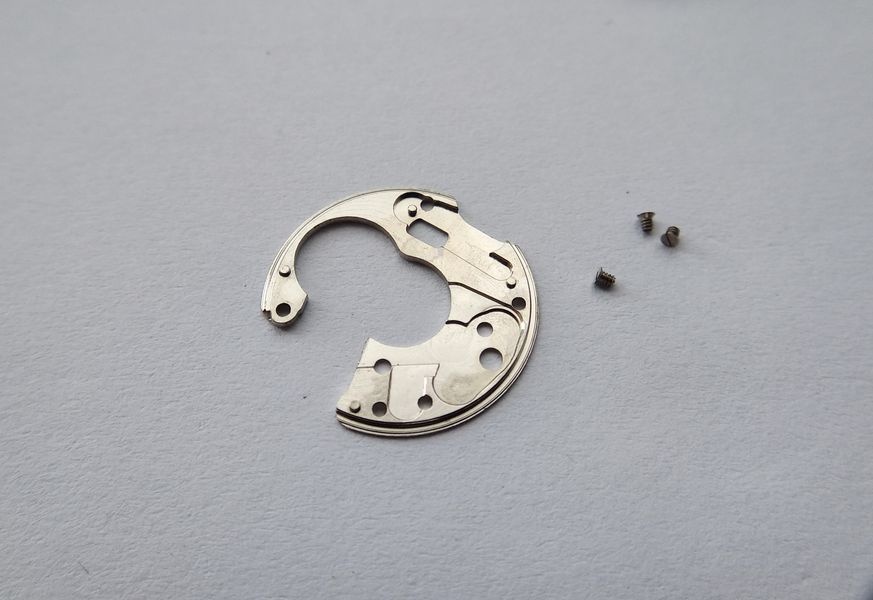
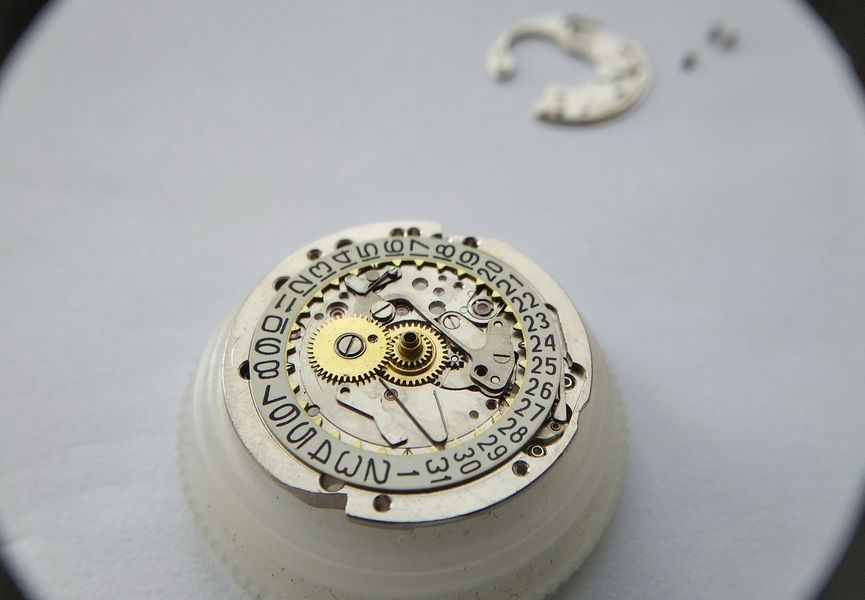
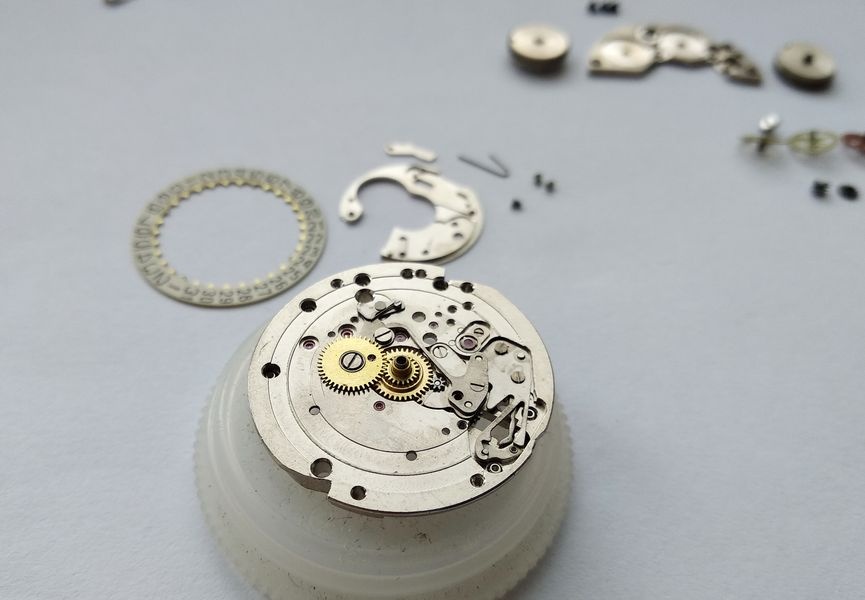
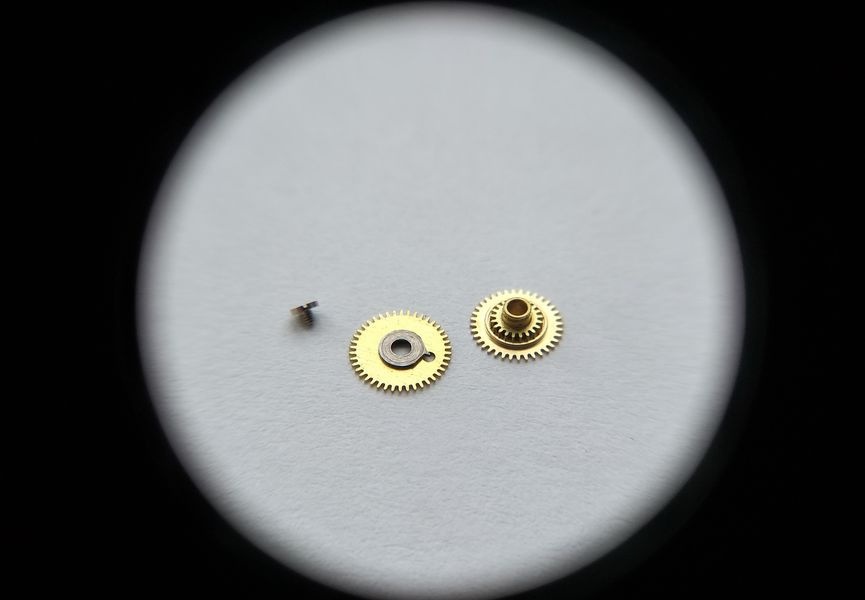
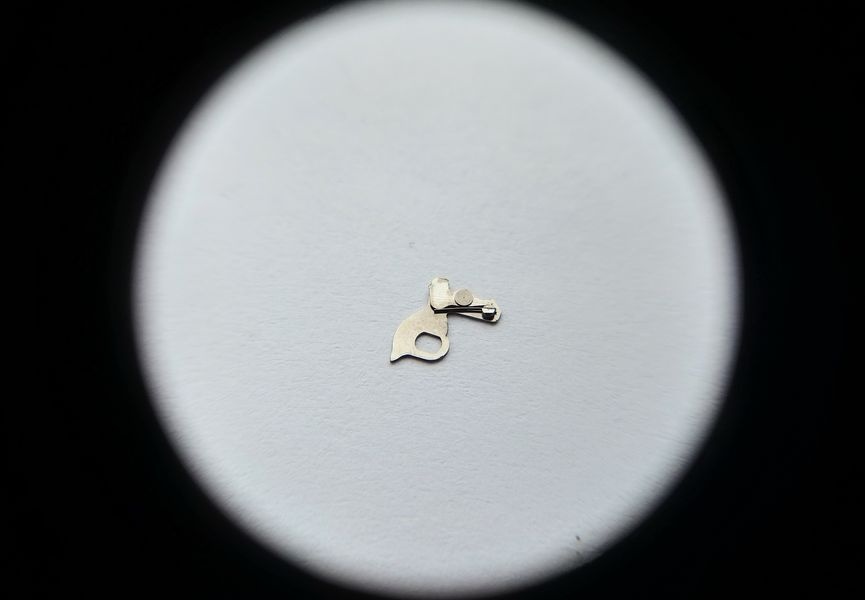
The date advance mechanism employs an accumulator spring and release lever arrangement. The command wheel carries a projection that tensions the accumulator spring during the pre-midnight hours. When sufficient energy has accumulated, the release lever trips, allowing the spring to snap the date disk forward by one position. The lever incorporates a hinged segment that permits forward motion only, preventing reverse date movement during hand adjustment.
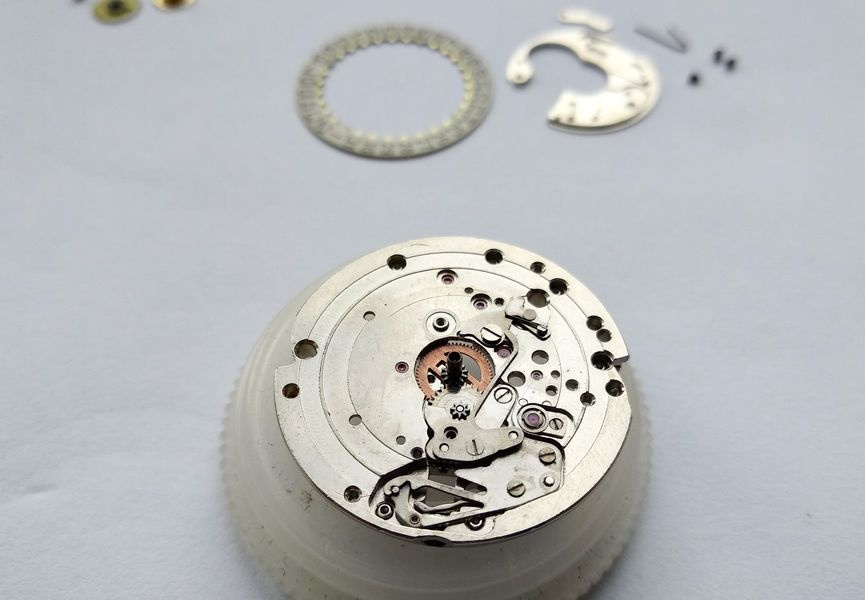
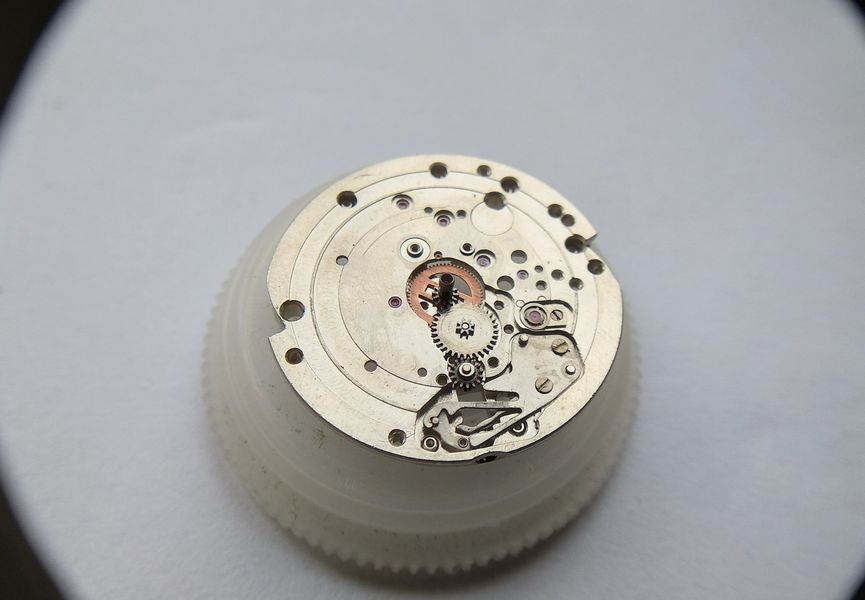
The final dial-side systems comprise the keyless works and motion works. The 2414 employs a straightforward keyless system without complications, making disassembly and reassembly rapid once the technique is familiar.
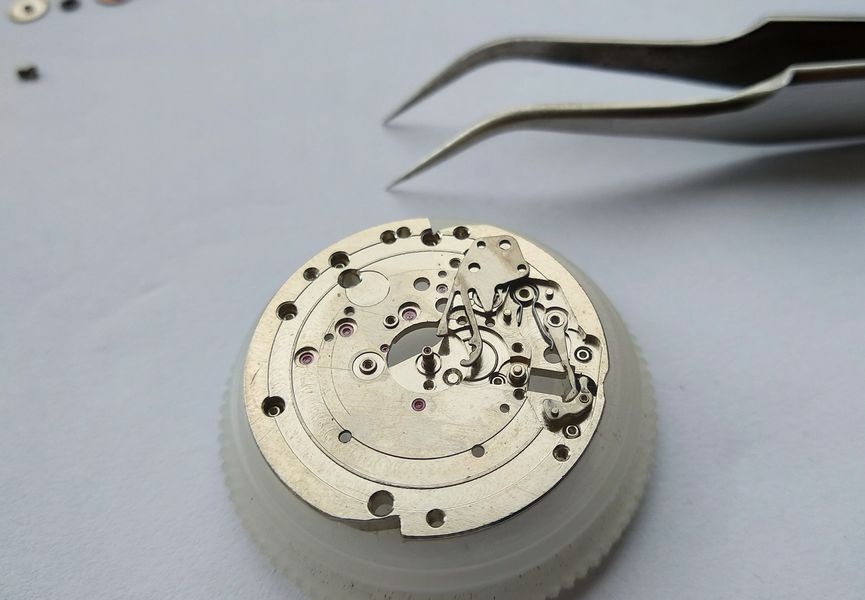
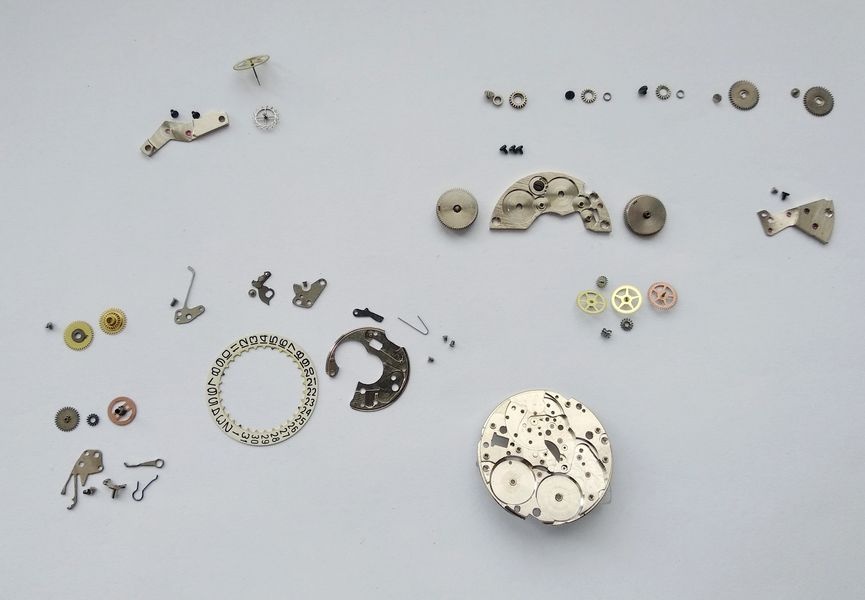
The dual mainspring barrels require individual attention. Opening the barrels revealed clean internal conditions consistent with minimal actual use, though complete absence of lubricant explained the sluggish power delivery. The S-shaped mainsprings, notably stiff compared to single-barrel calibers, showed no corrosion or fatigue indicators.
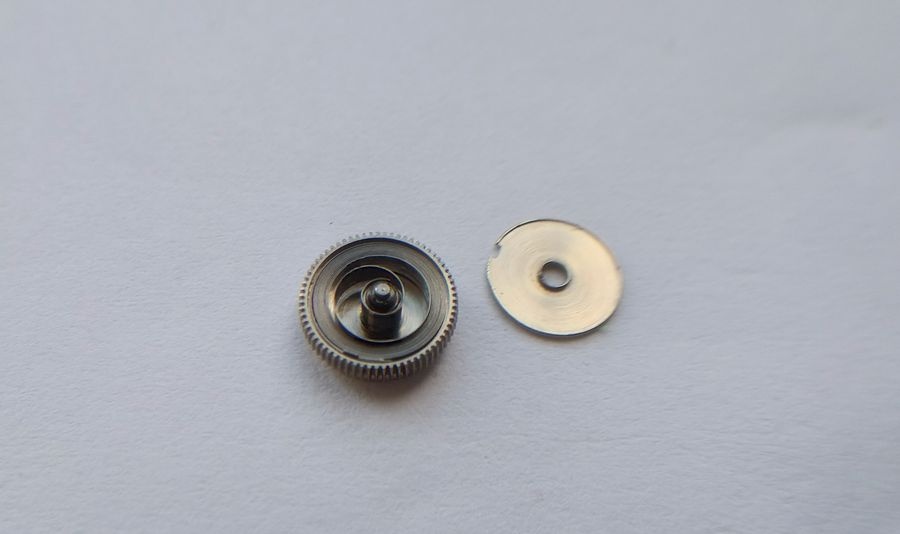
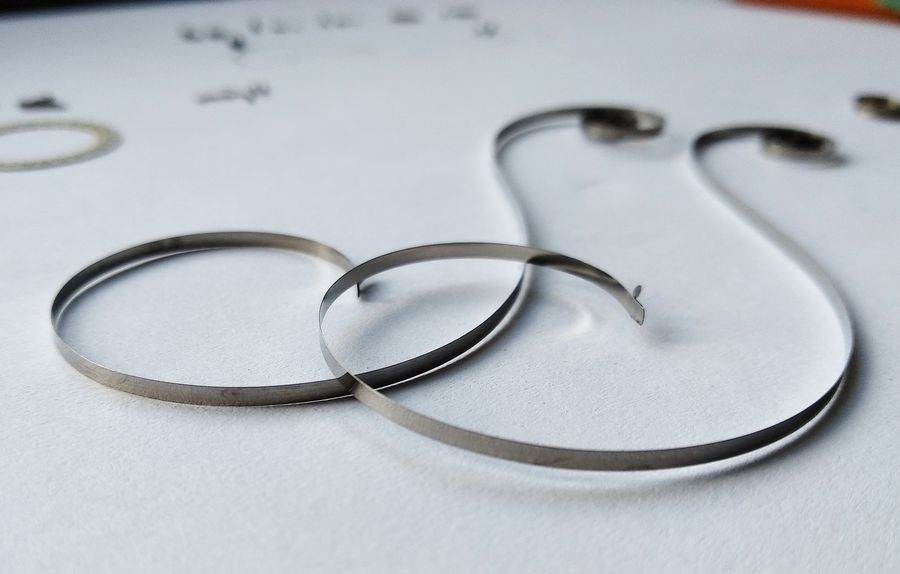
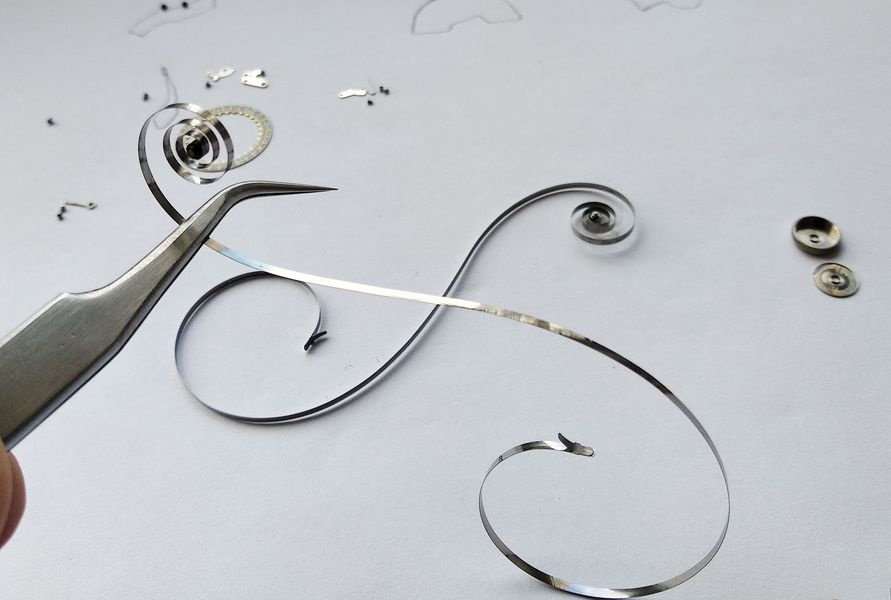
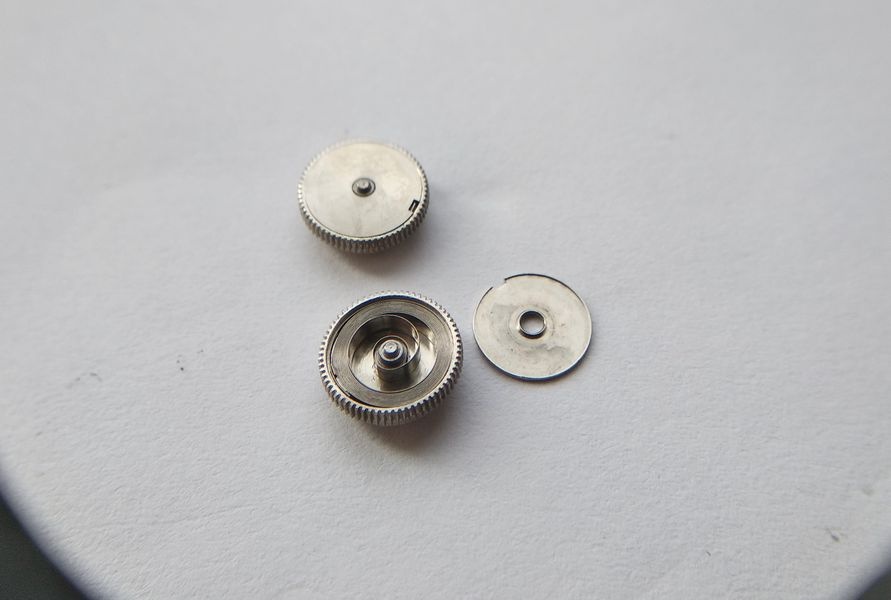
Following ultrasonic cleaning and thorough drying, reassembly proceeds in reverse order of disassembly. The Slava caliber family proves unusually pleasant in this regard, with components seating positively without excessive manipulation. A steady hand with wooden holding tools accomplishes most positioning tasks without difficulty.
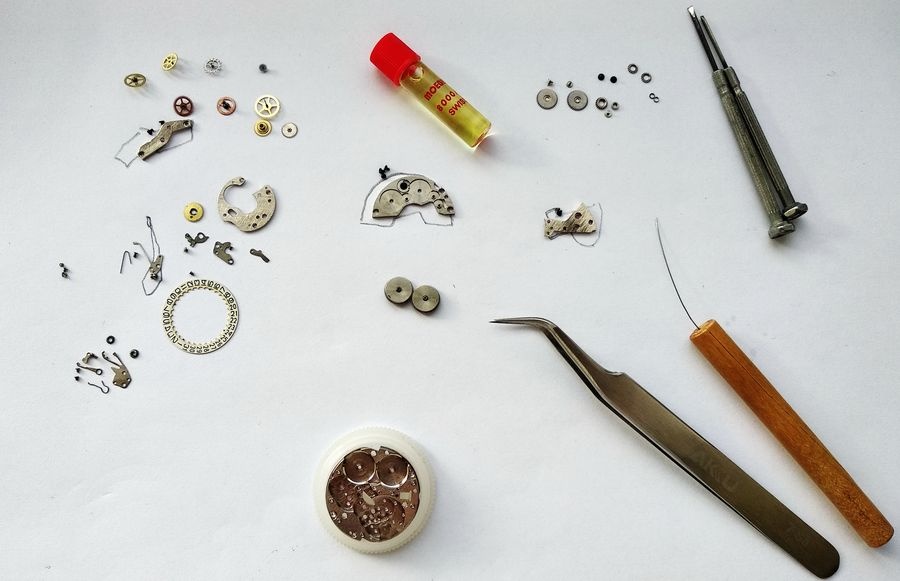
The keyless works receive attention first, establishing the winding and setting functions before other systems are installed.
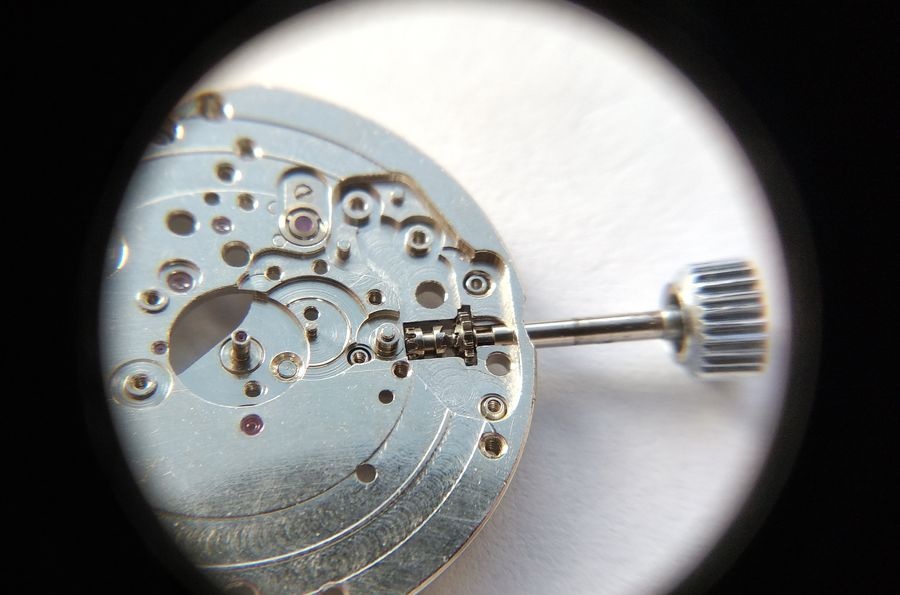
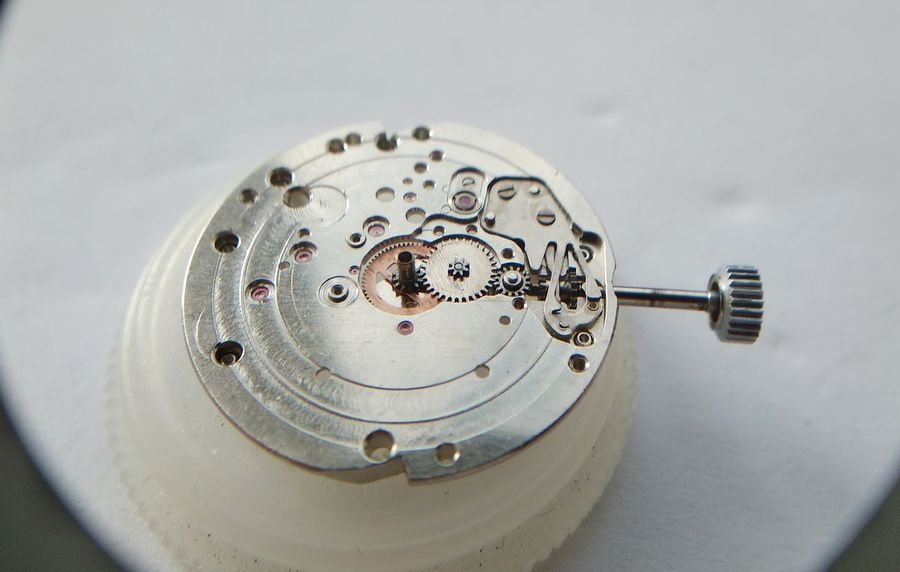
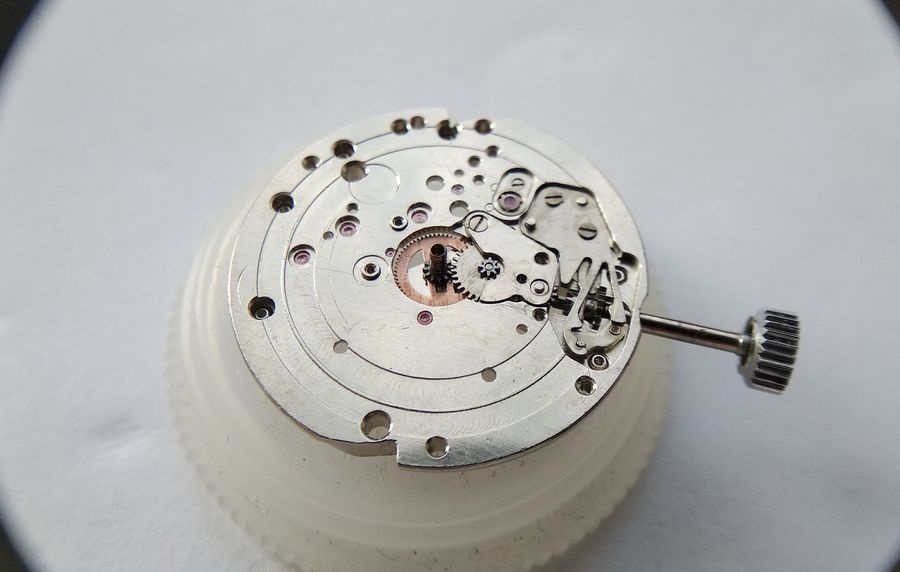
With the dial-side foundations established, the main plate inverts for gear train assembly. Each wheel receives appropriate lubricant at its jeweled bearings before the bridges close over them.
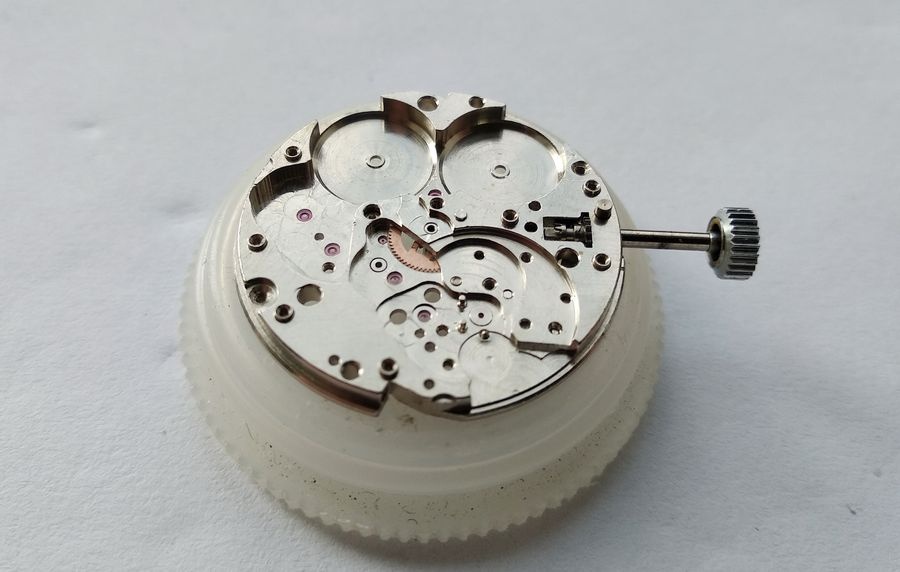
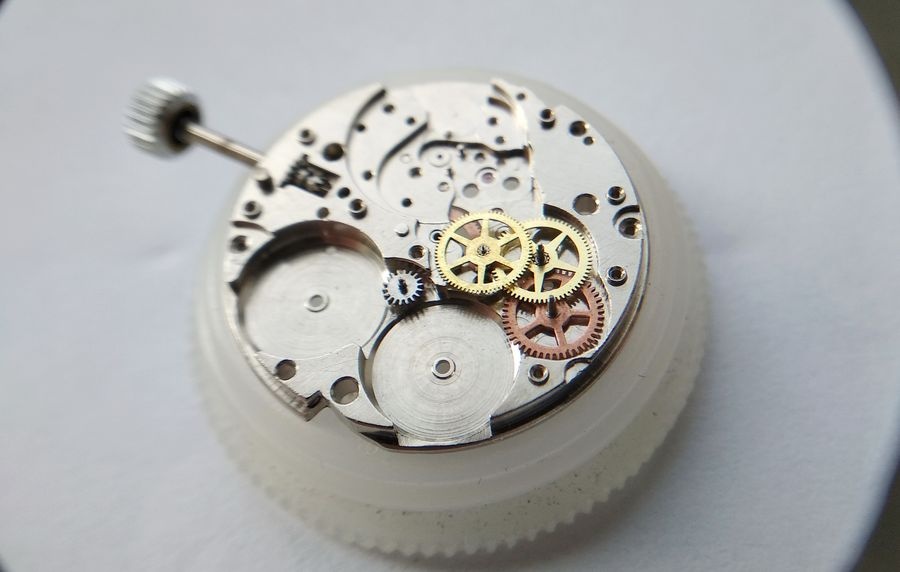
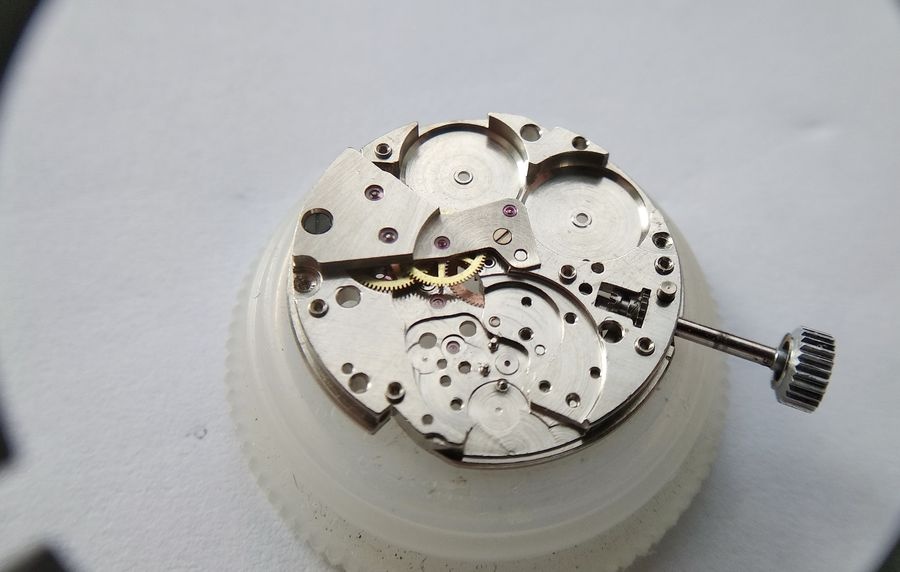
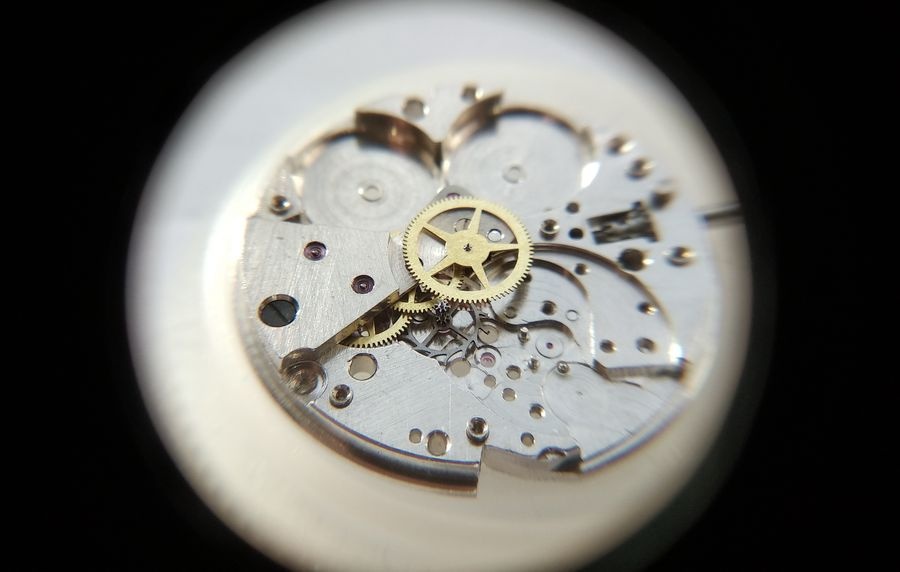
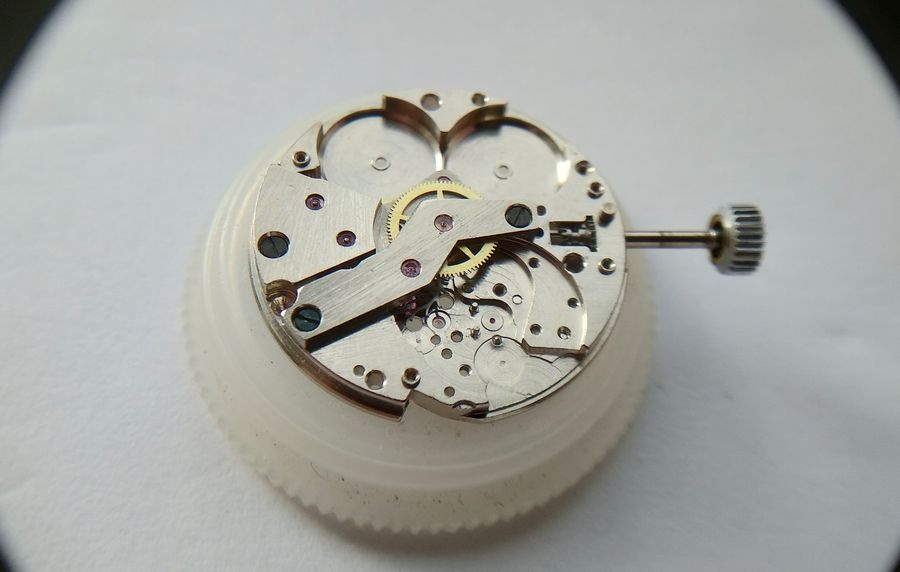
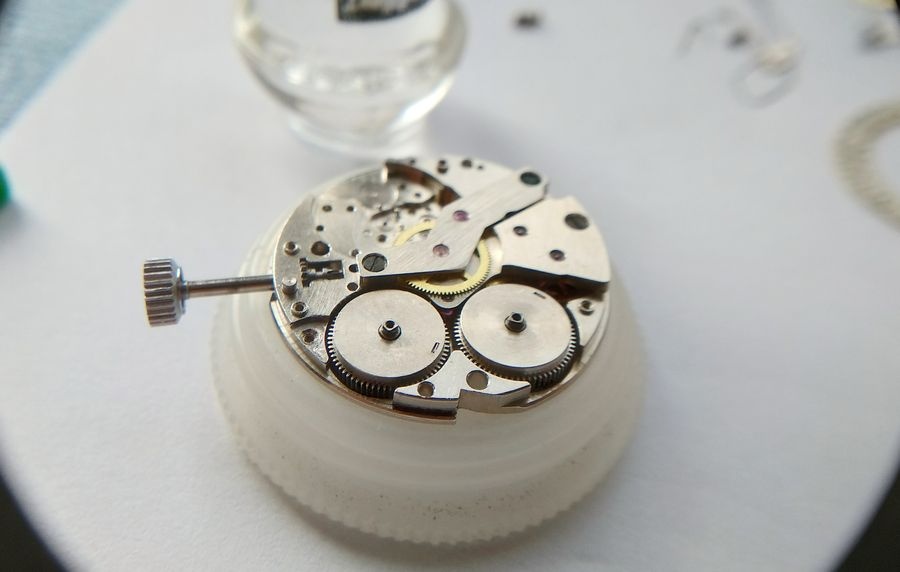
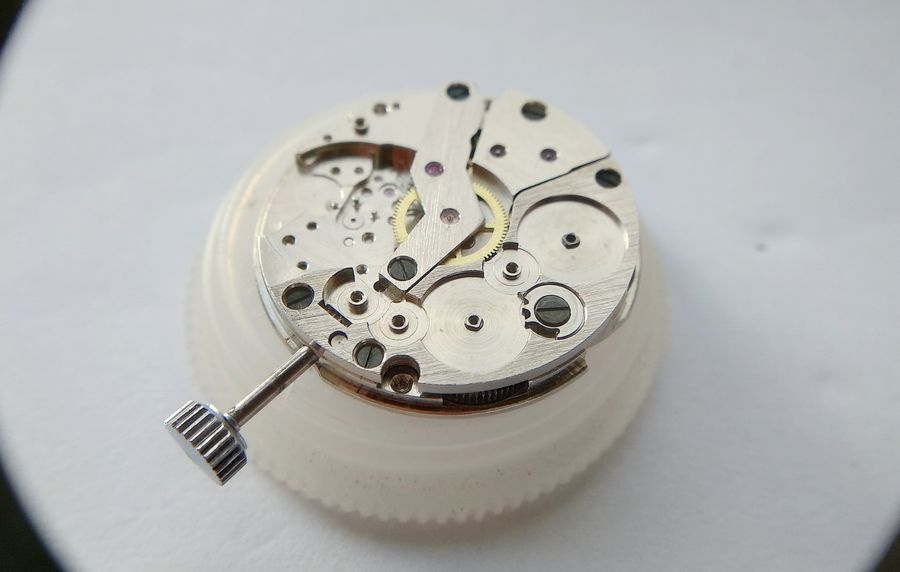
Calendar reassembly presents the 2414's primary service challenge. Installing the date detent with its spring on the bridge while simultaneously positioning the bridge on the main plate requires practice and patience. The components tend to separate during installation attempts, with the spring providing particular frustration. Success typically arrives on the third or fourth attempt.
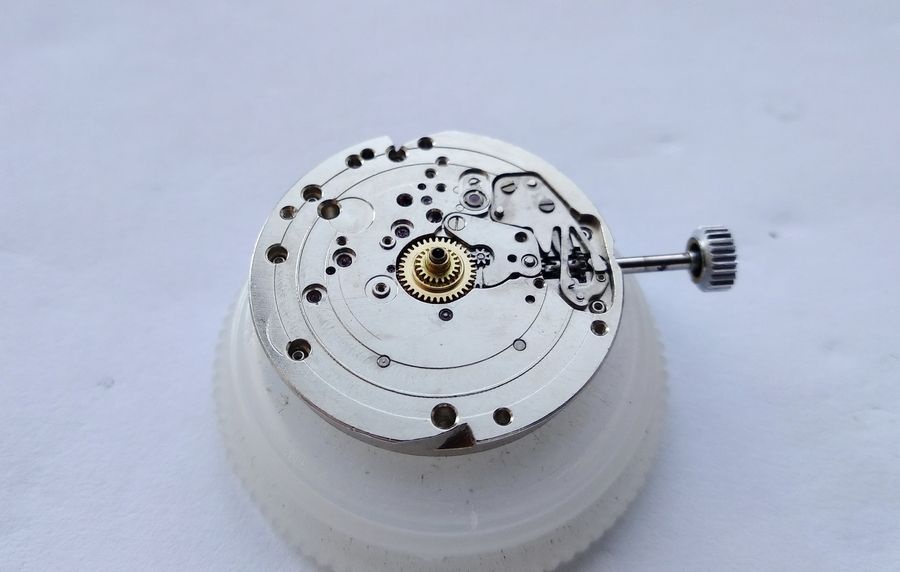
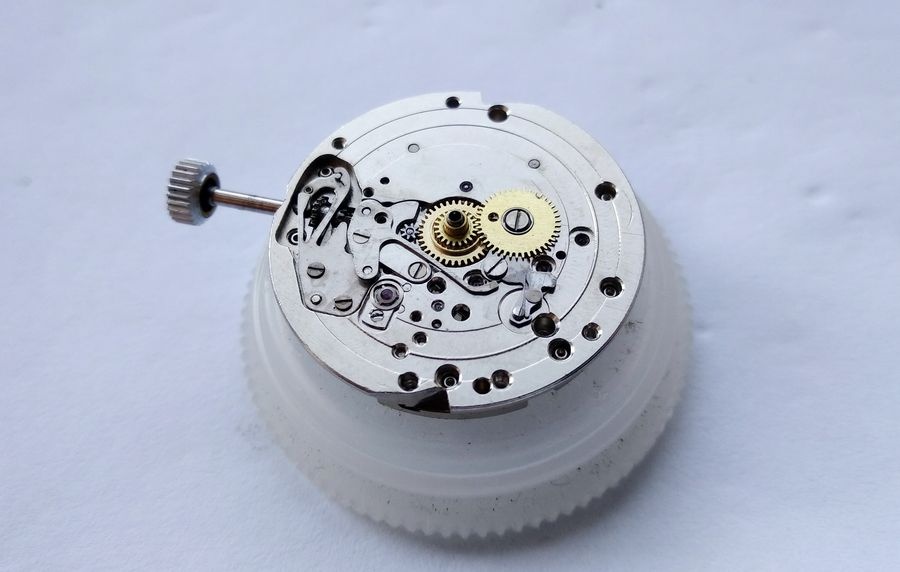
Verification of proper function follows immediately. With the accumulator spring tensioned, a slight touch to the winding crown releases the mechanism, advancing the date disk one position with a satisfying snap precisely at the midnight position.
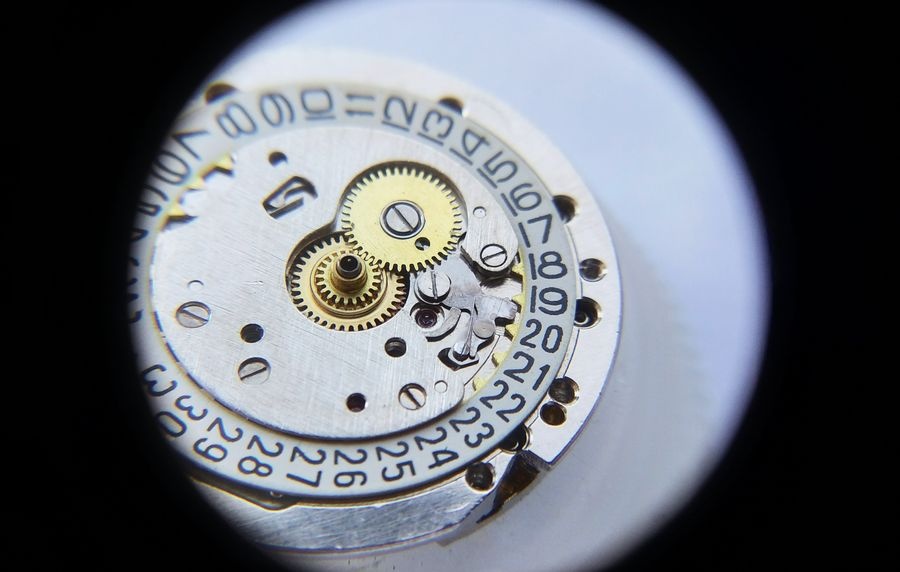
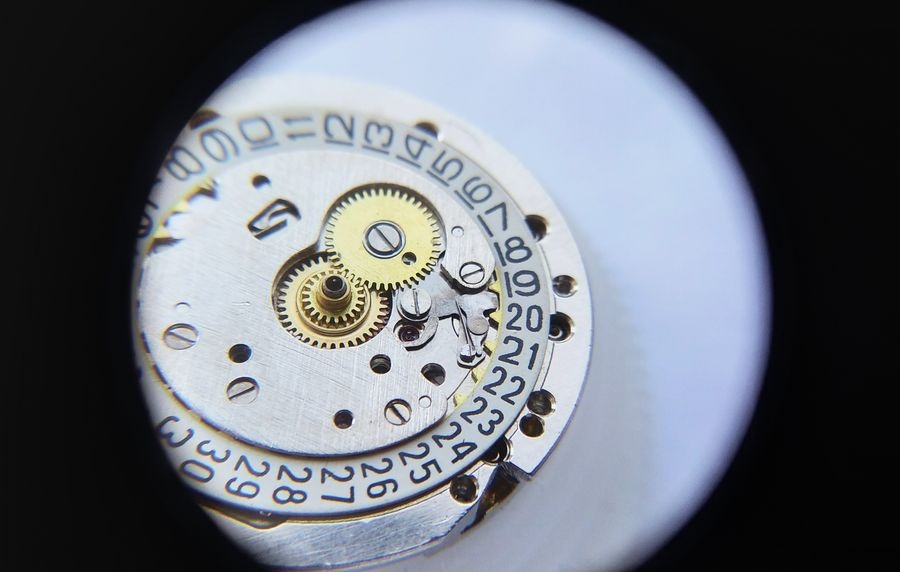
Pallet fork and balance installation complete the movement assembly. The pallet stone faces receive Moebius 8000 lubricant, as do the balance cap jewels. The shock protection springs on this caliber present notable difficulty, with their star points prone to fracturing during installation. Prudent practice maintains spare shock springs before beginning service on any Slava twenty-four series movement.
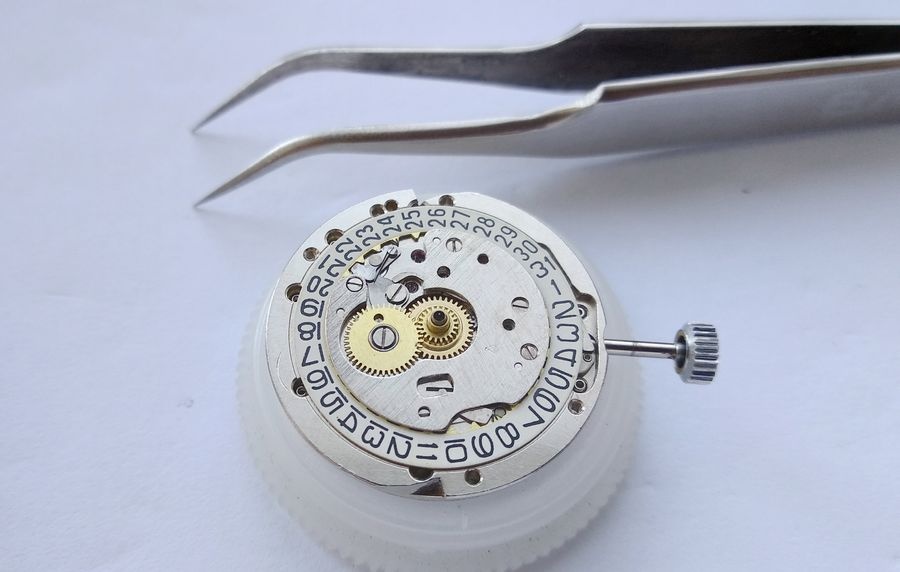
The dial returns to position with careful dust removal immediately prior. Calendar watches require hand installation at the date change position to ensure proper synchronization, a step easily overlooked by those unfamiliar with instantaneous calendar mechanisms.
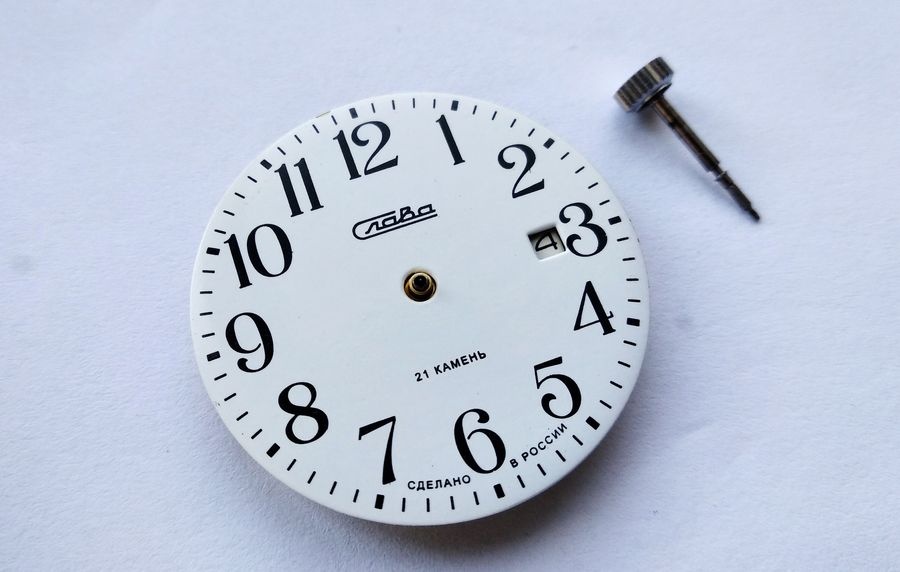
The case receives light polish to refresh its appearance without removing meaningful material, then accepts the movement with its securing clamps.
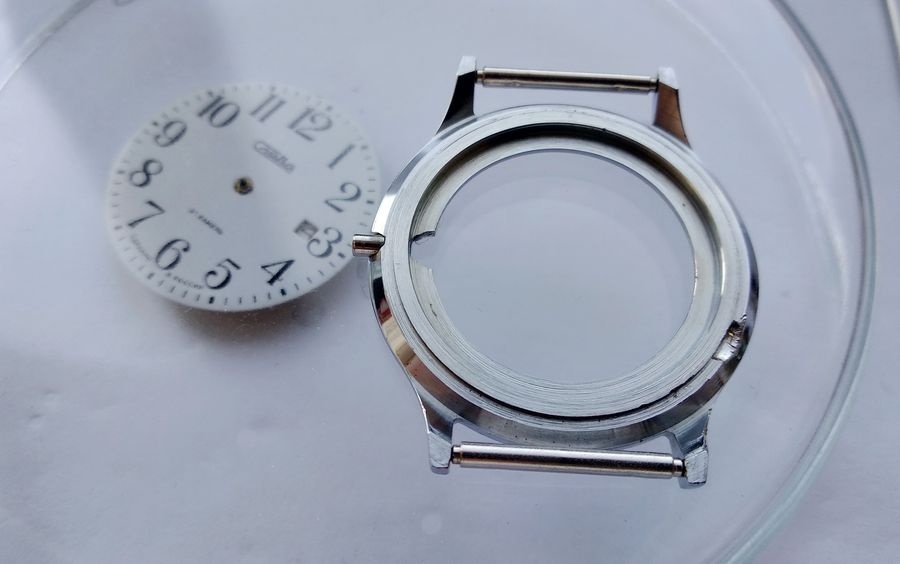
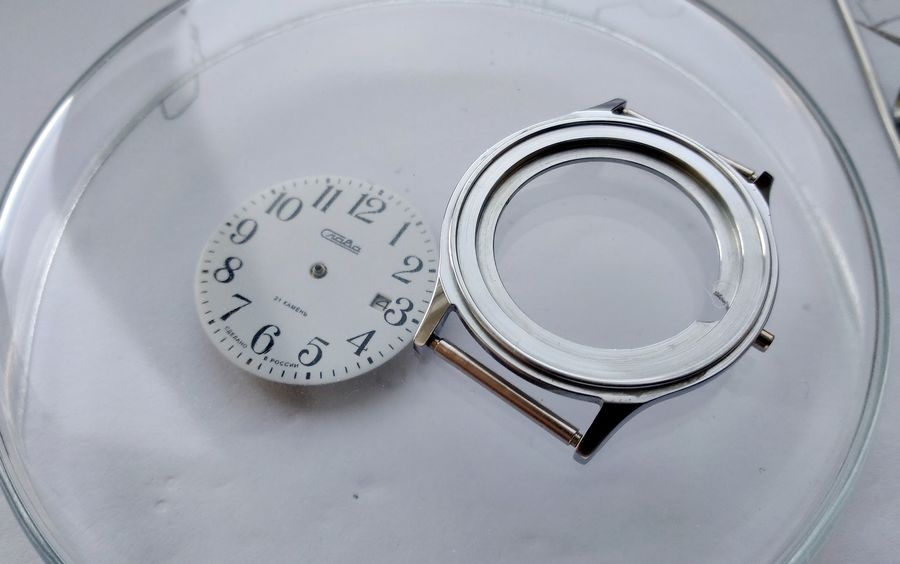
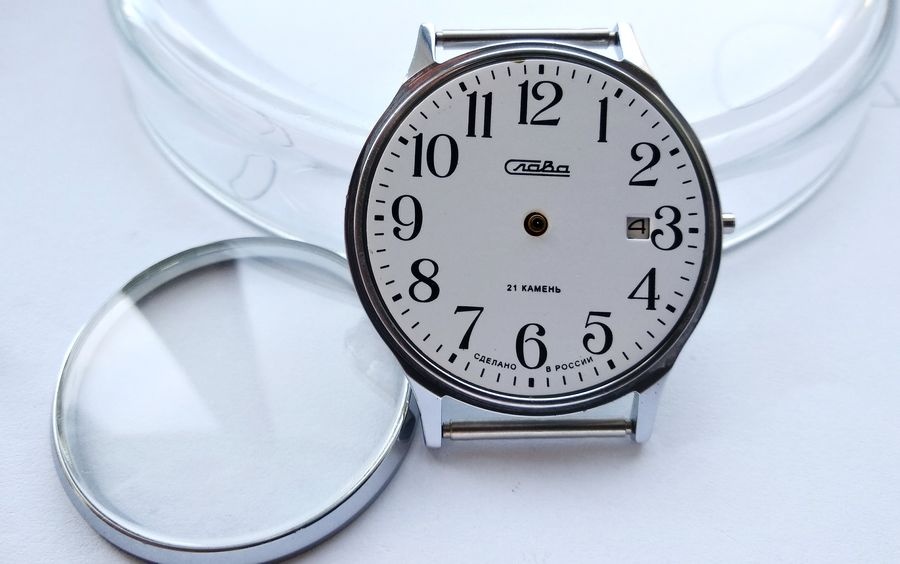
The acrylic crystal required extensive polishing to remove accumulated surface scratches, proving unusually resistant to standard techniques. The material's apparent hardness suggests possible period-specific formulation differences. Eventually, compound progression culminating in chromium oxide achieved the desired clarity.
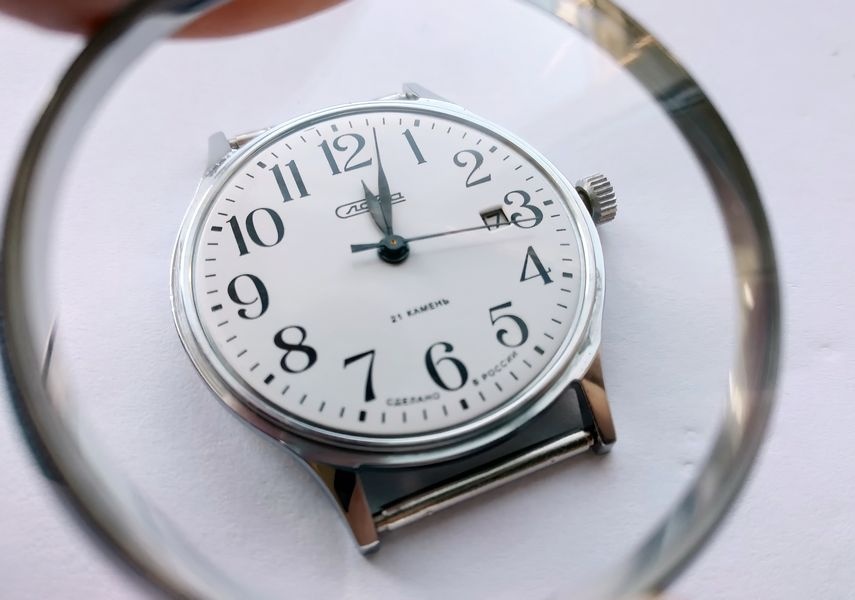
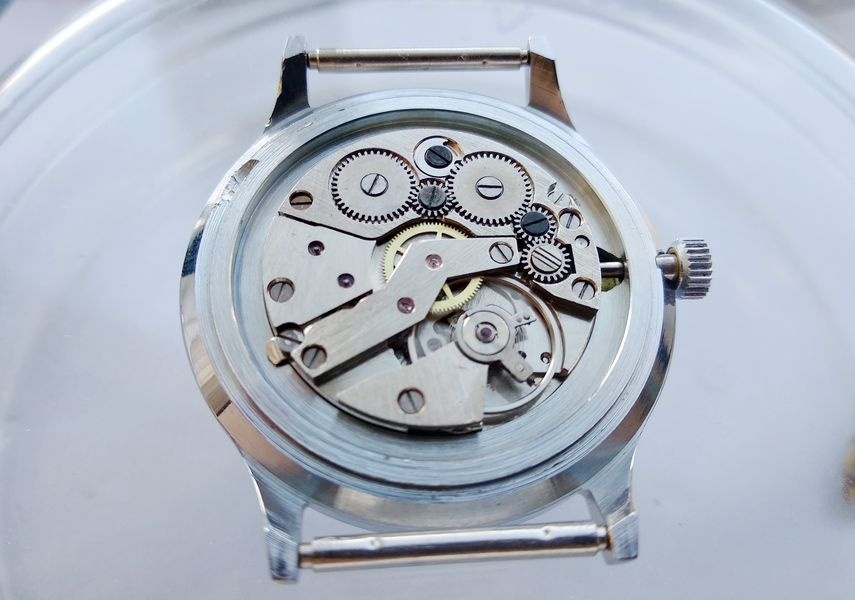
Comparison of this late-production movement with earlier examples reveals a cost-reduction measure worth noting. Early Slava calibers employed jewel settings with circumferential grooves surrounding each stone, serving as oil barriers to prevent lubricant migration away from the bearing surface. Later production, including this specimen, omitted these grooves, pressing jewels directly into plain recesses. The change reduces long-term lubricant retention, shortening optimal service intervals compared to earlier construction.
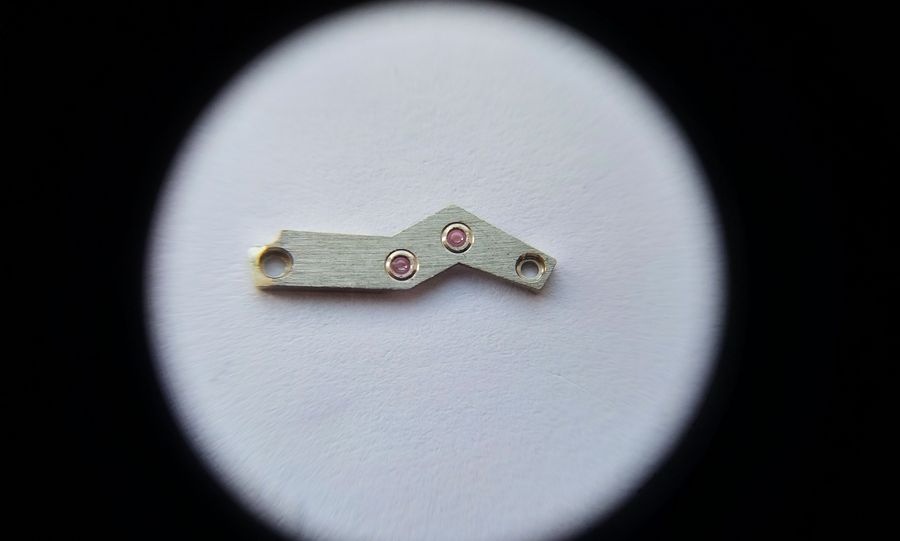
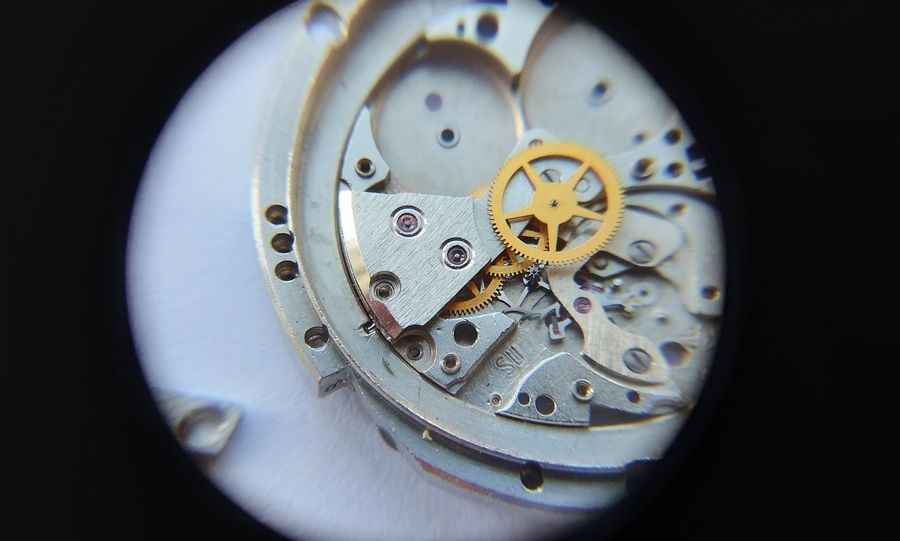
The completed service restored full function to a watch that had not run in perhaps three decades. Timing machine verification confirmed acceptable performance within the caliber's specification of negative twenty-five to positive sixty seconds daily deviation. Current regulation favors slight fast tendency, anticipating the settling period during which fresh lubricants distribute and components reestablish their working relationships.
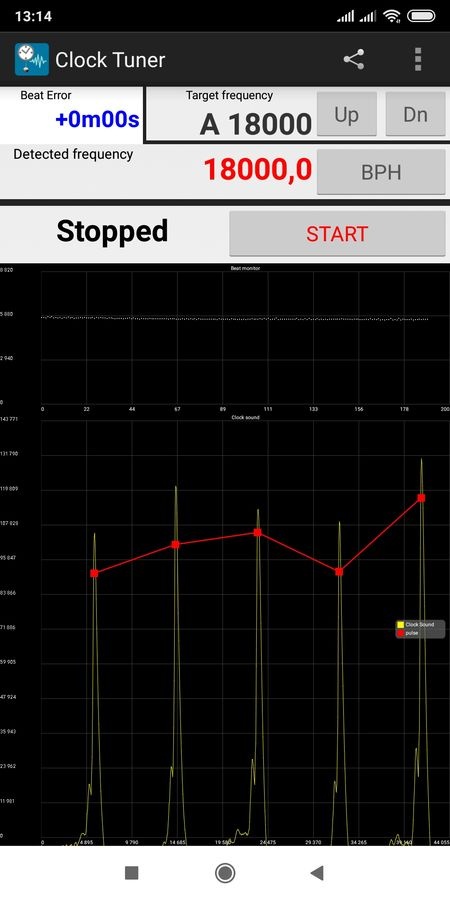
For reference, the essential specifications of the Slava caliber 2414 are as follows: production commenced in 1966; the movement incorporates center seconds and instantaneous date calendar; twenty-one functional jewels support the gear train and escapement; measured power reserve reaches forty-seven hours from full wind; beat rate is eighteen thousand vibrations per hour, or five Hertz; the balance incorporates shock protection; factory accuracy specification permits negative twenty-five to positive sixty seconds daily deviation; movement diameter measures twenty-four millimeters; movement height is four point seven millimeters.
These movements were produced in substantial numbers at the Second Moscow Watch Factory and exported widely, with assembly operations reportedly established in both France and Switzerland during peak production years.
The Slava 2414 represents Soviet watchmaking at an interesting juncture: technically accomplished movement design executed with production economies that increased over time. The dual-barrel motor, instantaneous calendar, and comprehensive jeweling indicate serious horological ambition, while the simplified jewel settings and darkened screws of late production suggest resources under pressure. Understanding both aspects enriches appreciation of these timepieces.
Service procedures prove straightforward for the experienced technician, with the calendar mechanism presenting the only notable difficulty. Spare shock springs should be considered mandatory preparation given their fragility. Parts availability from donor movements remains reasonable, though the unique small bridge screw and certain calendar components deserve careful handling to avoid replacement headaches.
For the collector seeking accessible mechanical watchmaking with genuine technical interest, the Slava twenty-four series offers considerable value. The movements reward attention with reliable performance, while the cases and dials present aesthetic options ranging from military utility to dress elegance. This particular example, with its stark white dial and shaped hands, achieves a visual balance that continues to satisfy long after the service bench has been cleared.