
A Legacy of Optical Innovation, Spanning Decades

Unveiling the Legacy of KMZ: From Wartime Production to Modern Optics
A Historical Journey of Optical Excellence
KMZ, standing for Krasnogorski Mekhanicheskii Zavod (Krasnogorsk Mechanical Factory), boasts a rich history deeply intertwined with the evolution of optical technology. Founded in 1942, during the turmoil of World War II, the company initially focused on crafting specialized equipment for the Soviet military.
From Humble Beginnings to Pioneering Cameras
Following the war, KMZ shifted gears towards civilian production, embarking on a journey that would solidify its place in the world of photography. In 1946, the company unveiled its first camera, the Moskva, a folding camera heavily inspired by the Zeiss-Ikon Ikona. This marked the beginning of a prolific era, with several variants of the Moskva gracing the market in the years to come.
KMZ's expertise further expanded with the co-production of the FED camera in 1948. This endeavor emerged from the need to meet the rising demand for the Leica II camera, a popular German model, after the original FED factory suffered wartime damage. This collaboration birthed millions of FED cameras under the FED-Zorki brand.
The Birth of the Iconic Zenit
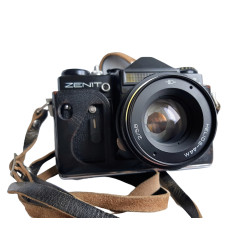
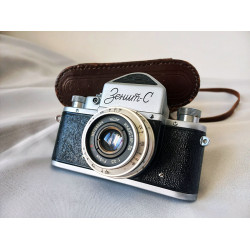
Driven by innovation, KMZ continued its foray into the world of cameras. In 1949, the company introduced the Zorki, a rangefinder camera that served as an improved version of the FED camera. This paved the way for the revolutionary Zenit, KMZ's first single-lens reflex (SLR) camera, unveiled in 1952. While sharing a similar 39mm screw mount with the Zorki, the Zenit boasted a unique design that restricted compatibility with Zorki lenses.
Evolution and Adaptation: The ZENIT-E and Beyond
The relentless pursuit of improvement led to the introduction of the ZENIT-E camera in 1962. This model sported a hinged back door reminiscent of the Western Praktika cameras, offering a more user-friendly experience. Notably, a variant of the ZENIT-E, the Zenit-ES, played a crucial role in the development of the KGB Photo Sniper camera.
Beyond commercial cameras, KMZ also delved into the realm of specialized equipment, catering to the needs of intelligence agencies. Their workshops produced a range of covert cameras, including the F-21 (Ayaks) button camera, the KGB Photo Sniper, and the Tochka-58 subminiature cameras, known in the West as necktie cameras.
A Legacy Enduring: The Transformation of KMZ
In 1993, KMZ underwent a name change, becoming S.A. Zverev Krasnogorsky Zavod JSC. Despite this, the company continued to operate under the familiar KMZ and ZENIT brands. Today, KMZ remains a prominent player in the field of optics, specializing in advanced cameras and laser rangefinders for military applications.
A Glimpse into the Shifting Visual Landscape: The Evolving KMZ Logo
The visual identity of KMZ has undergone several transformations throughout its history. The initial logo, introduced in 1942, featured a simple dove prism. This later evolved to incorporate a refracted light ray with an open arrow in 1949, which eventually transitioned to a closed arrow around 1970. The current logo retains the dove prism motif, accompanied by a thick reflected light ray and sometimes paired with the ZENIT name.