

Luch Caliber 1809: Servicing a Forgotten Minsk Center-Seconds Movement
"Simplicity is prerequisite for reliability."
— Edsger W. Dijkstra
Ask a collector about the Minsk watch factory "Luch" and two calibers usually come up first. One is the Luch 2209, an ultra-thin movement with a well-earned technical reputation. The other is the Luch 1801.1, a small hand-wound movement the factory still produces today. Few people remember that Minsk also built several other movements during the Soviet period, and that some of them were very competent designs. They have dropped out of collector conversation, but the watches built on them are still in service, and many still keep reasonable time. The Luch 1809 is one of these movements. It is a hand-wound caliber with center seconds, made mainly for ladies' watches. This article tries to fill some of that gap by documenting a complete service of one example.
Caliber Specifications
The Luch 1809 is an 18 mm movement, about eight lignes, and 3.8 mm thick. It runs on seventeen jewels with a conventional Swiss-type lever escapement. The balance staff has shock protection, and the second hand is driven from the center of the dial. The balance beats at 21,600 vibrations per hour, or 3 Hz. The movement was certified to accuracy Class 1 under the Soviet and post-Soviet watch standard GOST 10733-98. In practical terms, that is a well-specified time-only caliber with good small-scale proportions, closer in spirit to a men's three-hand movement than to the reduced, cost-cut calibers often found in period ladies' watches.
The Watch on the Bench
The example here is a ladies' Luch, probably made in the early-to-middle 1980s. It arrived in poor cosmetic condition. The crystal was cracked and the dial was badly corroded, but the case was in reasonably sound shape. If a replacement dial and crystal could be found in spare-parts stock, the watch could be returned to a decent appearance. That work comes second, though. The movement has to be put right first.
There is almost nothing published about this caliber beyond the basic factory specifications. No service guide, exploded diagram, or published teardown appears to exist, so the disassembly below has to establish the movement's architecture from scratch. This particular watch also appears never to have been opened. The flats on the case back show no tool marks, and there are no watchmaker's scratch marks or service notes inside. Despite that, the watch was still running. A timegrapher showed that it ran badly, with an erratic, uneven trace, and the disassembly would show why.
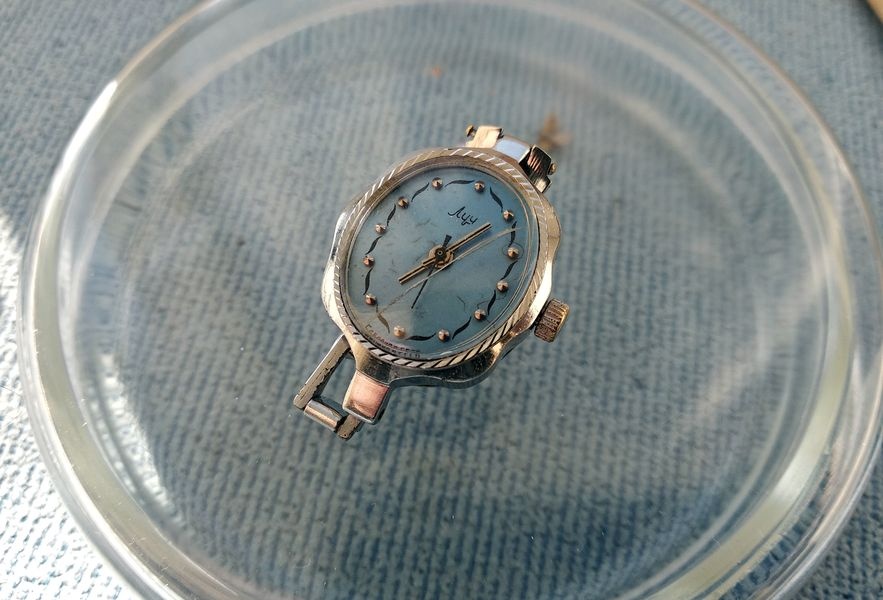
The case back carries the pentagonal Soviet State Quality Mark, which was reserved for products judged to meet a higher manufacturing standard. Decades of unserviced running would put that claim to a practical test.
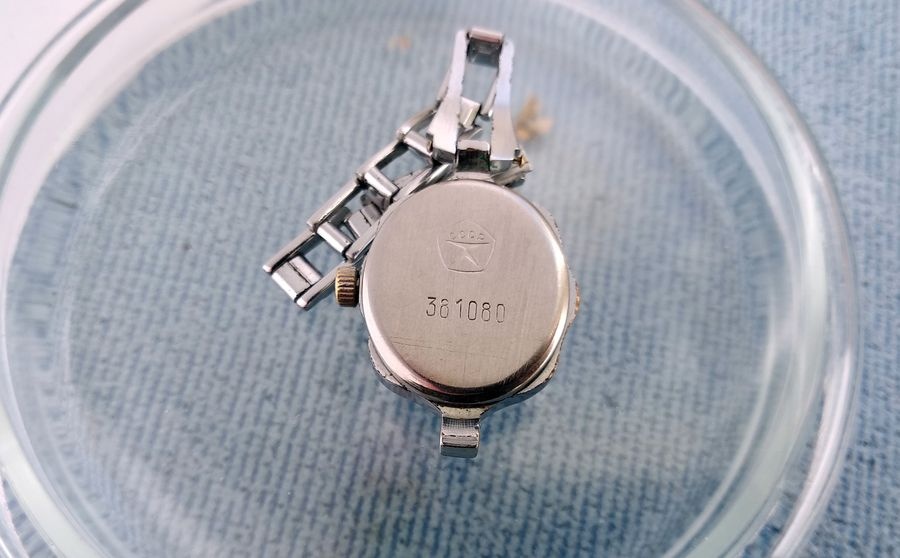
Opening the Case and Removing the Movement
The case back is opened with a case knife worked carefully into the joint. It is not a true snap-on back with a locating lip. It is a plain friction fit, held only by the tightness of the joint. Under the back, a separate dust cover shields the movement. A cover like this gives no protection against water or humidity, but against dust it works well as long as the watch is kept out of harsh conditions. The movement underneath was indeed fairly clean for a watch that had probably never been serviced.
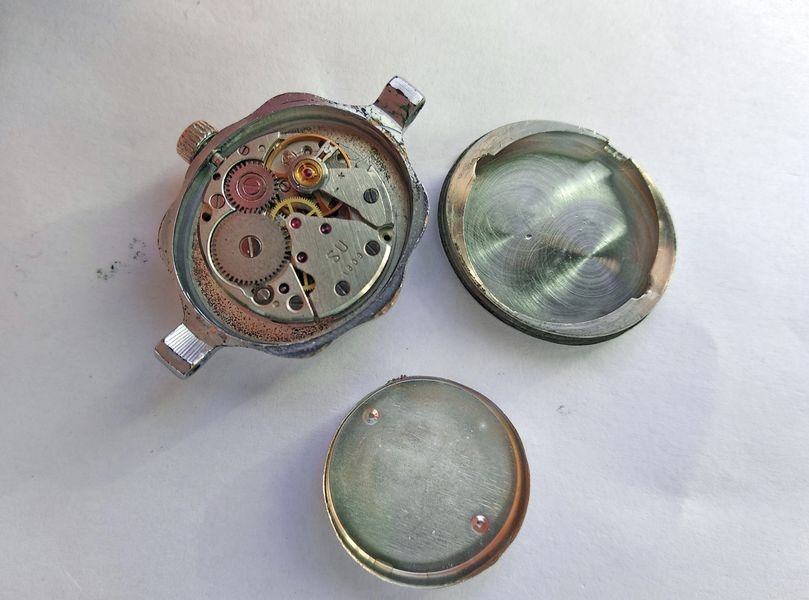
Disassembly starts with the winding stem. On the 1809, the stem release is deep inside a very narrow bore and can only be reached with a fine-tipped screwdriver. Pressing the release lifts the setting lever away from its engagement with the stem.
Once the release is pressed, the stem slides out of the case.
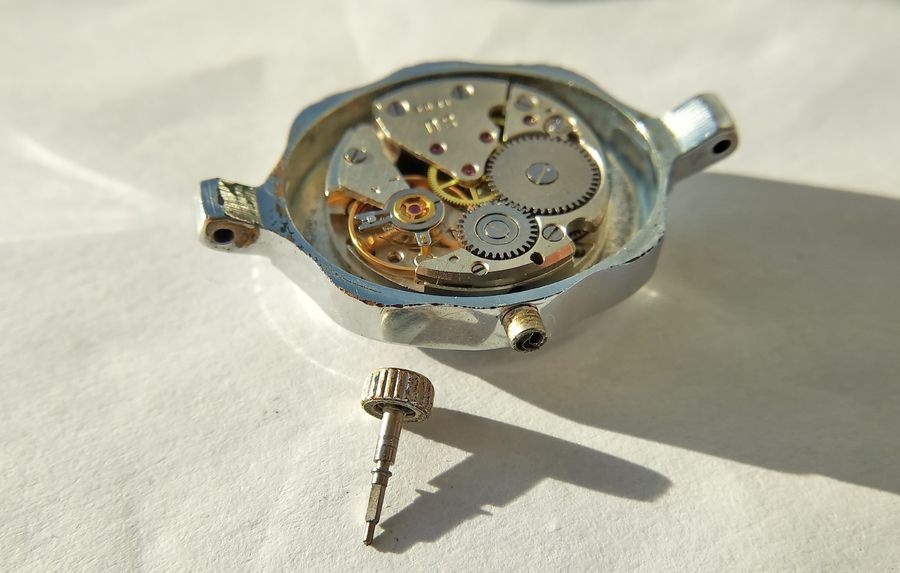
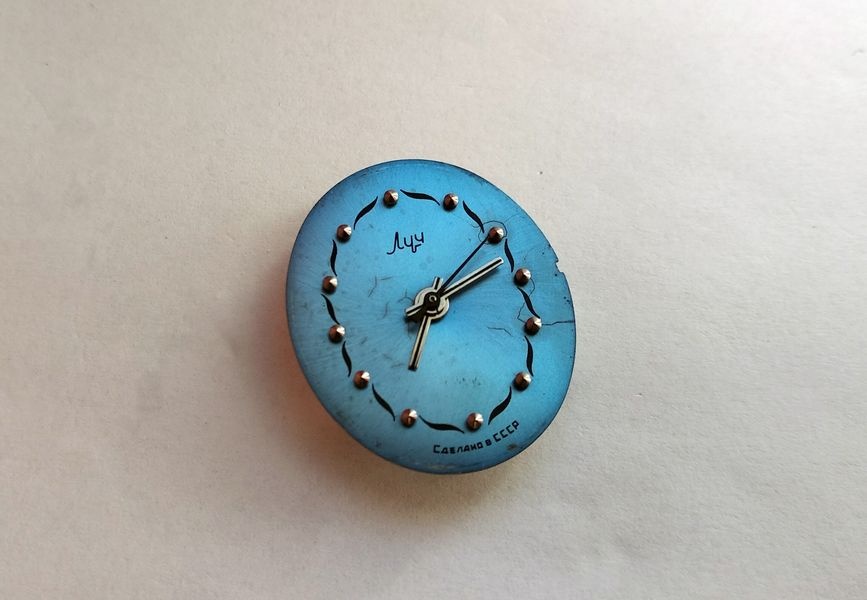
The movement then comes out of the case. There are no casing clamps or screws on this design; the movement simply sits in the case. Out of the case, the dial is obviously not worth saving. A search of the parts boxes will be needed for a replacement dial and a new crystal.
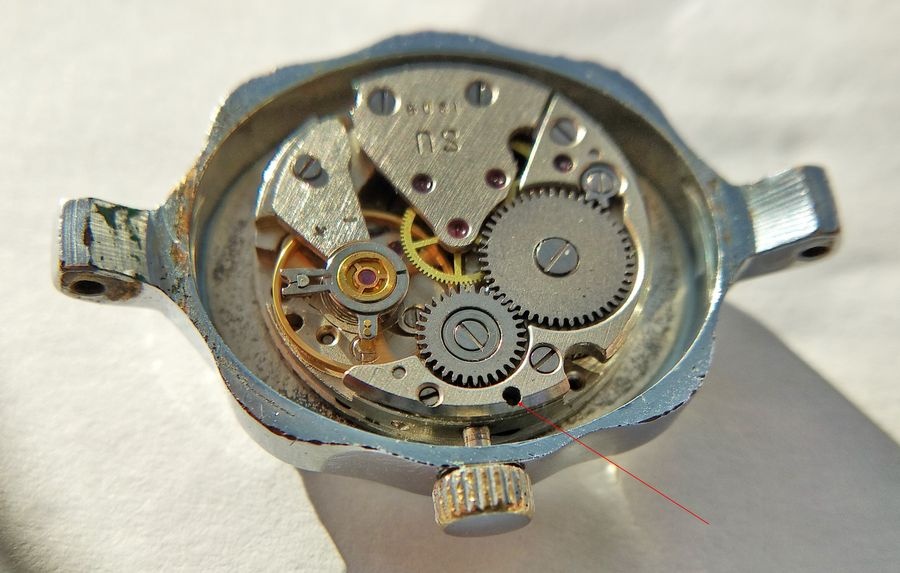
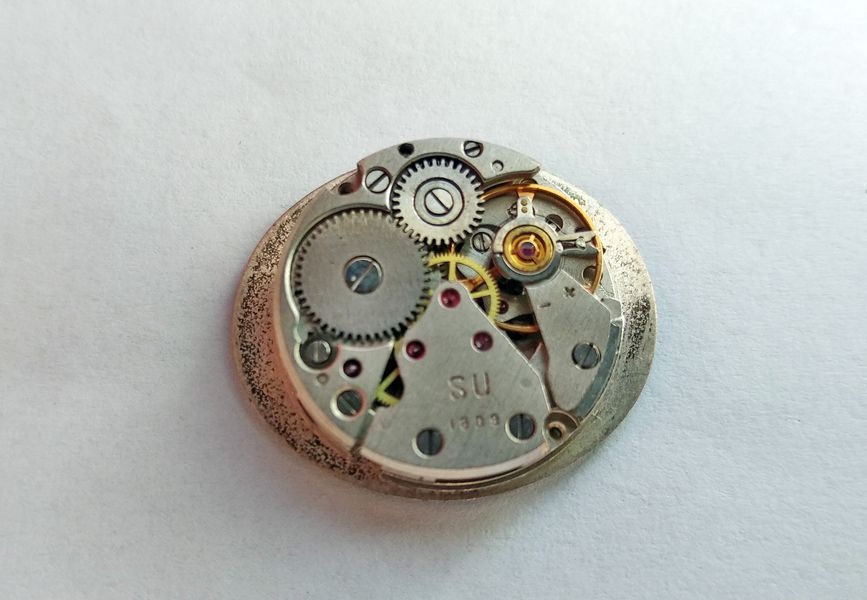
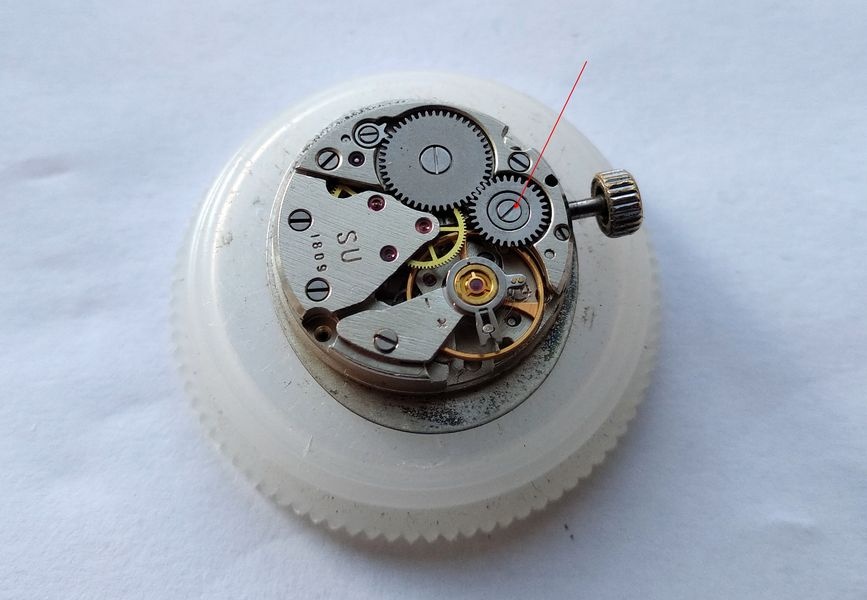
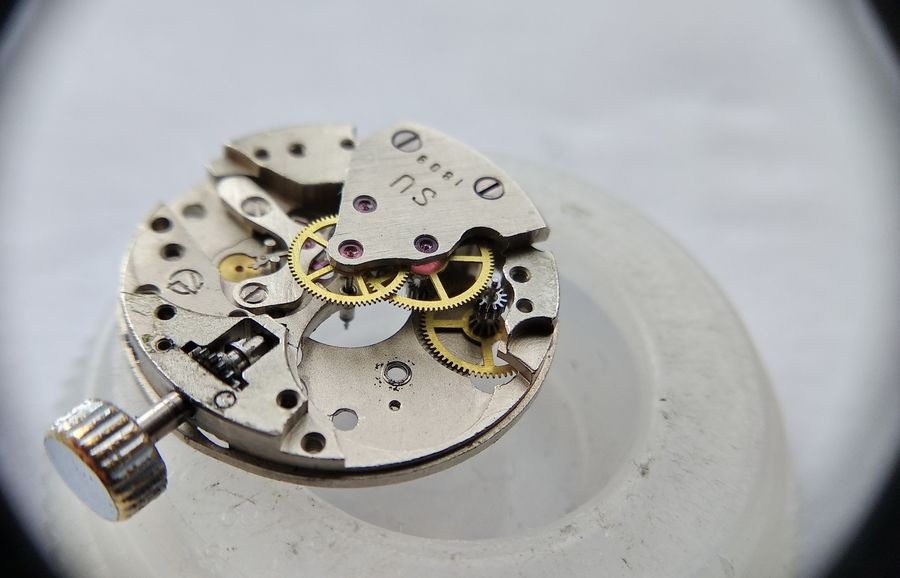
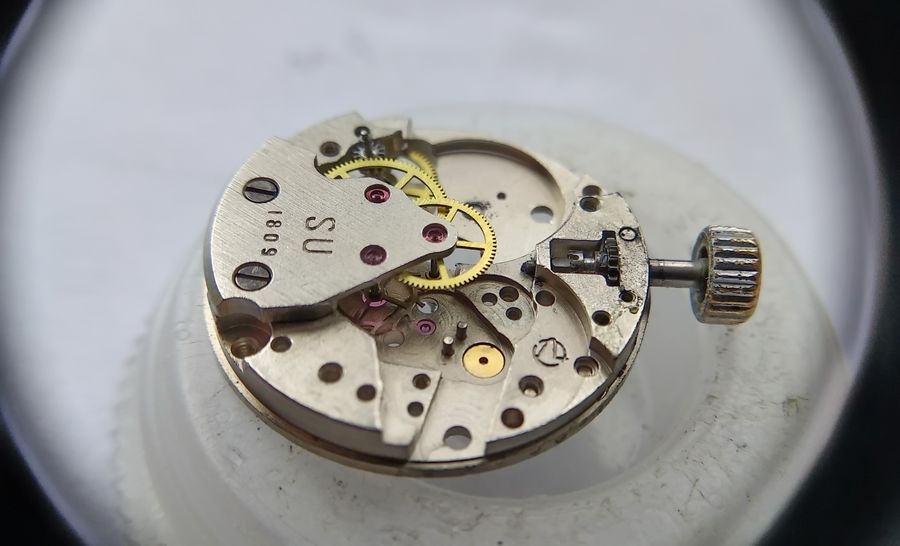
The train side of the movement, the side carrying the balance, is clean as well. The train bridge is stamped "SU," a marking adopted at about this time in the 1980s, along with the caliber number 1809. That number follows the standard Soviet coding: the first two digits give the movement diameter in millimeters, and the suffix "09" means the movement has center seconds.
Disassembly
Hands and Balance
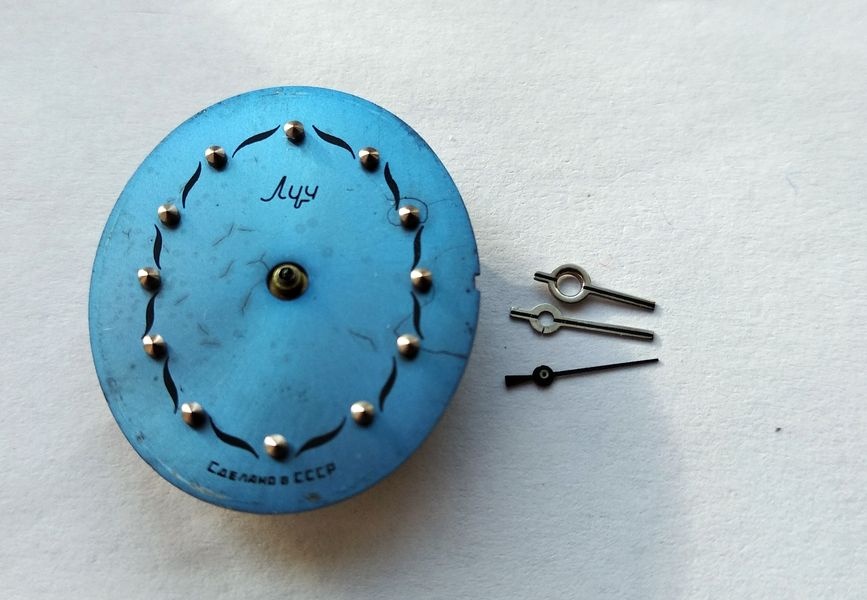
With the movement turned dial side up, the hands are removed using hand levers, working evenly so that the seconds, minute, and hour hands come off their pinions cleanly.
Next the movement is turned over and the balance is removed. The balance assembly is the most delicate part of any movement, and it should come out before the rest of the work begins so it cannot be damaged during handling. One detail stands out on this side of the movement. The screw holding the crown wheel has a left-hand thread. By common practice, a left-hand screw is marked with three short slots in the head so the watchmaker knows to turn it the other way. Here the screw has an ordinary single slot. A watchmaker who already knows about the reversed thread will not be caught out. Someone meeting the caliber for the first time could easily strip the screw or crack the head by turning it the conventional way.
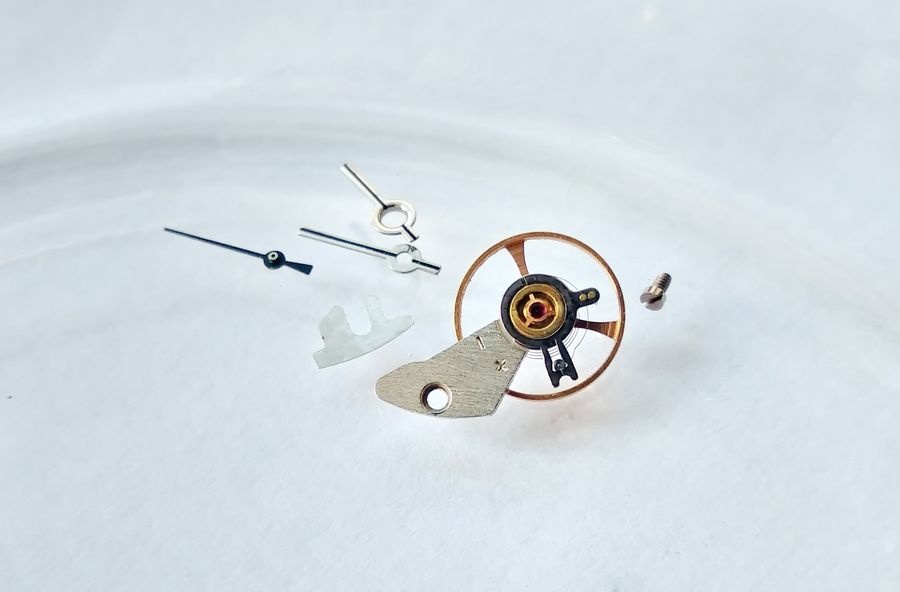
The first parts are now off: the hands, the balance, and a thin plastic shim that was under the balance cock. A shim like this is not part of the original design. It was almost certainly added during assembly to correct endshake or clearance at the balance, which says something about how individual movements were adjusted on the line.
Dial and Motion Works
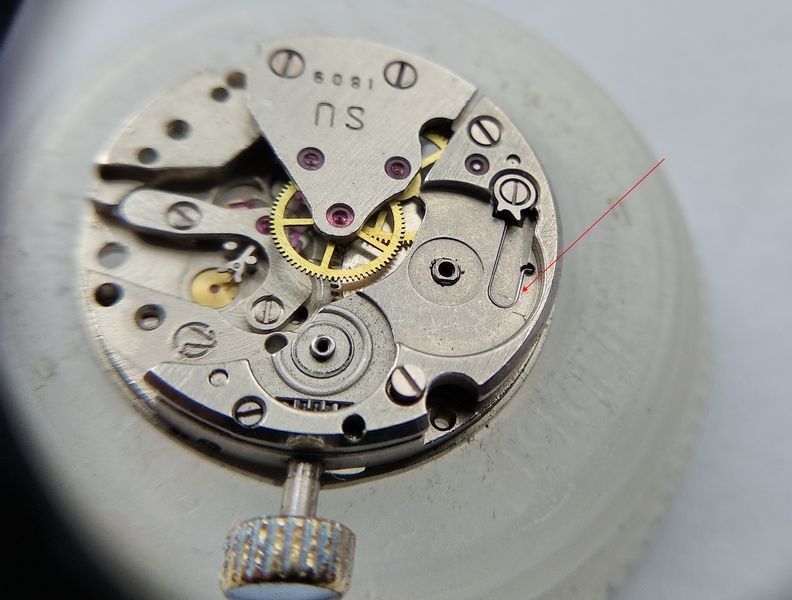
The dial is held by two feet. Each foot is clamped by a screw that enters from the edge of the main plate. The red line in the next photograph shows where one of these screws is.
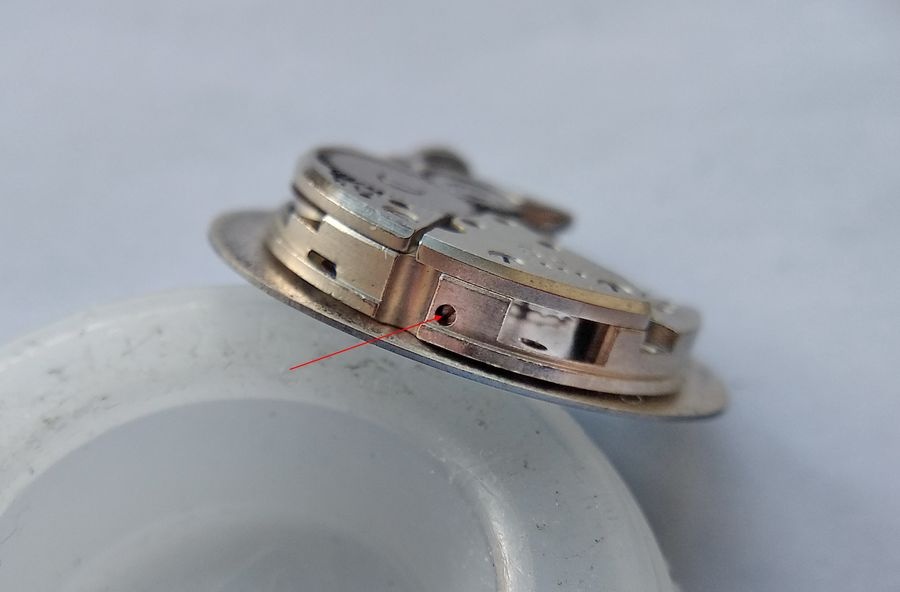
The two foot screws are loosened, but not taken out, and the dial is eased off with a fine screwdriver at its edge. The screws stay in the plate, which avoids losing them and makes it easier to start their threads again during reassembly.
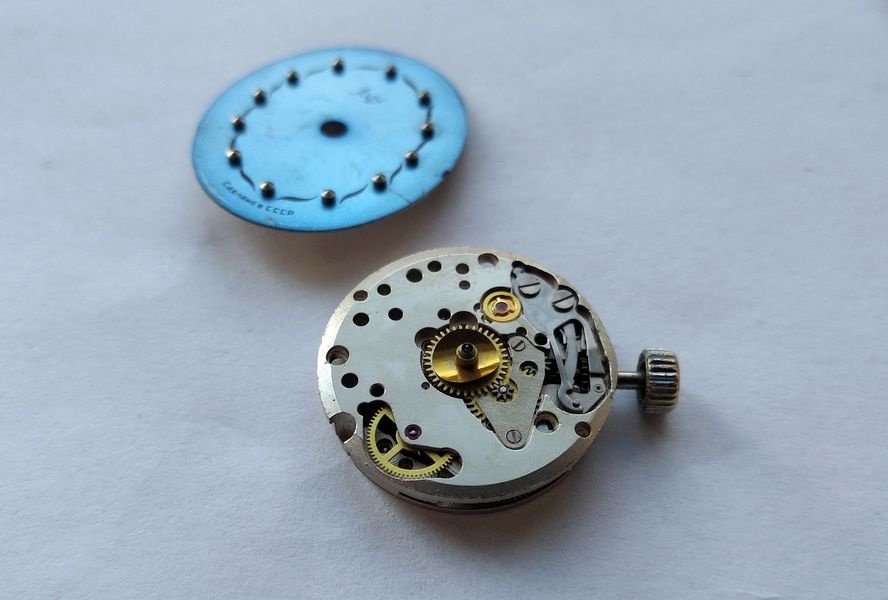
The hour wheel comes off next, together with its spring washer. The washer holds the hour wheel down on the cannon pinion and takes up axial play.
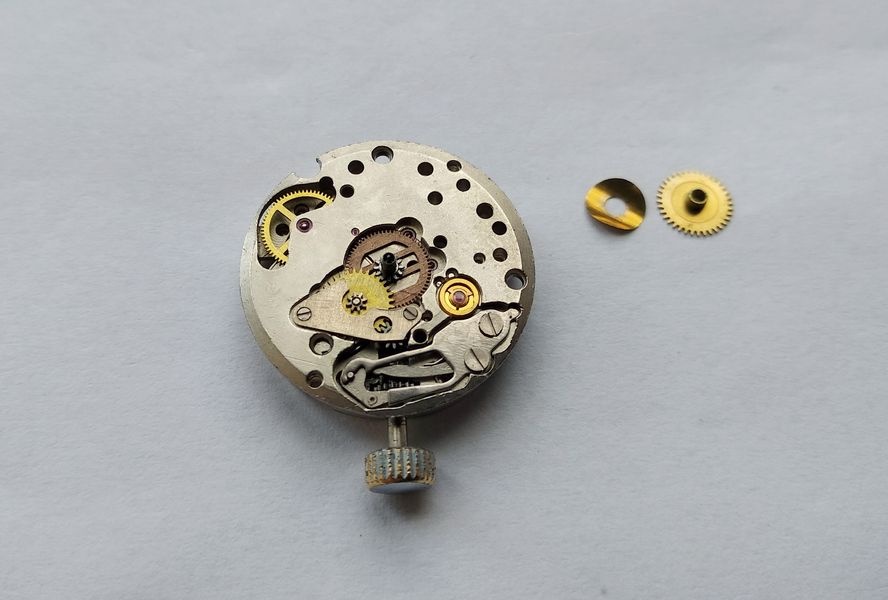
Then the minute wheel bridge is taken off.
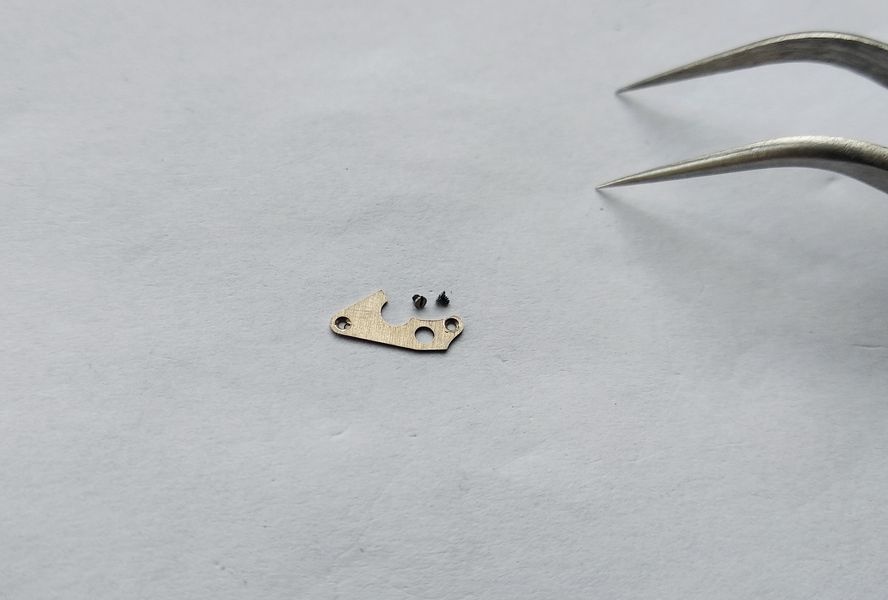
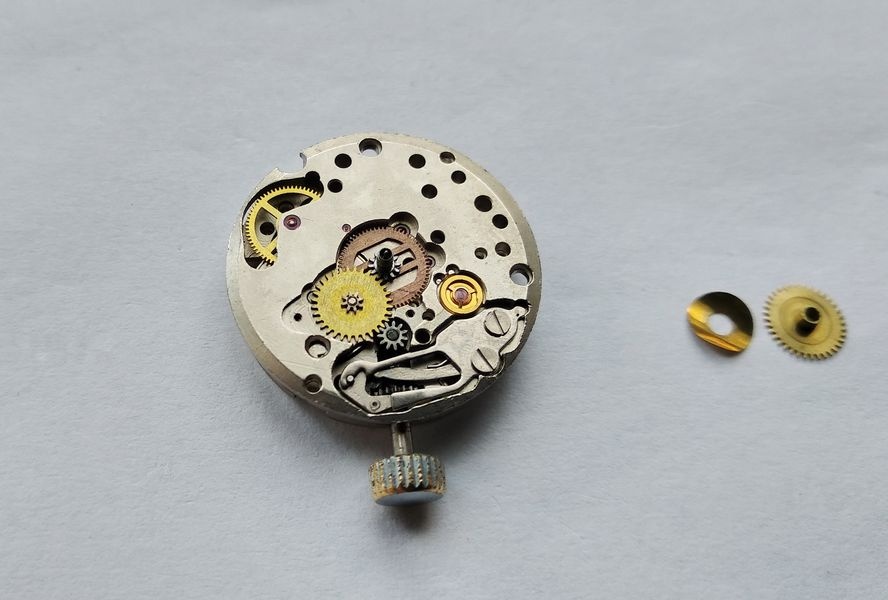
This exposes the motion works, the slow-moving dial-side train, and the first notable design feature. The friction clutch that lets the hands be set is not the usual crimped cannon pinion, where a dimple or pinch in the cannon tube grips the center wheel arbor. The 1809 uses a separate spring wheel instead. This is a very reliable arrangement. The friction stays consistent over the life of the watch, and as long as it is cleaned and lightly lubricated at sensible intervals, it shows almost no wear. A crimped cannon pinion is different: its grip changes with every service and can fail if the tube is over-compressed or work-hardened. On this feature alone, the movement deserves its quality mark.
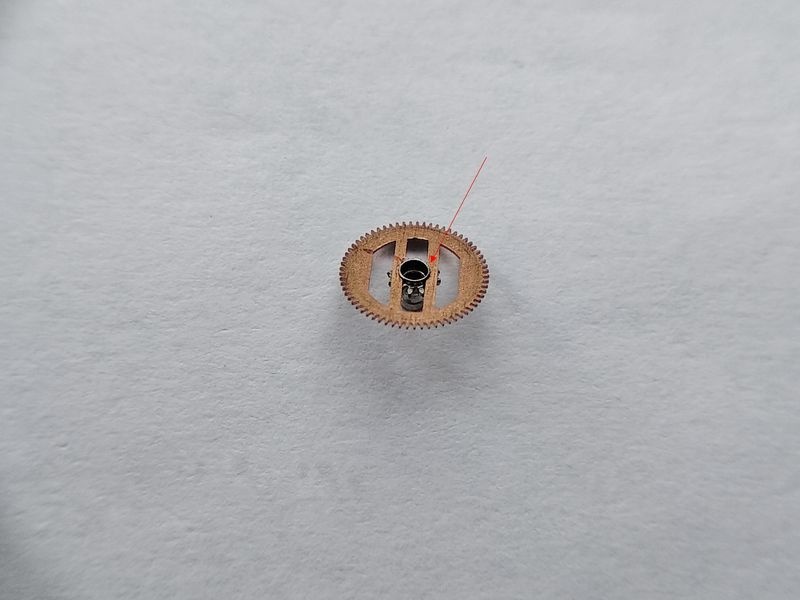
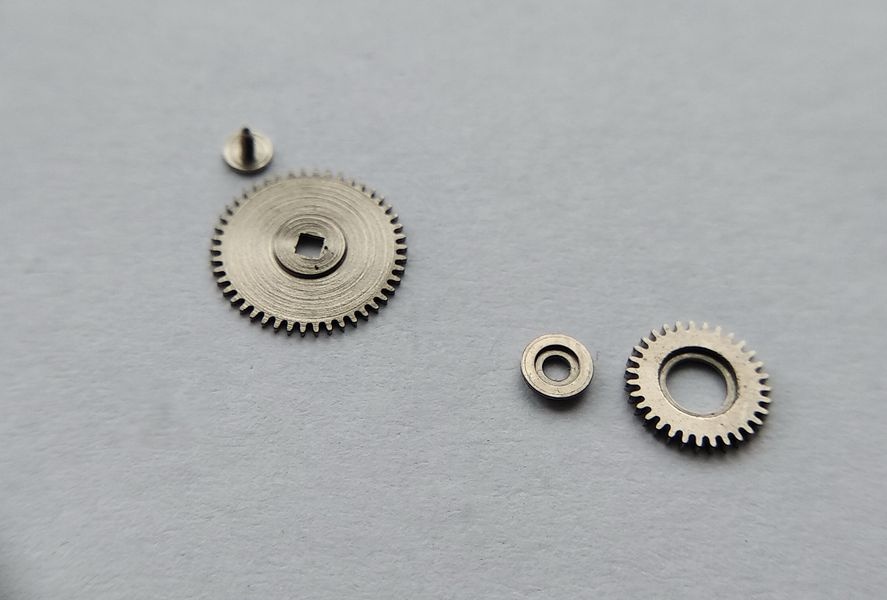
The motion works are now fully dismantled. In the upper row are the minute wheel bridge and the hour wheel. In the lower row are the minute wheel, the cannon pinion with its friction spring wheel, and the small setting wheel. Strictly, that last part is a setting pinion, not a wheel.
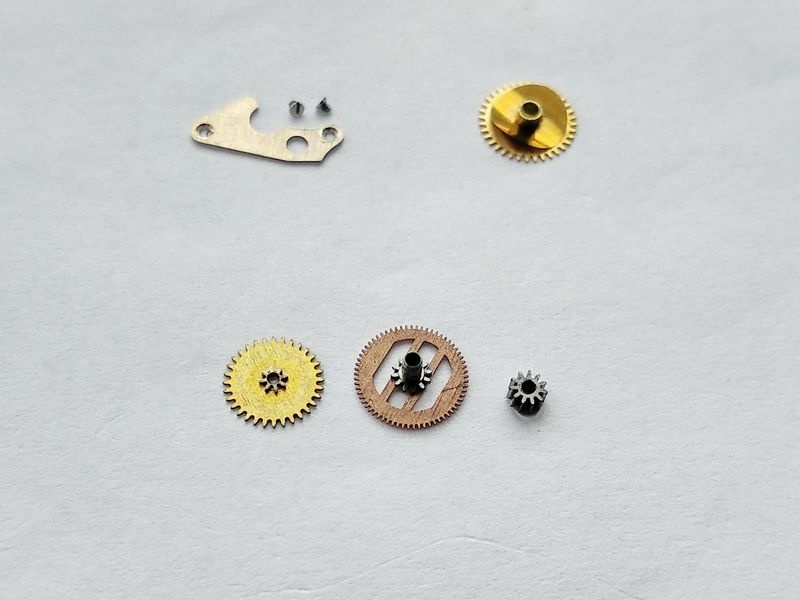
The cannon pinion's construction deserves a closer look. The wheel has an arched frame with two spring arms, and each arm presses into a groove cut into the pinion. The pinion turns with the wheel during normal running and slips against it when the hands are set. It is a well-executed solution.
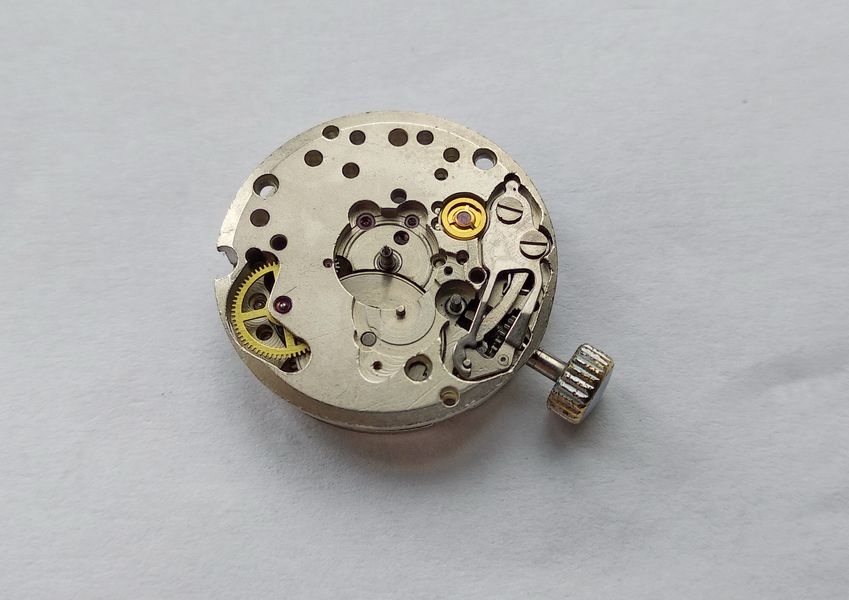
The motion works are off. The keyless works will be dismantled later, once the train side is done.
Mainspring Barrel and Barrel Bridge
Back on the balance side, the next step is the mainspring barrel and its winding wheels. The crown wheel screw comes out first. Because it has a left-hand thread, it is turned clockwise to undo it. Then the ratchet wheel on top of the barrel arbor is removed. Its screw has a standard right-hand thread.
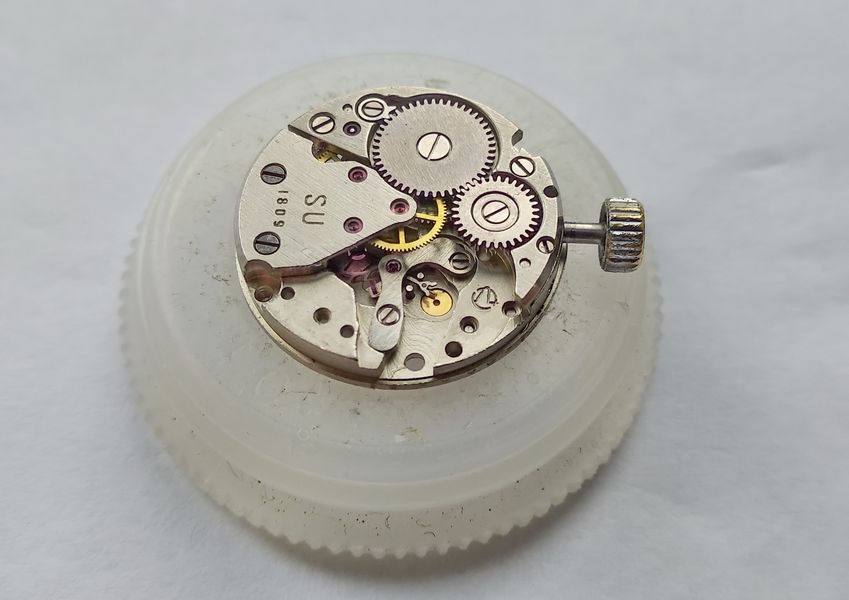
Both winding wheels are now off.
The barrel bridge comes next, and here the caliber has another quirk. The bridge is held by three screws, but one is noticeably thinner than the other two. Note which hole the thin screw comes from. The screws cannot be swapped, and putting a thicker screw into the narrow hole will damage the thread in the plate.
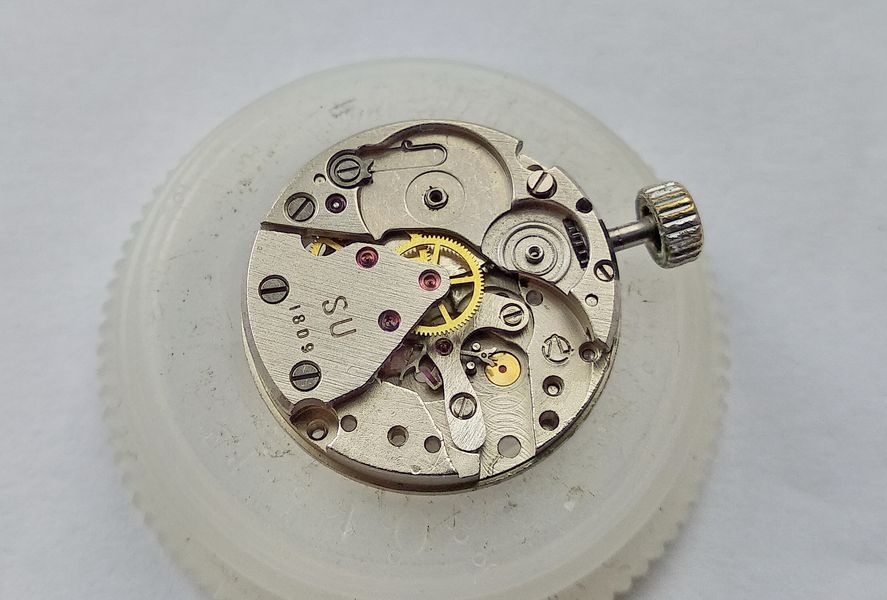
A second detail is worth recording: the click spring for the ratchet wheel has a distinctive shape that is not found on other Soviet movements of this period.
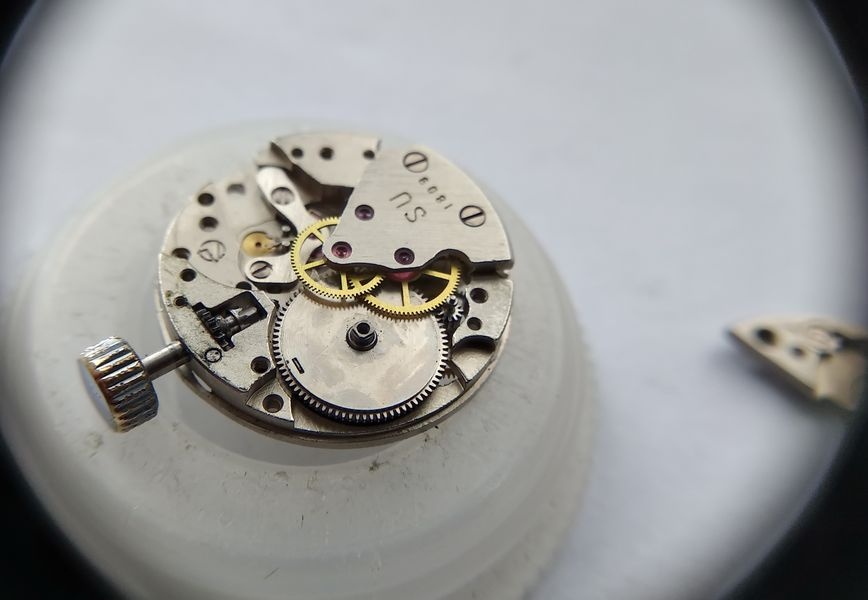
The barrel bridge is then lifted off.
This is the outer face of the bridge.
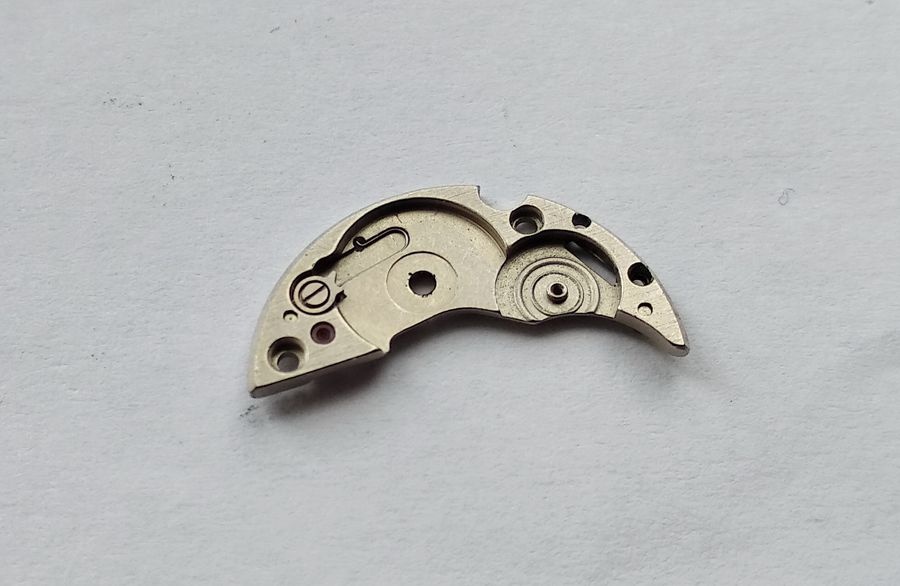
And this is its underside.
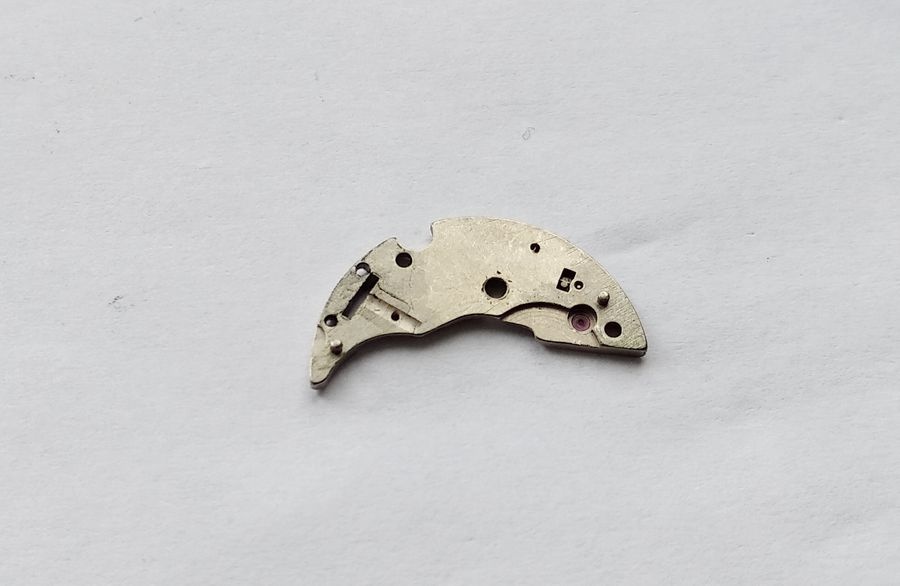
Next the barrel is removed from the main plate.
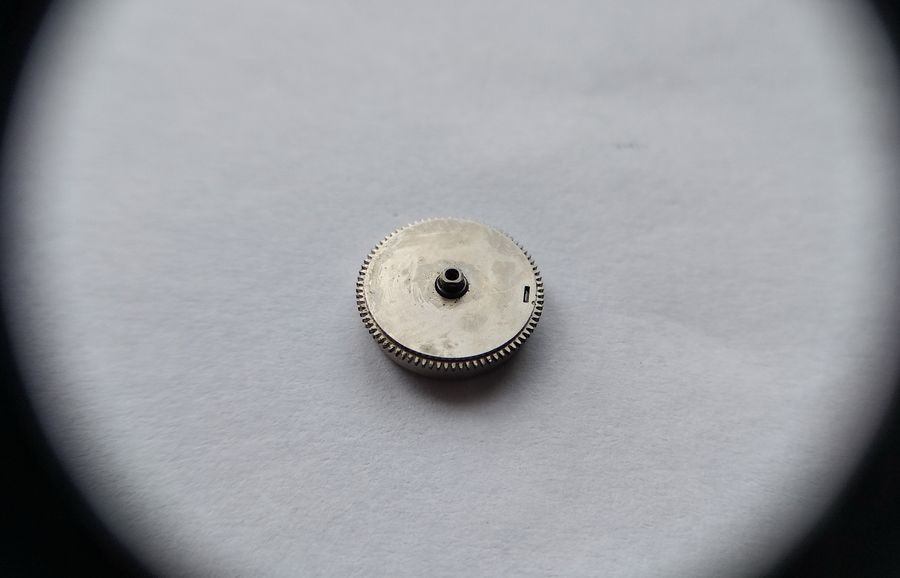
Here is the barrel, still closed.
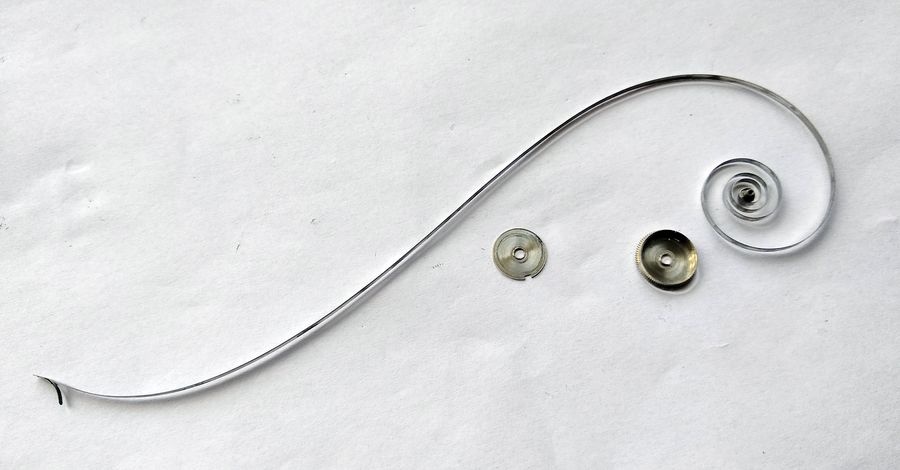
The barrel is opened and the mainspring taken out. Released, it relaxes into an S shape, which is good to see. This is the shape of a modern alloy spring, the kind that resists permanent set and delivers more even torque than an older carbon-steel spring, which tends to settle into a tight spiral with use.
Escapement and Going Train
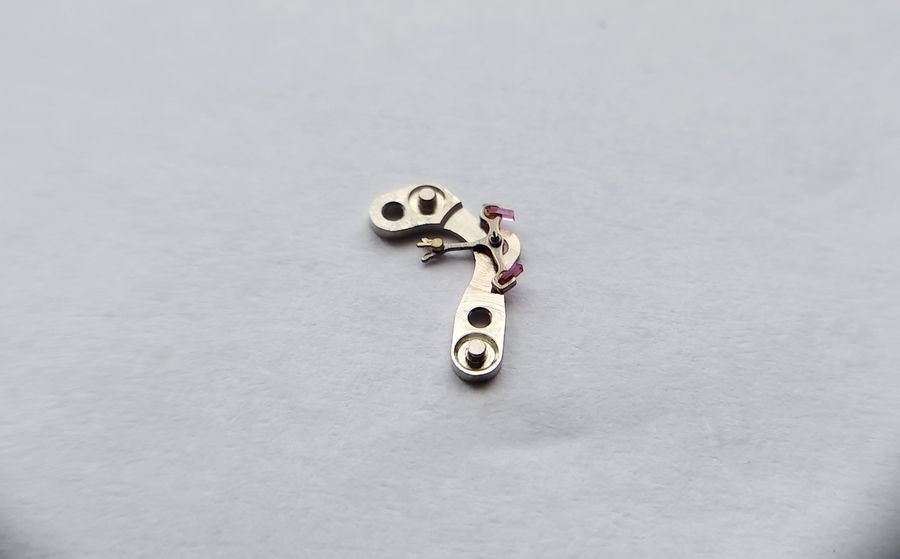
The pallet fork is removed next.
Here is the first cause of the erratic running. The pallet fork came away still stuck to the jewel in its bridge, held there by oil that had thickened to the consistency of glue. With the pallet arbor dragging in its bearing, the escapement cannot work freely, and the uneven beat on the timegrapher follows directly from that. The bridge and fork go into benzine so the old oil can dissolve and the two parts can be separated and cleaned.
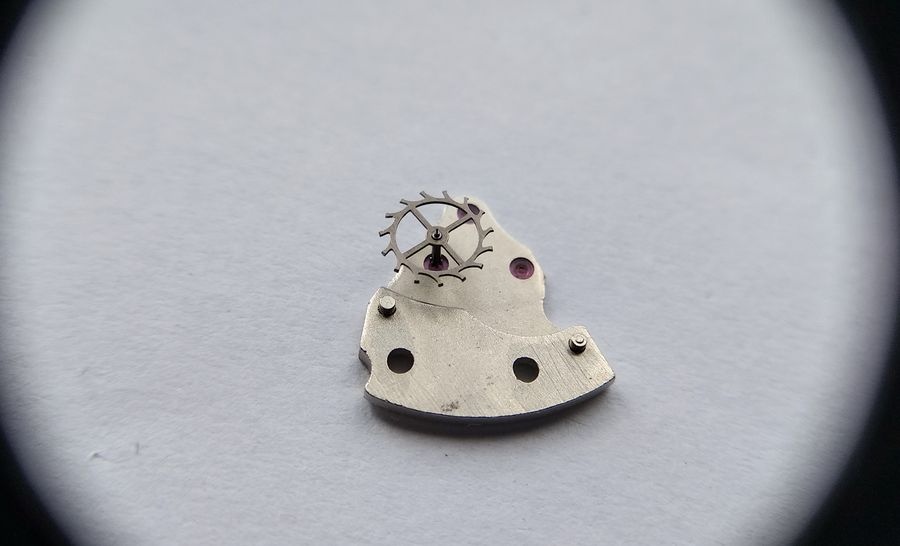
Then the going train. When the train bridge is lifted, the escape wheel comes with it, stuck to its upper jewel by the same hardened oil. This is the second cause of the poor running.
With both the escape wheel and the pallet fork held back by old oil, the movement was still running. That is a strong argument for the soundness of the design, and it suggests the quality mark on the case back was not just decoration.
With the bridge off, the going train is exposed in the main plate.
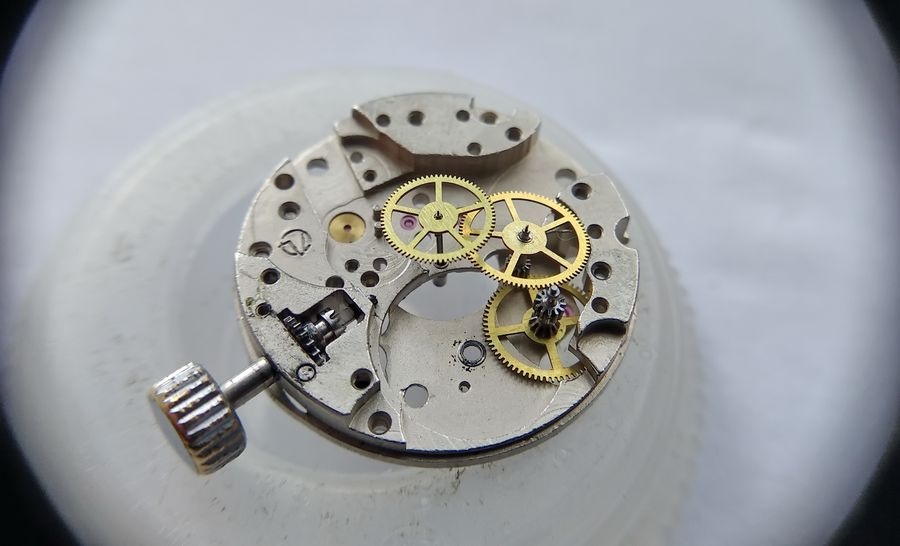
The wheels come out next: the seconds wheel and the two intermediate wheels.
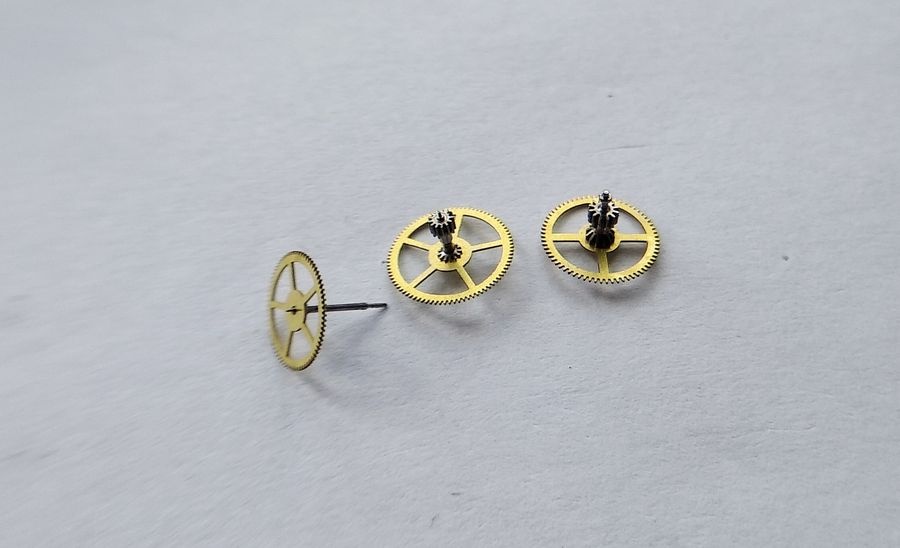
The train side is now fully stripped. The keyless works are the last group still assembled.
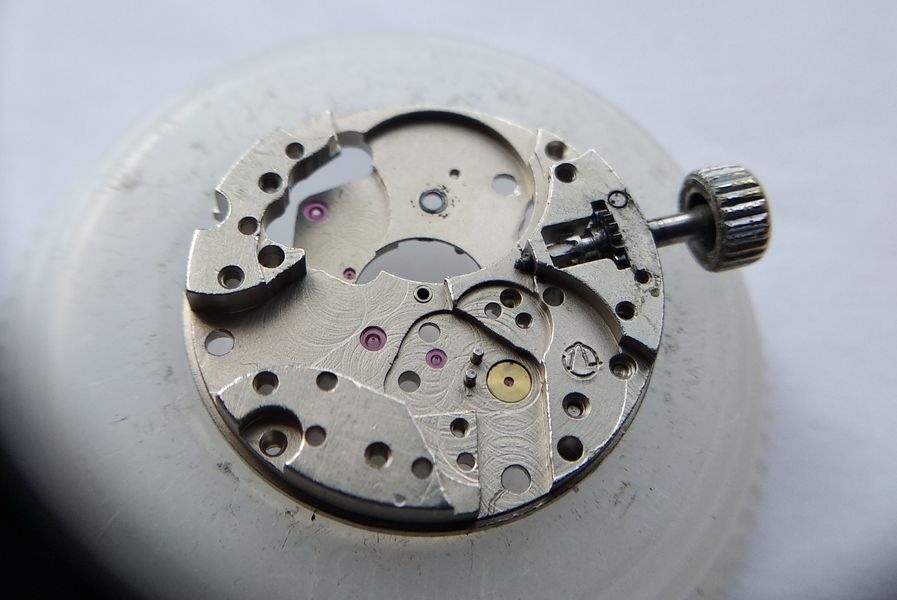
Keyless Works
The keyless works hold no surprises. The layout is simple, compact, and durable: a setting lever and a yoke, a sliding clutch wheel, an R-shaped spring that returns the yoke, and a spring-loaded cover plate that holds everything in place.
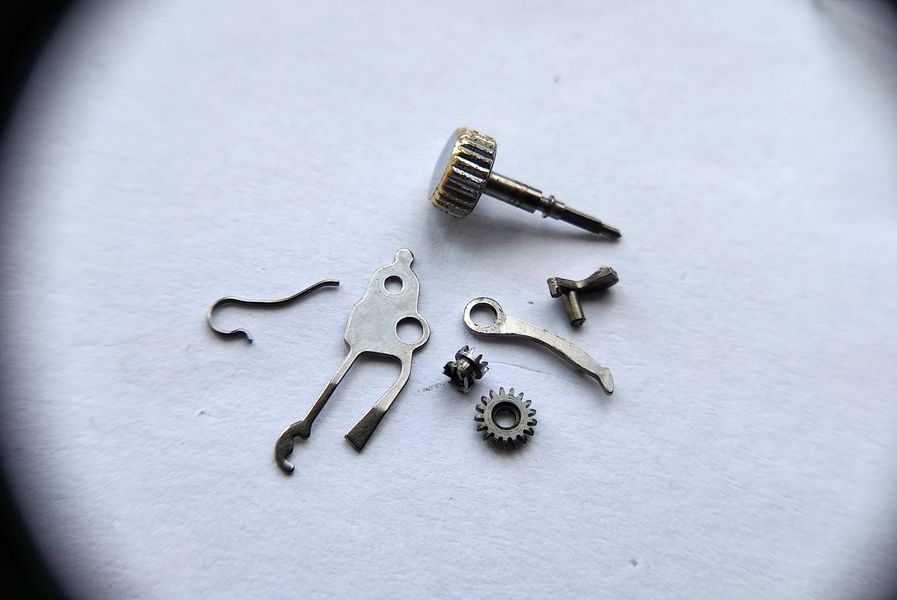
Cleaning
Cleaning is done in benzine, in two batches. The going train wheels, the main plate, and the bridges are washed first.
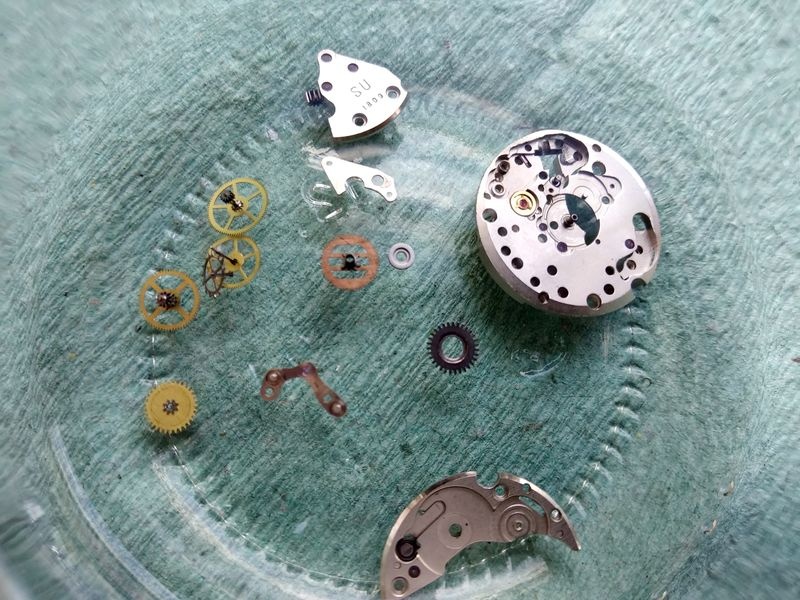
The keyless works parts and the barrel follow in the second batch.
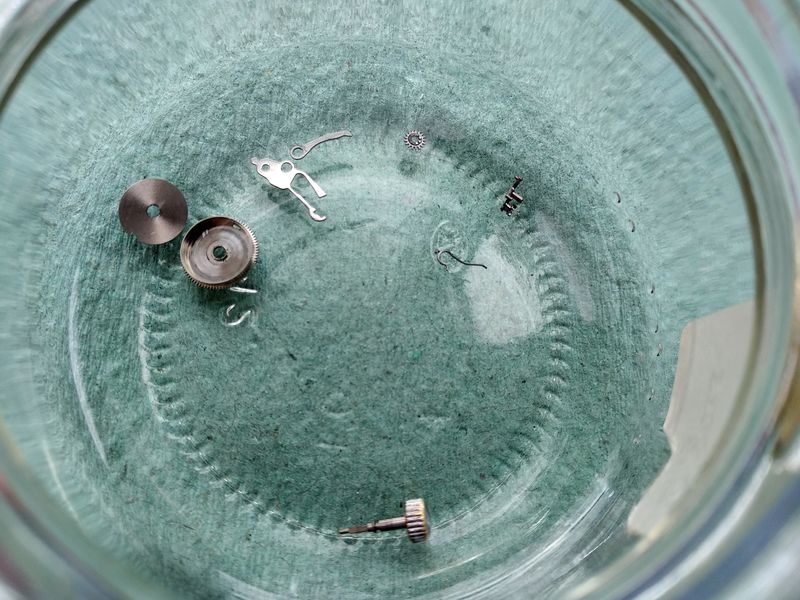
Once the keyless parts are clean and dry, they are ready to go back on the main plate. This is a good point for a short break. A pause between cleaning and assembly lets the last of the solvent evaporate, and it means the reassembly starts with a rested hand.
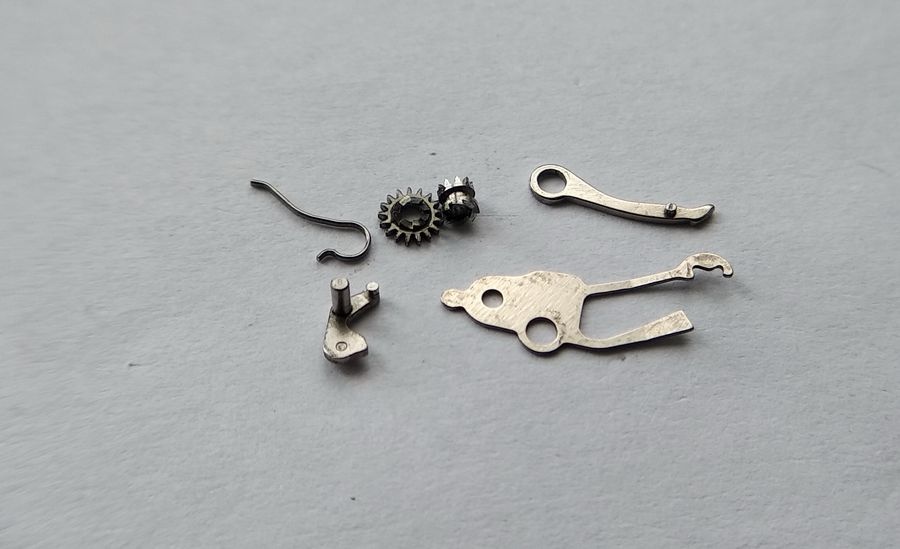
Reassembly
Keyless Works and Motion Works
Reassembly starts on the dial side. The keyless parts are put back in their positions.
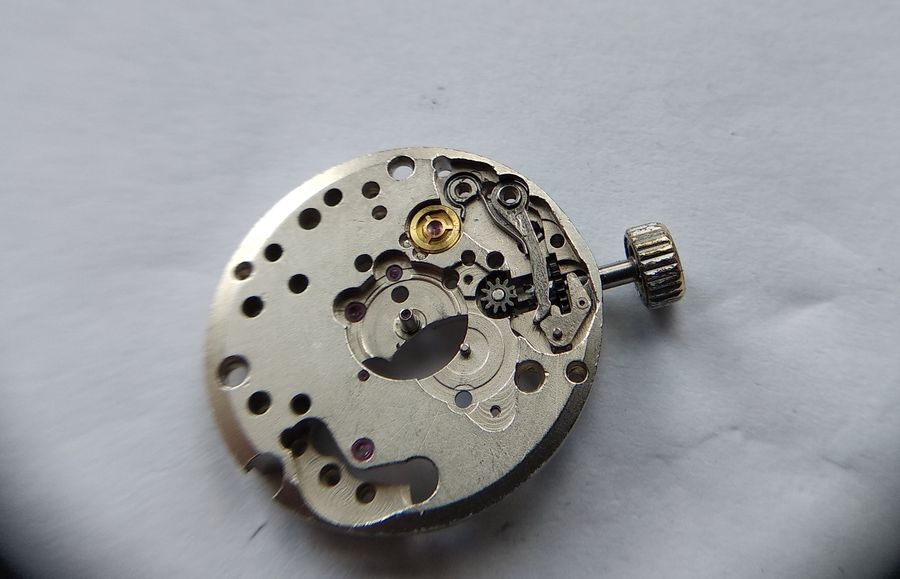
The group is then covered by its spring-loaded cover plate.
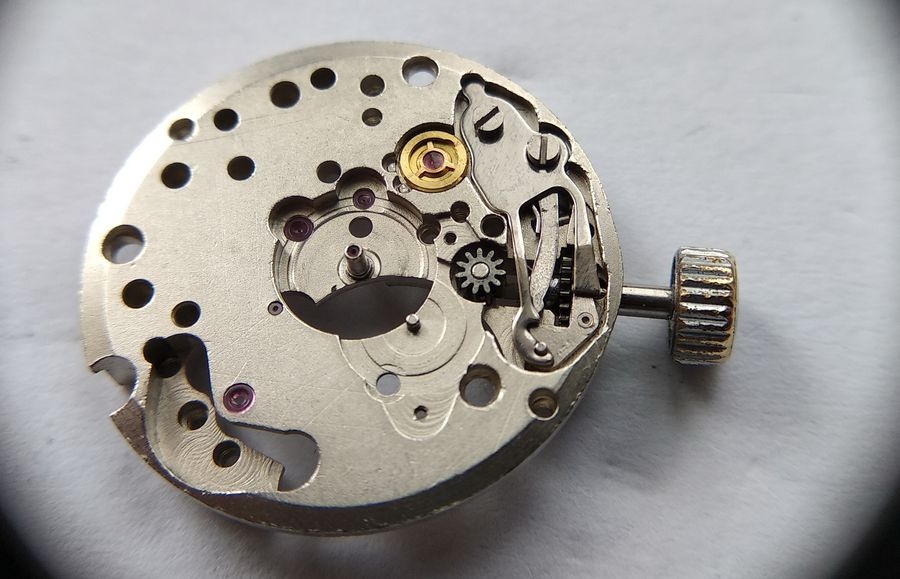
Next the cannon pinion is refitted, together with its spring wheel and friction clutch.
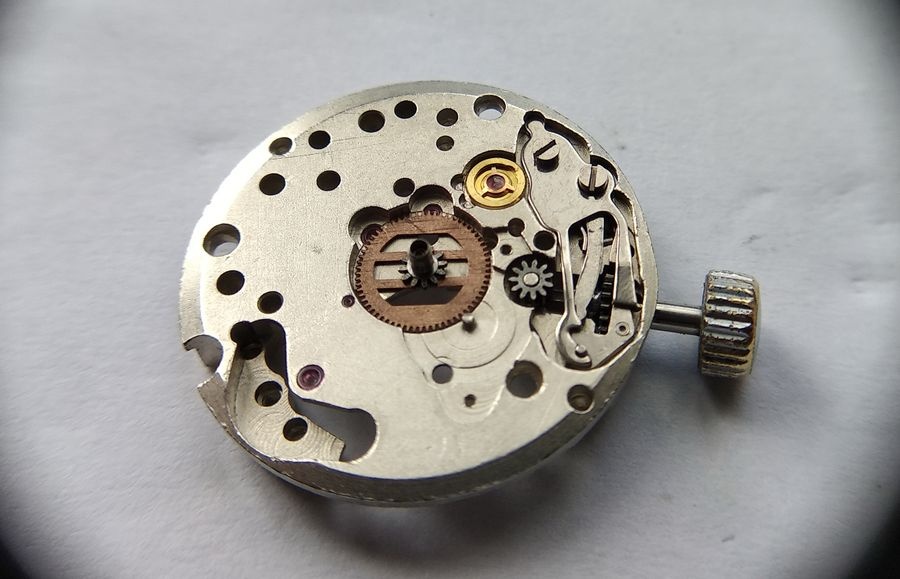
The minute wheel follows.
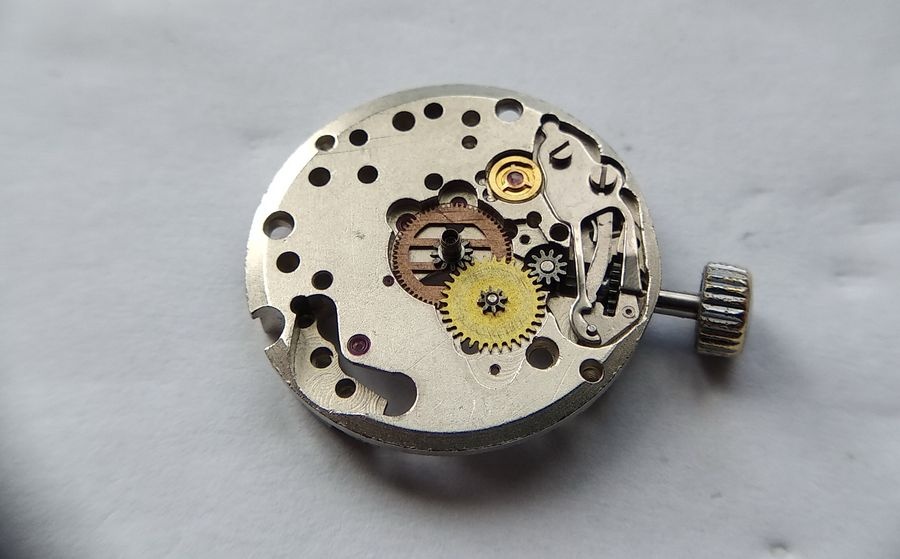
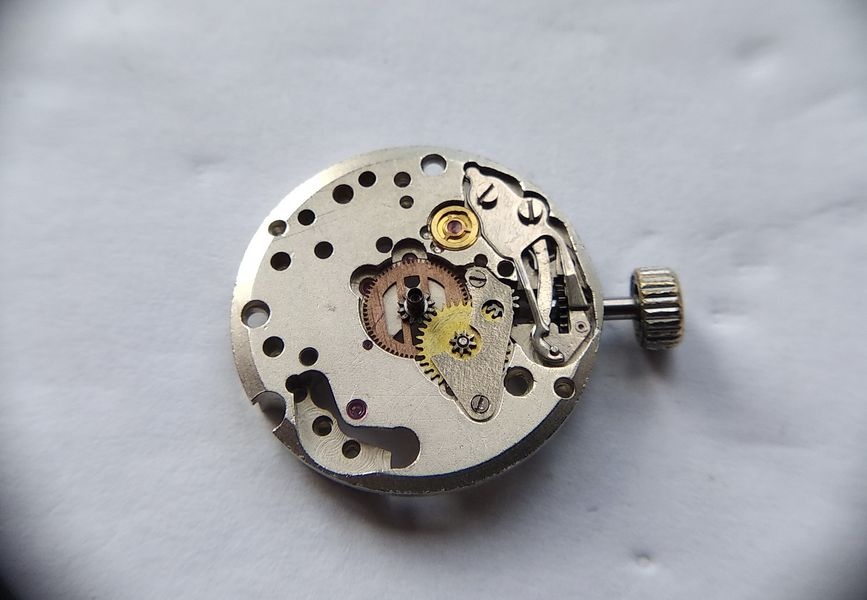
The minute wheel bridge goes on over it. The dial side is finished for now.
Mainspring, Barrel, and Wheel Sequence
The movement is turned over so the train side faces up.
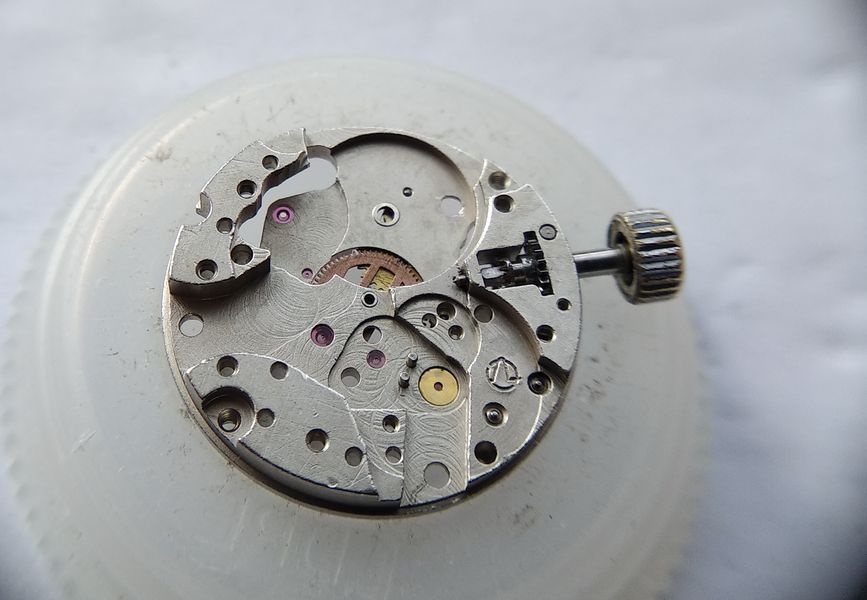
The barrel has to be assembled before any train-side work begins. The mainspring is wound back into the barrel, lubricated with the Soviet-specification grease designated B-1, and the lid is pressed home.
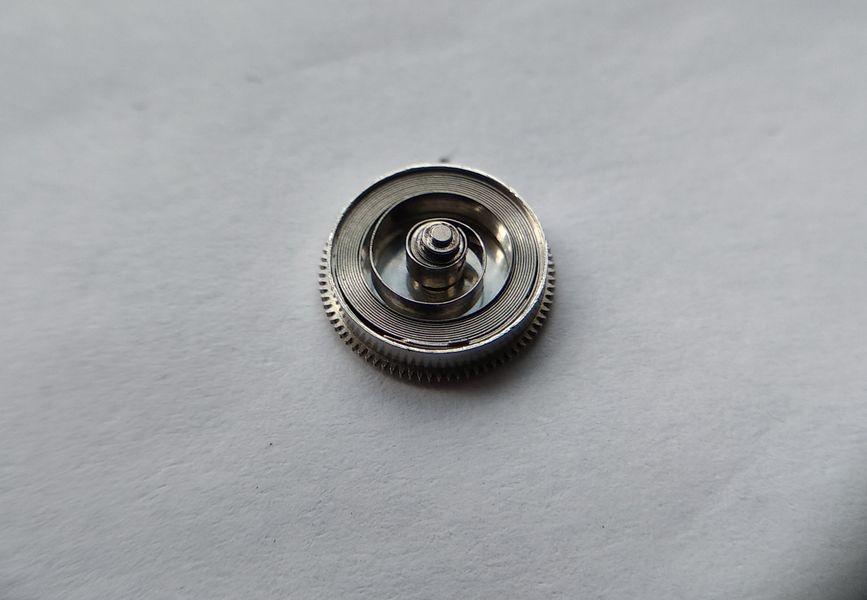
The barrel and the first intermediate wheel are now placed on the main plate. The 1809 has a fixed assembly order on this side. If the parts go in out of sequence, the barrel bridge cannot be seated properly, and the work already done has to be taken apart and started again.
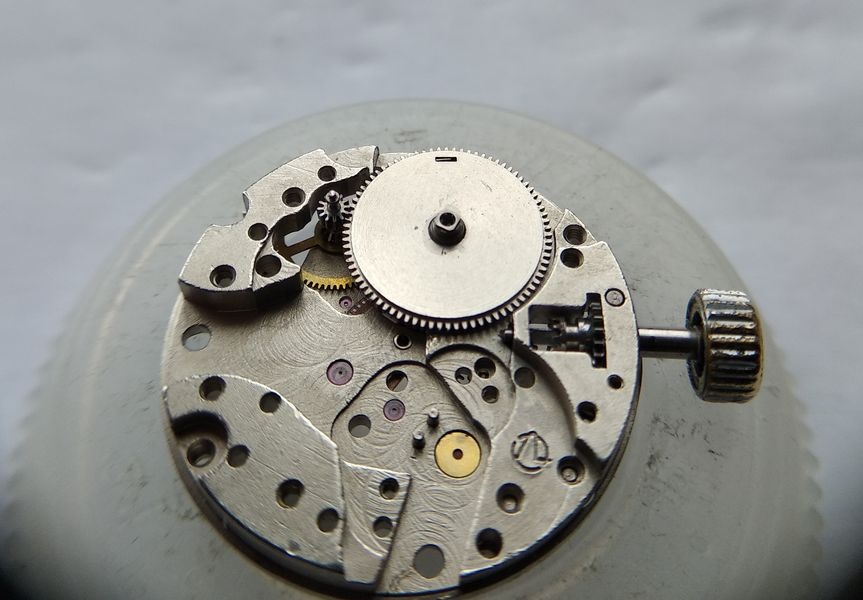
The second intermediate wheel goes in next.
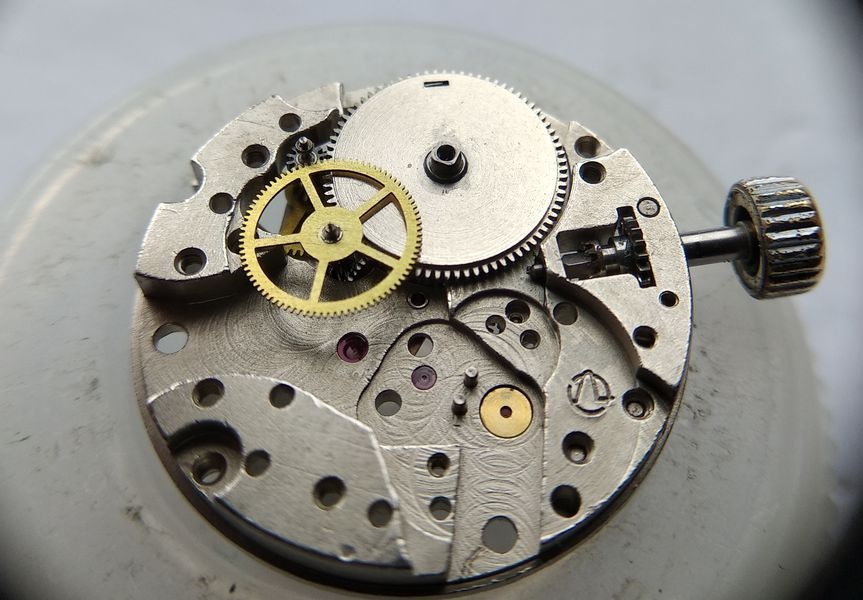
Only now can the barrel bridge go on. The thin screw goes back into its original hole, as noted during disassembly.
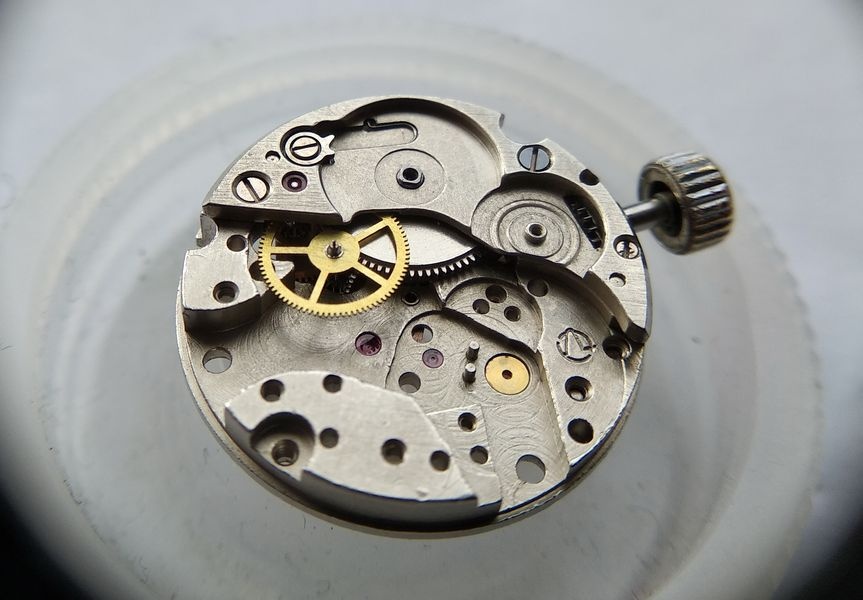
Going Train and Escapement
Next the going train is reassembled. Because so many components have to fit inside a small main plate, the wheel arbors on this caliber are relatively tall. That is neither a fault nor an advantage; it is simply a result of the layout, but it does affect the next step. The seconds wheel and the escape wheel are set into their lower jewels.
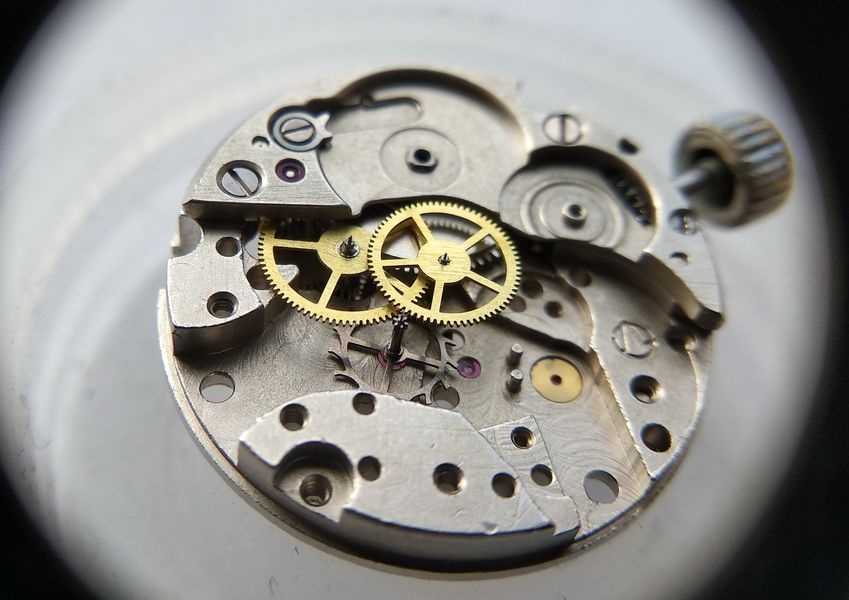
With wheels this tall, getting every upper pivot into its jewel at once takes patience. Eventually the train bridge settles and its screws can go in.
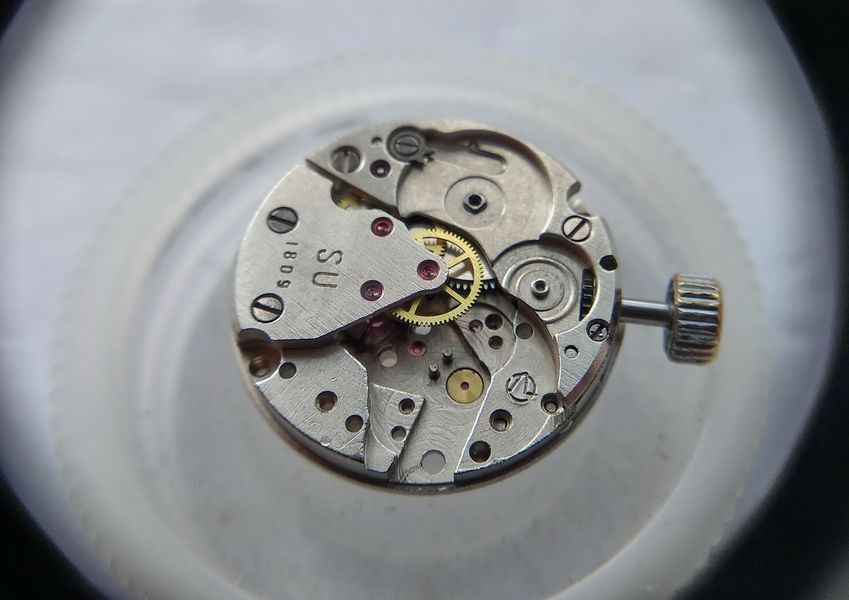
The crown wheel and ratchet wheel go back on, and the jewels of the going train are oiled with MBP-12, a Soviet-specification watch oil. Next the train's free run is checked. With a little power from the mainspring and the escapement still out, the wheels should turn freely and slow to a gradual stop, without any sudden check or stiffness. The train passed. Then the pallet fork and its bridge are fitted. As a matter of standard practice, the pallet arbor jewels are not oiled. Oil there tends to migrate and collect dirt, and it disturbs the escapement's action more than it helps.
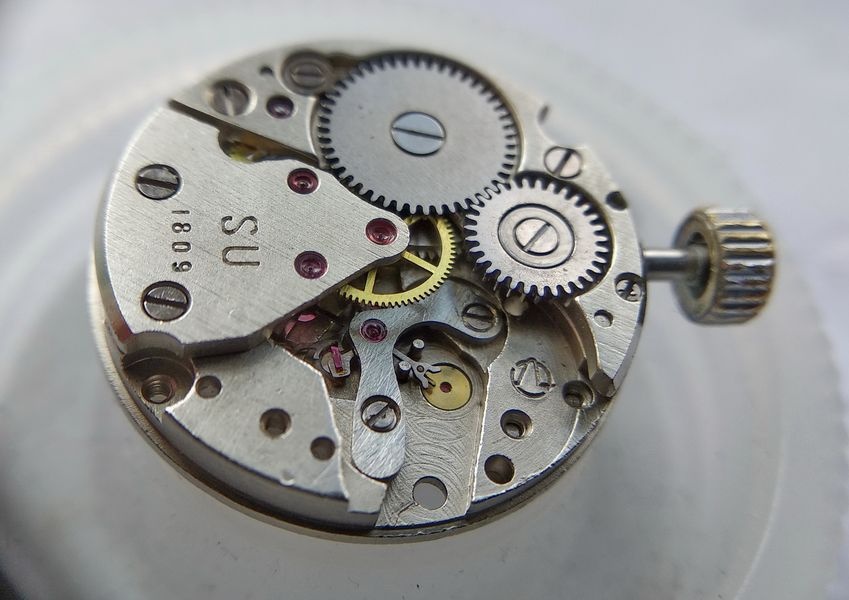
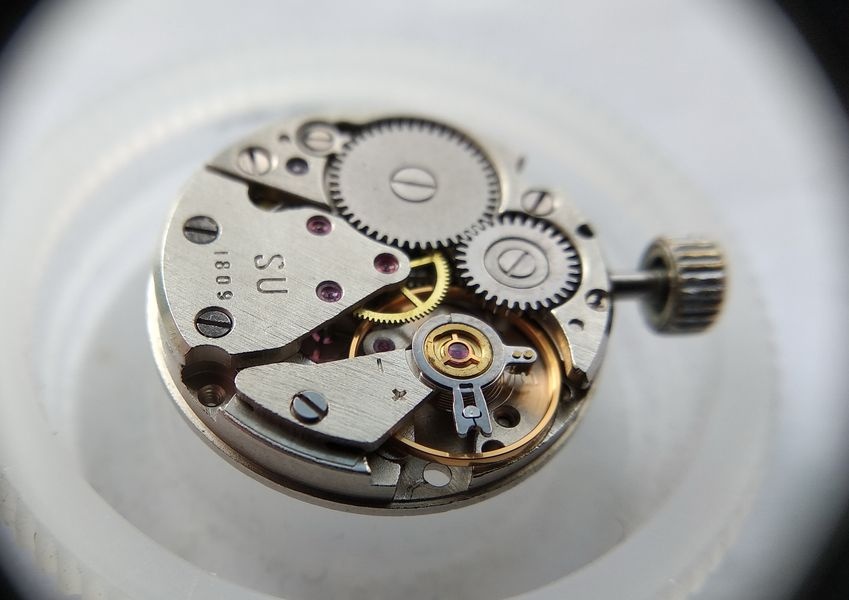
Finally the balance goes back in. Once its cock is secured and some power reaches the escapement, the balance starts swinging on its own, and the movement is running again.
Cosmetic Restoration and Final Results
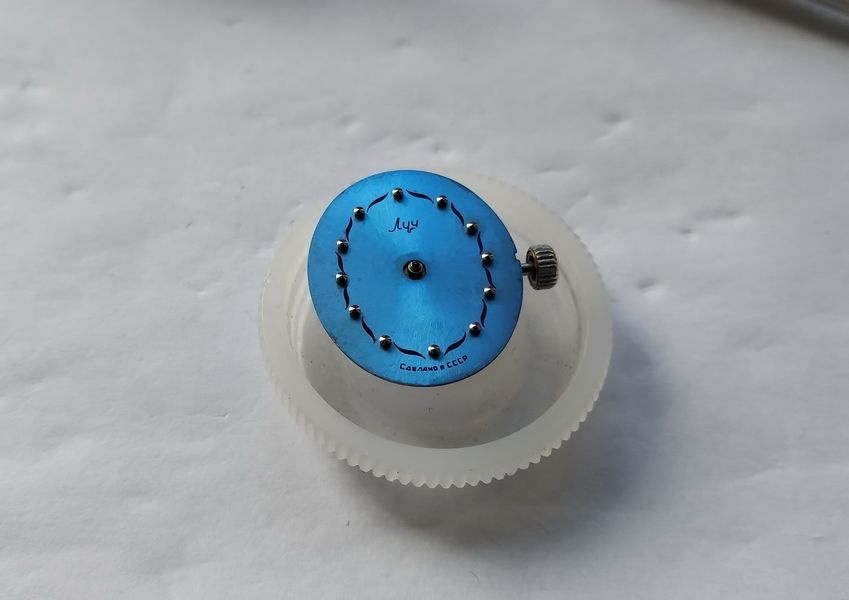
With the movement working, attention turns to the cosmetics. A search of the spare-parts boxes produced a suitable dial. It is not perfect, and it shows signs of earlier use, but it is far better than the corroded original. After a careful wipe-down, it is fitted to the movement.
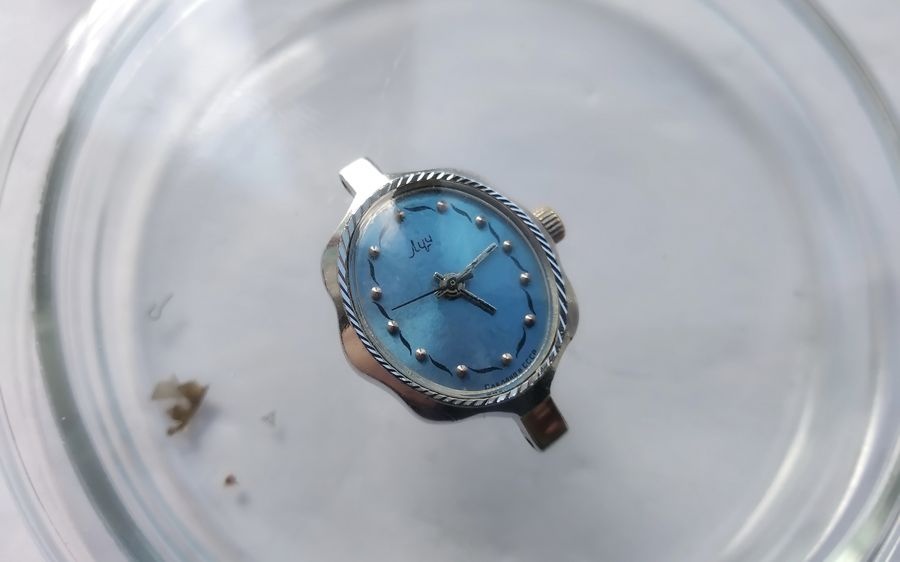
A crystal turned up as well, but it needed polishing before it could be used. The method was simple: a slightly damp cloth with about half a centimeter of ordinary toothpaste. Toothpaste contains a fine abrasive that works well on acrylic. After about fifteen minutes of steady work, the crystal was clear enough to fit. The result is shown below. Replacement hands may still be worth finding. The minute hand was slightly disturbed when it was refitted.
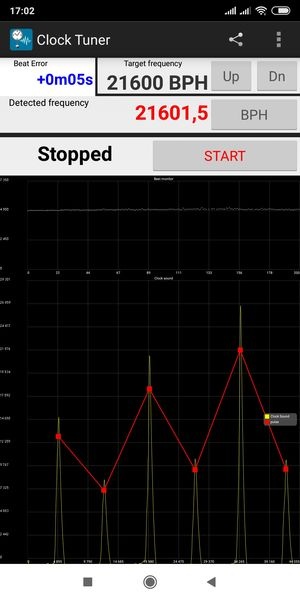
A timing app gives the final verdict. It measures 21,601.5 beats per hour against the nominal 21,600 and shows an accumulated error of about five seconds, which is fully acceptable for a movement rated to accuracy Class 1 under GOST 10733-98.
Assessment and Context
The Luch 1809 turns out to be a robust, well-designed three-hand movement. Its spring-wheel friction clutch, separate minute wheel bridge, shock-protected balance, and modern alloy mainspring are not the features of a cost-reduced ladies' caliber. They reflect a serious engineering effort at a small scale. That makes it hard to see why the factory kept the 1801.1 in long-term production while letting movements like the 1809 disappear. On engineering merit, the 1809 deserves its State Quality Mark.
The closest comparison among Soviet calibers is the Zarya 2009.V. The two movements are similar in purpose and layout, but each has its own advantage. The Zarya is thinner, while the Luch has the smaller diameter. Which one suits a given case depends on whether height or width is the limiting dimension.
The time spent restoring this movement was well spent. The 1809 is versatile enough that it would very likely have done well in a men's three-hand watch too, where its center seconds and Class 1 accuracy would be useful. Fashions and production priorities change, but sound engineering keeps its value. A revival of designs like this one at Minsk would be welcome.
The 1809 was also not an isolated design. It was the base of a small family of movements. The Luch 1814 added a day-of-week display, and the Luch 1816 added automatic winding. Both are good candidates for future documentation.
Comments
Write a comment