


Cart
Your shopping cart is empty!
It's never too late to make things right :)


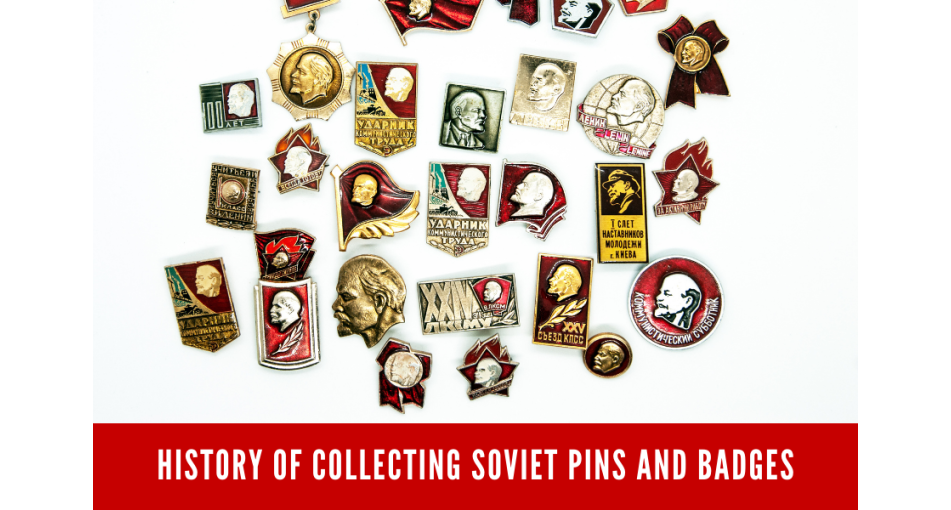
It won't be an exaggeration to say that one of the most curious mysteries of human existence is the passion for collecting. A variety of items can be collectibles. However, no matter how huge the range of collecting is, not everything and not everyone collects.
It won't be an exaggeration to say that one of the most curious mysteries of human existence is the passion for collecting. A variety of items can be collectibles. However, no matter how huge the range of collecting is, not everything and not everyone collects. Gathering has its roots in the distant past. In pre-revolutionary Russia, collectors were mostly very wealthy people. Their collections were accumulative in nature and only in rare cases did they really serve cultural and educational purposes. On the whole, bourgeois collecting in tsarist Russia and in the capitalist countries is currently associated, first of all, with money-grubbing, the desire for profit and the desire of collectors to turn their collections into material treasures.
Collecting took on a completely different meaning after 1917, when the Great October Socialist Revolution changed the social conditions of society in our country, when huge masses joined the culture and the living standard of the entire people rose.
Soviet collecting is fundamentally different from bourgeois collecting both in its tasks and content, and in its forms. Soviet collecting became one of the means of communist education of working people, especially young people. Therefore, it prioritizes the cognitive and educational value of the collected collections.
The broad masses of working people and our younger generation are attracted to collecting as a means of studying political and historical events, monuments of material culture, science, art and nature, as well as one of the types of socially useful activity that combines reasonable recreation with the expansion of the cultural and general educational horizons of the citizens of the USSR .
Ernst Teodorovich Krenkel, an outstanding polar explorer and prominent public figure, one of the founders of the All-Union Society of Philatelists and the first chairman of its board, wrote: 'Philately is a cultural and active leisure of many curious people. To make it the property of millions is an honorable and noble task. These words, full of deep meaning, apply to all other types of collecting.
The years that have passed since the creation of the All-Union Society of Philatelists, the scale of the work done by Soviet collectors have confirmed how popular collecting has become in our country and, most importantly, how the socially useful significance of this hobby, which conceals tremendous opportunities for the spiritual growth of Soviet people, has grown.
Favorable conditions for the massive development of all types of collecting in our country have been created by the transition to a five-day working week. In addition to evenings and Sundays, Saturday became free. There was more time for collecting.
Collecting is a purely individual hobby. But each person who deals with it, when completing a collection, preparing it for exhibiting, etc., obeys social laws, regulations, established traditions of the collective and, finally, the rules or requirements of collection.
People's passion for collecting is not an idle pastime and not eccentricity, as some imagine it. This is one of the forms of socially useful activity. This is creativity, and the collection itself is the result of sometimes many years of hard, but fascinating work, numerous searches and research.
And for collecting to be qualified, in order to create a memorable collection of icons, you need to master the basics of collecting, have a clear idea of what and how to collect, and also how best to develop and express your chosen theme.
This article is intended to acquaint the reader not only with the history of the most interesting Soviet badges, but also with practical questions: what and how to collect, how to organize the work of a section, club or circle of phalerists, and also to equip the reader with some catalog data on Soviet badges.
Badges are usually collected according to specific sections or topics.
Badge collectors are called phalerists. Falar is a metal badge, a badge that distinguished legionnaires in ancient Rome were awarded. In the narrow sense, the word 'faleristics' - derived from the Greek Ta Falara, German Die Phaleren - means a young auxiliary discipline of history, engaged in the study of orders, medals and decorations. In a broad sense, the word 'faleristics' means collecting badges.
There are often disputes among collectors about what is a token, sign, badge? What does the term 'badge' also include? In the 'Explanatory Dictionary of the Russian Language' V. I. Dahl says: 'A token (French medal), a penny, a sheleg or just a coin, knocked out in memory of an event for distribution.'
In the 'Dictionary of the Russian language', compiled by S.I.Ozhegov, a token is characterized as a metal circle, a badge issued as a prize for a competition, in memory of an event to its participants, etc. In everyday life, metal plates are called 'tokens' Round, oval and other shapes, replacing coins in the subway, vending machines, gambling houses, etc. It is customary to call a certain type of badge in sports a 'badge'.
The word 'tag' refers to a metal sign. Therefore, it cannot cover signs made of glass, wood, paper, plastics, ceramics, etc.
In the explanatory dictionaries of V.I.Dal and S.I. Ozhegov, the words 'sign' and 'icon' without the definition of 'breastplate' are explained in different ways. If both authors are unanimous about the name of the word 'sign' in relation to orders, then Dahl considers the word 'sign' to be a diminutive derivative of the word 'sign' in all meanings, Ozhegov singles it out to designate badges.
There is no strict dividing line in the interpretation of 'badge' and 'badge' in such reputable publications as the Great Soviet Encyclopedia. Moreover, in the article 'Signs and badges on the badges for persons who graduated from Soviet higher educational institutions', in one case, a sign after graduating from the Moscow Higher Technical School. Bauman is called a 'badge', in another - a 'badge'. Different interpretations are introduced into this issue because during the establishment of the badges, the founders use the word 'sign' for greater solidity.
Badges are classified by their purpose to:
Awards presented for achievements in work, social and political activity, military affairs, sports, etc. This group of badges can be united by one common name 'USSR insignia';
Service, indicating the belonging of their owner to a particular department, organization, enterprise, etc. They can, for example, be seen at taxi drivers, postmen, salesmen, guides at exhibitions and others;
Academic, showing graduation from higher and secondary specialized educational institutions;
Membership, certifying membership in various political, youth, as well as sports, defense and cultural and educational organizations, creative and professional unions, clubs, circles, etc.;
Commemoratives issued to commemorate an event, in honor of an outstanding figure, etc .;
Anniversary, dedicated to anniversaries of revolutionary holidays, anniversaries of the founding of cities, factories and plants, etc .;
Souvenirs dedicated to countries, cities, exhibitions, historical sites, etc.
Badges can be made from a wide variety of materials - metal, paper, wood, leather, plastic, glass, ceramics, fabric. The most common are metal: from bronze, copper, brass, gold, silver, aluminum, various alloys such as 'tombak'. They can be covered with paint, enamel, gilding. However, the essence of the matter is not in the material and not in the name of the 'badge'. The main thing is what meaning it carries, in connection with which it was released, what it expresses.


