
Yunost Magazine — Legendary Soviet Literary Journal
Yunost (Юность, "Youth") is one of the most iconic literary magazines of the Soviet era. Founded in Moscow in 1955 as an organ of the USSR Union of Writers, it was created by the writer Valentin Kataev, who became its first editor-in-chief. Aimed at a young, intellectual readership, Yunost combined contemporary prose, an exceptionally strong poetry section, social commentary, and striking illustrations and graphic design.
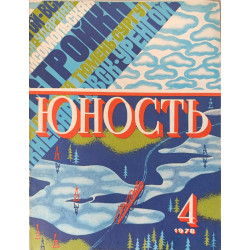
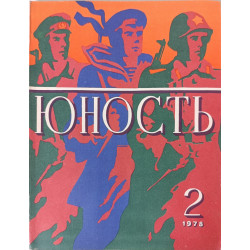
Yunost Magazine — Legendary Soviet Literary Journal (1955–1991)
A Platform for a Generation of Great Writers
The pages of Yunost premiered significant — and at times controversial — works by Anna Akhmatova, Bella Akhmadulina, Bulat Okudzhava, Yevgeny Yevtushenko, Andrei Voznesensky, Robert Rozhdestvensky, Nikolay Rubtsov, Fazil Iskander, Vasily Aksyonov, Boris Vasilyev, and many others. The magazine became closely associated with the "Sixtiers" (shestidesyatniki) generation of the Khrushchev Thaw. Its independent spirit came at a price: Kataev was dismissed in 1961 after publishing Vasily Aksyonov's novel A Ticket to the Stars. He was succeeded by Boris Polevoy (1961–1981) and later by the poet Andrey Dementyev (1981–1992).
During the Polevoy era, the editorial board itself read like a who's who of Soviet letters. The masthead of late-1970s issues lists chief editor B. N. Polevoy alongside board members Anatoly Aleksin, Vladimir Amlinsky, Boris Vasilyev, the artist Vitaly Goryaev, Andrey Dementyev (deputy editor-in-chief), L. A. Zheleznov, the poet Kirill Kovaldzhi, the Balkar poet Kaisyn Kuliev, Grigory Medynsky, S. N. Preobrazhensky, Maria Prilezhaeva, A. S. Pyanov (executive secretary), and V. A. Titov.
Circulation in the Millions
In the 1970s and 1980s, Yunost was among the most widely read journals in the USSR, with print runs reaching into the millions of copies. During Perestroika, it played a prominent role in glasnost-era publishing — printing previously suppressed material, including documents and memoirs of Gulag survivors, and Yuri Polyakov's One Hundred Days Before the Order, a story that openly exposed hazing in the Soviet army. Since 1991, Yunost has continued as an independently published journal.
The Art of Yunost
Yunost was renowned not only for its literature but also for its visual identity. From the 1960s through the late 1970s, the magazine's chief artist was Yuri Aleksandrovich Tsishevsky (1910–1992) — a Soviet graphic artist, book illustrator, and poster designer, member of the USSR Union of Artists and Honored Worker of Culture of the RSFSR. A graduate of the Moscow Polygraphic Institute and a decorated front-line war artist of the Great Patriotic War, Tsishevsky shaped the magazine's distinctive graphic look during one of its most celebrated decades. The masthead of late-1970s issues also credits art editor O. S. Kokin and technical editor L. K. Zyabkina among the team behind each issue's production.
Format
Late-1970s issues of Yunost were printed in the standard Soviet magazine format 84×108/16 — a trimmed page size of approximately 20.5 × 26 cm (8 × 10¼ in) — as softcover editions of 112 pages per issue, in Russian.
Why Collect Vintage Yunost Issues?
Original Soviet-era issues of Yunost are a genuine piece of cultural history. Each softcover issue captures the literature, art, humor, and everyday concerns of its moment — from Thaw-era optimism to the revelations of glasnost. They are sought after by collectors of Soviet memorabilia, students and readers of Russian literature, Cold War historians, and fans of distinctive mid-century Soviet graphic design and illustration.
In this category you will find original vintage issues of Yunost magazine from our collection. Every item is photographed individually — what you see is exactly what you will receive.