Field report

Industar-50 50mm f/3.5 M39: A Second Life for the Soviet Tessar

Reviewed

Industar-50 50mm f/3.5 M39: A Second Life for the Soviet Tessar

Industar-50 50mm f/3.5 M39: A Second Life for the Soviet Tessar

"Put marks on the mating parts. Of all the rules of the bench, it is the one that never fails to repay the minute it costs."
— Notes from the repair bench

A good friend of mine owns a Sony prosumer camera and has a taste for shooting through every lens he can lay his hands on. The other day he dropped in to show his latest purchase. It turned out to be an old acquaintance: the "button", as photographers used to call the Industar-50. This lens was supplied with the Zenit-3, the Zenit-3M, some rangefinder cameras and even the famous Zenit-E. The serial number dates this one to 1967. The trouble was plain at once: the grease had set hard, and the focusing would not move. The job was entirely fixable, so my friend went out for beer while I sat down to work. Having once promised to describe how the Industar-50 is taken apart and put back together, here is that account.

The Tessar Lineage

A little history first. At the very beginning of the twentieth century, and already at the end of the nineteenth, the photographic industry was locked in a fierce contest for image sharpness. One of the most popular lenses of the time was the Triplet, a system of three elements that was used successfully for more than a hundred years in inexpensive cameras and in more costly ones too. The Triplet also worked well as a projection lens, since it has no cemented components and heat does it no harm. In 1902, however, Paul Rudolph patented a similar optical design in which the rear component was cemented from two elements, giving four elements in all. "Four" in Greek is tessera, and so the lens was named the Tessar. Among photographers it earned the well-deserved nickname "Eagle Eye", because it delivered amazing sharpness at what was then a quite respectable aperture of f/3.5 to f/4. The Industar-50, the "Soviet Tessar", is built to exactly this design, and such optics are still used today. This is the lens's optical diagram.
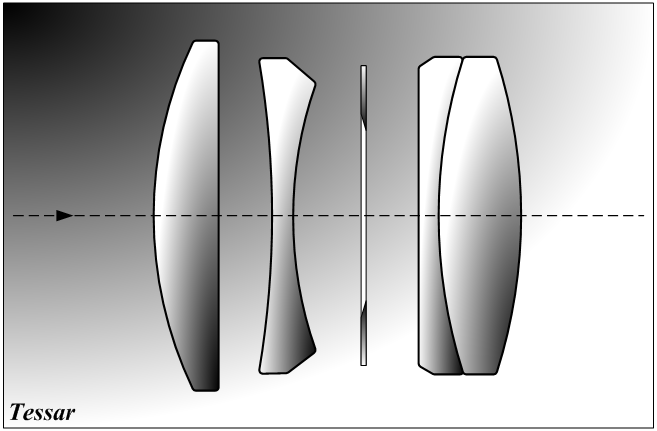
Tessar optical diagram: front positive element, negative element, diaphragm and cemented rear doublet
The Tessar layout shared by the Industar-50: a positive front element, a negative second element, the diaphragm, and the cemented rear doublet that distinguishes it from the Triplet.

So, on the bench is an Industar-50 for cameras with a flange focal distance of 45.2 mm and the M39×1 mounting thread. Time has left plenty of marks on it, along with everything that should never be on a lens at all.
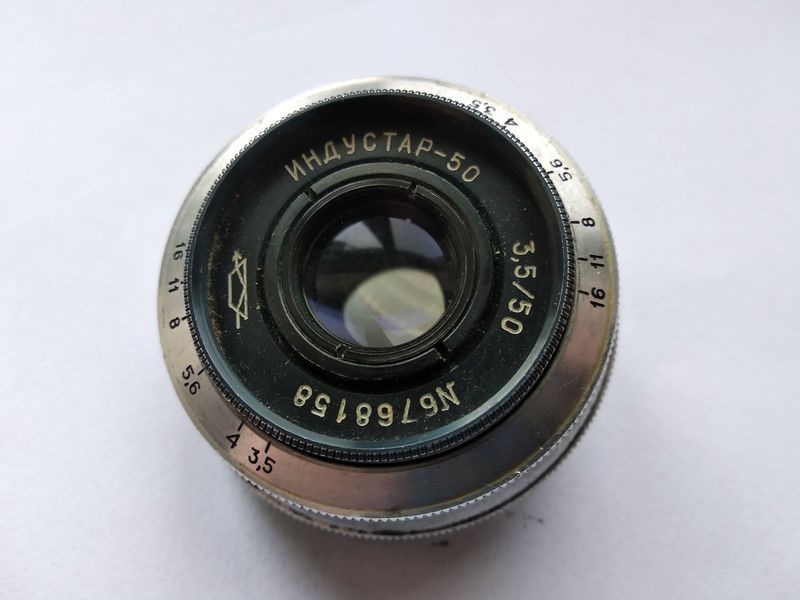
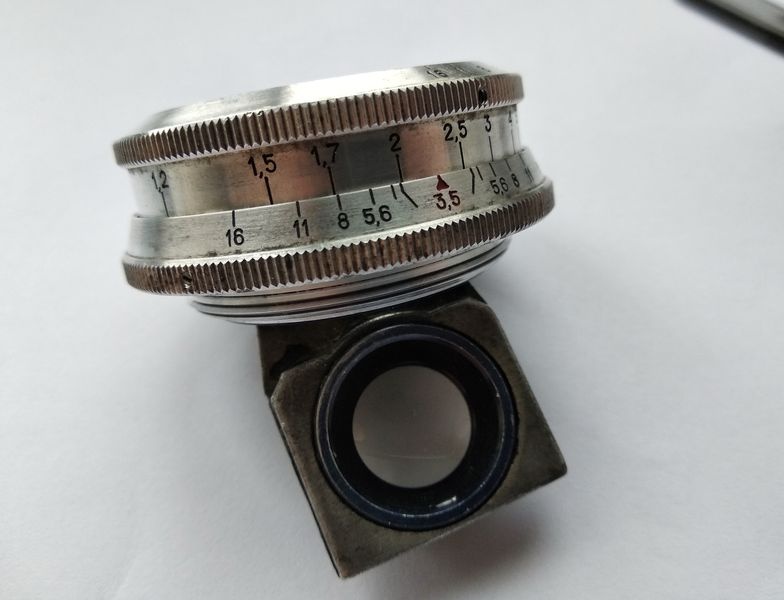
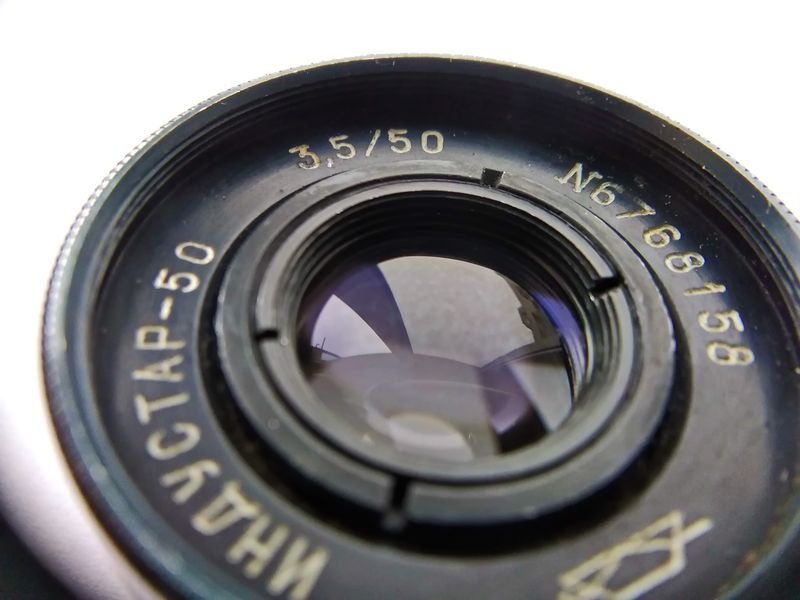
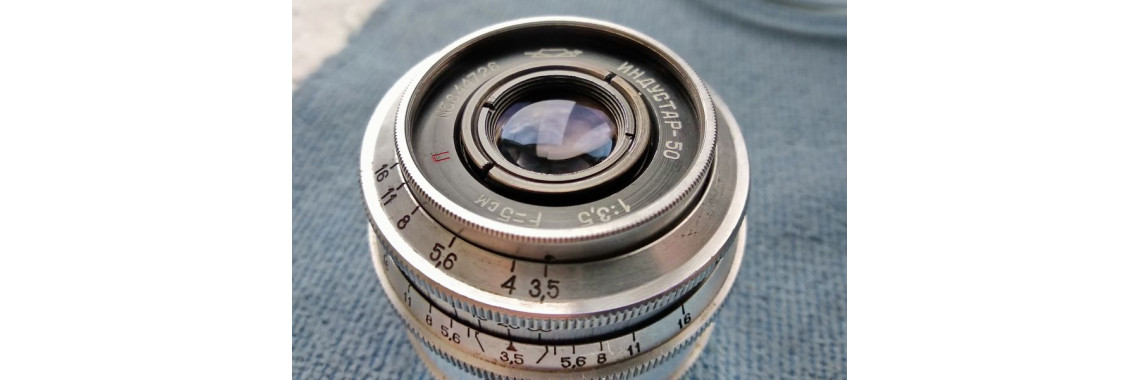
Front of a 1967 Industar-50 3.5/50 with grimy aperture scale and name ring
The Industar-50 as it arrived: the name ring, the 3.5/50 designation and an aperture scale dulled by decades of grime.

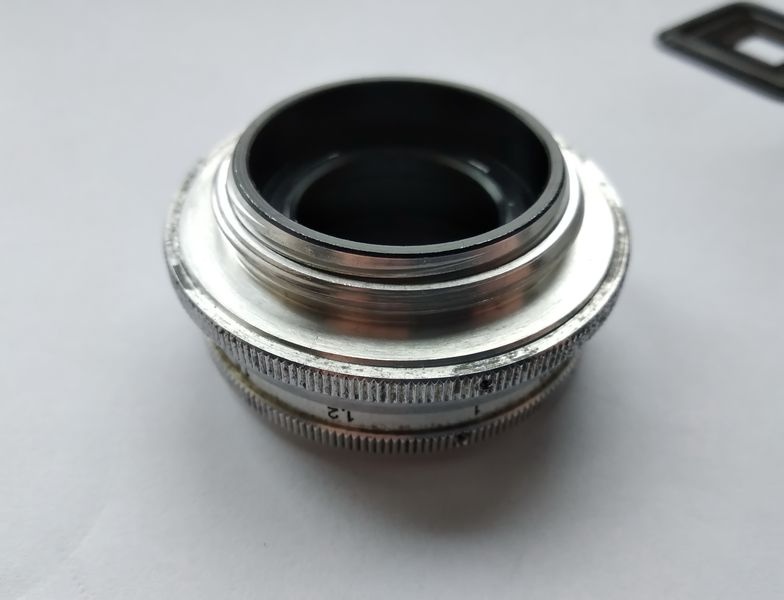
This is most obvious from the mounting flange side. Part of the multi-start focusing thread can be seen there, jammed with hardened grease.
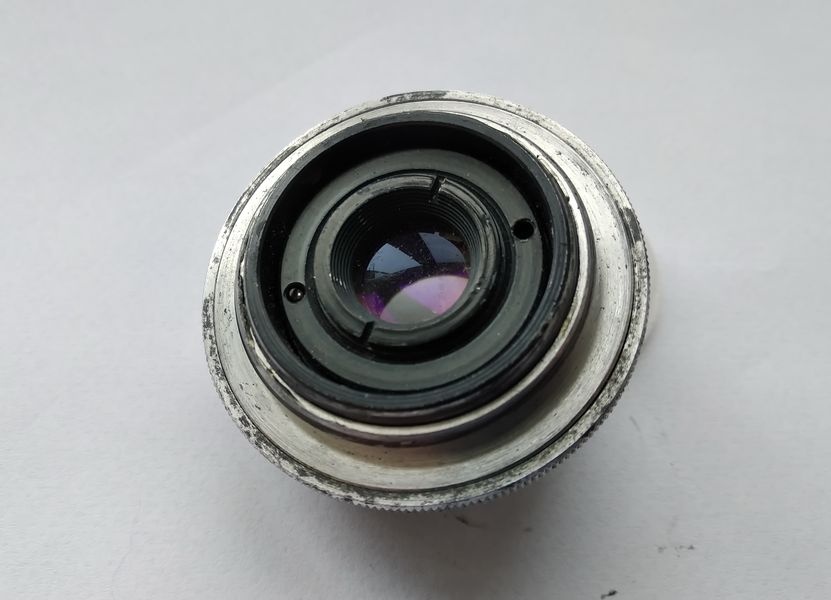
Rear of the Industar-50 showing the lens block retaining ring and dirt on the focusing thread
The rear of the lens. The lens block retaining ring sits in the center; dirt and set grease cover the edges of the focusing mount.

Removing the Lens Block

The lens therefore has to be taken apart, its parts washed clean, and the grease replaced before it can be used again.

The lens consists of two components: the lens block and the barrel. The lens block speaks for itself; it holds the elements, the diaphragm and the diaphragm control. The barrel mounts the lens on the camera and focuses it, so it contains the focusing device, a multi-start thread that is sometimes called a helicoid, although strictly speaking that is not quite correct.

The first stage is to separate these two units by taking the lens block out of the barrel. The lens block is held in the barrel by a threaded ring, and the ring in turn is locked by two set screws. The first step, then, is to release the set screws and unscrew the ring from the lens block mount. As can be seen, the slot on the screw is chewed up, and there is only one screw anyway. It will have to be replaced at reassembly.
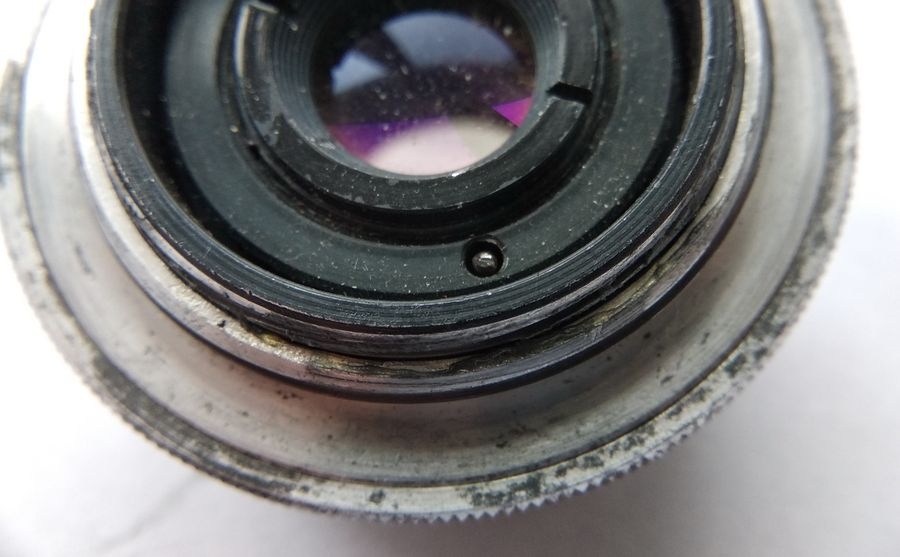
Close view of the Industar-50 retaining ring with a single set screw whose slot is damaged
The retaining ring and its only surviving set screw, the slot badly chewed. A second screw is missing altogether.

The lock is released and the ring is off.
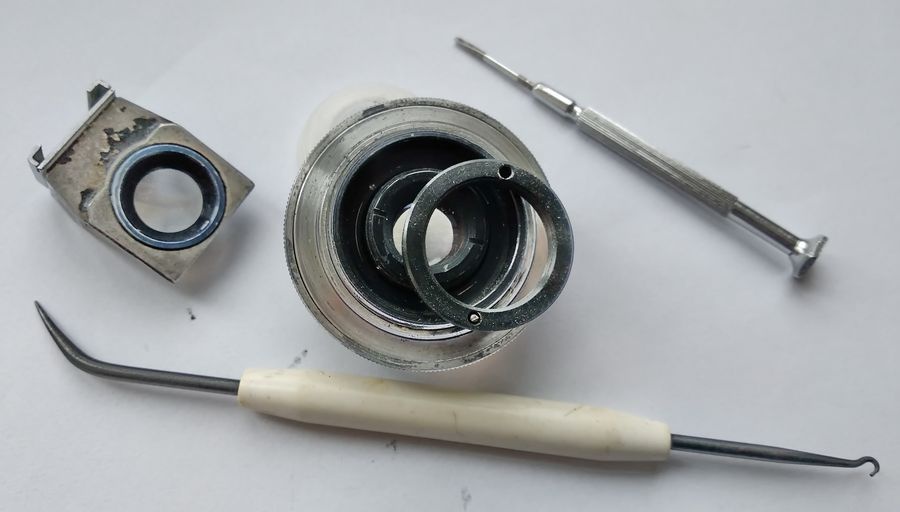
Industar-50 with the retaining ring unscrewed, next to a screwdriver and a spring hook tool
The ring removed. Beside the lens are a watchmaker's screwdriver and the long-serving relay spring hook.

This is how it looks at closer range.
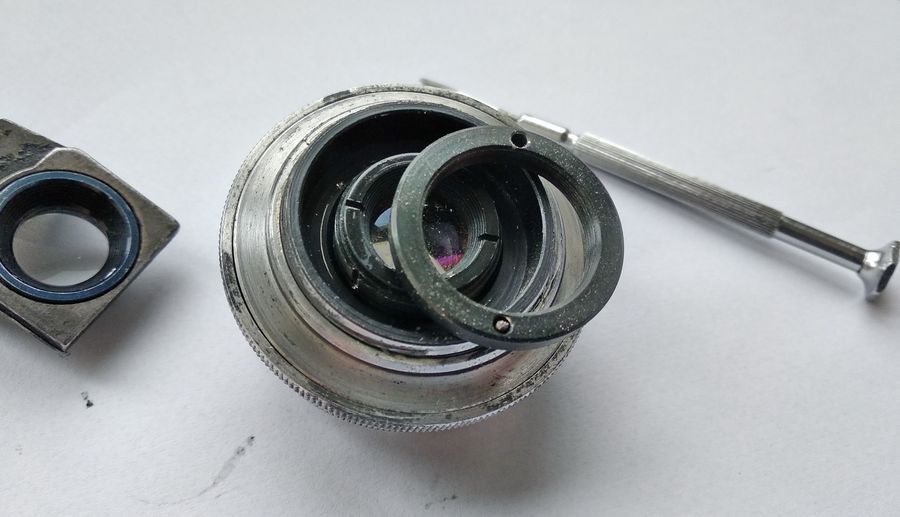
Closer view of the Industar-50 rear with the retaining ring lifted off the lens block
A closer view: the retaining ring lifted clear, exposing the rear of the lens block.

And this is the retaining ring with its screw.
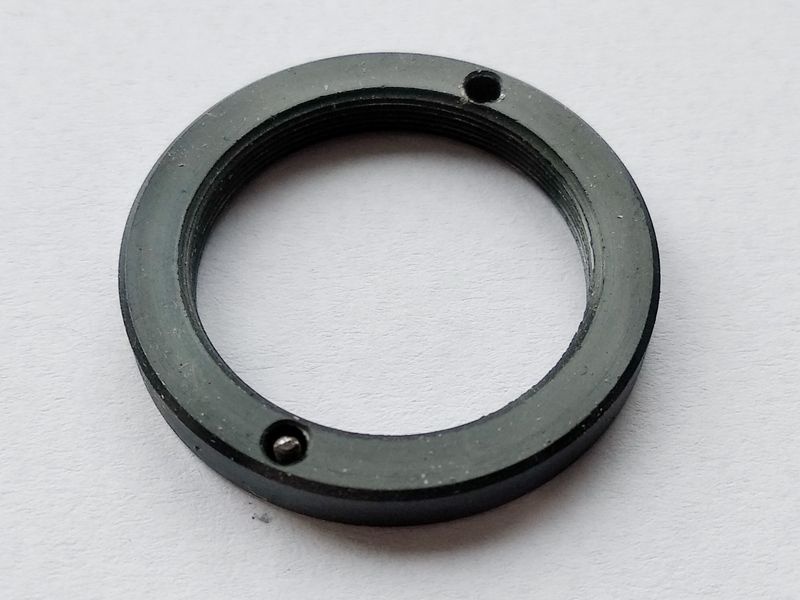
Black threaded retaining ring of the Industar-50 lens block with two screw holes
The black retaining ring with its internal thread and the two holes for the set screws.

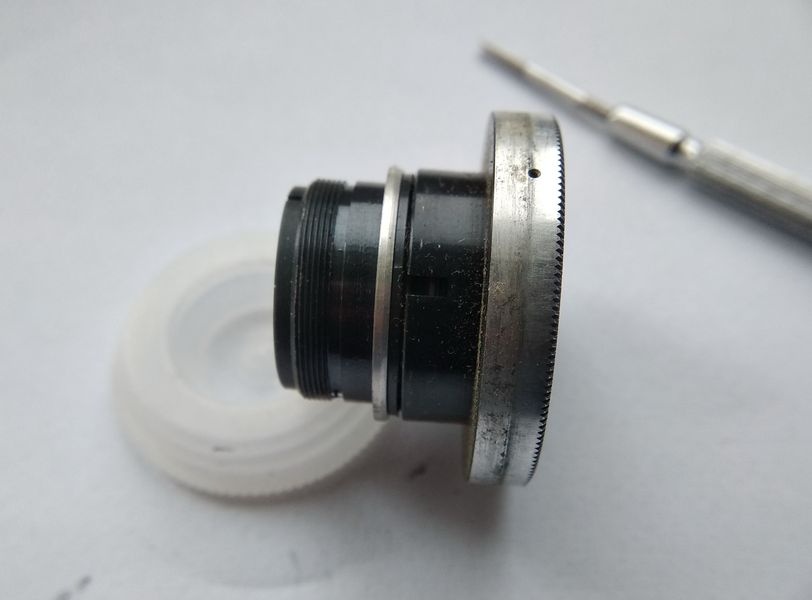
Now the barrel and the lens block can be separated.
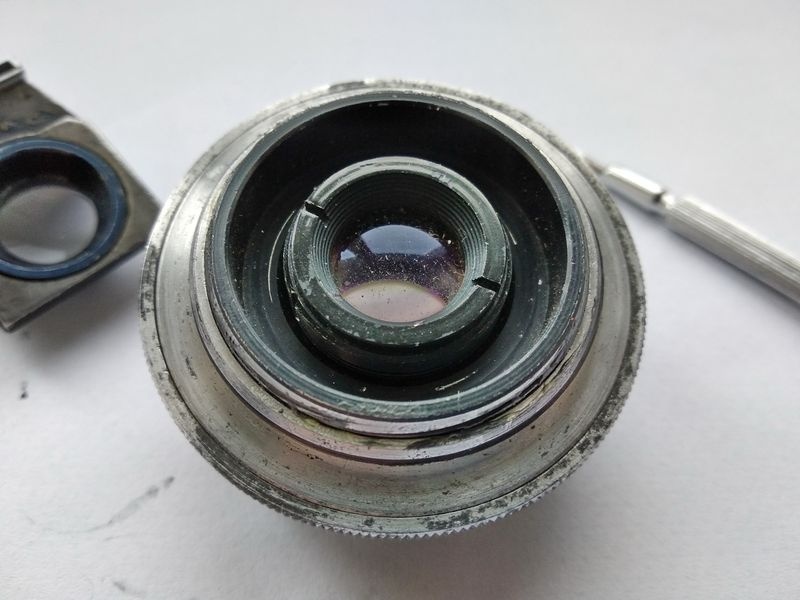
Industar-50 lens block ready to be lifted out of the barrel
The lens block free in the barrel and ready to be withdrawn.

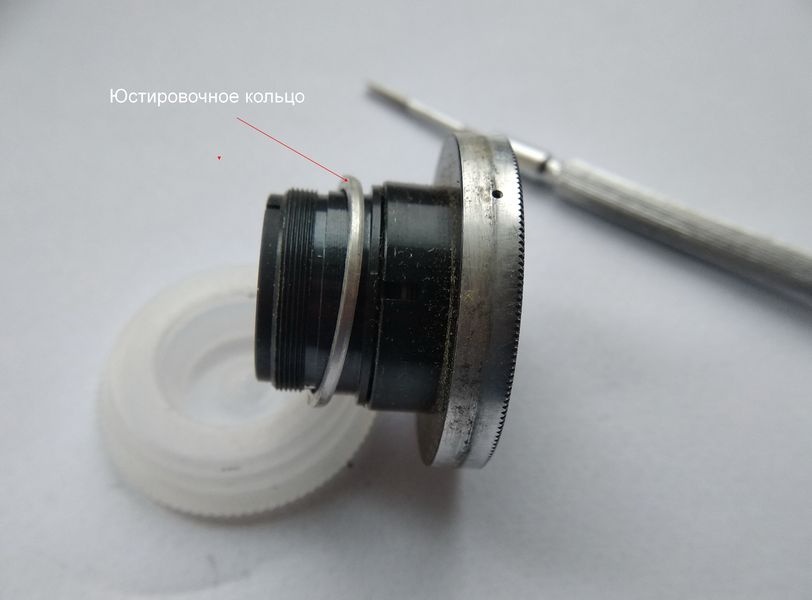
Some care is needed here not to lose the adjusting shim that sits between the barrel and the lens block. Each lens is collimated individually, so each has a shim of the thickness selected for it alone. If the shim is lost, a nontrivial job of collimating the lens to the camera lies ahead, and it requires suitable materials as well.

So the lens is laid on the table front element down, and the barrel is simply lifted carefully away. That is all. On the left is the lens block, on the right the lens barrel.

A note in passing: by changing the thickness of the shim, the lens can be adapted to cameras with a different flange distance. For example, with the shim made 0.3 mm thinner, the lens will work on a camera with a 45.5 mm flange distance. And if the shim turns out to be more than 1.3 mm thick, such a lens can be adjusted to a 46.5 mm flange distance.
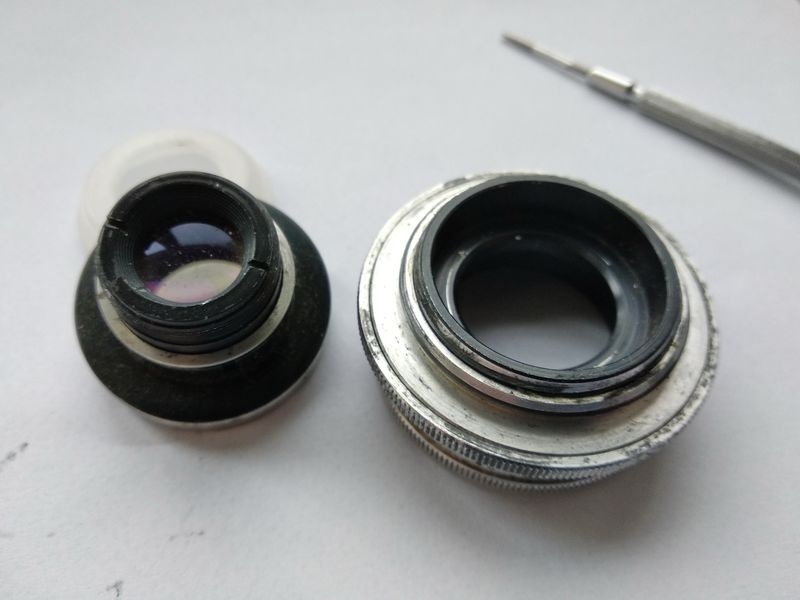
Industar-50 lens block standing beside the empty lens barrel
The two units apart: the lens block on the left, the empty barrel on the right.

A look at the lens block.

Side view of the Industar-50 lens block with its thin shim ring
The lens block from the side, with the thin shim ring around its body.

Here it is, the adjusting shim.

Arrow and label pointing to the thin adjusting shim on the Industar-50 lens block
The arrow, labeled by hand on the photograph, points to the adjusting shim. Its thickness sets the lens-to-film distance for this individual lens.

With these two parts the lens block is installed in the barrel.
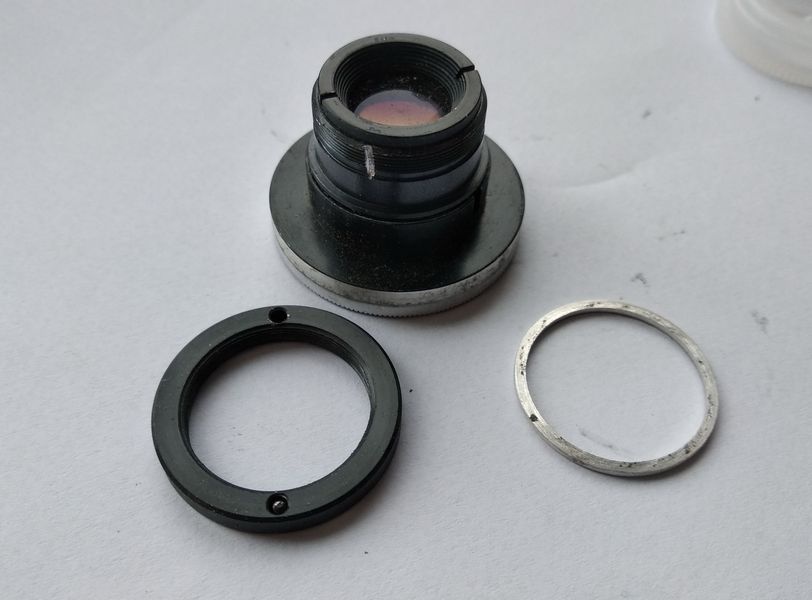
Industar-50 lens block with the black retaining ring and the thin shim laid beside it
The lens block with the two parts that seat it in the barrel: the black retaining ring and the thin shim.

For now the parts are put back on the lens block and it is set aside…
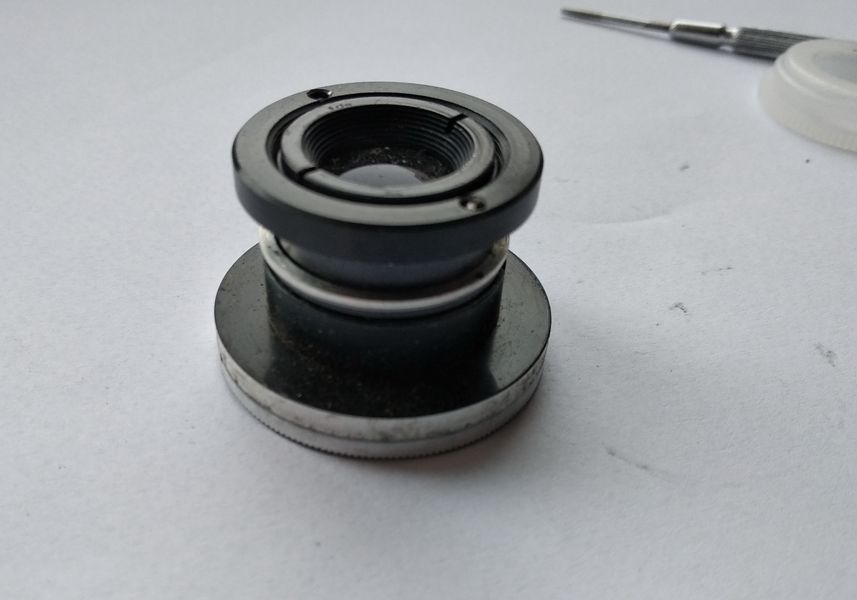
Industar-50 lens block with shim and retaining ring fitted back on for safekeeping
The shim and ring refitted to the lens block so neither goes astray while the barrel is serviced.

Dismantling the Barrel

…and attention turns to the barrel. It will be taken apart, washed properly and lubricated.
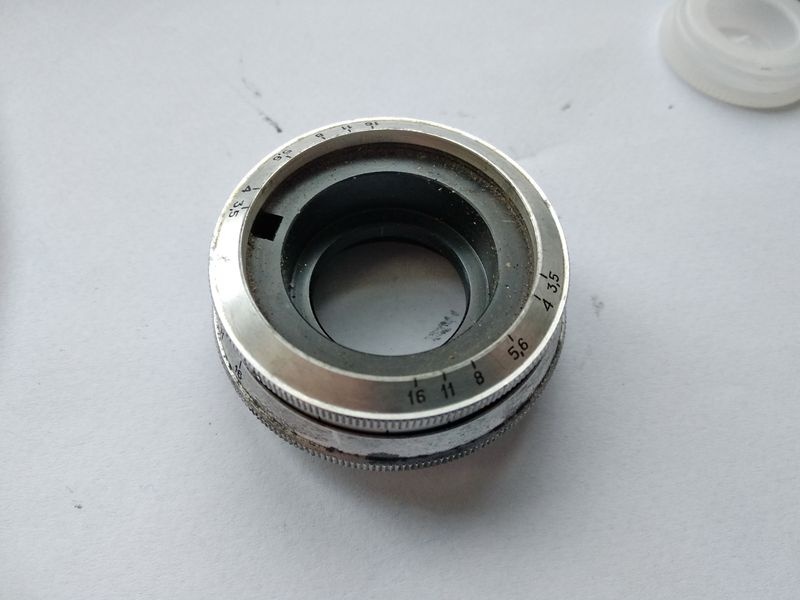
Industar-50 barrel without the lens block, aperture scale ring on top
The barrel on its own, with the aperture scale ring uppermost.

Goodness, the dirt… never mind. Let us begin.
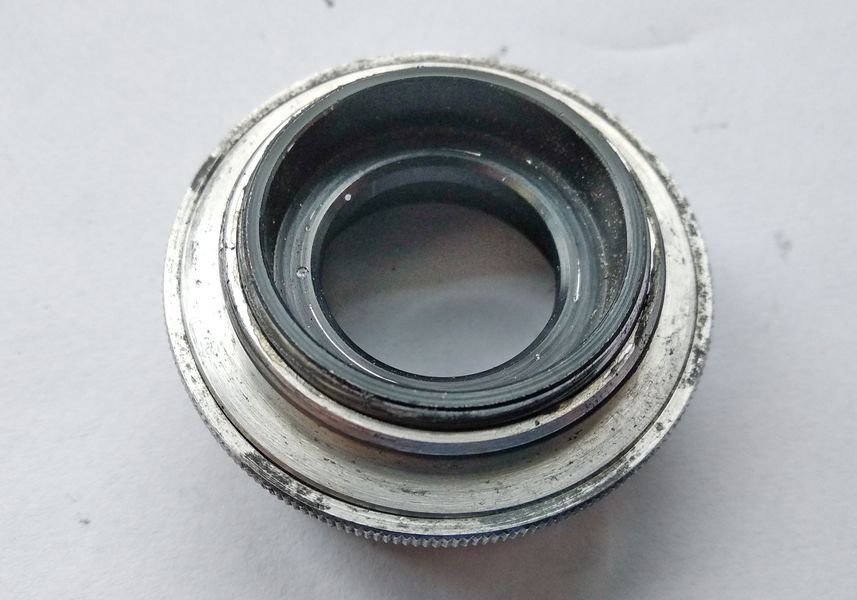
Inside of the Industar-50 barrel coated with dirt and hardened grease
The inside of the barrel, coated with dust bound into hardened grease.

There is one great commandment that is best never ignored: put marks on the mating parts! And so we do, scribing fine lines carefully with a scriber.
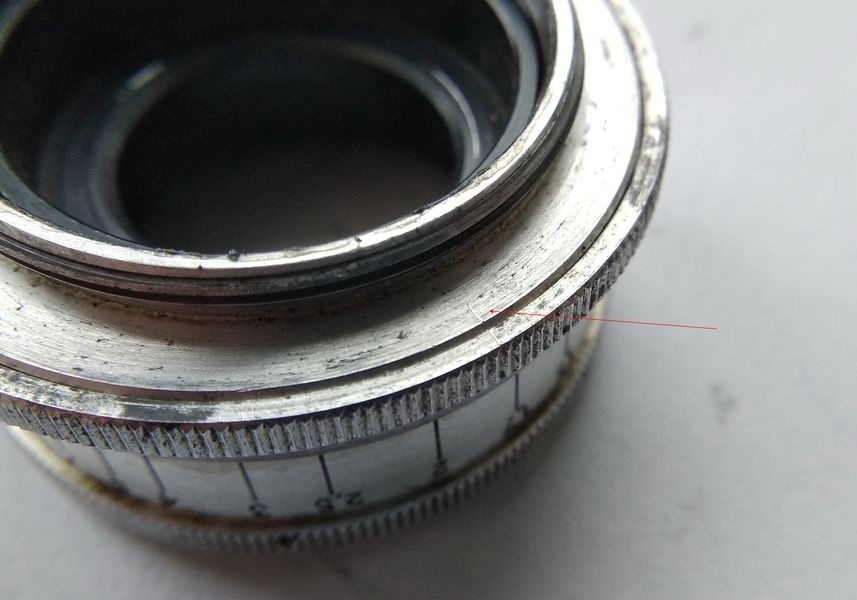
Fine scribed mark across two rings of the Industar-50 barrel, indicated by a line
A fine witness mark scribed across the depth-of-field scale ring and the barrel.

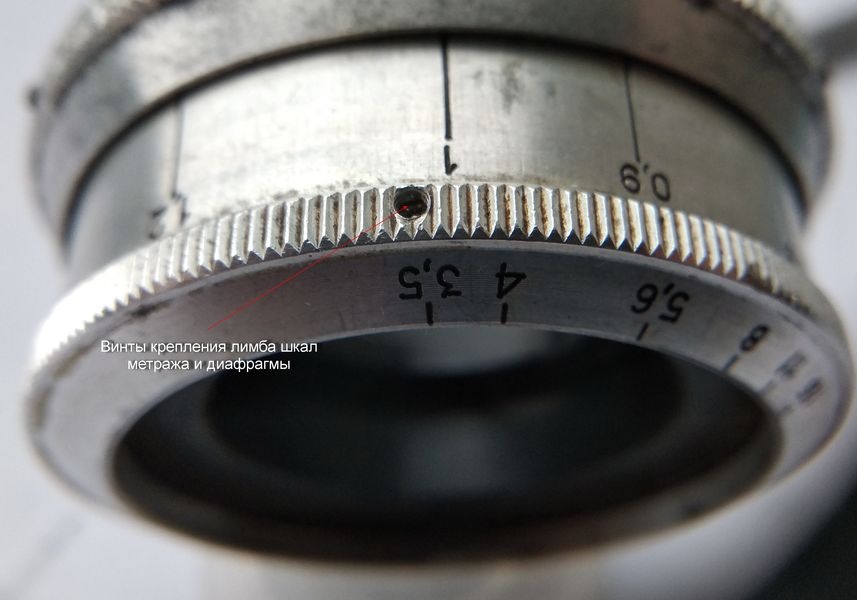
Now the scale rings can be removed by releasing their fixing screws. These little screws need great care; their slots are very easy to strip. If a screw will not give, it is better to put a drop of kerosene or WD-40 on it and wait an hour or two for the liquid to work into the thread. That way the scarce little screws will certainly be saved, and the thread in the soft metal will not be damaged.
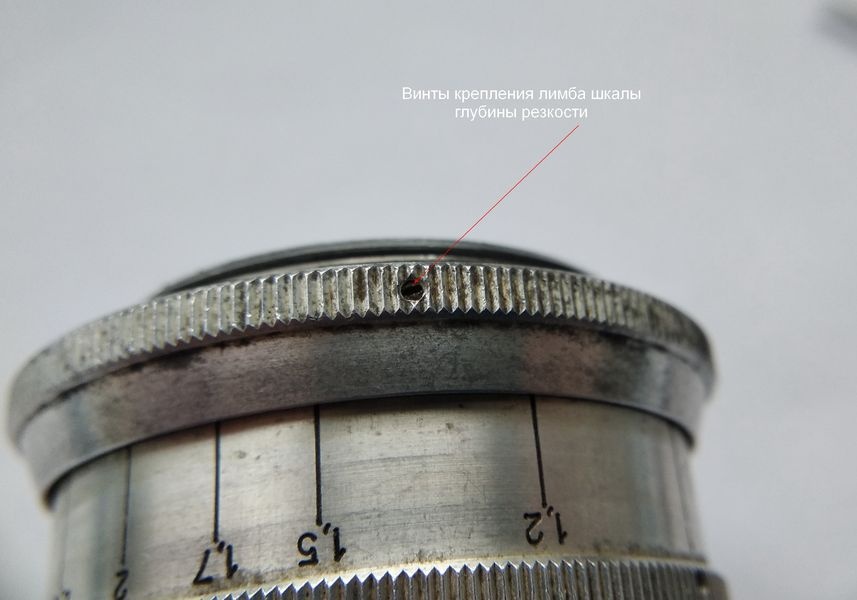
Industar-50 barrel with a labeled arrow on the fixing screw of the depth-of-field scale ring
The handwritten label on the photograph marks the fixing screws of the depth-of-field scale ring.
Industar-50 focusing ring with a labeled arrow on the screw securing the distance and aperture scales
Here the label marks the fixing screws of the ring carrying the distance and aperture scales.

Following the Great Commandment, a mark is scribed on the barrel and on the distance scale ring. Looking ahead, it is not strictly necessary, but… a commandment is a commandment!
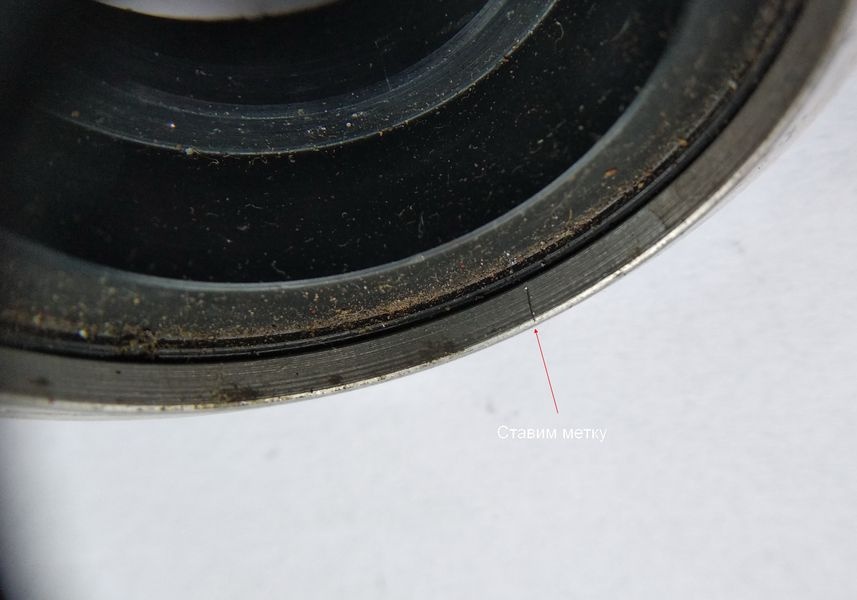
Close view of a scribed mark, labeled on the photo, on the Industar-50 barrel
The label on the photograph reads "making a mark": a scribed line on the barrel, close to the edge of the distance scale ring.

Only after the marks are made are the screws of the distance and aperture scale ring loosened and the ring itself, the focusing ring, removed. That is where we start.
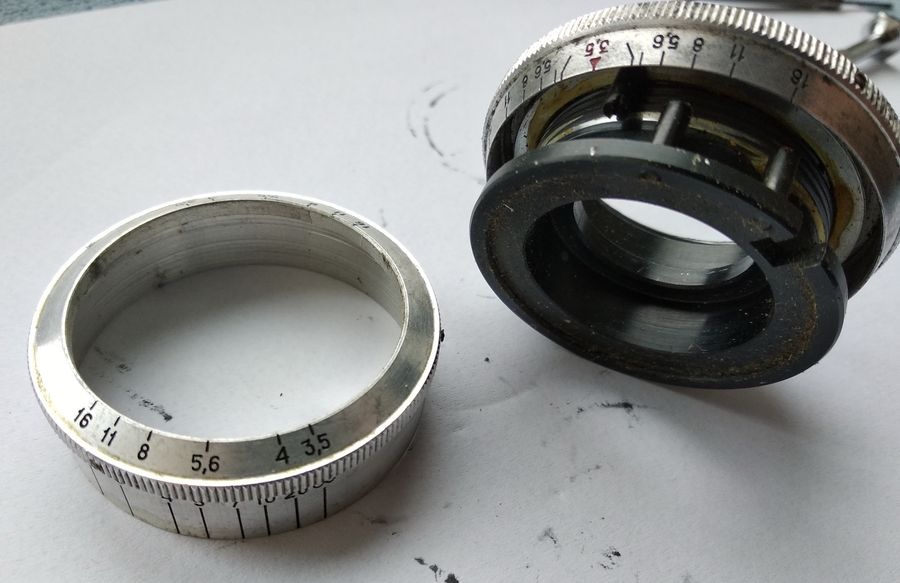
Industar-50 focusing ring removed and placed beside the barrel, revealing the inner helicoid parts
The focusing ring with the distance and aperture scales off the barrel, uncovering the helicoid beneath.

Then the same procedure is carried out with the depth-of-field scale ring.
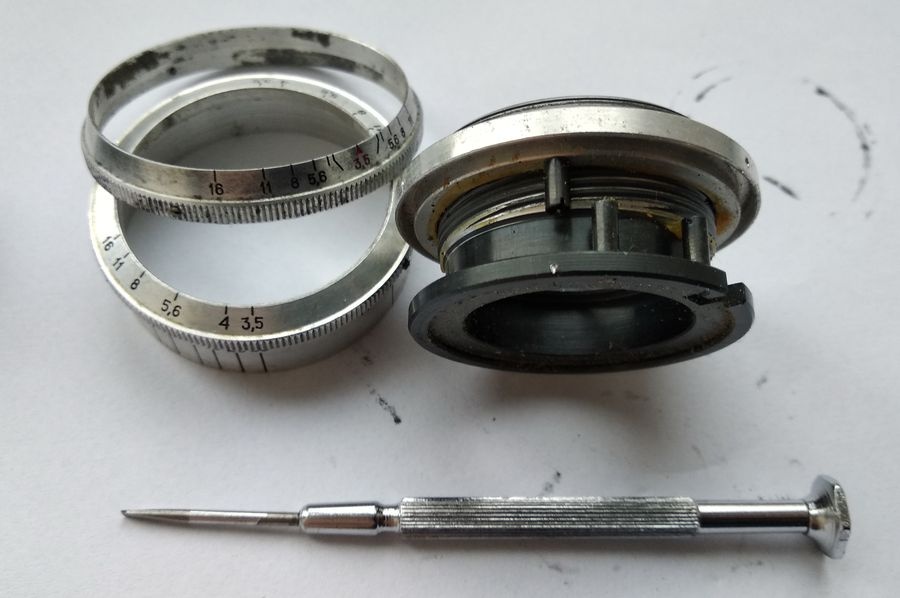
Both scale rings of the Industar-50 removed and laid beside the barrel
The depth-of-field scale ring removed as well, both rings now off the barrel.

This opens access to the helicoid stop screw.
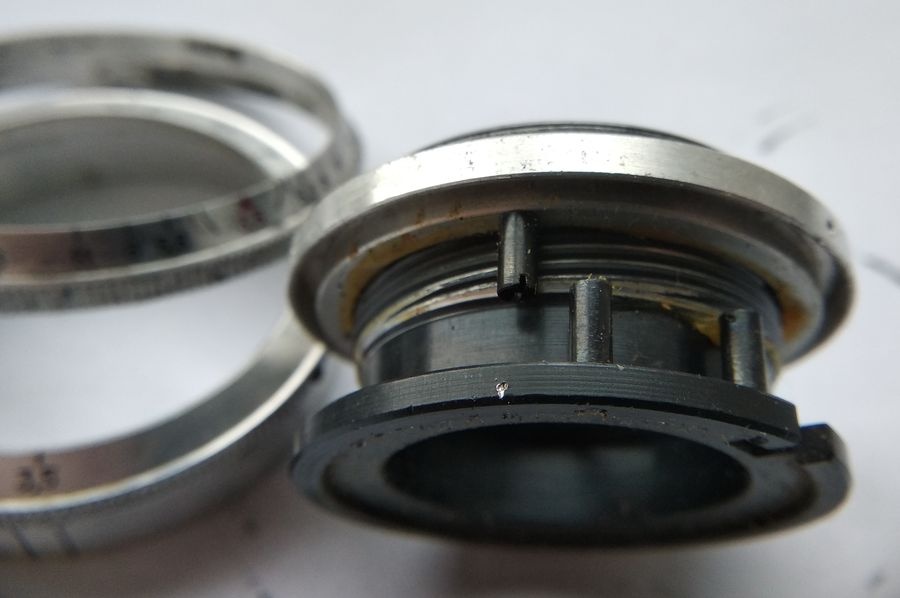
Industar-50 helicoid with its stop post visible between the guide lugs
The helicoid with its stop post now visible between the guide lugs.

The helicoid is turned (and how stiff it is!) until the screw lines up with the service slot, and the screw is unscrewed.
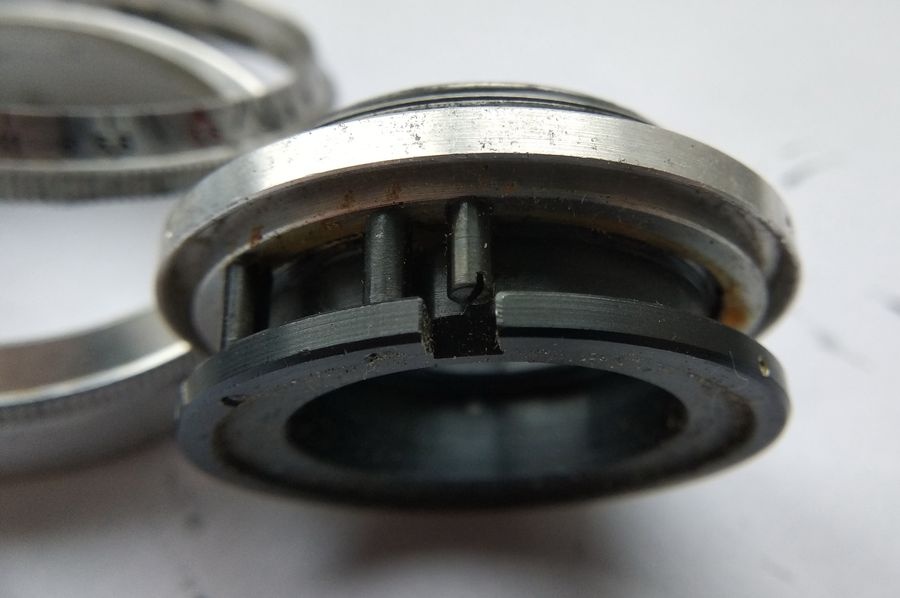
Industar-50 helicoid turned so the stop screw lines up with the service slot
The stop screw brought into line with the service slot, where it can be reached and removed.

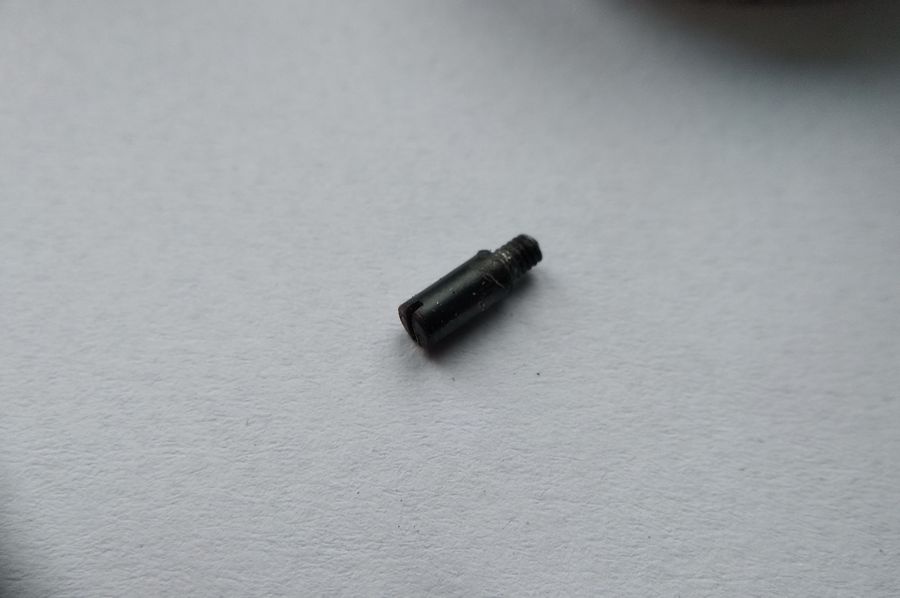
Here it is, the stop.

Small black stop screw of the Industar-50 helicoid lying on white paper
The helicoid stop screw removed, a small black post with a slotted head.

With the stop gone, the helicoid can be separated.
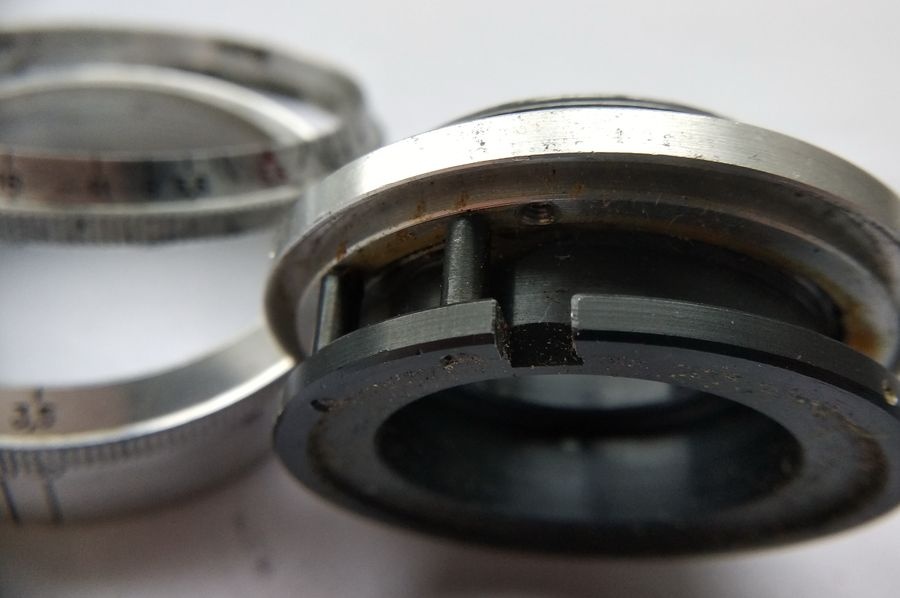
Industar-50 helicoid with the service slot clear after the stop screw is removed
The service slot clear, with the stop screw gone. Nothing now limits the helicoid's travel.

And here, attention! To avoid struggling to catch the right start of the multi-start thread on reassembly, a mark is made here too, but this time at the moment the parts separate.

The helicoid is unscrewed. At the point where the parts come apart, their position is recorded. One reference is the hole for the stop screw; the other is a mark made opposite that hole at the moment of separation, as the arrows show.
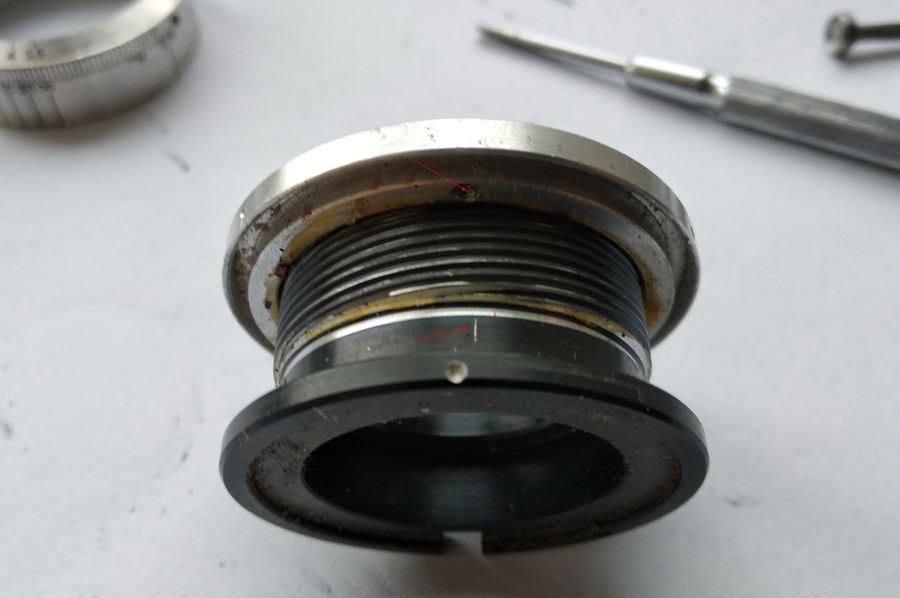
Industar-50 helicoid at the point of separation, with a mark opposite the stop screw hole
The point of separation recorded: a mark scribed on the outer part opposite the stop screw hole. Matching them later finds the correct thread start at once.

Washing

The helicoid is apart, and the parts go into a bath of benzine. Well, well, the "dust of ages" really does float out! A toothbrush comes to the rescue. Quietly humming a nursery song about little mice, kittens and ducklings washing themselves, I clean the thread starts and the machined grooves, and everything else with them, using the brush and a toothpick, then wipe the parts with paper towels and lay them out to dry.
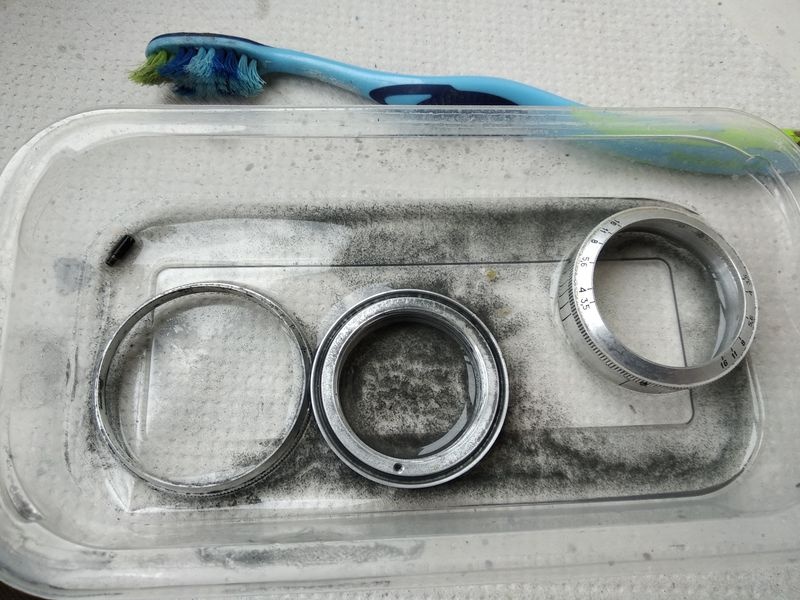
Industar-50 barrel parts in a plastic tray of benzine clouded with dirt, with a toothbrush
The barrel parts in the benzine tray with the toothbrush used to scrub the threads. The liquid turns grey almost at once.

Reassembly of the Barrel

Assembly starts with a clean sheet, literally. A clean sheet of paper goes on the workbench. The one the lens was dismantled on, as you have seen, goes in the bin; it is far too dirty.
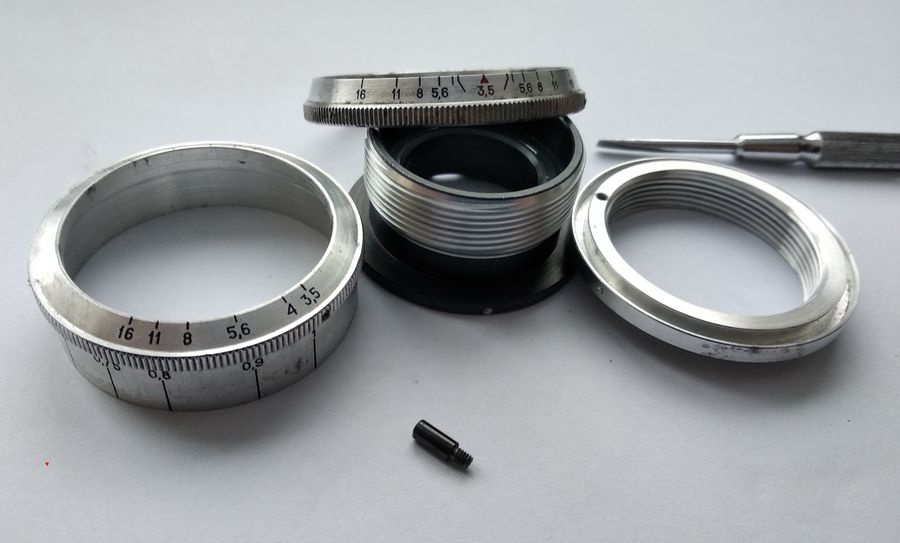
Cleaned Industar-50 helicoid parts, scale rings and stop screw laid on fresh white paper
All the barrel parts clean and laid out on a fresh sheet: the helicoid sections, both scale rings and the stop screw.

Fresh grease is applied to the thread. I use OKB-122-7, a semi-synthetic grease. I like it: it gives a smooth action, has good temperature stability and keeps its properties for a long time. Only a little is needed. Otherwise, whatever the circumstances, it may creep out and reach the lenses, which must not be allowed. Yes, of course, there are those who like to pack in enough grease to take up the play from wear. But that, as you understand, is sheer hooliganism. The play comes back within a couple of days, and the grease spreads to every corner.

Another note in passing: guess what I currently use as a macro attachment for a phone camera? Of course you have guessed. The lens block of an Industar-50! And it works quite nicely.
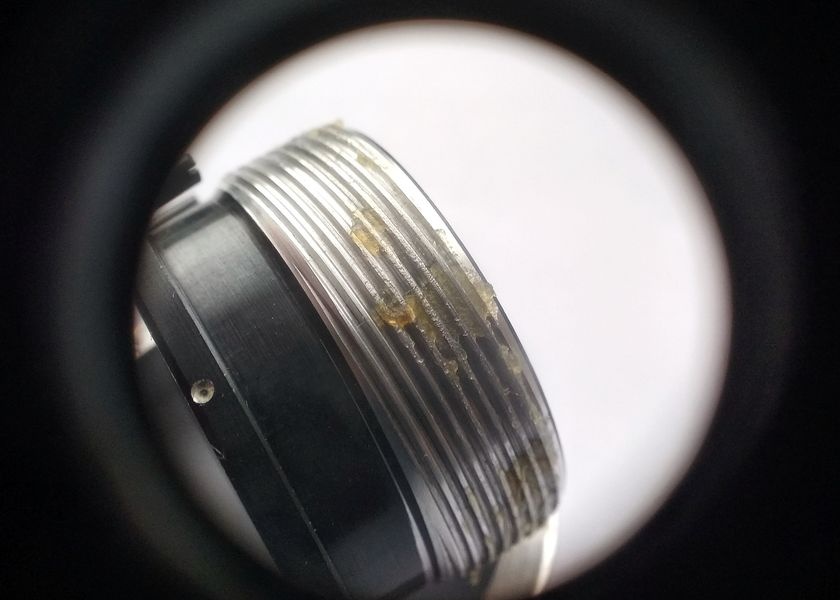
Magnified view of fresh OKB-122-7 grease on the Industar-50 helicoid thread
Fresh OKB-122-7 on the multi-start thread, photographed through a magnifier.

The scale rings are cleaned and ready to go on, but their time has not yet come. First the helicoid is assembled.
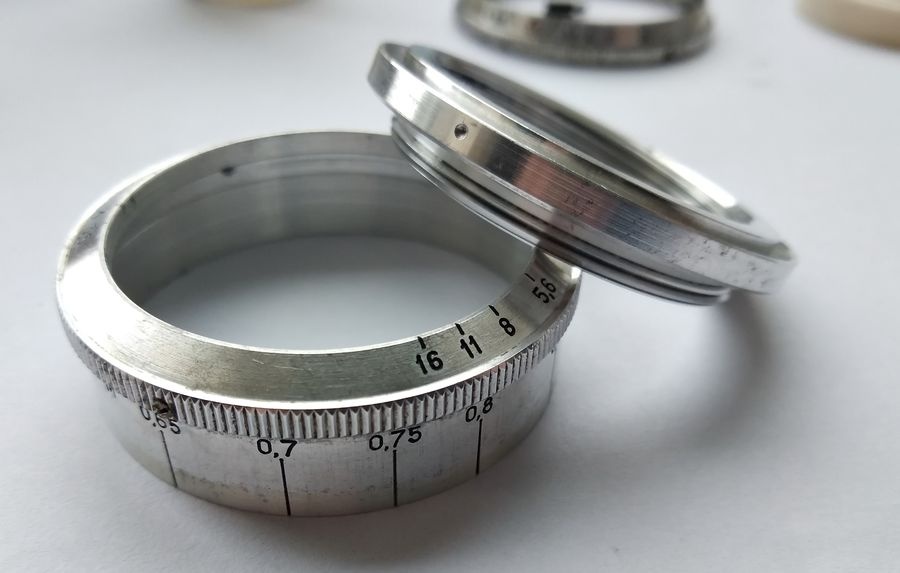
Cleaned Industar-50 depth-of-field ring and helicoid nut ready for assembly
The cleaned scale ring and the helicoid nut, ready for assembly.

And now the mark made earlier comes in very handy!
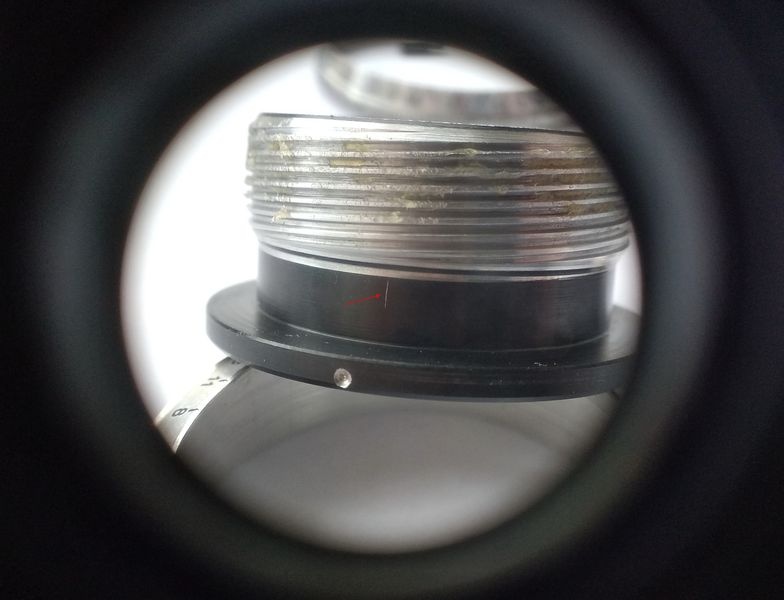
Magnified view of the separation mark on the Industar-50 helicoid, arrowed
Under the magnifier, the arrow points to the separation mark that will guide the thread start.

So the hole for the stop screw is set opposite the scribed line, the parts are brought together, and the helicoid ring is screwed onto the barrel thread.
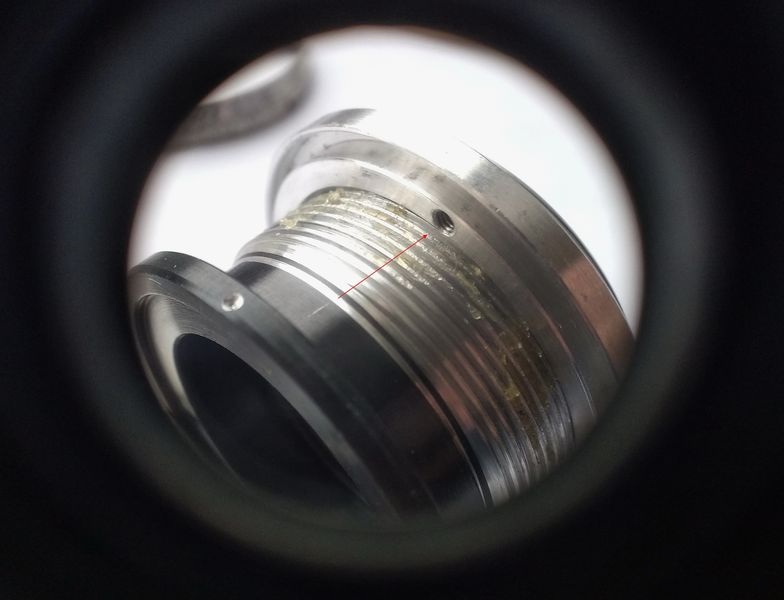
Industar-50 helicoid parts brought together with the stop screw hole opposite the scribed mark
The stop screw hole aligned with the scribed mark, arrowed, as the helicoid ring is started on the thread.

Excellent! The parts are turned through several revolutions to spread the grease evenly.
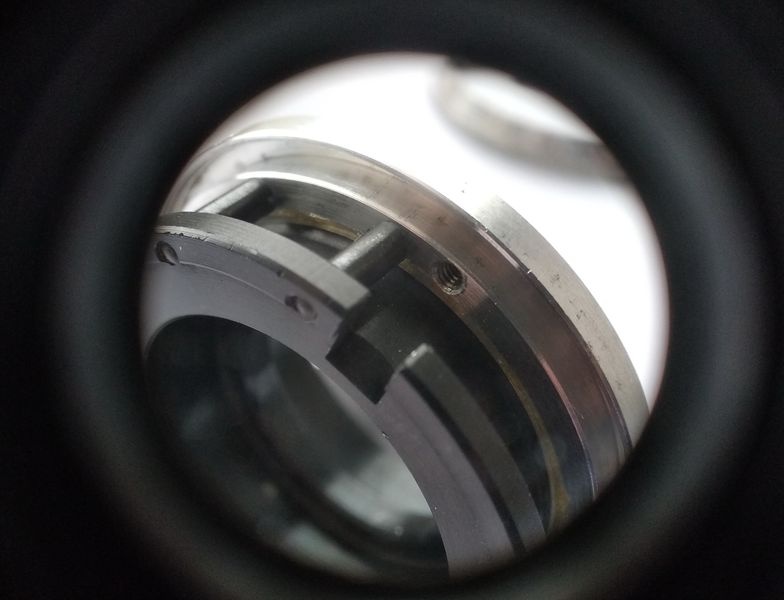
Assembled Industar-50 helicoid seen through a magnifier after the grease has been spread
The helicoid assembled and turned back and forth to work the grease into an even film.

The stop screw is screwed back in place.
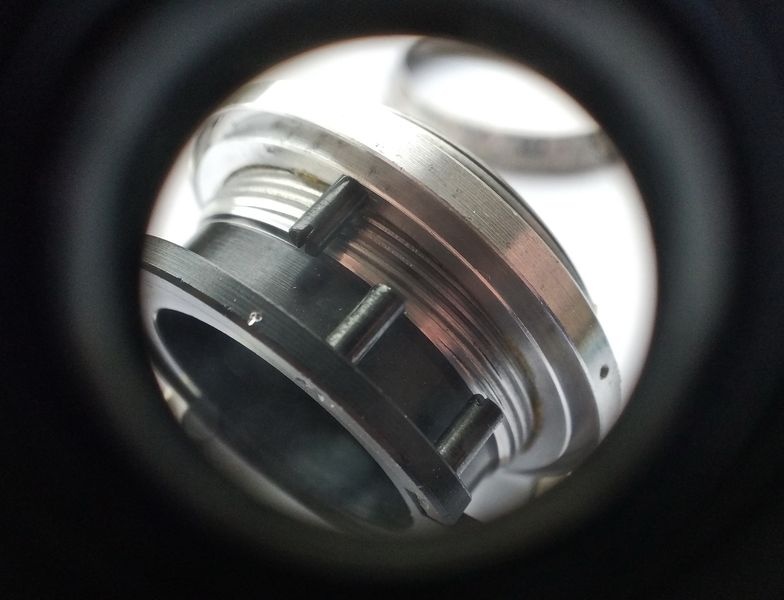
Industar-50 helicoid with the stop screw refitted, seen through a magnifier
The stop screw back in its hole, once more limiting the helicoid's travel.

Once again we thank ourselves for not being too lazy to scribe marks on the mating parts, and the depth-of-field scale ring goes into its rightful place.
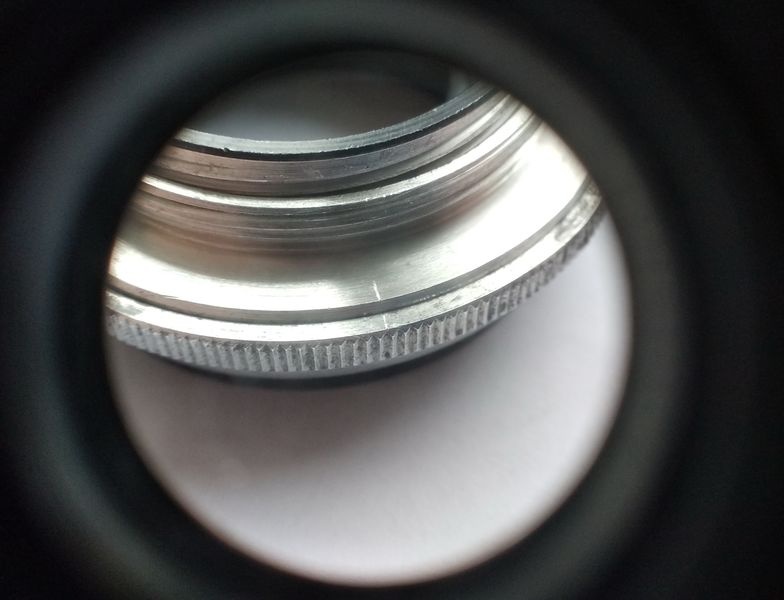
Industar-50 depth-of-field scale ring refitted, viewed through a magnifier
The depth-of-field scale ring refitted at its marked position.

The ring is secured with its screws. OK!
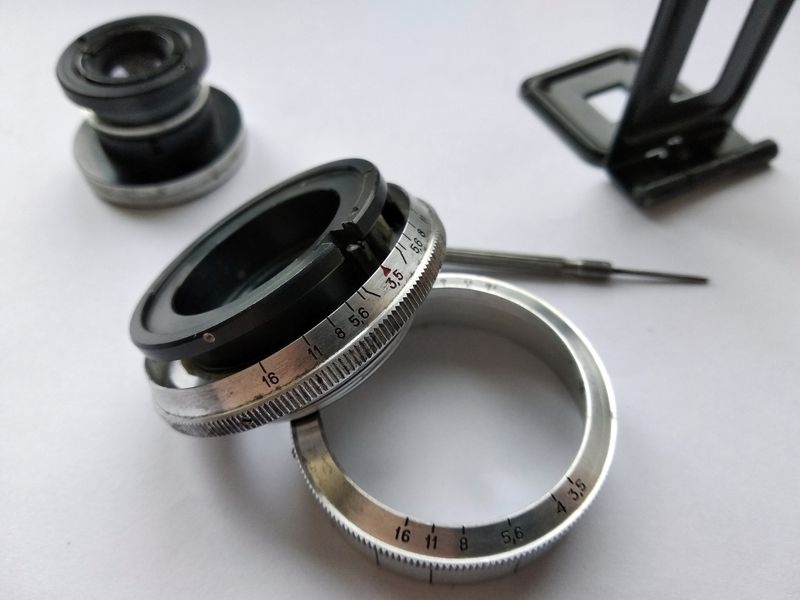
Industar-50 barrel with the depth-of-field ring screwed down and the distance ring beside it
The depth-of-field ring screwed down; the distance and aperture scale ring waits beside the barrel.

When the focusing ring with the aperture and distance scales was removed, a mark was scribed too. But, as I said above, it is not really essential: the ring's position is easily set by the infinity mark. Still, the alignment is checked just in case.
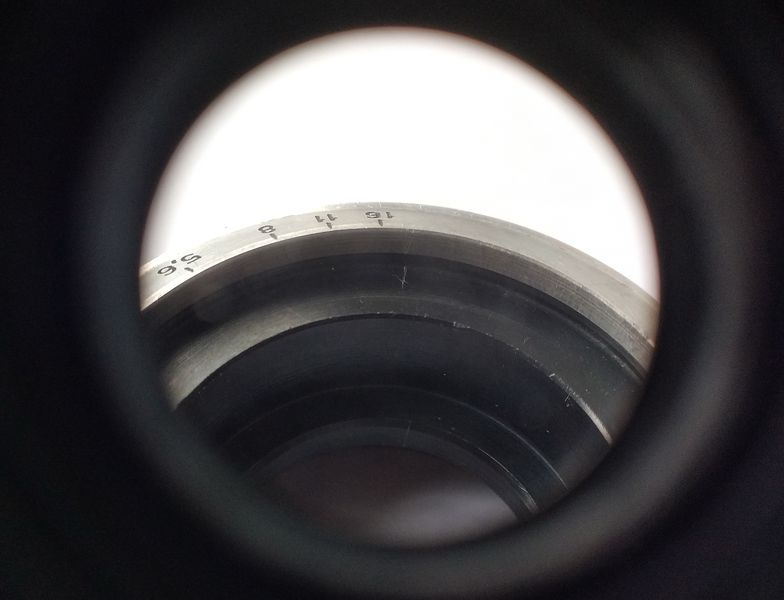
Magnified view checking the alignment of the Industar-50 focusing ring mark
Checking under the magnifier that the focusing ring sits at its marked position.

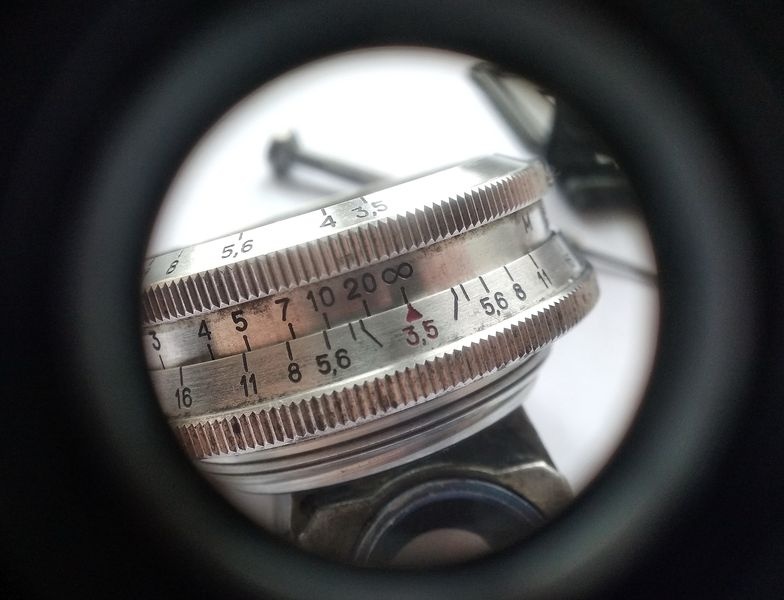
OK!

Industar-50 scales seen through a magnifier with infinity opposite the red 3.5 index
Infinity on the distance scale stands exactly opposite the red index. The marks and the infinity reference agree.

There, the barrel is ready!

Reassembled Industar-50 barrel with distance and depth-of-field scales
The barrel fully reassembled, its scales clean and legible.

The flange side is clean.

Clean mounting flange side of the reassembled Industar-50 barrel
The mounting side of the barrel, free of the old grease and grit.

The front is in order too, and the action is excellent. Focusing will be a pleasure.
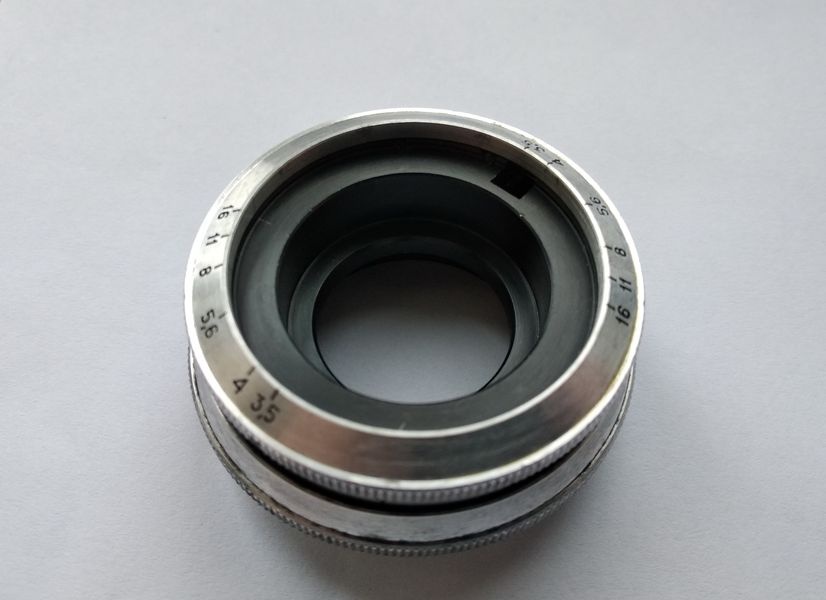
Front of the reassembled Industar-50 barrel with the aperture scale ring
The front of the barrel with the aperture scale. The focusing now turns smoothly over its full range.

Cleaning the Lens Block with Carbon

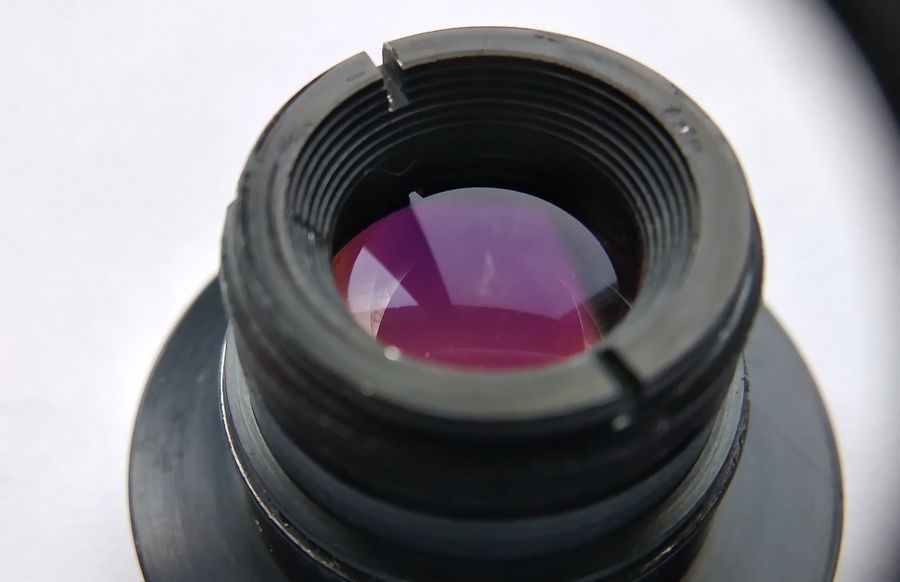
And the lens block? Yes, it deserves attention too. Its body is wiped, and the elements are cleaned.
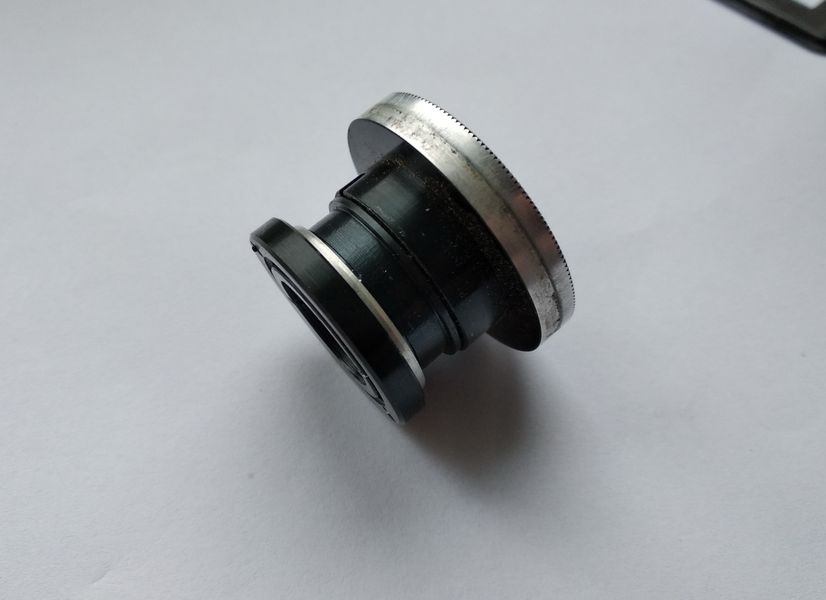
Industar-50 lens block on its side before cleaning
The lens block before cleaning, its body dusty and its glass smeared.

The optics are in tolerable condition, but there is a considerable amount of dirt on the elements. Time to clean them.
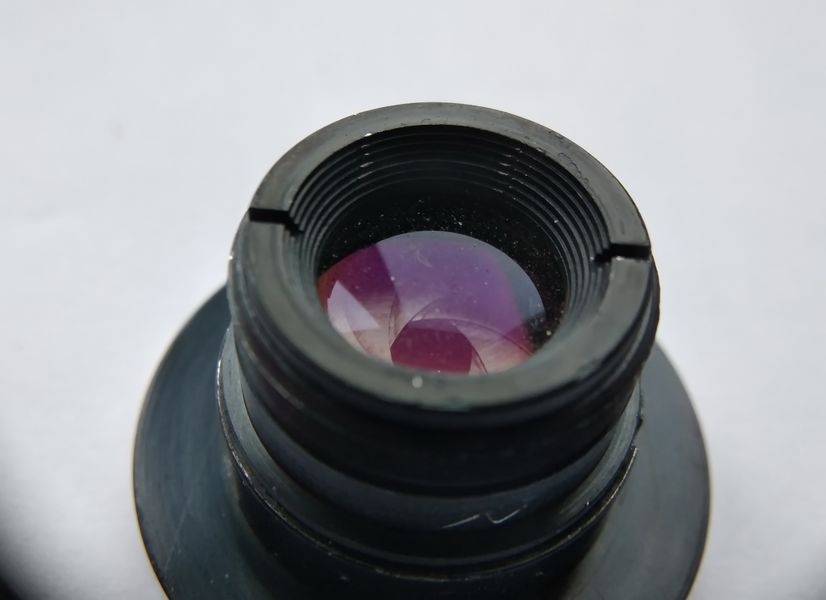
Rear element of the Industar-50 lens block covered with dust and smears
The rear element close up, with dust and greasy smears across the coating.

But before cleaning, the cleaning agent has to be prepared. First the surfaces of the elements are simply washed with a mixture of petroleum ether and isopropyl alcohol, which removes greasy deposits perfectly. And then, then comes cleaning with carbon!

A candle is lit, and some metal object is held in the flame. A teaspoon will do, or a knife blade like this one.
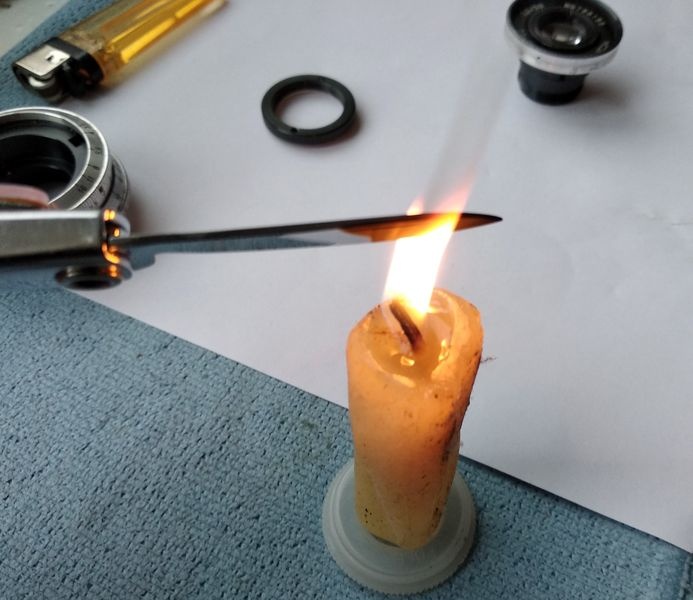
Knife blade held in a candle flame to collect soot for lens cleaning
A pocket knife blade held in the candle flame to collect a layer of soot.

The soot collected on the metal is transferred to a cotton swab.
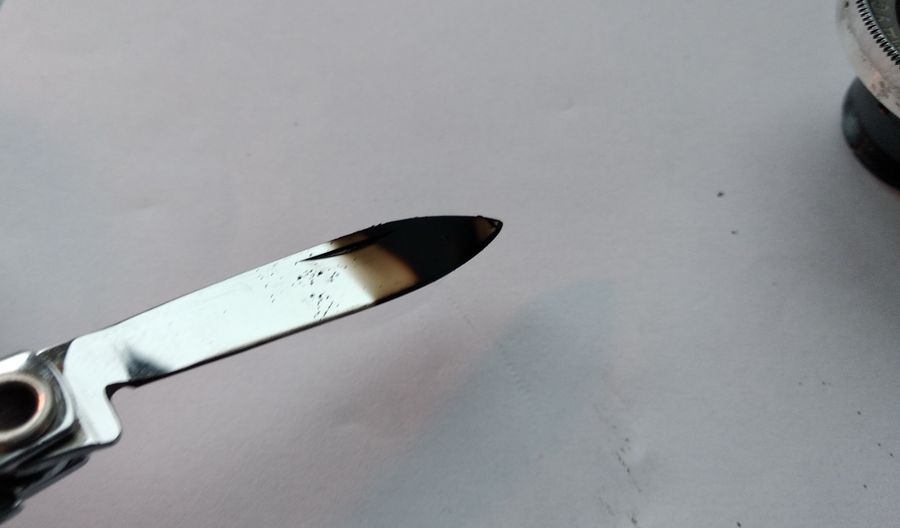
Knife blade coated with black candle soot after being held in the flame
The blade after the flame, coated with a fine black layer of carbon.

And with that swab the elements are brought to a perfect state. Admire them, from the rear…
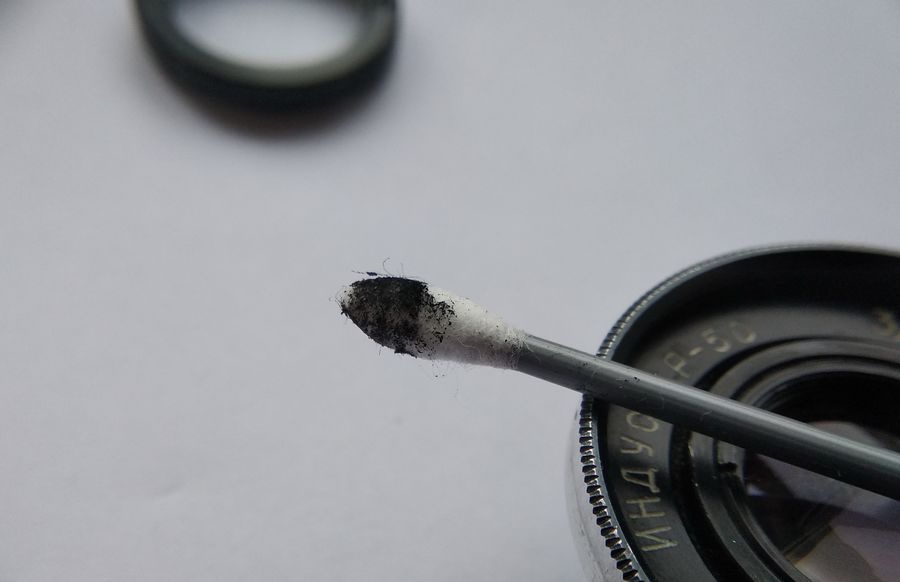
Cotton swab blackened with soot held over the Industar-50 lens
The soot-charged cotton swab, ready to polish the glass.
Clean rear element of the Industar-50 lens block after carbon cleaning
The rear element after cleaning: clear glass with an even coating reflection.

…and from the front!

Clean front element of the Industar-50 with the engraved name ring
The front element after cleaning, seen through the engraved name ring.

Final Assembly

The lens block is ready to go into the barrel.
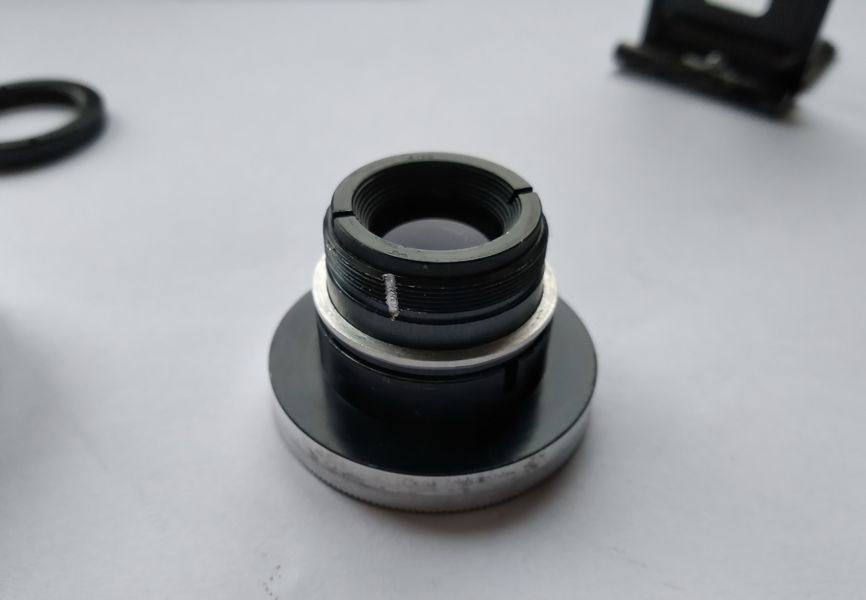
Cleaned Industar-50 lens block with its shim in place, ready for installation
The cleaned lens block with its own shim in place, ready to be installed.

The diaphragm is opened, and the aperture value 3.5 is aligned with the mark on the scale…
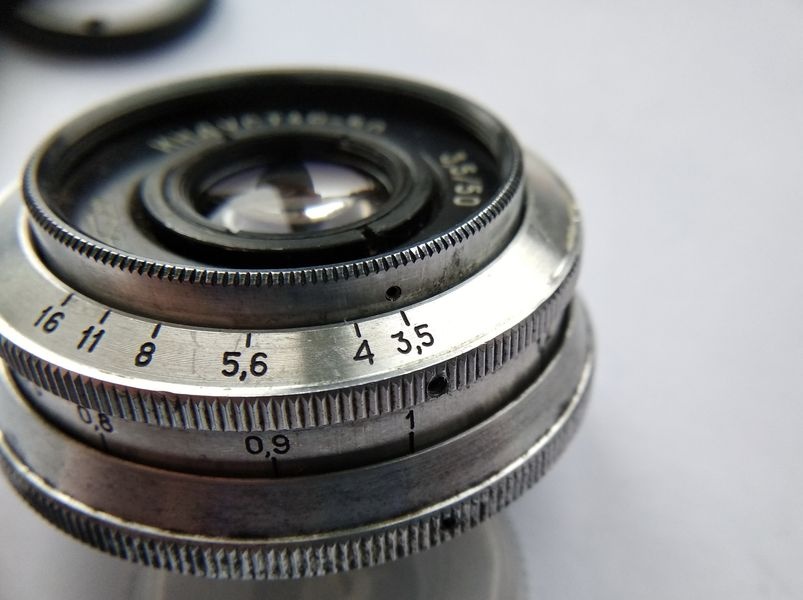
Industar-50 with the aperture set to 3.5 against the index mark during installation
The aperture opened fully, with 3.5 set against the index before the block is locked.

…and the lens block is secured with its ring from the rear of the lens, making sure the aperture index does not drift away from 3.5. The ring is locked in position with its screws. New screws, with proper slots.
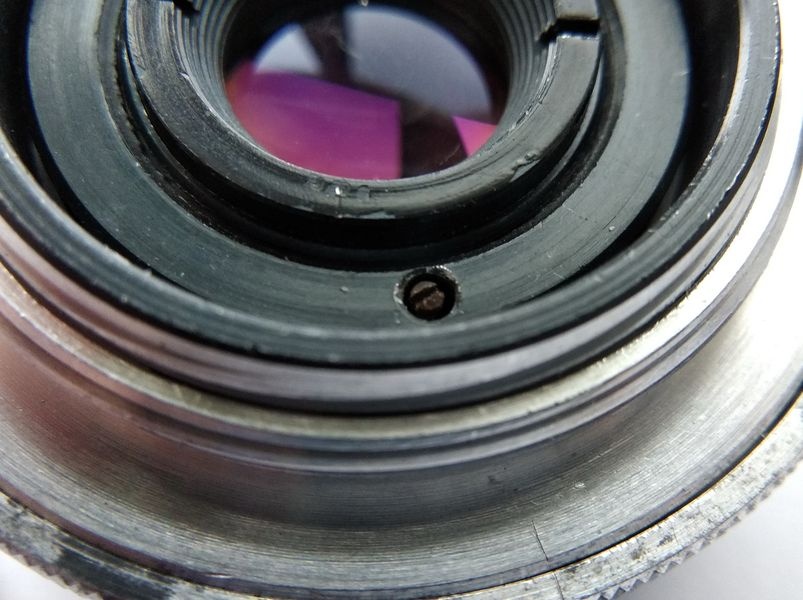
Rear of the Industar-50 with the retaining ring locked by a new set screw
The retaining ring locked from the rear with new set screws whose slots are intact.

Done!

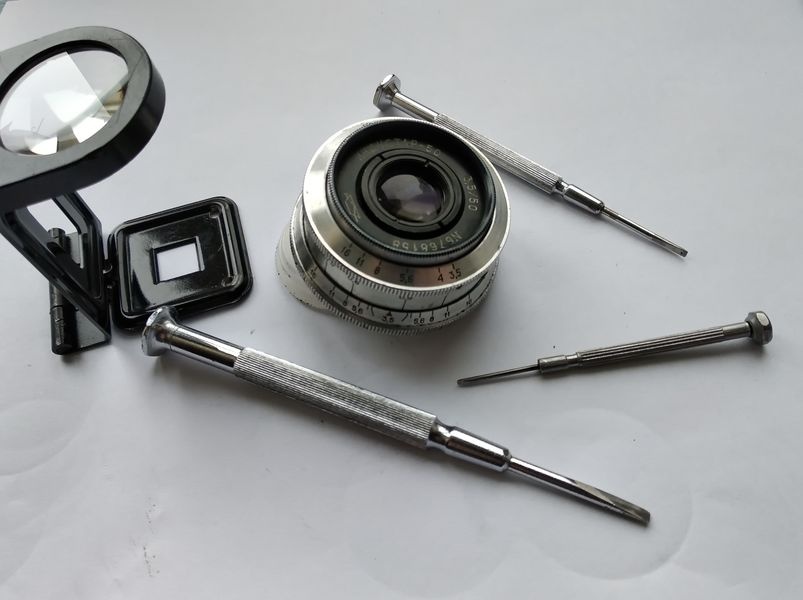
Fully reassembled Industar-50 with watchmaker's screwdrivers and a folding magnifier
The Industar-50 complete, with the screwdrivers and folding magnifier used for the job.

And my friend has just come back with the beer. While the beer is being opened, a couple of test shots with this lens. Open the diaphragm, and…

Something like this.
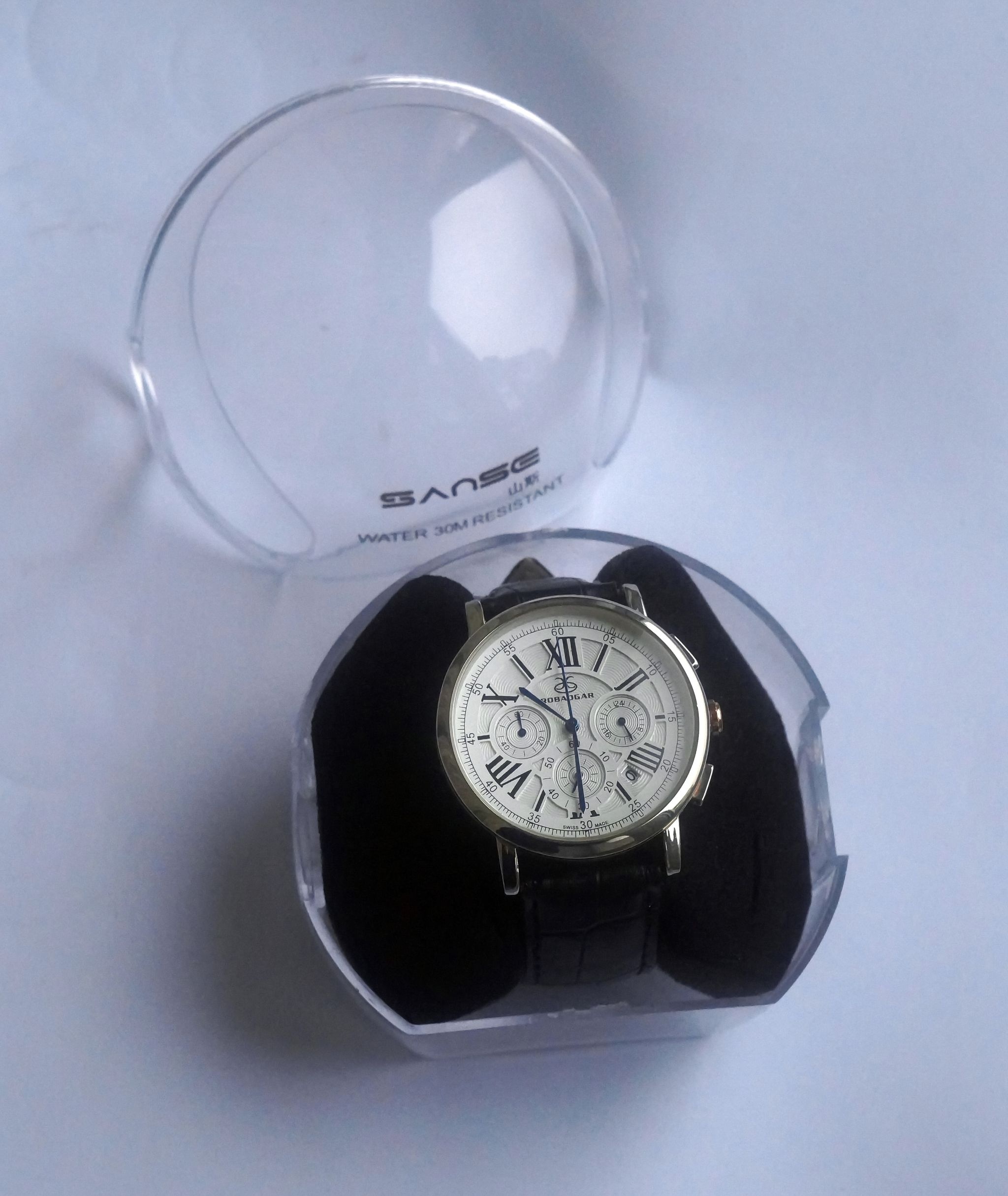
Test shot with the Industar-50 wide open of a wristwatch in a clear display box
A test frame at full aperture: a wristwatch in its clear presentation box, the dial sharp and the background softening away.

P.S. And this is, so to speak, the native setting for the Industar-50: the camera it was made for.
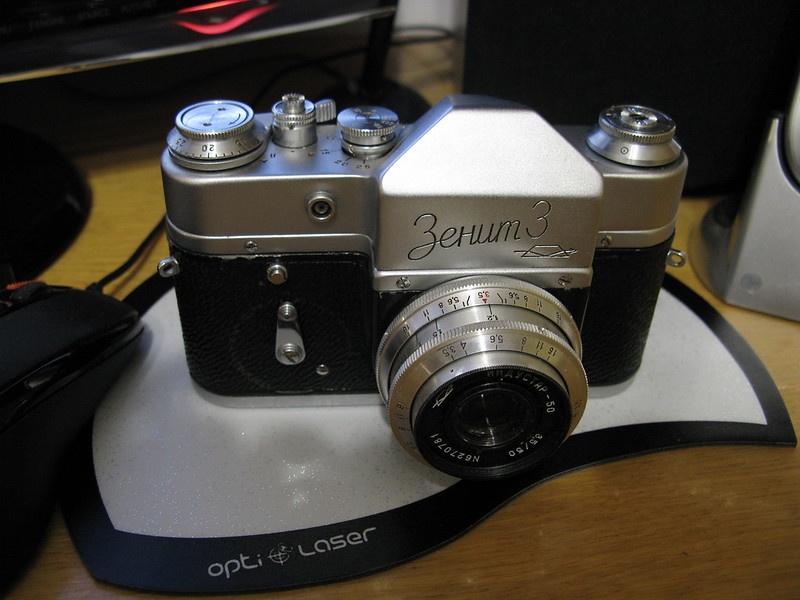
Zenit-3 camera fitted with an Industar-50 lens
A Zenit-3 with its standard Industar-50, the pairing in which most of these lenses first went into service.

Political education department

The Study Continues

More restoration diaries and service guides in the reading room.

All Articles

Feedback from comrades

Was this article useful?

Comments

By vornic · 06/03/2020

I have always admired reviews like this.

By Soviet Box · 06/03/2020 in reply to vornic

Thank you!

By timinus · 06/03/2020 in reply to Soviet Box

Do you know any secret remedy for eyeglasses? I bought rather expensive Zeiss wet wipes; they did not impress me much. Additional information

By parakhod · 06/03/2020 in reply to timinus

Tap water, dishwashing liquid, wipe dry with a soft paper towel. The most secret and the best.

By Sintetik · 06/03/2020 in reply to parakhod

For this purpose I like window cleaner. But I will not advertise it.

By parakhod · 06/03/2020 in reply to Sintetik

They all stink, though.

By scharap1 · 07/03/2020 in reply to Sintetik

By its smell, that cleaner is isopropyl alcohol.

By Tolan · 08/03/2020 in reply to parakhod

After rinsing and an initial wipe, breathe on the lenses and wipe with a clean cotton towel…

By Segor · 06/03/2020 in reply to timinus

The same Zeiss, only the liquid, plus lint-free wipes
Photo attached by Segor

By VladSher · 06/03/2020 in reply to timinus

As someone who has worn glasses for 30+ years, I advise simply water. Just under the tap with a drop of Fairy. Then dry with a paper towel.

By Soviet Box · 06/03/2020 in reply to VladSher

Right!

By Opacha · 06/03/2020 in reply to VladSher

Still, better a COTTON towel. Paper often contains various clays, and you can scratch the coating.

By serge_petrov · 06/03/2020 in reply to VladSher

"just under the tap with a drop of Fairy"
a grain of sand gets in, and hello, scratch

By yup2 · 07/03/2020 in reply to serge_petrov

Wet the lens, add a drop of detergent, spread it over the whole surface with a finger, rinse under running water. A grain of sand simply has no chance of scratching anything: there is none in the detergent, there is very little wetting water, there is practically no pressure, the finger is soft and will feel a large grain at once, and a small one will hide in the folds of the fingerprint ridges. You are far more likely to scratch when wiping…

By Oleg80 · 07/03/2020 in reply to VladSher

Fairy is better colorless.

By friend1 · 08/03/2020 in reply to VladSher

And are cloths bad? The square-rectangular ones.

By VladSher · 08/03/2020 in reply to friend1

The dirt on glasses is mainly skin grease mixed with dust. A cloth only smears that grease across the lens. Fairy washes the grease off.

By friend1 · 08/03/2020 in reply to VladSher

No, of course I understand that a surfactant is a surfactant. I thought a good cloth actually soaks up that grease. You cannot carry Fairy around with you

By OEM · 13/03/2020 in reply to VladSher

Agreed, only instead of a towel I dry them with a hair dryer. A towel can damage the coating, while this way everything is clean and there are no drop marks at all. True, if the frame is plastic, it is best not to overheat it :)

By VladSher · 13/03/2020 in reply to OEM

Now that is a mistake. I once washed my glasses in hot water. Well, how hot… from the tap. And my lenses (plastic, of course, modern ones) went into a fine orange-peel texture. It was clearly visible in reflections. So in this respect the lenses are more delicate than the frame.

By nlo_oln · 06/03/2020 in reply to timinus

Intimate hygiene cream-gel plus my wife's cotton nightgown. ;) I use it every morning. Squeaky clean. Wearing glasses for almost 40 years.)

By trembo · 06/03/2020 in reply to nlo_oln

In winter, a sweater. In summer, a shirt. Wearing glasses for 50 years.

By nlo_oln · 06/03/2020 in reply to trembo

I have not yet attained such zen. No reflections. ;)

By Tolan · 08/03/2020 in reply to nlo_oln

With that cream-gel, everything it is intended for squeaks!

By Aostspb · 10/03/2020 in reply to nlo_oln

"Squeaky clean."
That is your wife grinding her teeth. :) I use soft toilet paper or the hem of my cotton shirt…

By Soviet Box · 06/03/2020 in reply to Soviet Box

I just washed mine with a hygiene shampoo under warm water. Super. There is also an ultrasonic bath made especially for glasses. They say it cleans well. Me, the old way: collected some soot, cleaned… Also any cleaner for windows, mirrors and so on. These are an aqueous solution of isopropyl alcohol with fragrance and some surfactant. They clean beautifully, are always at hand and cost pennies. For glasses it is exactly the same, only much more expensive.

By Stormeg · 06/03/2020 in reply to Soviet Box

With this Industar you can use any detergent; the lens is no great loss. Quality branded cleaners should protect the lens coating from damage during cleaning. And with a lens costing $100 and up, it makes sense to use them. P.S. I have nothing against pure carbon (soot).

By Soviet Box · 06/03/2020 in reply to Stormeg

You see, a person first has to confirm certain statements through his own mistakes :)

By yup2 · 06/03/2020 in reply to Soviet Box

"Also any cleaner for windows, mirrors and so on. These are an aqueous solution of isopropyl alcohol"
Not all, far from all. About half contain ammonia rather than isopropyl alcohol. And ammonia can cause problems. At any rate, I have come across monitors whose anti-glare coating peeled off from such glass cleaners.

By Ivan_113 · 07/03/2020 in reply to Soviet Box

And about soot: there is a special pencil, you know.
Photo attached by Ivan_113

By shaman · 07/03/2020 in reply to Ivan_113

Soot is much cheaper, and you do not have to run anywhere for it.

By friend1 · 07/03/2020 in reply to Ivan_113

By the way, few people know that its cap holds a pollen renewer and a suede-nap raiser (or whatever it is) and a shine remover. Something like a convex graphite tablet.

By Myp · 07/03/2020 in reply to Ivan_113

That pencil is the very same soot, only in a pretty case and with a limited service life.

By gird · 06/03/2020

Wow! I read it out of respect for craftsmen like this! Cool!

By Soviet Box · 06/03/2020 in reply to gird

Thank you!

By Bbarmaley · 06/03/2020 in reply to Soviet Box

Can I lubricate it with solidol? I just have no other grease at hand.

By Nordline-Ost · 07/03/2020 in reply to Bbarmaley

No. That is real necrophilia: it runs in the heat, stiffens in the cold, and its anti-seize properties are nominal. It is easier to buy a molybdenum grease at a car parts store, or at least a graphite one, if the electronics parts shop is short of CIATIM

By friend1 · 07/03/2020 in reply to Nordline-Ost

Are you sure molybdenum is suitable here? It has other purposes

By Nordline-Ost · 07/03/2020 in reply to friend1

It is an anti-seize component. Essentially Litol with good anti-seize properties and, thanks to other additives, good temperature properties. Certainly better than solidol

By friend1 · 08/03/2020 in reply to Nordline-Ost

And essentially, Litol must not be used with aluminum.

By Aostspb · 10/03/2020 in reply to friend1

"Litol must not be used with aluminum"
I remember that in the 1980s, at the plant, there were regulations for lubricating the moving parts of aluminum cans specifically with Litol-24 (for military acceptance).

By Myp · 07/03/2020 in reply to friend1

Molybdenum grease suits well. But the loads are zero; by and large it does not matter what you use, as long as it does not run in the heat or stiffen in the cold.

By Myp · 07/03/2020 in reply to Nordline-Ost

Definitely not graphite grease; it gives a peculiar feel in use.

By NikGold · 11/03/2020 in reply to Nordline-Ost

No graphite grease! It is based on fat 1-13, which is even worse, and the graphite grain is no gift either!

By Soviet Box · 07/03/2020 in reply to Bbarmaley

"Can I lubricate it with solidol?"
You know, a wise man once said: "You can, but you shouldn't."

By Tolan · 08/03/2020 in reply to Bbarmaley

Litol will do well… But it will turn a little more stiffly than with CIATIM.

By friend1 · 08/03/2020 in reply to Tolan

Litol will eat aluminum

By Tolan · 08/03/2020 in reply to friend1

I have never heard of such malice on Litol's part! I have never lubricated rotating pairs in lenses with it myself, only CIATIM…

By Aostspb · 10/03/2020 in reply to Tolan

"never heard of such malice on Litol's part"
Probably modern Litol, in which more alkali than the norm was added during manufacture… Normally 0.1% free alkali is the standard for it.

By Professore · 10/03/2020 in reply to Tolan

Solidol oxidizes and breaks down over time. Depending on the manufacturer it becomes acidic or alkaline, with corresponding destruction of the metal, as luck would have it. It also turns into plasticine and the mechanism stops turning. I once had to repair an ancient German Grundig VCR, a copy of a Sony, that the stingy Germans had lubricated with solidol. In 15 years it had turned into bitumen. Complete disassembly and washing. And Litol is made on a solidol base. Not all grades, of course, but as luck would have it.

By NikVar · 10/03/2020 in reply to Professore

Today I cleaned an Industar 50-2 and lubricated it with PMS-100 liquid silicone grease. Kinematic viscosity 100 cSt. A multipurpose neutral lubricant.

By Tolan · 10/03/2020 in reply to Professore

Signor professore, thank you for the warning; I have never had occasion to observe LITOL's behavior over many years…

By Professore · 13/03/2020 in reply to Tolan

Well, if it is for 5 years, or for someone else, you can use solidol. But if it is to be kept for 20 years, then Litol should not be used either. I have come across (taken apart) military vehicles lubricated with Litol and CIATIM where it had turned into plasticine. But that was 1960s equipment. Silicone grease is not intended for loaded metal rubbing surfaces. That is not its job. That said, I once had to lubricate the helicoid thread of a lens with graphite automotive grease too. Many years ago. I think it was 1987. As a museum piece the Jupiter-8 still works quite well. But of course I do not shoot with it.

By Tolan · 13/03/2020 in reply to Professore

A Helios-44, Jupiter-37 and Mir-10, lubricated over 20 years ago with CIATIM, still turn easily and softly…

By Soviet Box · 13/03/2020 in reply to Tolan

"lubricated over 20 years ago with CIATIM"
Which exactly? There is CIATIM-201 and there is CIATIM-202. If the second, it will last half a lifetime. The first… well, how to put it.

By Tolan · 13/03/2020 in reply to Soviet Box

I am almost sure it was the 201… That tin can is still on a shelf in the garage; I need to take a look when I get the chance.

By parakhod · 06/03/2020

Cleaning and repairing old lenses is a good and right idea. Thanks for the useful advice. I have a whole pile of old lenses and cameras; I never get round to them, but someday I definitely will. A couple of questions: why not use an ultrasonic bath to wash the parts? Are there less shamanistic ways of cleaning lenses than soot? Russian greases are very hard for me to buy. Does anyone know which European or Japanese makes are good for lenses, and in which cases? Some time ago I bought some Japanese helicoid greases on eBay, several jars of different types, but I have used only one, once. And as for the Industar-50 itself, as a test "kitty" it is of course ideal, but as a lens, honestly, it was always complete junk.

By Soviet Box · 06/03/2020 in reply to parakhod

A bath, of course you can. It is just quicker this way. It is not a shamanistic method. By the way, the much-advertised Lenspen is nothing other than practically the same candle soot, only refined. And… I do not know a more effective method, somehow. Still, I try not to clean in front of the client, otherwise some especially sensitive ones faint :) As for greases… In Italy you will not find OKB, of course, but you have bought specialized ones, and that is excellent. Actually, you can pick a semi-synthetic of the right viscosity at a bicycle shop, for example. Well… I would not speak of the "button" like that. Yes, my ideal is the Industar-22, but it was not well suited to color work, although a slide on UT-16 shot with the I-22 was airy and colorful. The I-50 worked better for color for printing. And better than the Helios-44. But that is a long-gone time. Now it is the domain of experimenters.

By parakhod · 06/03/2020 in reply to Soviet Box

Well, about this particular one, that is my memory from the 1980s ))) I never liked it. The question about greases is precisely about choosing different viscosities. The Japanese have a huge table, but I have never seen anywhere by what criteria to choose the viscosity.

By Soviet Box · 06/03/2020 in reply to parakhod

By trial and error, for Soviet or rare manual optics in general. I still have a tube of this stuff. There is a little left. And after that…

By parakhod · 06/03/2020 in reply to Soviet Box

Well, that is roughly what I thought, but deep down I hoped there was some clever trick )) Thank you

By TheLamer · 06/03/2020 in reply to parakhod

Of those tested and showing the best results: Liqui Moly Thermoflex Spezialfett, lithium-based on PAO, best for loaded metal-to-metal pairs but also fine for metal-to-plastic, no solid particles. HUSKEY HTL-500, the same but with PTFE; preferable for metal-to-plastic pairs, less so for metal-to-metal. Liqui Moly 3312, pure silicone for the most sensitive pairs with plastic and with hardened surfaces such as anodizing. Inert to any plastics and rubbers.

By parakhod · 06/03/2020 in reply to TheLamer

Thanks, I will look at these

By EagleB3 · 08/03/2020 in reply to TheLamer

I am all for Liqui Moly Silicon Fett (the 3312). I have been using it for (I counted, OMG!!!!) 12 years (I never even noticed it had a number...) with invariably excellent results. Thick, does not run, does not attract dust, rubs into the pores of the metal and glides, glides, glides! Expensive, damn it. But worth the money. Recommended! I usually use it (that is my lot...) on smooth ground or polished surfaces. Apply a little, spread and rub it in with a piece of polyethylene (or a polyethylene glove). Wait. Collect the excess with a paper or non-woven wipe, practically clean. That is all. What remains does the work.

By OreSama · 06/03/2020 in reply to Soviet Box

Still, I have doubts about OKB grease: what about its volatility? It seems to be intended purely for mechanical assemblies. Whatever is near the optics must not evaporate; otherwise everything that evaporates will settle on the lenses, and in 10 years or so that will become clearly noticeable.

By Soviet Box · 06/03/2020 in reply to OreSama

I have not noticed that so far.

By smasters · 06/03/2020 in reply to parakhod

Cleaning lenses with soot was used, and is sometimes still used today, at Carl Zeiss (I speak as a Zeiss employee, although not ZEISS Consumer). The method is unusual, but far from shamanistic.

By parakhod · 06/03/2020 in reply to smasters

Funny, I did not know. I am mostly into electronics; my knowledge of optics is only second-year physics, over 25 years ago.

By Ser_Go · 10/03/2020 in reply to smasters

I took up photography back in the mid-1970s as a schoolboy. At the city library they would periodically find me various books on photography, some of which seemed simply "ancient" to me, editions from the 1930s. It was in them that I first read about the method of cleaning optics with soot. I have used it ever since, and when I bought the much-praised Lens Pen out of curiosity, I made sure that the cleaning agent is the same soot, only in a pretty and, I will not argue, convenient package.

By mooni73 · 06/03/2020 in reply to parakhod

I suspect the factory used plain Litol-24.

By Soviet Box · 06/03/2020 in reply to mooni73

No, not at all. There is a lubrication chart, there are GOST greases. And LITOL-24 is very stiff, it will not do; it is hard to turn. CIATIM-202 is good. But for the price… then better HELIMAX-XP. And its price is not so scary if you want quality.

By mooni73 · 06/03/2020 in reply to Soviet Box

I just know from my parents' memories and my own how factories worked in those years: smear on whatever you have! And what they had was Litol and CIATIM-2. But yes, there were lubrication charts and process engineers.

By LeggO · 06/03/2020 in reply to Soviet Box

"Soviet Box"
"CIATIM-202 is good. But for the price…"
What is wrong with the price? A 0.8 kg tin costs 325 rubles.

By Tolan · 08/03/2020 in reply to parakhod

As the author of the review already said, the Industar-50 is a full copy of the Zeiss Tessar. And Carl Zeiss did not use junk. The Industar-50 is unbeatable for price to quality; in the USSR it cost 7 rubles! The Helios-44 cost 30 rubles. Its aperture is just not impressive, and it does not look impressive either…

By Vovick · 06/03/2020

Beautiful!

By Soviet Box · 06/03/2020 in reply to Vovick

And nostalgic :)

By n432s · 06/03/2020

I did not know about cleaning lenses with carbon, thank you.

By Soviet Box · 06/03/2020 in reply to n432s

In my opinion, the most effective method.

By pesche · 06/03/2020 in reply to Soviet Box

In my armchair-expert view, the Lenspen is a sham. The effect is achieved by rubbing black soot into scratches and scuffs, if any, so that in side and back light the defects stop reflecting in the lenses and become invisible. Plus removing dust with a brush, the role of which can be played by a cotton swab (I use a clean squirrel-hair painting brush). I wash grease off the front element with tap water and a drop of detergent, laundry soap and the like, chase the remaining water drops to the corner of the frame and collect them with a dry cotton swab, so that no salt marks remain on the coating. If anything is left, I breathe on the particular spot of the lens first and wipe it with a soft paper towel or toilet paper without fragrance impregnation and the like. What worries me about cleaning with candle soot is that the heated, evaporating paraffin also settles on the blade together with the soot, so it is effectively a mixture of grease and soot.

By TheLamer · 06/03/2020 in reply to pesche

"What worries me about cleaning with candle soot is that the heated, evaporating paraffin also settles on the blade together with the soot, so it is effectively a mixture of grease and soot."
Absolutely right, which is why the best way to get soot is with an ordinary lighter set out of adjustment (turn the flame up and cover the air-access slots under the casing). Have you seen "gas black" written on black paints and gouaches? That is it. The purest easily obtained carbon, with no impurities.

By M-Max · 06/03/2020 in reply to pesche

What rubbing in of scratches!? You could rub until the coating is gone. The Lenspen is for removing dirt, and it removes fingerprints very well. When its cleaning compound runs out, you can "refill" it with that same soot from a lighter. I do that myself.

By Tolan · 08/03/2020 in reply to pesche

Wash lens elements with tap water? Water might seep in deeper than it should. It will dry later, but since it is mineralized it will leave streaks on the inner side of the element…

By fant_asia · 06/03/2020

The master is SUPER!

By Soviet Box · 06/03/2020 in reply to fant_asia

Thank you!

By k_sashka · 06/03/2020

If your friend had come back a bit earlier, you could also have cleaned it with a thin layer of alcohol :)

By Soviet Box · 06/03/2020 in reply to k_sashka

Pure alcohol is poor at removing grease. A petroleum ether and alcohol mixture, on the other hand, is excellent. And with isopropyl alcohol, at that.

By Netopsihunter · 06/03/2020 in reply to Soviet Box

And in what proportion do you mix isopropanol with the petroleum ether?

By Soviet Box · 06/03/2020 in reply to Netopsihunter

Half and half, by eye.

By lanc1807 · 06/03/2020

Old lenses can be used wonderfully with new cameras through adapters. I am on the Sony A system myself. Old Minoltas are very good indeed.

By Mikhail_Mikhaylov · 06/03/2020 in reply to lanc1807

Minoltas, maybe. I have no Minoltas. The native 18-135 and a fifty from Canon that I bought for it suit me fine. I have no need to put an old Helios or Industar on a Canon.

By parakhod · 06/03/2020 in reply to Mikhail_Mikhaylov

And I have adapters for the EF system to FD (passive and with a lens), and several rings to M42 and M39. And a couple of Canon EF film bodies. And about 10 lenses for EF and EF-S. It is purely a matter of taste.

By loole · 06/03/2020 in reply to Mikhail_Mikhaylov

You have no need; someone who knows that these primes with DSLRs shoot quite good macro, and that all glass renders differently in general, does. You wanted to check about "threw it in the trash and do not regret it a bit"
That is unlikely…
Photo attached by loole

By Soviet Box · 06/03/2020 in reply to loole

"these primes with DSLRs"
And even better with mirrorless cameras. There any of them works across the whole range of distances. And as for the Industar-26m, I can show you its insides.

By loole · 06/03/2020 in reply to Soviet Box

"the Industar-26m write-up" It is in my bookmarks, since I have one; I still cannot bring myself to throw out even its native body)
Photo attached by loole

By Soviet Box · 06/03/2020 in reply to loole

What do you mean, "throw out"?! It takes little space and does not ask to be fed. Remember, one of the great photographers said that "a camera is not an ornament, it is not a medallion on your neck". Well then. Such a camera nowadays is indeed an ornament!

By loole · 06/03/2020 in reply to Soviet Box

A joke, of course; there are enough "throwers-out" without me.

By Mikhail_Mikhaylov · 06/03/2020 in reply to loole

I did not understand your last phrase. I throw out rubbish regularly. Too much new equipment appears to keep old stuff on top of it. I always read all of Soviet Box's articles from beginning to end. It is just interesting and educational, probably from a historical point of view, but I do not feel a desire to buy mechanical watches or keep any old equipment at home.

By pesche · 06/03/2020 in reply to Mikhail_Mikhaylov

I did not downvote your post about throwing out old stuff, but I disagree with it. In the days of these lenses marketing played a much smaller role in production, and lenses that are now made of plastic and with a small aperture, to reduce size and weight for, say, girls who run food vlogs on Instagram, used to be built without compromise, in metal and "sparing no expense". I have a relatively new modern mirrorless Panasonic GH5s; it cost money that is significant for me (shooting is a hobby, not work), but by and large it is a brick stuffed with transistors, because the choice of native optics is extremely meager. And old glass, using adapters from the MFT mount to the corresponding thread, could, I believe, help out quite well.

By caliban · 06/03/2020 in reply to pesche

Modern plastic lenses, made, as you well know, by marketers rather than engineers, are for some reason much sharper than the earlier uncompromising ones. Not to mention how they handle backlight, what aberrations they give and so on. Take the watch photo from the review. Using this as an artistic lens, no question, but purely technically it is fierce trash. Second. The extremely meager choice of native optics for MFT, are you joking? There are heaps of native lenses alone, plus Olympus, plus Sigma, plus adapters to everything possible and impossible. P.S. In case anyone wonders, I am not saying the lens in the review is junk. Optics like any other; each lens is good in its place, and for the one reviewed such places can certainly be found. But your argument that an excellent modern body is just a brick, while in the old days they made beautiful things… so-so logic. And by the way, choosing precisely the GH5s as a camera not for earning money… extremely strange.

By Horus · 07/03/2020 in reply to pesche

Old lenses generally need stopping down by a stop and a half. The Industar reviewed shoots acceptably only from f/5.0. I once fooled around and bought a lot of old Minolta lenses, and some Soviet ones too. On a Mir they are practically useless, narrow and soft. Except that sometimes the blur rendering is interesting.

By 0_W_L · 08/03/2020 in reply to loole

I will add one of… ) a Tair-3 from a Photosniper. Shot on a Kholodilnik.
Photo attached by 0_W_L

By mike888 · 06/03/2020 in reply to Mikhail_Mikhaylov

As for kit lenses, everything is learned by comparison. Fitted in place of the 18-135, the Helios 44 shows what crap the kit lens is. But it suits someone.

By Minatavrus · 06/03/2020 in reply to mike888

And, for example, cheap 1980s Minolta fifties show what crap the Helios 44 is, and after them you close the subject of Soviet lenses for yourself forever)))

By mike888 · 06/03/2020 in reply to Minatavrus

Nobody is arguing. Everything is relative, but you would have to look hard for anything worse than kit plugs

By Fire_bird · 06/03/2020 in reply to mike888

What if I told you that Fuji has a mega-sharp metal 18-55 2.8-4 OIS as its kit lens?

By Minatavrus · 06/03/2020 in reply to Mikhail_Mikhaylov

Minolta lenses were good in their day too, and some models are true masterpieces that give good results even on modern digital cameras, and for their price have no equal at all. However, this does not apply at all to old Soviet lenses, let alone the Industar.

By NikVar · 07/03/2020 in reply to Minatavrus

"However, this does not apply at all to old Soviet lenses, let alone the Industar."
The old Soviet Industar 61L is still in demand for macro photography today. An excellent thing.

By Minatavrus · 07/03/2020 in reply to NikVar

An excellent thing, if you do not compare it with, say, the Minolta AF Macro 50/2.8 (I bought one back then for 3,900 rubles)

By NikVar · 07/03/2020 in reply to Minatavrus

And I bought my Industar 61L in 1976 for about 45 rubles! And for price to quality the Industar is far ahead of the Minolta. Of course, I may be wrong, since I do not know the Minolta.

By dskinder · 06/03/2020 in reply to lanc1807

I confirm, Minoltas are very good! And no adapters needed; they are compatible with the Sony A mount. My collection at its peak :-)
Photo attached by dskinder

By Alekkomi · 07/03/2020 in reply to dskinder

There is a whole fortune on that table.

By RaJa · 12/03/2020 in reply to dskinder

Exactly, a collection, not a working tool. Even with 3 lenses along it takes time to choose the right one, and often before a shot there is no time to take out and fit the one you need. And how do you choose what to take and what to shoot with here? There are 5 or more of each type of lens. Which one to take? Which of those taken to mount? Most often 90% of such a collection just lies in a cupboard, taken out periodically to make a few test shots, admire the beauty of the picture and put back. In practice one, at most 2 lenses of a type, the favorites, are used, and the rest are not.

By vlo · 06/03/2020 in reply to lanc1807

That Industar certainly represents nothing "wonderful".

By RaJa · 12/03/2020 in reply to vlo

By today's standards, simply junk. What is shot with it has that very "tint of antiquity": the lousy image quality is not due to the age of the picture, it is like that by nature.

By parakhod · 06/03/2020

I use them a lot; quite recently I even bought several bodies and a pile of lenses for the Canon FD system (they cost pennies and are simply of excellent quality). Film is still made; buying it is no problem in specialized online stores (I will not name them so as not to sound like advertising). Just this summer I replenished my stock:
Photo attached by parakhod

By Bald · 06/03/2020 in reply to parakhod

My mother has my father's Kiev lying around; maybe I should buy film and surprise the kids… And passers-by)

By Soviet Box · 06/03/2020 in reply to Bald

Only before buying film, check the shutter for "dragging". And also open the shutter and hold a ground glass, or at worst just tracing paper, against the film gate. Now that will surprise the kids!

By parakhod · 06/03/2020 in reply to Soviet Box

"Now that will surprise the kids"
Last summer I handed my older daughter (14) this very T70, about five lenses and several rolls of color negative and black-and-white film. The delight was enormous. She shot everything, then developed the color film herself in C-41 and the black-and-white in an ordinary developer, hung it up, dried it, cut it, scanned it in a film scanner. And this is a child who runs some Instagram and YouTube channels and lives the normal life of her generation.

By Tolan · 08/03/2020 in reply to Soviet Box

Very sensible advice! In a Kiev shutter the grease hardens over time and it starts lying shamelessly, especially at long speeds, all the way to 1/50…

By parakhod · 06/03/2020 in reply to Bald

You definitely should! They will appreciate it very much. Passers-by will not notice the difference, if anything )

By caliban · 06/03/2020 in reply to parakhod

why not in the fridge??

By parakhod · 06/03/2020 in reply to caliban

That room is not particularly warm. And there is practically nothing left of that stock anyway. In general, these consumer-line films do not have to be stored unexposed in the fridge. Exposed ones, yes, better (if not developed right away)

By Soviet Box · 06/03/2020

Masses and masses of film. Just go into Rossmann or DM. There is black-and-white and plenty of color. If only there is the desire. And there are masses of enthusiasts. People queue for Zorki-4s :) And… "Human life is so arranged that a significant part of it takes place outside the rational sphere." S. Lem.

By VladSher · 06/03/2020 in reply to Soviet Box

I gave my Zorki-4 to exactly such an enthusiastic friend. Let it serve a while longer. For now I have kept a Yashica-5 with a Carl Zeiss Tessar. I liked it.

By Fire_bird · 06/03/2020 in reply to Soviet Box

Well, I do not know who is queuing for Soviet photo equipment) Unless it is in absolutely perfect condition. Compared with Western equivalents, both bodies and lenses are pretty so-so. But they are cheap and give a warm vintage picture, that is true.

By VladSher · 06/03/2020

There are such people. And there is film. And it is sold. And developed. And why?.. A similar question already arose after photography appeared. But more than 100 years have passed, and people still paint pictures with brushes on canvas. And also… my daughter recently got a school assignment to make something like a family tree. Rummaging through old boxes and albums, we found photos of relatives from as far back as the early 20th century. And holding those photos, I wondered… what will remain of me in 100 years? Photos on internet servers? Not a given. Photos on a hard drive? Will it be possible to read them in 100 years? Oh, I doubt it… In the early 1990s I once talked with an employee of a reprography institute. And back then I too was all for modern technology, digital and so on. To which he replied: with every new storage medium, the corresponding readers must be put in the archives. And it is not a given that in 100 years they will work, or that the software and operating systems able to work with those readers will survive. Whereas microfilm on film and plates can last hundreds of years in normal conditions. And all you need to read it is a magnifying glass…

By parakhod · 06/03/2020 in reply to VladSher

It will remain. Everything will remain. There are modern long-term data storage systems. True, they are expensive, of course.

By loole · 06/03/2020 in reply to parakhod

People thought the same about optical discs and made backups on them…

By VladSher · 06/03/2020 in reply to loole

Exactly. And it turned out that CD-Rs could no longer be read after 2 or 3 years.

By Sinclair · 07/03/2020 in reply to VladSher

Well, that depends on the disc and the write speed. I have a blank written somewhere in the mid-1990s that still reads fine

By NikGold · 11/03/2020 in reply to VladSher

If it is a (genuine) Verbatim, everything is fine; some are already 15 years old and the test shows 100% integrity. But if the blanks come from some metallurgical plant of ours.., or with some other "fancy" name, then yes, a surprise (complete destruction of the data) within a couple of years is guaranteed

By parakhod · 06/03/2020 in reply to loole

"thought the same"
"Thought" does not count. There were CDs for long-term data storage, and MO, not to mention tape drives. But they cost a lot and still do, yes.

By pesche · 06/03/2020 in reply to parakhod

I still have an Iomega ZIP with an LPT interface and a dozen disks lying around somewhere, but the system units with a parallel port on the motherboard run Windows 98 and, accordingly, have no browsers capable of sending, say, a file from the Iomega to Google Drive. And I think I/O cards with an LPT port need a PCI-E slot, so that is a fairly niche product too.

By parakhod · 06/03/2020 in reply to pesche

ZIPs were not intended for long-term data storage either (that is not the magneto-optics I meant). Most professional devices in the 1990s came with SCSI, and there are still no problems with that.

By pesche · 06/03/2020 in reply to parakhod

If you mean the Fujitsu DynaMO, 1.3 GB disks are not serious, even if the drives had a SCSI interface )) I have at least 2 TB of files a year that I would like to keep, and today even a desktop HDD has an MTBF of 500 thousand hours against 100 to 150 for the DynaMO and costs an order of magnitude less. So it seems to me that if magneto-optics died, it is dead.

By parakhod · 06/03/2020 in reply to pesche

Yes, for today's volumes tape drives are a good solution.

By penzet · 06/03/2020 in reply to VladSher

Photography is a quite complete and self-sufficient way of preserving information that requires no additional investment to view that very information.

By Bald · 06/03/2020 in reply to VladSher

We put together an album every 5 years or so. I print and we put them in. The question is how the photos will look in 100 years, though. By the way, there is a service that will print a book with glossy pages from your photos. We made one for my grandmother. I trust it more than inkjet prints.

By VladSher · 06/03/2020 in reply to Bald

There are still labs where you can print digital files by the ordinary wet process. Those will last a long time. Inkjet prints, of course, will not last that long.

By parakhod · 06/03/2020 in reply to VladSher

Why a lab? Print at home, with an enlarger! Hardcore is hardcore ))) Actually, if we are talking about minilabs, everything there is very short-lived. Nobody washes anything, the chemicals are expired, the paper is the cheapest. But if it is a proper lab with proper chemicals and paper, why not. But doing it yourself is more fun, of course.

By Tolan · 08/03/2020 in reply to VladSher

I agree completely. People take a great many pictures of various genres with smartphones. And the overwhelming majority of them perish along with the outdated phone. Few people bother with orderly archival storage of digital photos…

By djinn_82 · 08/03/2020 in reply to Tolan

Why would they perish? Many services now (Google Drive, Yandex Disk and so on) let you store an unlimited number of photos. Sync mode, internet access, and your photos are saved forever.

By Tolan · 09/03/2020 in reply to djinn_82

Read it again: "Few people bother.."

By Professore · 10/03/2020 in reply to djinn_82

For you, forever means 3 to 5 years?:))) Yandex NO LONGER has photos from 10 years ago. Erased. You go to old forums looking for information, and the links to photos are all broken; the photos are deleted, erased, gone along with the services. The cloud glitches and… that is it. Not for the first time.

By penzet · 06/03/2020

"People queue for Zorki-4s"
IMHO, at an ordinary flea market in the city of Dnipro I saw several pieces of old Soviet photo equipment, and there was no queue

By Mikhail_Mikhaylov · 06/03/2020 in reply to penzet

In Germany there may be film and chemicals. But here in the post-Soviet space you will not find anything like that within a radius of several thousand kilometers. And ordering from Germany, you will pay more for shipping, and personally I have no interest in fussing with film, chemicals and so on. Digital did its job; it is more convenient. And I see no one around me with such analog equipment.

By djinn_82 · 08/03/2020 in reply to Mikhail_Mikhaylov

Film, chemicals and paper can easily be found on Avito. Not expensive. Color film can be handed in for developing. I do not know where you are from; in Murmansk you can. I have about 15 cameras (that is my hobby), like the ones you threw out; I shoot and develop. No problems at all. And arguing about digital versus film is pointless; you will not understand anyway.

By Soviet Box · 06/03/2020 in reply to penzet

One example differs from another.

By OlegVlCh · 06/03/2020

Thank you! About cleaning lenses: there are special cleaning things called LensPen. As I understand it, they use this very carbon. Why did you have to use homemade soot? Is there some prejudice against LensPen, or is it just a matter of habit or economy?

By Soviet Box · 06/03/2020 in reply to OlegVlCh

I have used this method all my life. It has never let me down.

By OlegVlCh · 06/03/2020 in reply to Soviet Box

A little son came to his father,
and the little one asked:
Is a LensPen good?
Or very bad?

Well, I was just asking to understand for myself whether to use it or forget it? Clearly it is more convenient than lighting a candle every time…

By Soviet Box · 06/03/2020 in reply to OlegVlCh

Well… how often do you need to light it? And rubbing optics in the open air, and rubbing optics at all, and with something it has already been wiped with once… There is a blower bulb. But if there is a juicy, greasy, mischievous fingerprint, then you can light a candle :)

By Professore · 10/03/2020 in reply to OlegVlCh

A LensPen is baaad. Because it is a disposable tool, yet people keep rubbing with it after it has become dirty and greasy. Endlessly. They feel sorry for the money spent; they restore the soot, but properly it should be boiled in alcohol to clean the grease off. As a disposable tool, the LensPen is of course good. The rule of cleaning optics: whatever you wipe with must be sterile clean and SINGLE-USE. To the point that when you wipe with cotton wool on a matchstick, you rotate the stick so that a fresh side is constantly presented as you move. And the side of the cotton that has already wiped is never used to wipe anything on the lens again. And naturally your hands are clean, washed with soap in hot water and degreased with alcohol.

By M-Max · 06/03/2020 in reply to OlegVlCh

The LensPen is quite a handy thing. And when its cleaning compound runs out, I refill it with soot from a match or a lighter )

By Xiiz · 06/03/2020

"completely useless now, so about 10 years ago, when moving from one apartment to another, I threw it, the enlarger and the rest of the junk in the trash and do not regret it a bit."
English has a saying on this: "one man's trash is another man's treasure". The plain truth. Surely there is something valuable to you and completely useless to most people.

By Ki4Gorodok · 06/03/2020

Note, by the way: no Wiha, Xiaomi, Bosch or other electric screwdrivers. A screwdriver from Fix Price and a homemade hook. Well done!

By Soviet Box · 06/03/2020 in reply to Ki4Gorodok

No, it is not a homemade hook! That tool has been with me for very many years. The thing is designed for fitting springs in relays. A special tool. And how it helps out now! And the screwdrivers… well, I went into a "euro shop" and bought them for one euro.

By ALE_X · 06/03/2020

Super, as always. A question about petroleum ether: Grandpa Google, in answer to a quick search by name, said this ether comes "heavy" and "light". What does that mean, and which is needed for the alcohol-ether mixture? And another question: which country do you live in, if it is not a secret?) Do you take old mechanical cameras and lenses for overhaul?

By Soviet Box · 06/03/2020 in reply to ALE_X

Thank you! Petroleum ether is a light fraction of gasoline. There is such a thing. I live far away )

By ALE_X · 06/03/2020 in reply to Soviet Box

Well, for example, one website offers: Petroleum ether 40-65 (light), 1 L; Petroleum ether 65-90 (heavy), 1 L. "I live far away )"
A pity it is a secret. What if we are neighbors in the same courtyard?))

By OlegVlCh · 06/03/2020 in reply to ALE_X

Heavy ether does not evaporate completely from the surface, as far as I know…

By Soviet Box · 06/03/2020 in reply to OlegVlCh

Then mine is light. It leaves no traces.

By Professore · 10/03/2020 in reply to Soviet Box

In the 1970s I successfully used medical ether mixed with the purest medical alcohol. The ether used for anesthesia. It cleans like a dream, only it evaporates very quickly.

By moyemail · 06/03/2020 in reply to ALE_X

I wash optics with a 50/50 mixture of Nefras (Kalosha benzine) and isopropanol. In the absence of the latter I used ethanol for the mixture; that works fine too!

By Soviet Box · 06/03/2020 in reply to moyemail

Exactly. Only the benzine should preferably be a very light fraction.

By Ruaz · 07/03/2020 in reply to Soviet Box

A very good option is Shellsol D60; in Russia you can buy it in stores for electronics repairers, packaged by Solins.

By Soviet Box · 07/03/2020 in reply to Ruaz

There is a ready-made mixture. It is called "PCB cleaning fluid". That is exactly purified light benzine with isopropyl alcohol.

By Ruaz · 07/03/2020 in reply to Soviet Box

Here is the thing: D60 is ligroin, a light naphtha. Formally it belongs to the Nefras solvents, which include Kalosha, solvent naphtha and white spirit. Although in fact what is sold here as white spirit is not that. So D60 is a base component, possibly of that board-cleaning solution too. And very pure. So it is preferable to use it plus good isopropanol, or methanol, or ethanol, or neat when needed, IMHO. By the way, propanol is also very good as a cleaner; it is available mixed with isopropanol in the Sterillium antiseptic.

By Zhendai · 06/03/2020

Author, I admire how effortlessly you handle cleaning a lens!!! You are a master! I read it with pleasure!

By Soviet Box · 06/03/2020 in reply to Zhendai

Thank you!

By habatuk · 06/03/2020

Wow! I gave it a plus; now I will read it))

By Soviet Box · 06/03/2020 in reply to habatuk

Drop by any time, always glad!

By Segor · 06/03/2020

I have not posted on this site for a long time, but since it is my subject, I will add something. On the Industar-50 (and also the 50-2) marks are not really needed. The middle of the depth-of-field scale (for the uninitiated, the red triangle with the number 3.5) on these lenses is always near the stop post that is unscrewed first. The helicoid start is easy to find by putting the helicoid parts against each other with slight pressure and turning counterclockwise until a click; the right start is when the helicoid nut comes up against the stop posts and it becomes possible to screw in the locking post. The focusing ring goes on with the helicoid fully screwed in, simply by aligning the middle of the depth-of-field scale with the infinity mark. I use HELIMAX-XP grease. Yes, it is expensive, but it does not run and its temperature range is something else, which lets it fill that very play, and the lens starts to turn softly and pleasantly. Wiping lenses with soot is undoubtedly a good option for occasional use, but I prefer Zeiss liquid and lint-free wipes. And of course, "but what about". What about washing the diaphragm? There is plenty of dirt there too, especially since it comes apart very easily (it goes back together a bit harder, but that is another matter). White lenses (including the Industar-50) can be restored even better, in terms of looks. Take everything on the outside and throw it into hot water, with washing powder if you like, then scrub carefully with a toothbrush. All the figures will inevitably wash off (amazingly, the inscription on the front always stays), but that is not a problem. Take permanent markers in black and red and paint over the figures in 2 or 3 coats (no precision, just smear over the top until the figures are completely filled). Then take 3000-grit sandpaper and sand until the figures are sharp. After that go over it with GOI paste, wash, and admire the beautiful shiny surfaces.

By Soviet Box · 06/03/2020 in reply to Segor

Boil the aluminum in caustic soda, the stuff called "Krot" for cleaning drain pipes. You get a matte surface, like new from the warehouse. Only degrease it as thoroughly as possible first, so no spots form. As for the marks: what if someone else overhauls it? You and I could take apart the first lever-focus Jupiter-8 from the Zorki-3 or an Orion-15 with our eyes closed, but what is a beginner to do with all these subtleties? A mark! And often, often there is no need to clean optics. Blowing off is enough. But if you are going to clean, then clean :) Yes, and the diaphragm: let us not do things that cannot be repeated at home, otherwise they will say later that you and I are to blame :)

By Segor · 06/03/2020 in reply to Soviet Box

OK, I agree. But I like shiny lenses better ))

By Tolan · 08/03/2020 in reply to Soviet Box

"often there is no need to clean optics"
That is right! You just have to try not to get it dirty. If there is a little dust, blow it off with a special bulb, or brush it off with a soft degreased brush. (My brush is kept in the aluminum tube from a Havana cigar)…

By OlegVlCh · 06/03/2020 in reply to Segor

"Take permanent markers in black and red and paint over the figures in 2 or 3 coats (no precision, just smear over the top until the figures are completely filled). Then take 3000-grit sandpaper and sand until the figures are sharp. After that go over it with GOI paste, wash, and admire the beautiful shiny surfaces."
Yes. I did that with the scale of a caliper. Only instead of 3000-grit sandpaper and GOI paste I used a licked finger. :))

By deddy · 06/03/2020

I always liked the author's "watch" reviews. A small correction: 4 in Greek is "tetra". Tessera (translated from Greek) means a roof tile.

By Soviet Box · 06/03/2020 in reply to deddy

τέσσερα?

By deddy · 06/03/2020 in reply to Soviet Box

My mistake, indeed τέσσερα = 4.

By parakhod · 06/03/2020 in reply to deddy

In Italian "tessera" means a card (used all the time for documents). A roof tile, by the way, is tegola (also clearly a related word)

By Soviet Box · 06/03/2020 in reply to parakhod

That is because a card is four-cornered.

By suici · 06/03/2020 in reply to deddy

Tesseract ;-) The house that Teal built ©

By hamlo29 · 06/03/2020

People do shoot, and film is made, and chemicals, and paper, by several manufacturers even. And buying it is no problem. And nothing happened to the expired stuff; I printed on paper made in 1966. And this hassle in the digital age is for roughly the same reason people run marathons in the age of cars, or learn guitar in the age of MP3 players. A fun hobby. And still popular. And working Zenits sell successfully on Avito for 1,000 rubles. Even shooting with a view camera is no problem. It is fun, I have tried it.
Photo attached by hamlo29

By Soviet Box · 06/03/2020 in reply to hamlo29

You know… how to put it… "I can make iron bannik ramrods, but where do I get Kostolevskys (to wield them)?" It is exactly the same here. A camera like that needs a Sally Mann behind it. And where do you get so many? In the same way you can make plenty of monocles. But where do you get a Kolosov for every monocle? And there is film aplenty, but where are the Josef Hoflehners?

By tklim · 06/03/2020

Steady hands are good. But in practice, is there any point? I bought one like this for 4 euros at the nearest flea market (with a Zenit thrown in, to which it was screwed; they did not want to sell the lens separately). Everything works and turns well. And that is in the Netherlands. I think in the CIS countries there is even more of this stuff on Avito and OLX

By Soviet Box · 06/03/2020 in reply to tklim

And if you have one and it does not turn? The job takes about as long as drinking a beer. With steady hands, as you say, of course.

By NikVar · 07/03/2020 in reply to tklim

"I think in the CIS countries there is even more of this stuff on Avito and OLX"
Far more is lying on top shelves. I have 3 Zenit-Es and a Zenit-122 lying around. I do not even feel like listing them, since nobody needs them.

By Brs · 06/03/2020

Now this is much more practical than restoring watches) old lenses are needed by modern photographers too, but who needs watches is anyone's guess

By Soviet Box · 06/03/2020 in reply to Brs

To each his own…

By virrao · 06/03/2020

I could not tear myself away: a real Mechanical Fairy Tale. I really liked the photographs.

By Soviet Box · 06/03/2020 in reply to virrao

Thank you! The photos are from the most ordinary Xiaomi Redmi 5 Plus. With attachments. Homemade.

By oleg333 · 06/03/2020 in reply to Soviet Box

Could we see a photo of how the attachments are mounted? I do not much like the Chinese clips.

By AL_Kur · 10/03/2020 in reply to virrao

competence porn, n: Entertainment featuring competent characters carrying out difficult tasks with great aptitude.

By wallie · 06/03/2020

Thank you, it was really very interesting. I did not know about carbon at all before; I will adopt it. I liked the hook for removing springs; it reminded me of my youth at once. I had to work with one a lot; a pity it has not survived. It was a very handy thing.

By Soviet Box · 06/03/2020 in reply to wallie

Thank you! Yes, a wonderful tool. In cameras it is simply a pleasure to fit springs with it :)

By akantus · 07/03/2020 in reply to wallie

"I liked the hook for removing springs… a pity it has not survived. It was a very handy thing."
I can suggest an alternative. Probably every woman used to have a tool like this, for "repairing" tights and stockings… I do not know, maybe it is still sold among sewing supplies.
Photo attached by akantus

By Soviet Box · 07/03/2020 in reply to akantus

I have one of those! Two even, one with the latch and the other with the latch removed. The latch is not always convenient.

By akantus · 07/03/2020 in reply to Soviet Box

I tore the latch off mine right away; I did not have it at hand, so I took a photo from the internet as an example.

By Murometz · 06/03/2020

Thanks for the review and the lesson. A plus for the craftsmanship. I did not know about soot; I will try it, I am even curious.

By Soviet Box · 06/03/2020 in reply to Murometz

Thank you! As for soot, first try it on some piece of glass, on eyeglasses, for example. You will see how it works and get the hang of the technique.

By serge_petrov · 06/03/2020

"transfer the soot collected on the metal to a cotton swab"
a folk Lenspen :)

By Soviet Box · 06/03/2020 in reply to serge_petrov

And the pressure plate used to be polished with cigarette ash… :)

By friend1 · 06/03/2020

I put a pancake from an old Nikon film camera on my DSLR without any adapters. It rendered an excellent picture. The only minus is manual focus, but it was a useful and interesting experience.
Photo attached by friend1

By e2e4pirolexx · 07/03/2020


Photo attached by e2e4pirolexx

By Soviet Box · 07/03/2020 in reply to e2e4pirolexx

Compared with watches, not that fine, really :)

By nuport · 07/03/2020

I liked it very much. Interesting and educational. Thank you.

By Soviet Box · 07/03/2020 in reply to nuport

Thank you!

By Maruschito · 07/03/2020

...................................! No comment...(why waste words?!) +++++.....;-)

By Soviet Box · 07/03/2020 in reply to Maruschito

Thank you, my friend!

By NikVar · 07/03/2020

A good article. However, I do not understand why this poor lens was called "Among the people it earned the deserved nickname "Eagle Eye", since it delivered amazing sharpness with a quite decent aperture for the time, 3.5 to 4. The Industar-50, the "Soviet Tessar", is built to exactly this design."
I think the Industar 61L/Z deserves that title. That really is something. I bought one myself in 1976.

By Tolan · 08/03/2020 in reply to NikVar

When photographers admired the Tessar and gave it that nickname, nobody yet anticipated the Industar-61, which appeared some 40 to 50 years later…

By Soviet Box · 10/03/2020 in reply to Tolan

For sporting interest, run the I-61 through test charts like this: first a shot wide open, super (well, relatively)! Then stop down to 3.3 to 4.5 and… you see a sharp drop in resolution. Go to 5.6 to 8, good again. Go to 11 to 16, a dip again. With the I-61 they did what must not be done with a Tessar. They decided to stretch it to 2.8, and that was achieved at the cost of a dip at the middle values of the new scale. So, take your pick. And, like everything from that era, it depends on the copy you get. On my 9×12 Zeiss Ikon with interchangeable optics I had a Tessar 4.5. An amazing rendering. I shot with it in the 1600s with a 6×9 adapter and on the full format. Uncoated, yet a marvel. Generally, though, I am an apologist for the Jupiter-8 :)

By NikVar · 10/03/2020 in reply to Soviet Box

I will definitely test it exactly that way. And I will test the others the same way too. Including Helioses from three different manufacturers. And a 1973 Industar 50-2.

By Soviet Box · 10/03/2020 in reply to NikVar

"And I will test the others"
If you have a Helios-103, run that one too. You can learn a lot of interesting things about the parameters. Only one thing: these parameters have very little to do with the practical side of photography. Play with them and forget. Oh well. It seems I was wrong to get distracted from the mechanical side…

By NikVar · 10/03/2020 in reply to Soviet Box

No, I do not have that one. But I will run these at different apertures. And on a landscape, to determine sharpness in the center and at the edge.

By Tolan · 10/03/2020 in reply to Soviet Box

I have not done such detailed tests with the 61; interesting results, I would never have thought… I do have a 9×12 Zeiss Ikon in excellent condition, with a 3.5 lens. In my time I also made it a 6×9 adapter and shot a little…
Photo attached by Tolan

By Soviet Box · 10/03/2020 in reply to Tolan

"I do have a 9×12 Zeiss Ikon"
Damn it! Super, Anatoly, super!!!

By Tolan · 10/03/2020 in reply to Soviet Box

It is super, of course, but I got the aperture wrong: it is a 4.5 Tessar, the same as yours. The focal length is 13.5 cm. For some reason I read 3.5 from that figure… And only noticed now.

By Soviet Box · 10/03/2020 in reply to Tolan

The classic Tessar is 4.5. That is how it was conceived and built. Remember our I-51 and I-13? They are 4.5. What more do you need? Well, except perhaps a small but decent Rodenstock 6.3 that covers 10″×10″ :)

By sov39 · 18/05/2021 in reply to Soviet Box

The I-61 replaced the Industar-26M 2.8/50, that is, 2.8 already existed. As for the difference, here are excerpts from T. S. Ostanovsky's book "Modern Cameras", 1971:
Photo attached by sov39

By Soviet Box · 25/05/2021 in reply to sov39

For a mechanic these two lenses are practically identical. We do not photograph, we only repair.

By sov39 · 25/05/2021 in reply to Soviet Box

For a mechanic, yes, identical.))

By NikVar · 10/03/2020 in reply to Tolan

I decided to test the real sharpness of my Soviet lenses. True, I can only do it once the adapter [AliExpress listing no longer available] arrives. Here are the Soviet lenses I will be testing:
Photo attached by NikVar

By mastak · 07/03/2020

A super review, excellent work and knowledge of the subject. I will have to take the RO3-3M and a Pentacon 1.8/50 out of their boxes again and try to restore them to working order paired with a Canon M mirrorless. I will look forward to your reviews on photographic subjects.

By Soviet Box · 07/03/2020 in reply to mastak

Thank you! The RO is a half-frame cine lens. And the Pentacon was on my Praktica: an improved Helios-44, something like the Helios-81. Also a good lens, by the way. Later they appeared under the ARSAT-N brand. There is also a little thing called the RIKENON P 1:2 from a Ricoh camera. Also a beauty. Reviews on photography. I have dropped them… well, right now I have very little on this subject. But as soon as I do… :)

By mastak · 09/03/2020 in reply to Soviet Box

The Pentacon came to me unscrewed, the rear lens group knocked out of place. I no longer remember how, but it definitely rattles. I looked for somewhere to see the disassembly and assembly, without success. Only this, and I would like to fit it to the M

By friend1 · 08/03/2020

It reminded me of how I took apart a Jupiter-11 and a Helios-44. What Soviet glass has in common is plasticine-like grease with a recognizable smell. The diaphragm blades were oily. I marked the helicoid start with a scratch. I was also careless enough to test the helicoid dry. Barely got it apart afterward. I washed everything with a brush and soap. I thought of lubricating with blue Mobil 1, but something about it put me off. I worried it would start reacting with the aluminum. I dug up Sony grease for Betacams. Probably silicone-based. The owners of the lenses were pleased with how light and smooth the action was.
Photo attached by friend1

By Soviet Box · 08/03/2020 in reply to friend1

If it gave good action, why not?

By Tolan · 08/03/2020 in reply to Soviet Box

And if that action stays the same in 7 to 10 years…

By vlandus · 08/03/2020

Thank you!

By Soviet Box · 08/03/2020 in reply to vlandus

You are welcome! Always a pleasure :)

By urix · 08/03/2020

And we make monocles out of lenses like these :)

By Soviet Box · 09/03/2020 in reply to urix

And what do you make Yerins and Kolosovs out of? ;)

By urix · 12/03/2020 in reply to Soviet Box

We grow our own :)

By pugachov · 10/03/2020

I have a Zorki camera, complete, even the passport in the case. If nobody finds me ten excuses, I will smash it with a sledgehammer.

By Soviet Box · 10/03/2020 in reply to pugachov

The main thing is, do not be too lazy to write a review about it :) Only keep in mind that a certain part of the population may get a heart attack watching such an act.

By NikVar · 10/03/2020 in reply to Soviet Box

I remember that on some website (I do not recall which, it was long ago) a fellow announced he was switching to another platform and on video crushed a pile of his lenses with a tractor.

By Soviet Box · 10/03/2020 in reply to NikVar

I think that PR move was well paid for by a competing firm. Which most likely also supplied the fellow with a set of optics to crush :)

By NikVar · 10/03/2020 in reply to Soviet Box

I think that is unlikely for that time. Nowadays they would organize it without any problem.

By ZSasha · 16/03/2020

Explain, please, what is the point of using such an outdated piece of crap item? Has nothing better really been created in more than 50 years? What is the point?? Or is your friend an avid historian-collector?

By Soviet Box · 16/03/2020 in reply to ZSasha

You cannot even imagine what people try to shoot with. For example, they attach an eyeglass lens to the camera and call it a "monocle". They get the expected heap of smudge, but a certain category of connoisseurs finds some sacred meaning in it. Moreover. They pierce a hole in a piece of aluminum foil and tape it to the camera. They get a result similar to the previous one and interpret it the same way. So shooting with normal lenses looks quite reasonable by comparison. And what about, say, Lomography, where using all sorts of Triplets, plastic Periscopes, even Achromats et cetera is perfectly normal? But it works. Sometimes it even produces things for which exhibitions are held. And such exhibitions are visited by the corresponding connoisseurs. Maybe the universal meaning of photography is not in the lens after all, nor in photographic equipment in general? And you know, try writing a review about how bad it is to shoot with an Industar-50 lens. Only include photos. No, not a photo of a brick wall or a sign placed a hundred meters from your window, but a proper artistic photograph, and explain what prevented creating that photo with the terrible, worthless Industar-50 lens. Especially since I have not seen any reviews or blogs of yours. This will be the first.

By ZSasha · 16/03/2020 in reply to Soviet Box

I apologize if my previous post seemed offensive; that was not my aim. But seeing what your friend bought and in what condition, I could not hold back my bewilderment. I am far from photography, so I will not write reviews of lenses (which I do not have) :) (I used to dabble; it is all in my profile). But honestly, have technologies in optics, materials science and so on really not moved anywhere in more than half a century?! Tell me "as if at confession": there are modern lenses (currently in production) of comparable and better quality, aren't there? Or do they cost 10 times more at comparable quality? If so, the question is withdrawn. P.S. Or is this in the category of "warm tube sound light", which the uninitiated cannot understand? :)

By Mike70 · 20/06/2024

Has anyone tried this grease for lenses? Silicone with PTFE. link They say it does not evaporate. Fairly thick in consistency.
Photo attached by Mike70