
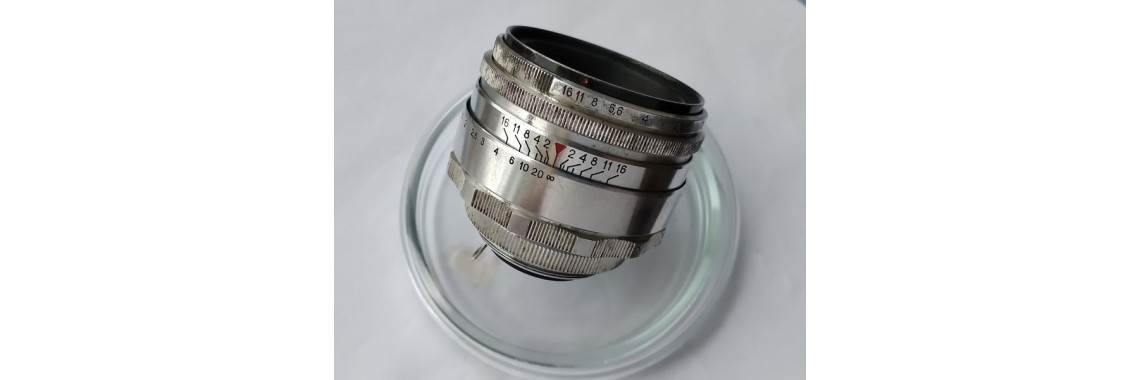
Helios-44 58mm f/2 M39: Helicoid Service of the Thirteen-Blade Biotar Copy
"A focusing mount is a screw thread that must stay sweet for half a century. Mark it before it parts, clean it to bare metal, and give it only as much grease as it needs."
— Notes from the repair bench
The earlier account of overhauling the Industar-50 drew a lively response, so without a long preamble, here is the service of a lens much sought after by photographers working in an artistic vein: the Helios-44. The example on the bench is the version made for cameras with the M39×1 mounting thread and a flange focal distance of 45.2 mm. Its defining feature is a diaphragm of thirteen blades, which gives the out-of-focus zone a particular character. Later series of the Helios-44 repeat the mechanics of this lens, so once the disassembly and assembly of the Helios-44 M39 are understood, the same work is easily done on the Helios-44-2 with the M42×1 thread and 45.5 mm register.
A Copy of the Zeiss Biotar
The Helios-44 is a copy of the Zeiss Biotar 2/58 and entered Soviet production in 1958. The two optical diagrams below show how closely the Soviet lens follows its German original.
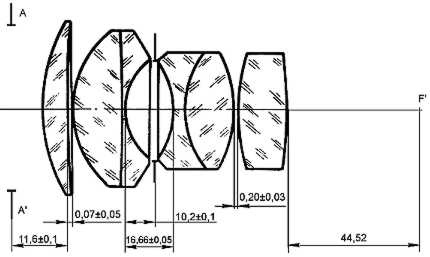
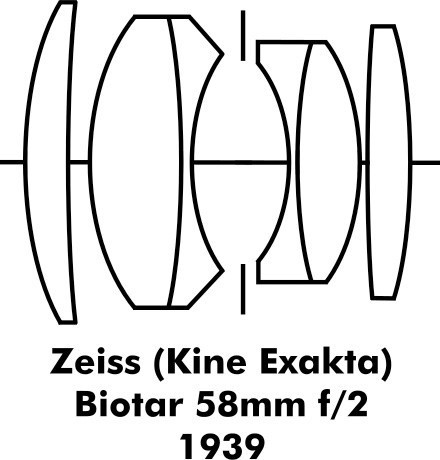
The Helios-44 was first fitted to the Start camera. That version had an automatic diaphragm mechanism and practically repeated the solutions used in the Kine Exakta. It is still regarded as the best of the whole Helios-44 family: mechanics and photographers know that its elements were numbered, selected and matched individually for each lens. That is why Helios-44 enthusiasts transplant optical blocks from the Start into barrels compatible with their own cameras. The Helios-44 M39 described here is interesting for its many-bladed diaphragm.
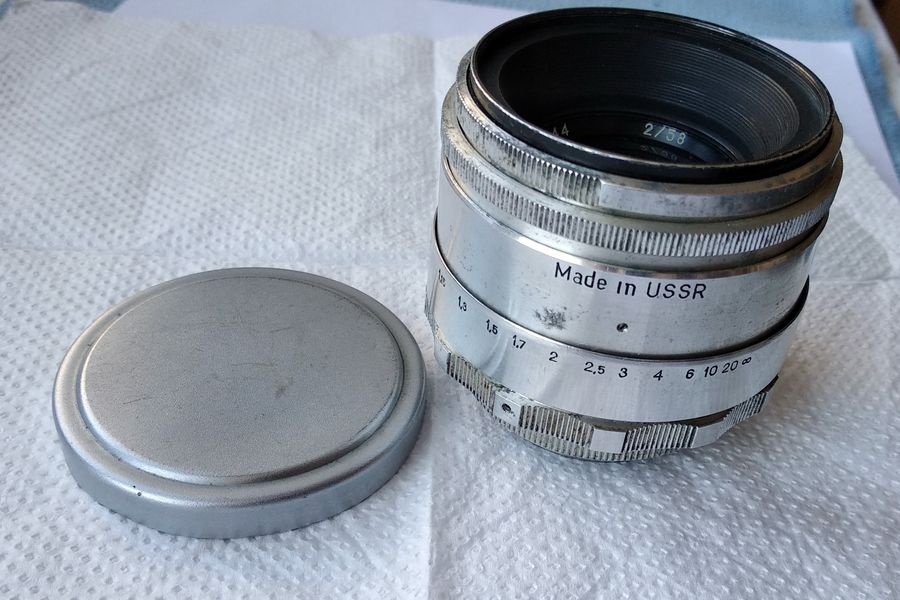
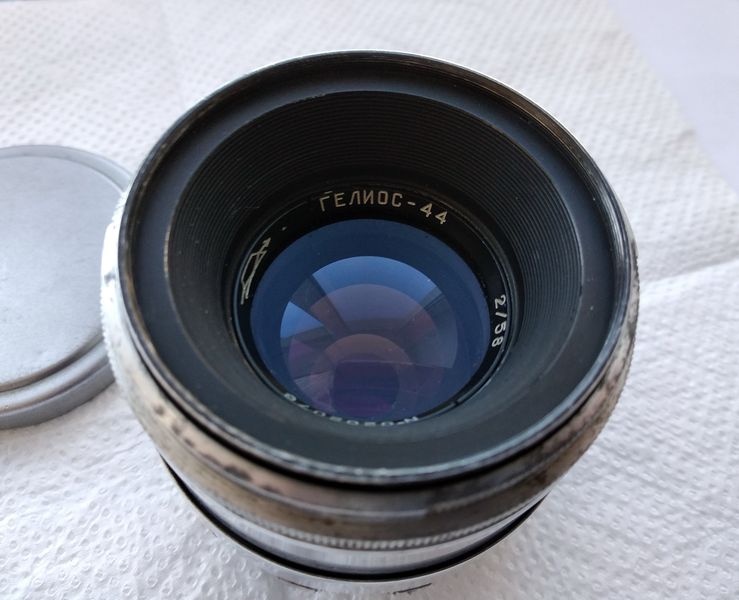
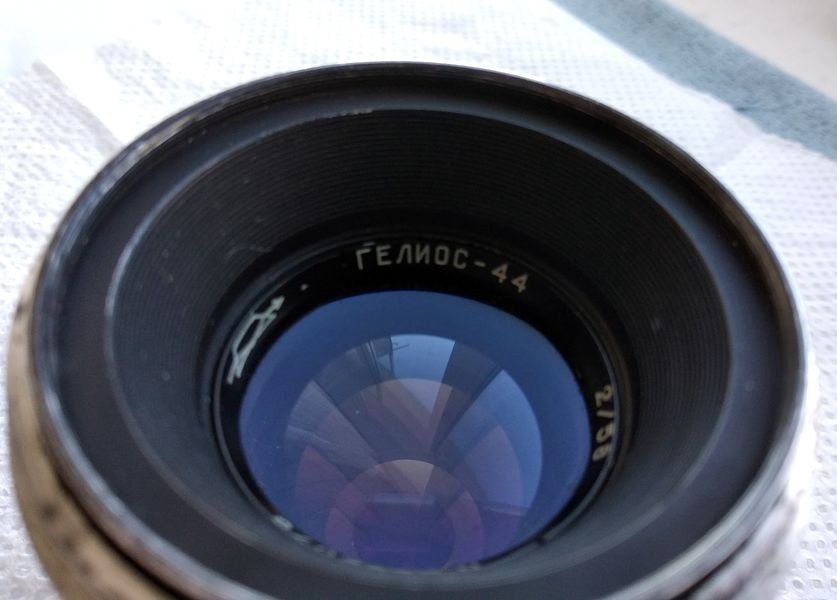
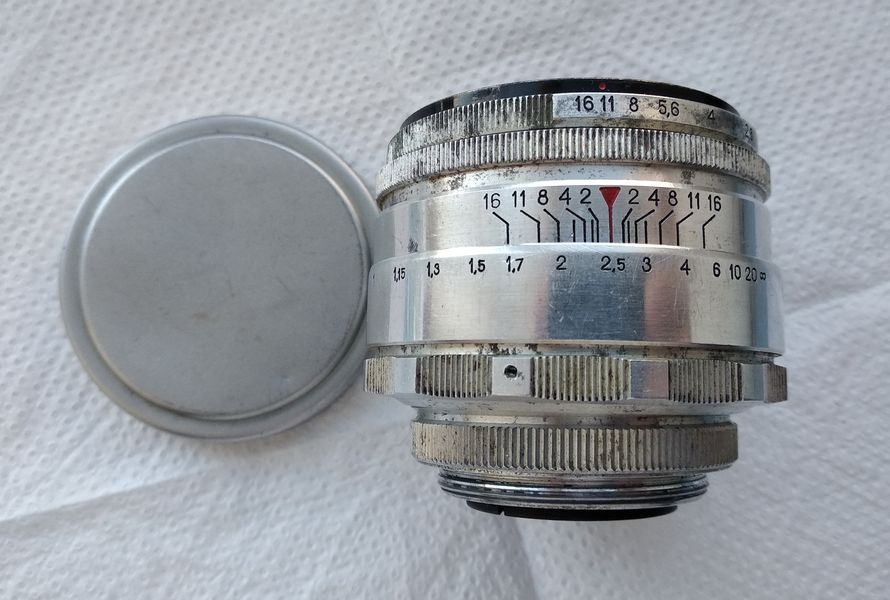
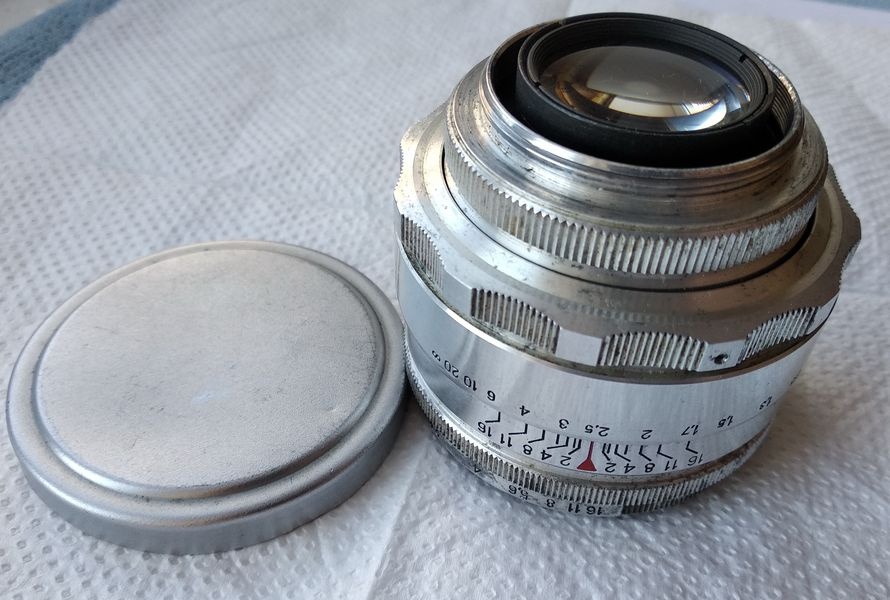
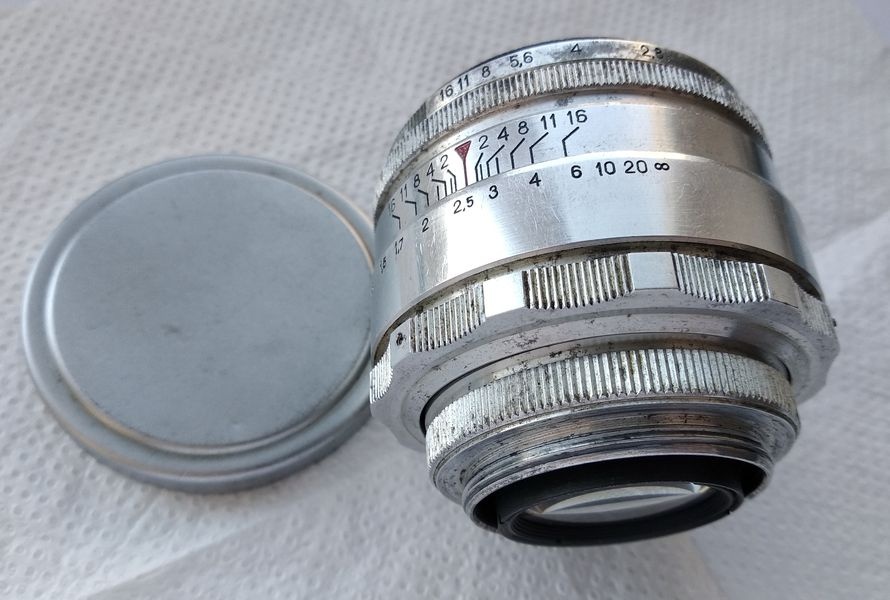
Now to the work itself. Focusing on this example is difficult: the ring moves in jerks, the characteristic sign of a contaminated helicoid thread and missing lubricant. The lens will be partly disassembled, the thread cleaned and the grease replaced. The optical block needs no attention. Despite its somewhat worn appearance, the lens has lost none of its photographic quality. This is how it looks on arrival.
Separating the Optical Block
The lens consists of two units. The helicoid unit mounts the lens on the camera and focuses it. The optical block holds the lenses themselves, the diaphragm mechanism and the diaphragm control. Taking the optical block apart is strongly discouraged and is justified only as a last resort, for example when the elements and diaphragm blades are heavily contaminated with oil. Even then it must be remembered that such an intervention always disturbs the positioning of the elements and changes the photographic properties of the lens, and it should not be attempted without sufficient experience.
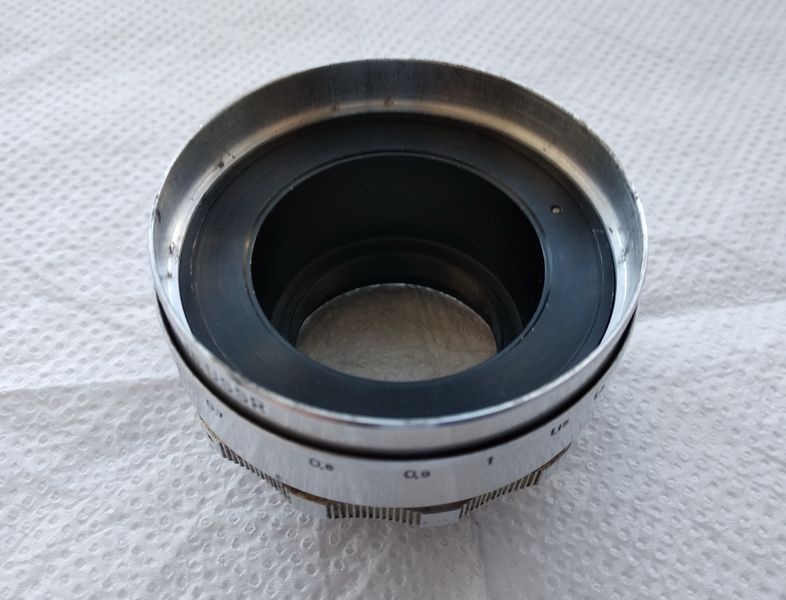
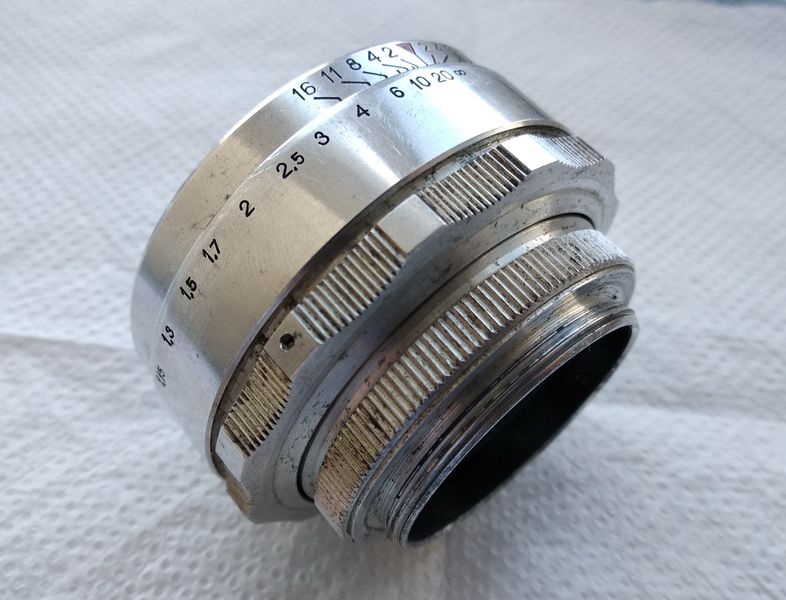
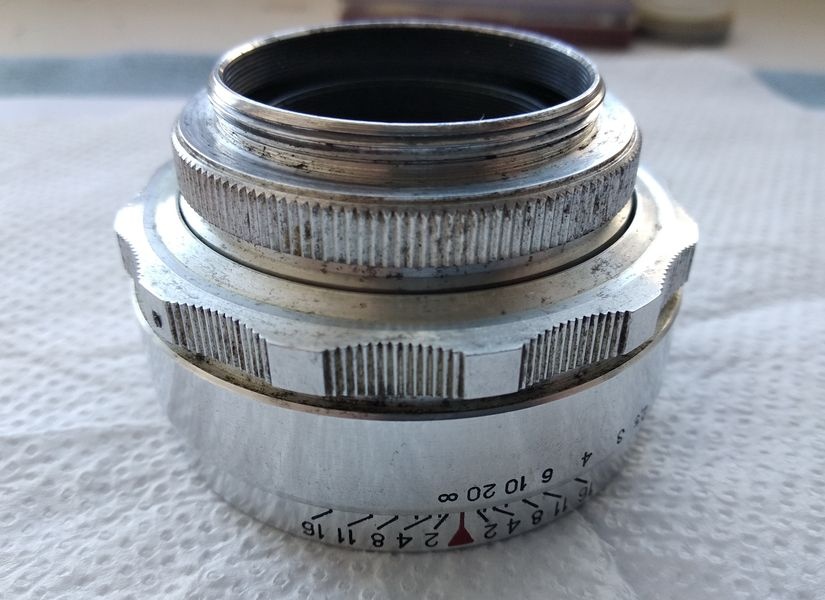
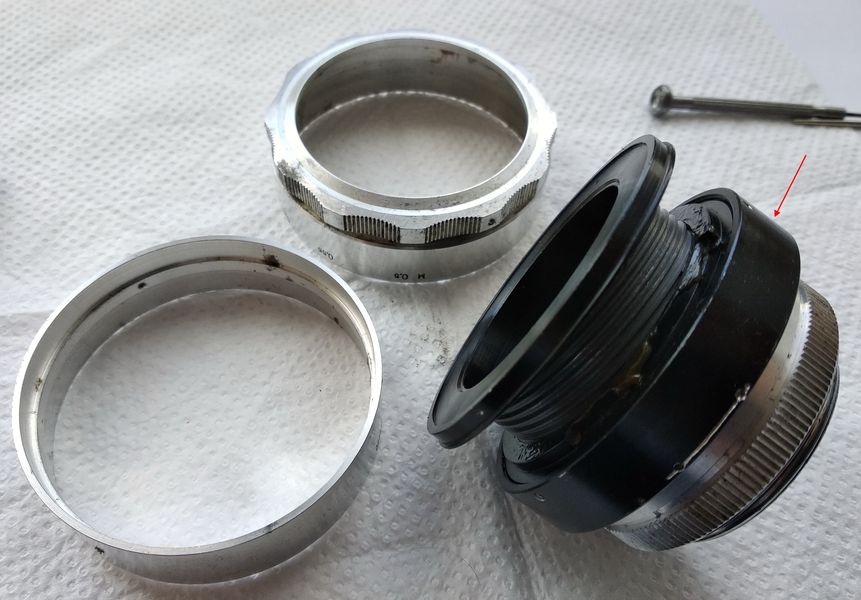
The first step is to separate the focusing unit from the optical block. The lens is held by its tail, the part that fits the camera, in the left hand, while the right hand grips the front of the lens and turns it counterclockwise with some force. The optical block sits on a tight fit and is secured by nothing else, so it simply unscrews from the focusing unit, as the photograph shows.
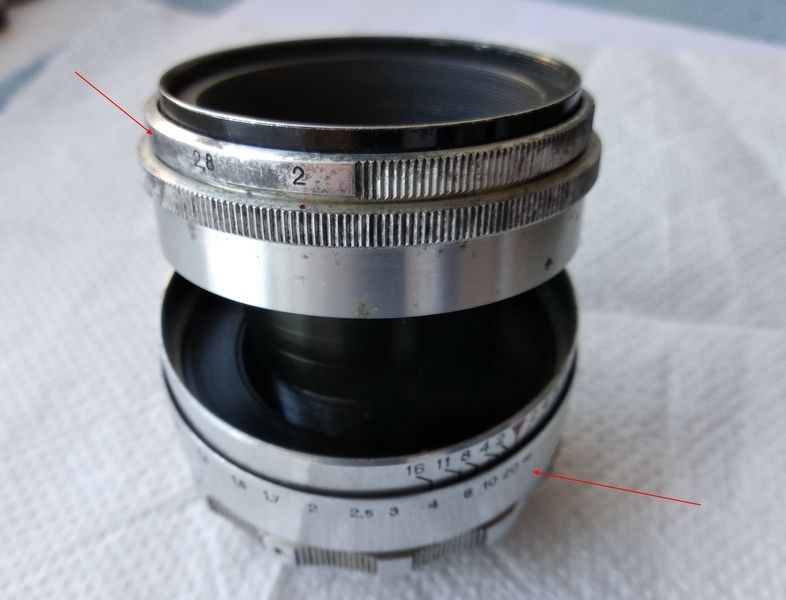
On the left is the optical block with its adjusting shim, marked with a red arrow; on the right is the helicoid unit.
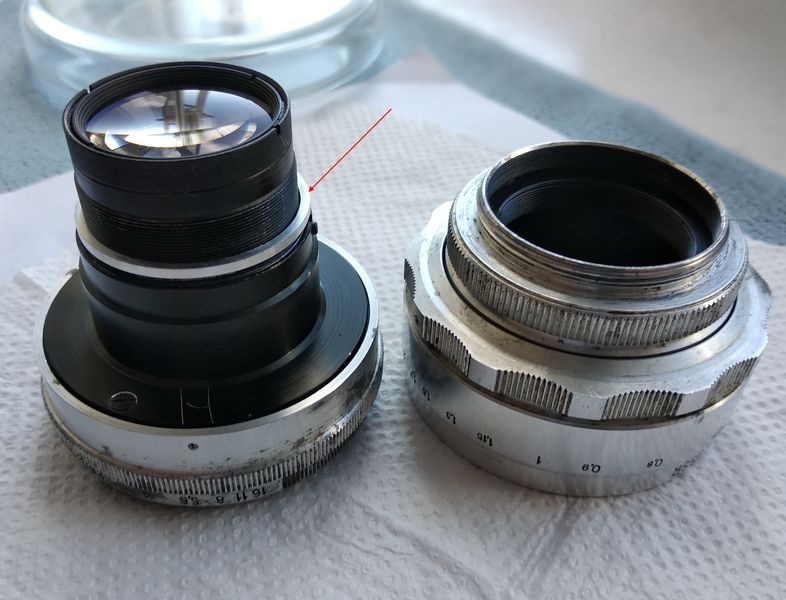
This is the adjusting shim.
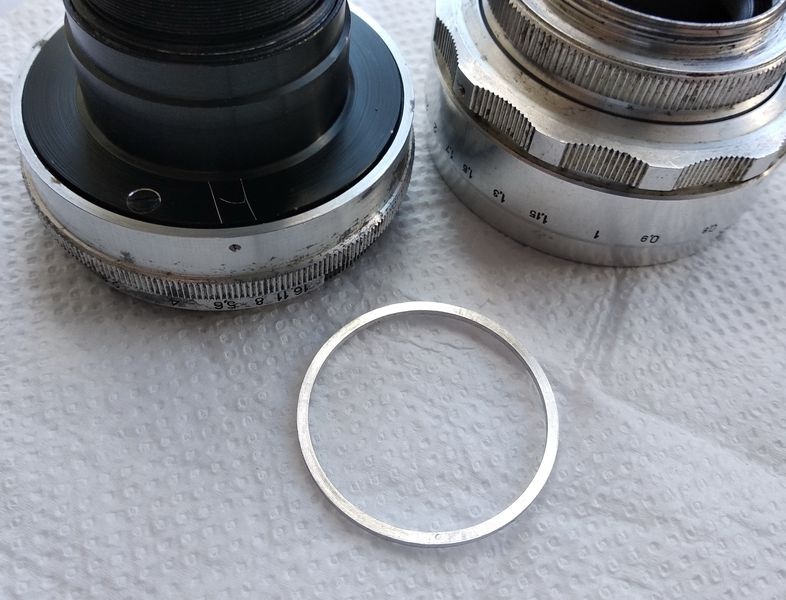
And this is the helicoid unit.
Dismantling the Helicoid Unit
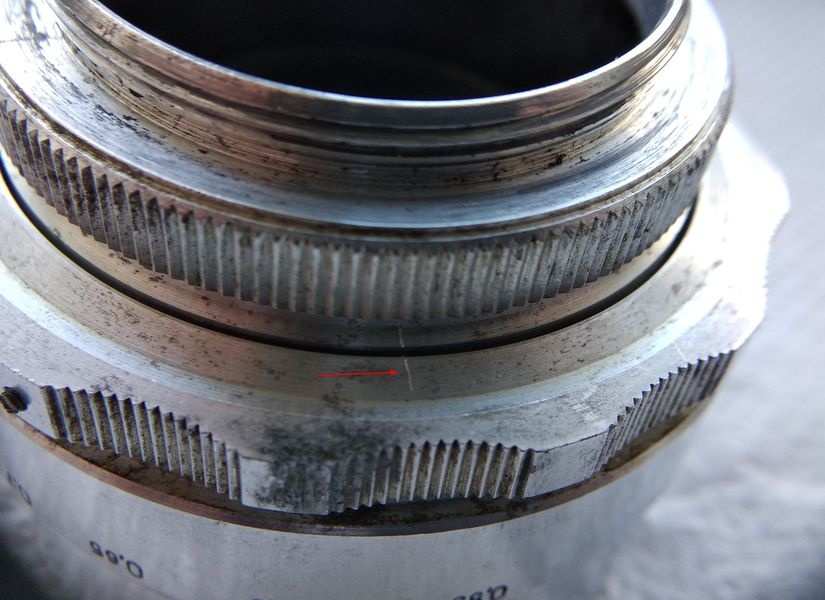
Before anything comes apart, a mark is made across the mating parts.
The focusing ring is then removed. This opens access to the large black ring that holds the tail, and part of the helicoid thread with its contaminated grease comes into view.
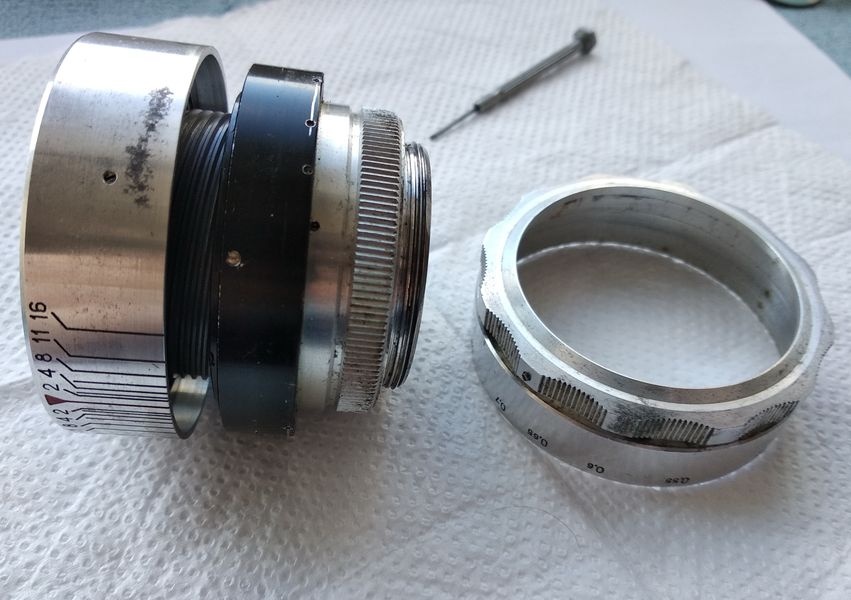
More marks are scribed. First on the body.
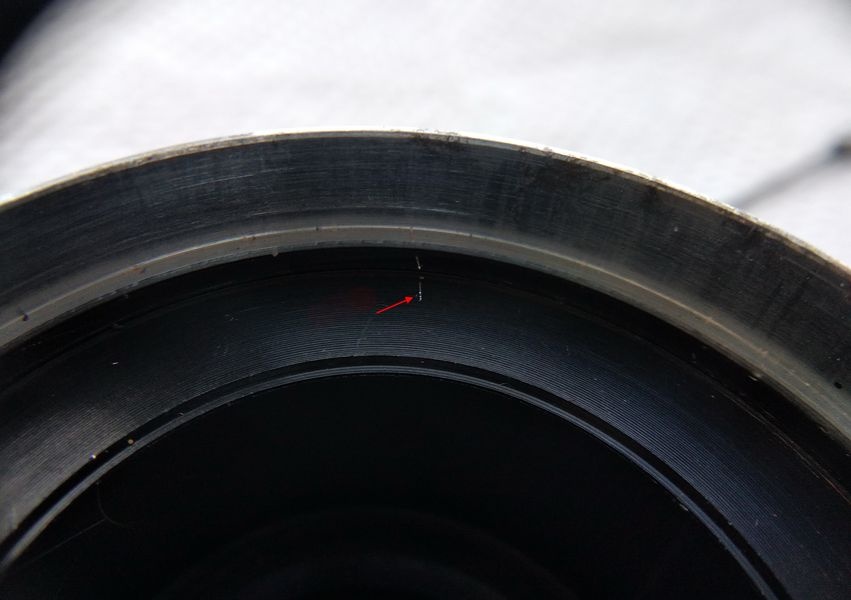
Then on the large ring.
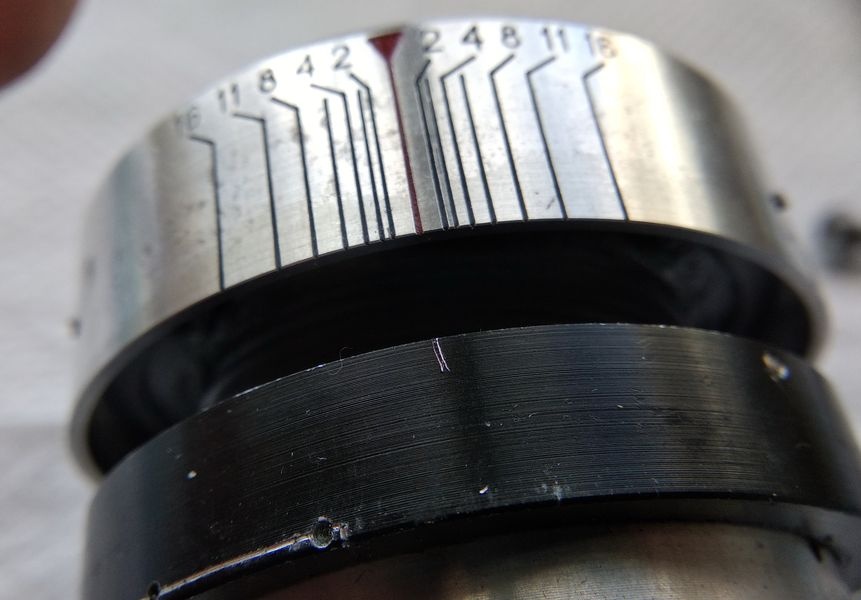
Now the tail-retaining ring can be removed. The three screws spaced around it are released, and the ring is unscrewed counterclockwise. This is a fine single-start thread, so there is no risk of refitting it wrongly.
Even so, a reference line is scribed to show how far the part must be tightened on reassembly.
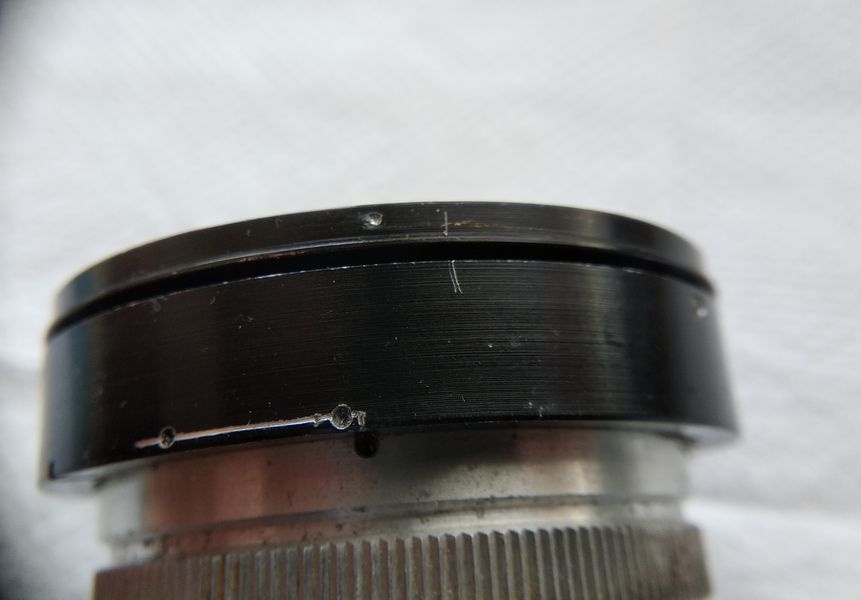
Only then is the ring removed…
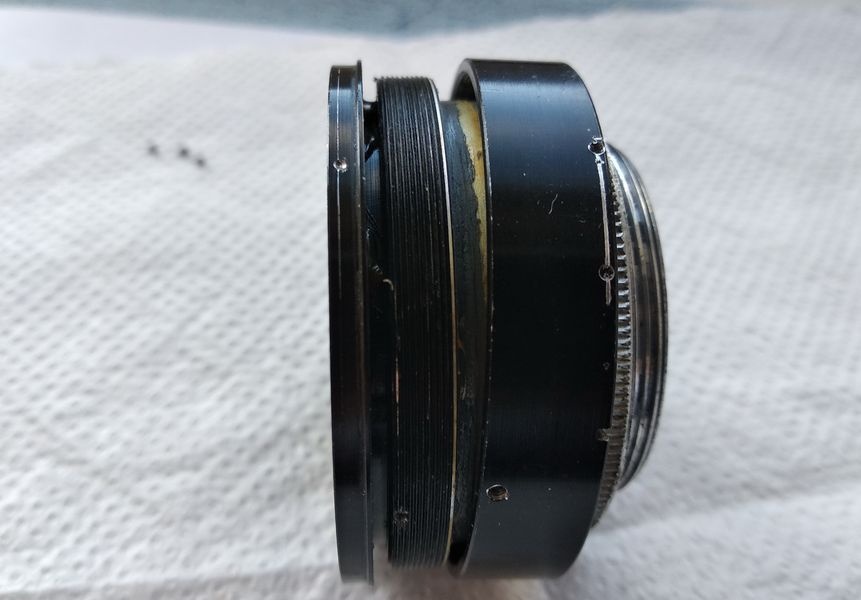
…followed by the tail of the lens, sometimes also called the shank. A guide slot is cut on the inner side of the tail, and a guide screw runs in it.
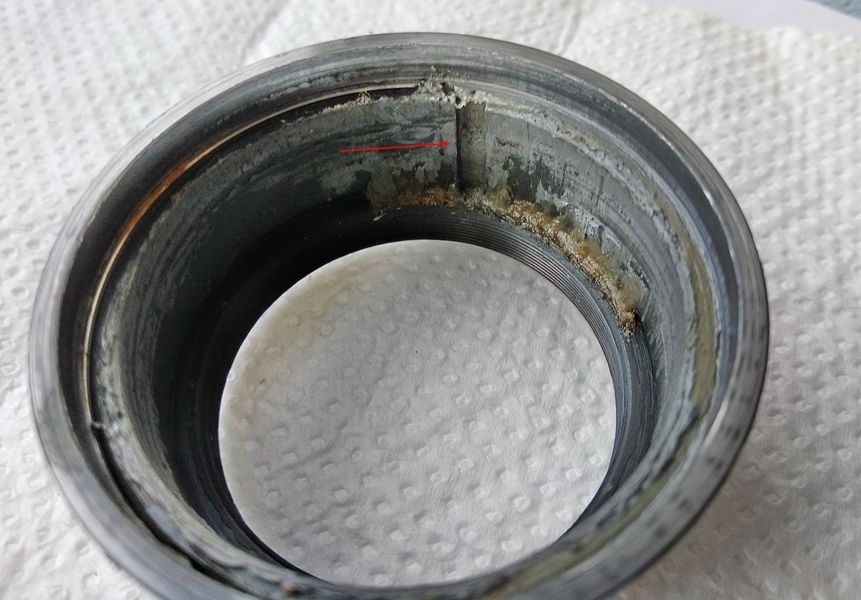
Here is that screw. The dirt had to be wiped off with a cloth first; under it the screw could not even be found.
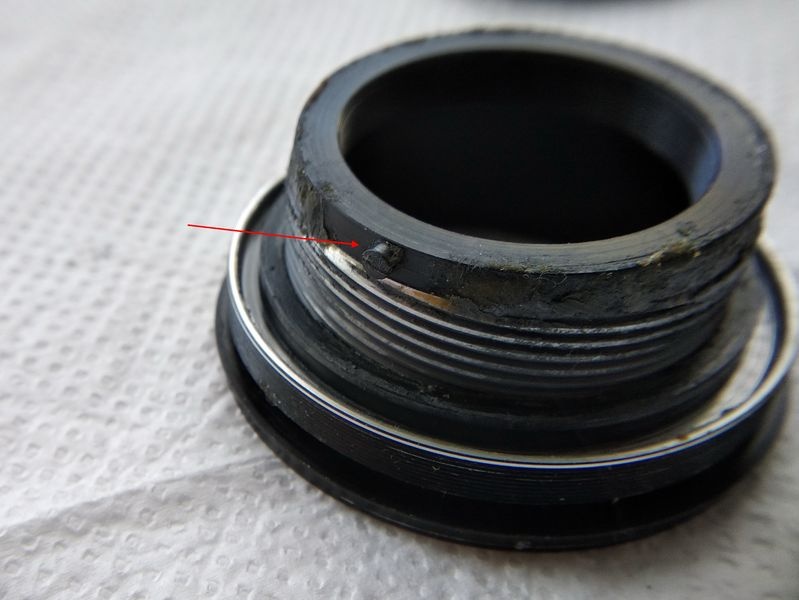
To dismantle the helicoid, the screw has to come out, and so it does.
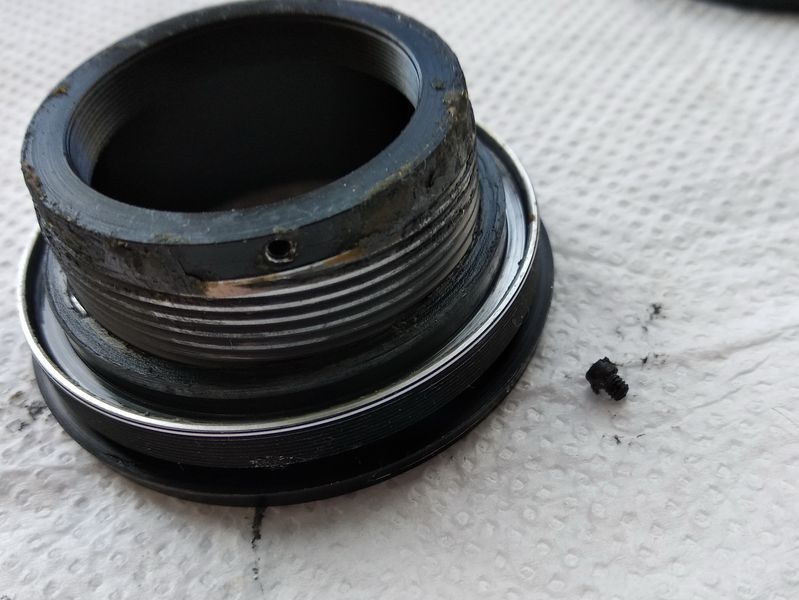
Marks are scribed again, this time with the helicoid against its infinity stop…
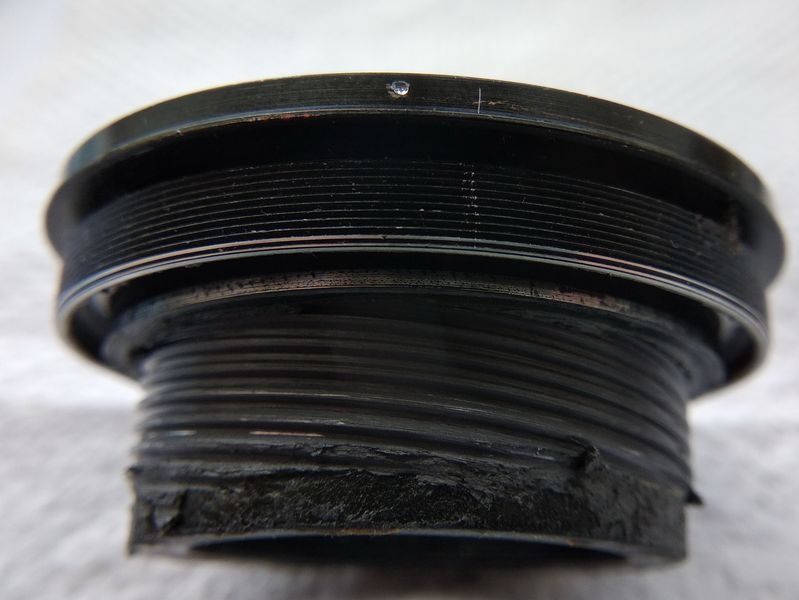
…and at the point where the outer helicoid ring comes off its thread.
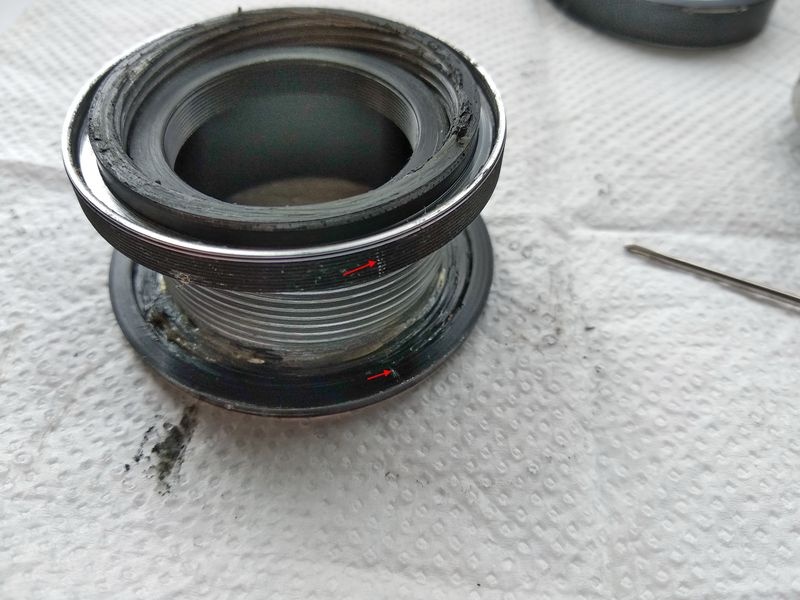
That is all. The focusing unit is fully dismantled.
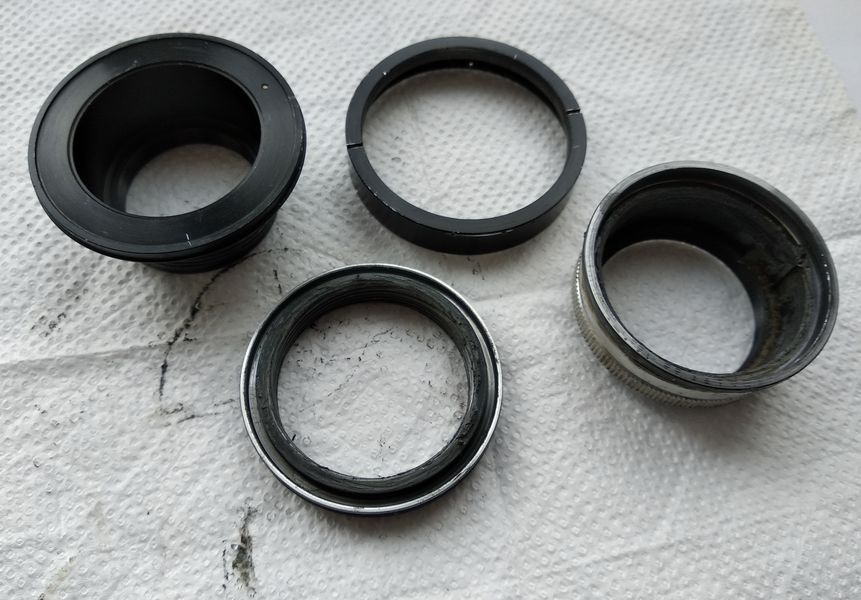
Washing
As the old children's rhyme has it, open up the tap and wash your nose and both eyes too. As can be seen, there is plenty to wash off. A good deal of benzine seems to go on lenses; a whole tray of it. The thought of putting everything in the ultrasonic cleaner did come up, but the prospect of then having to clean the ultrasonic bath itself after all that grime was not appealing. This way is better: the parts come out cleaner, and the bath stays clean for more delicate work.
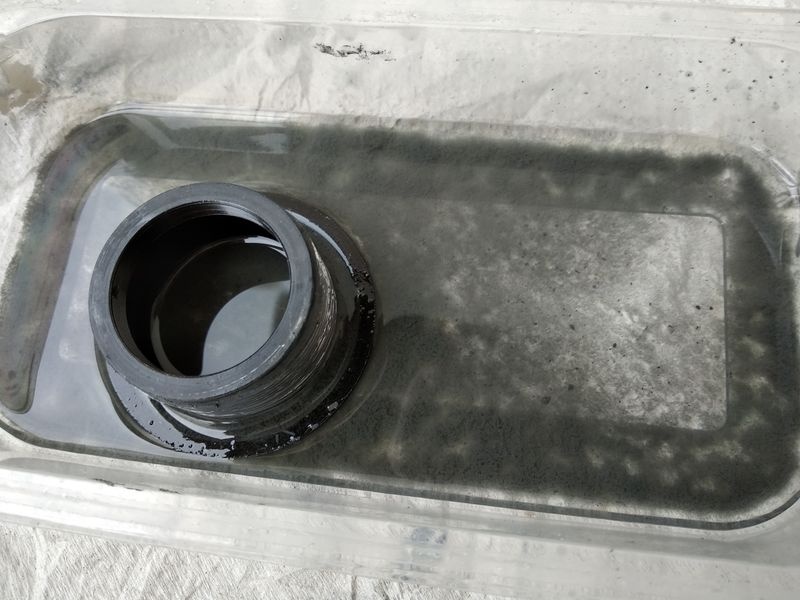
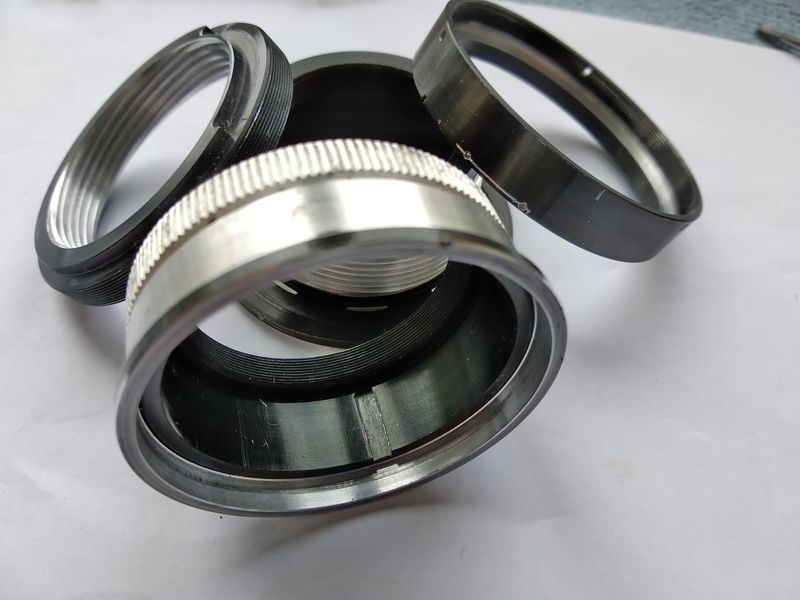
And here everything is clean.
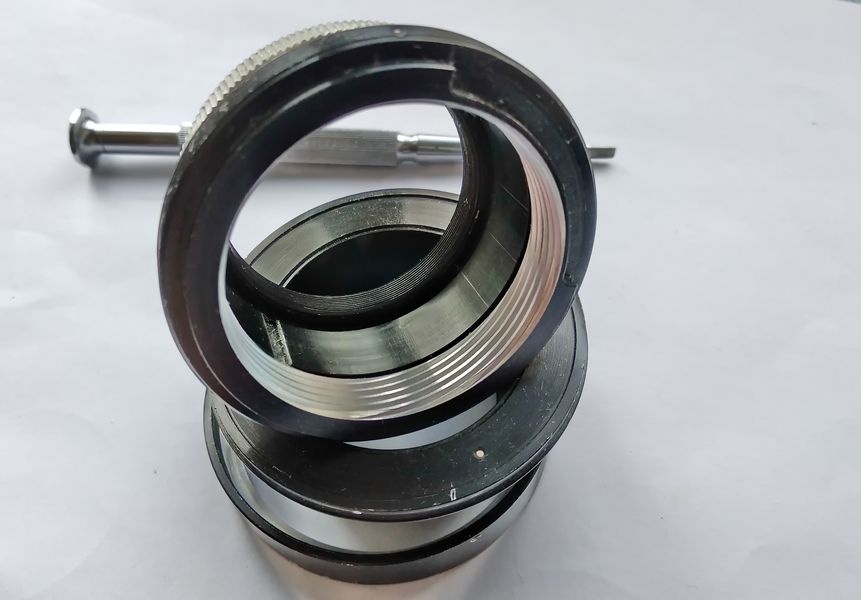
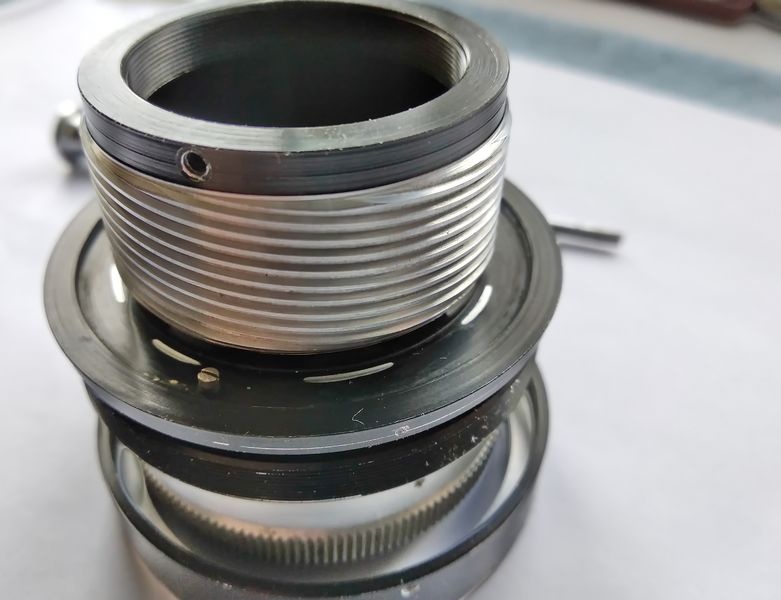
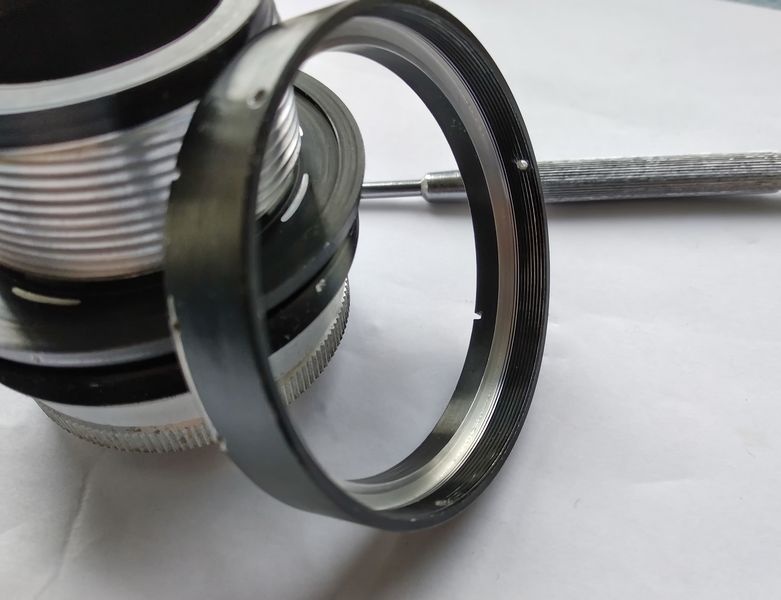
Reassembly
Assembly can begin, but first two warnings.
First, never try to assemble the helicoid thread dry, without grease. If it seizes, getting it apart again will be very, very difficult.
Second, never put grease on the static threads intended only for fastening. The parts will stick on the grease, and unscrewing them later will be very hard and sometimes impossible.
So, grease is applied to the multi-start helicoid thread. This much, and no more.
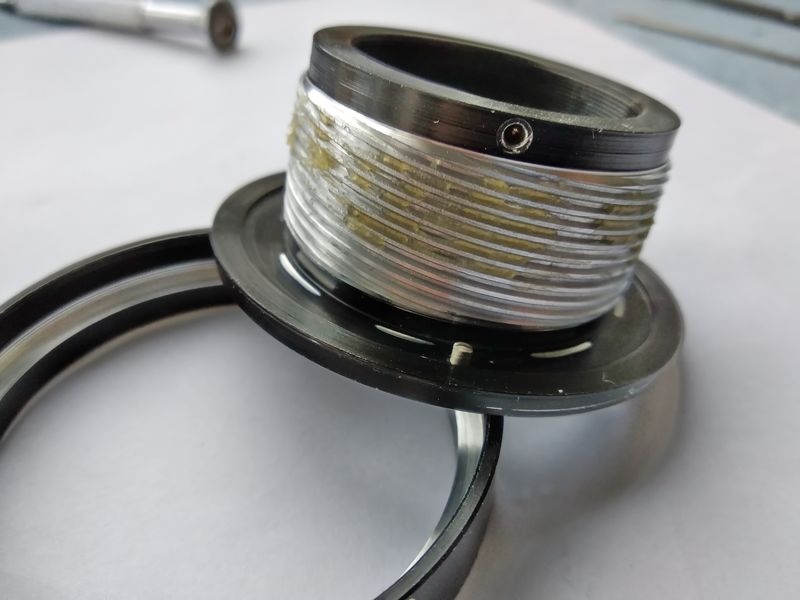
With the marks aligned, the outer helicoid ring is screwed onto the thread…
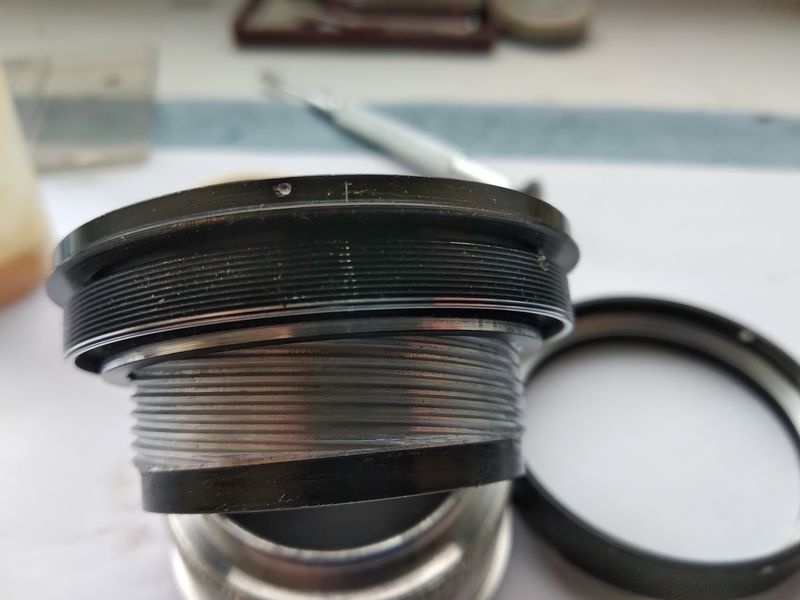
…the combined stop and guide screw is screwed back in, and its head is greased.
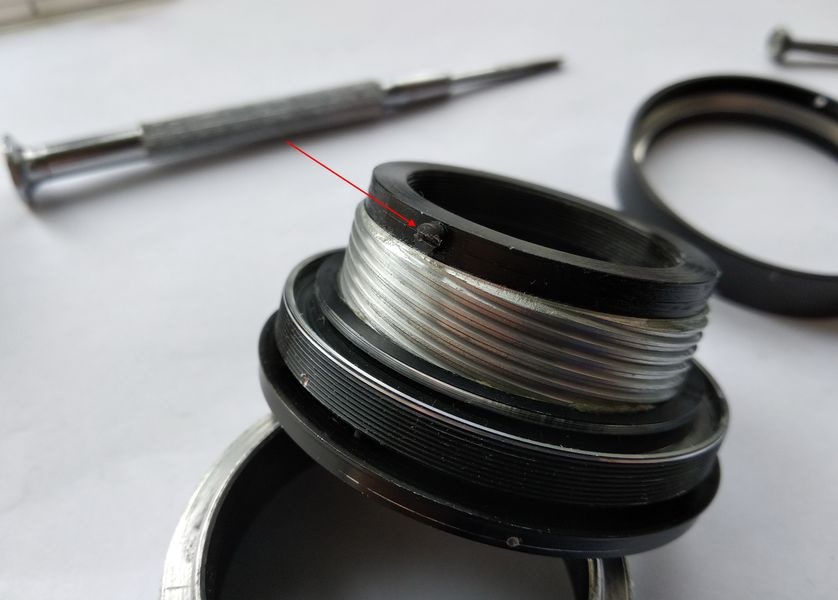
Grease is put into the guide slot of the tail.
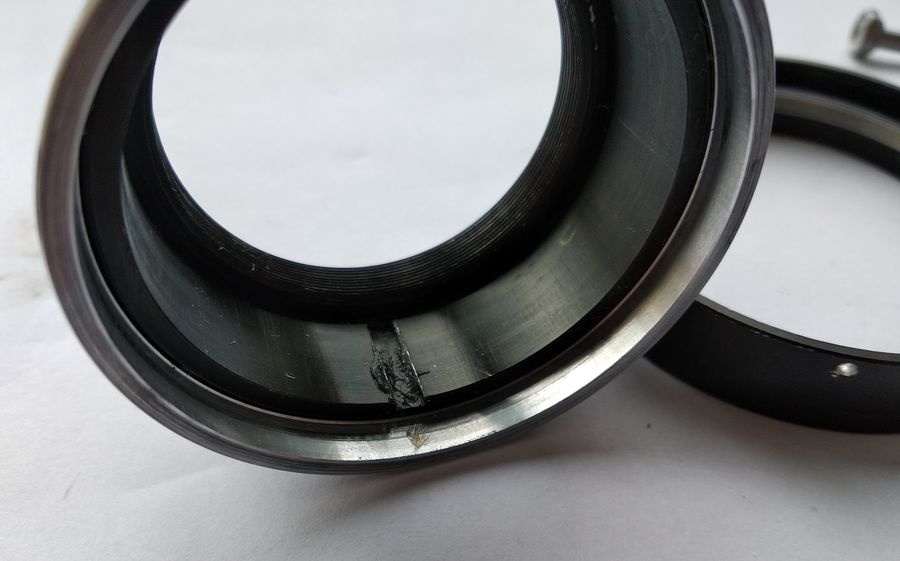
The tail goes back in place.
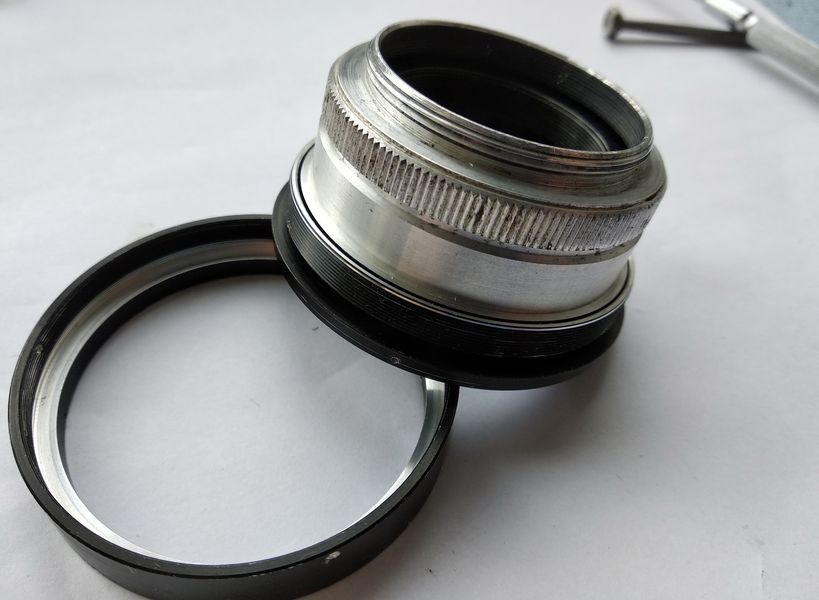
The tail is secured by screwing on the large ring, which is then locked with its three screws.
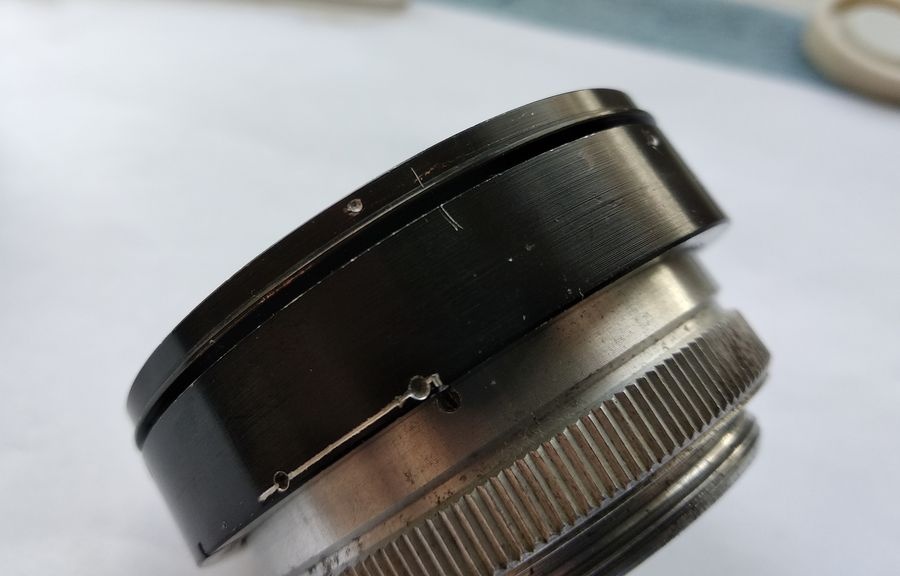
The helicoid action is checked. Note the thread: practically no grease can be seen on it. That is how it should be.
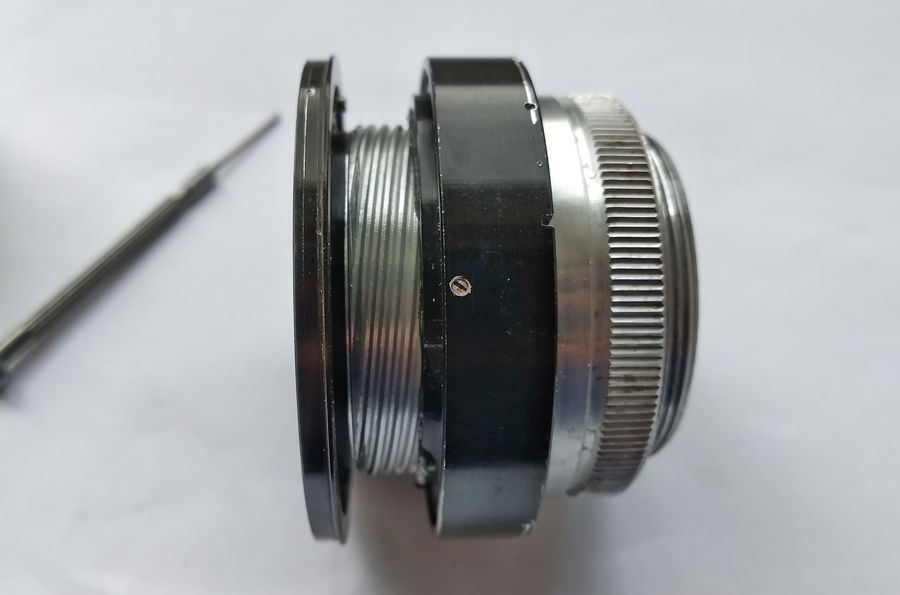
Using the marks made earlier, the rings carrying the scales are fitted.
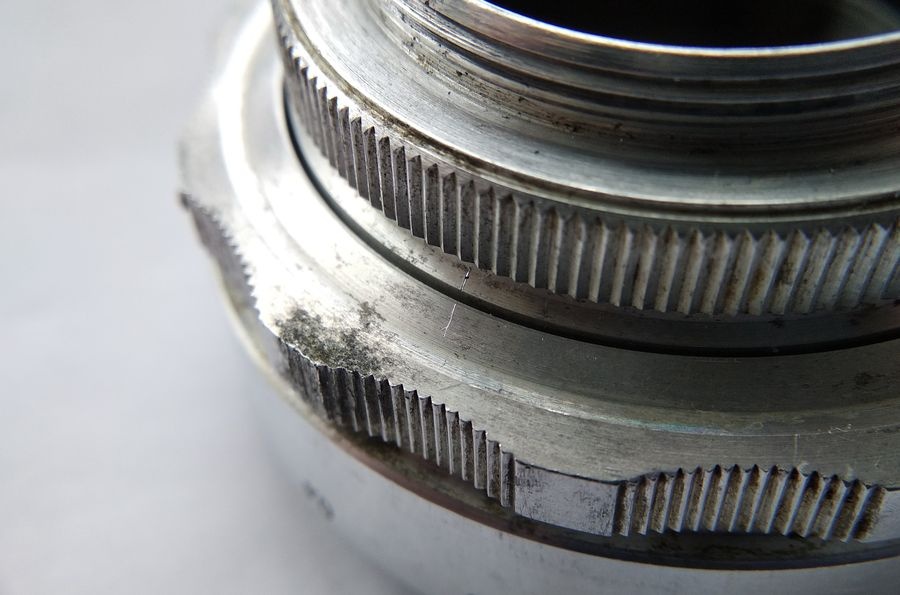
The scales are checked against their indices.
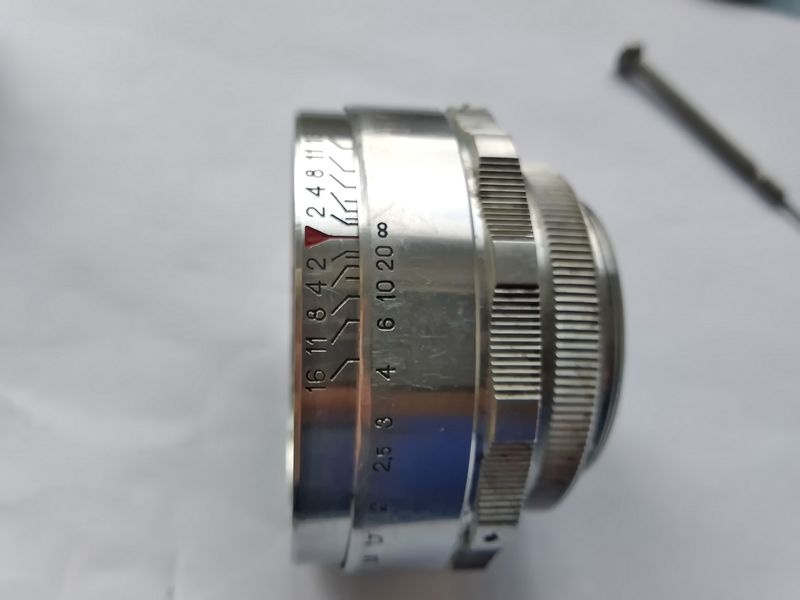
Remembering the adjusting shim, the optical block is screwed in until the red dot on the aperture scale lines up with the red mark on the distance scale.
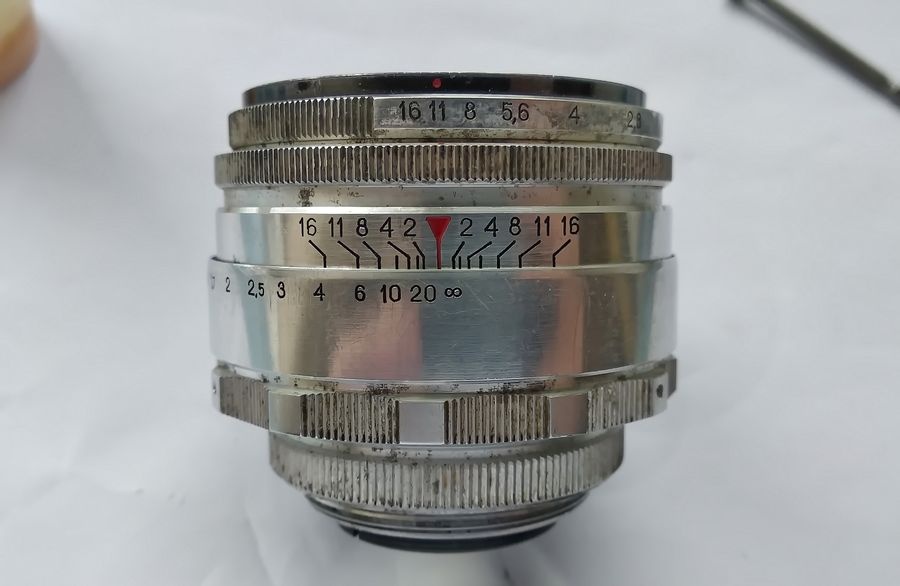
The lens is assembled. This is its front element…
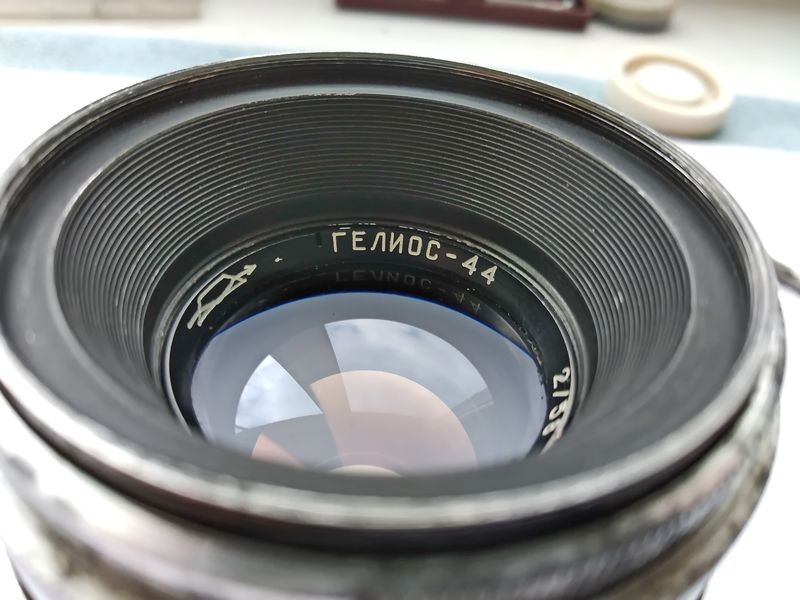
…and this is the rear. Yes, those were cleaned with candle soot too.
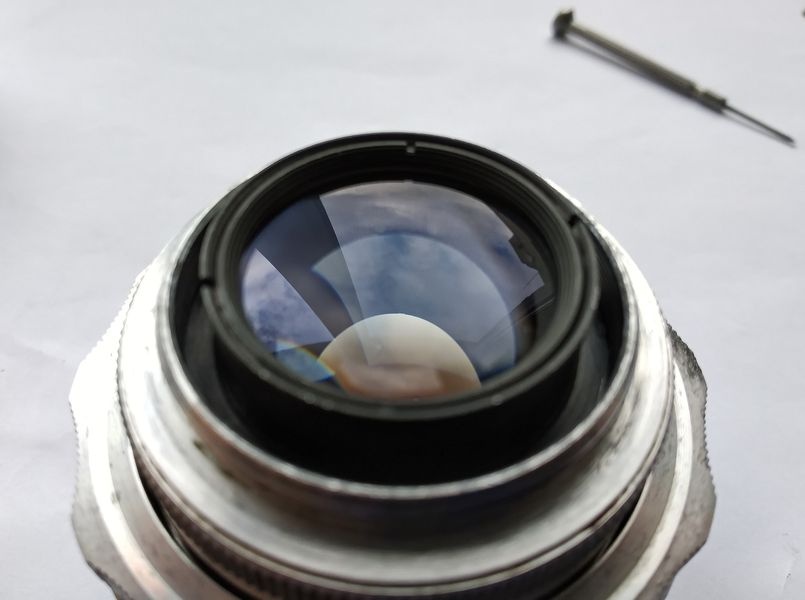
This is an illustration of how the lens can be used for macro photography with a mobile phone, simply by holding it against the phone like a close-up attachment lens.
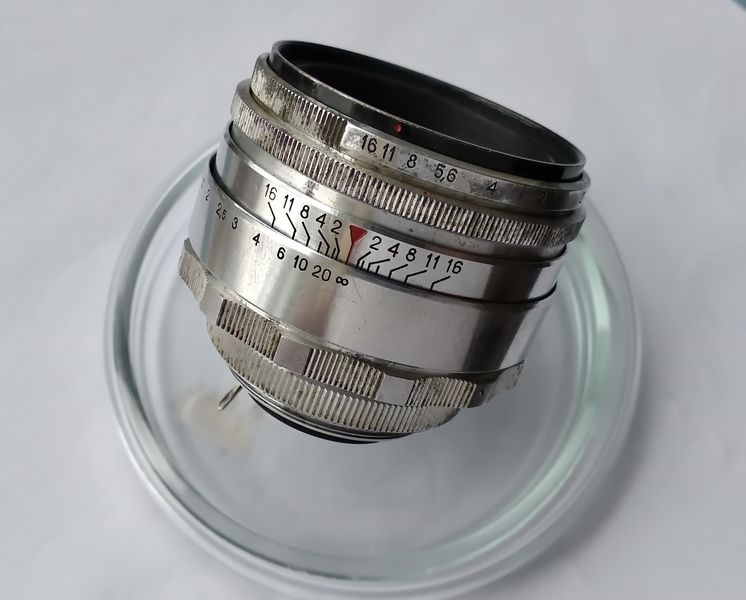
The lens fully assembled.
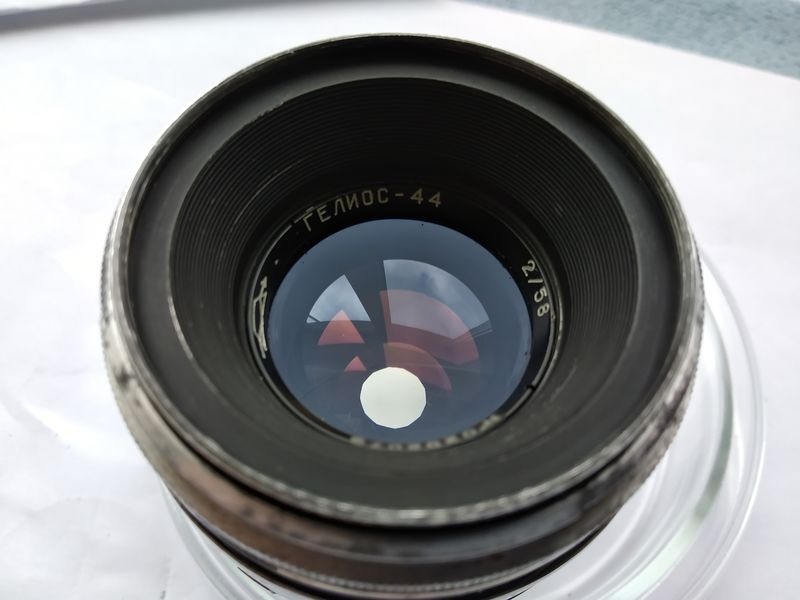
And here it is, the famous round diaphragm of thirteen blades.
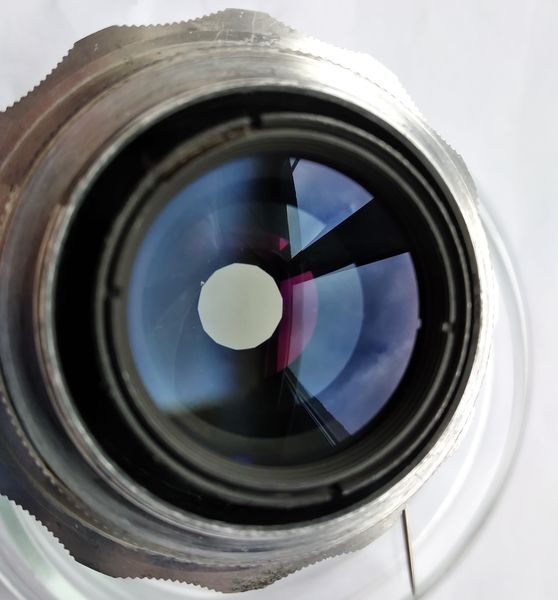
Welcome to a new life, old friend.
Comments
By tirarex · 13/03/2020
By Opacha · 13/03/2020 in reply to tirarex
By Soviet Box · 13/03/2020 in reply to Opacha
By Opacha · 13/03/2020 in reply to Soviet Box
By Soviet Box · 13/03/2020 in reply to Opacha
An army inspection is under way. A general walks into the barracks and looks around. Spotless, nothing to find fault with. He calls the sergeant major.
"Well done, sergeant major! What rule do you live by?"
"'Cleanliness is the key to health,' comrade general."
The general goes into the arms room and orders the rifle rack moved aside. They move it, and there is a cigarette butt. He calls the sergeant major again.
"Sergeant major, and what rule do you live by here?"
"Well, comrade general, a pig will find dirt anywhere!"
Something like that.
By tirarex · 14/03/2020 in reply to Soviet Box
By Soviet Box · 14/03/2020 in reply to tirarex
By tirarex · 14/03/2020 in reply to Soviet Box
By boyscout · 14/03/2020 in reply to Soviet Box
On the other hand, with what measure ye mete, it shall be measured to you again. And the giving hand will never fail.
By OreSama · 13/03/2020 in reply to Opacha
By Professore · 13/03/2020 in reply to Opacha
By consumewhore · 14/03/2020 in reply to Professore
By Professore · 16/03/2020 in reply to consumewhore
You look at a scratched lens with a continuous fine web on the outer elements, with leaching spots on the coating from rainwater, and you cannot understand how it was used, what could be seen through it, what internal reflections and flare it had, how much the glass absorbed, what its color cast was. Something incomprehensible and useless for knowledge just sits there: do not touch, do not think. Only the outer shell. The man in a case.
By Asteroth · 13/03/2020
By Soviet Box · 13/03/2020 in reply to Asteroth
By I_m_possible · 13/03/2020
By Soviet Box · 13/03/2020 in reply to I_m_possible
By jeepeg · 13/03/2020
By Soviet Box · 13/03/2020 in reply to jeepeg
By Oswald · 13/03/2020
By BanZay_Pro · 13/03/2020 in reply to Oswald
By Asteroth · 13/03/2020 in reply to BanZay_Pro
By Soviet Box · 13/03/2020 in reply to Asteroth
By Asteroth · 13/03/2020 in reply to Soviet Box
By Soviet Box · 13/03/2020 in reply to Asteroth
By karabas7650 · 13/03/2020 in reply to BanZay_Pro
By Oswald · 13/03/2020 in reply to BanZay_Pro
By Stranger12 · 13/03/2020 in reply to Oswald
Yes, except the quality of those pictures was rubbish. To make a decent photo that you were not ashamed to print larger than 10×15, you needed expensive equipment and materials. You could not buy them on one salary, as you can now (or even less: it is easy to invest 20 to 30 thousand). "nostalgia and a piece of life"
That is true, though. Back then it was magic; now it is routine.
By Professore · 16/03/2020 in reply to Stranger12
By Soviet Box · 16/03/2020 in reply to Professore
We have drifted off topic again…
By Professore · 16/03/2020 in reply to Soviet Box
By wired · 13/03/2020 in reply to BanZay_Pro
By Asteroth · 13/03/2020 in reply to Oswald
By FlyingRat · 13/03/2020 in reply to Asteroth
By Asteroth · 13/03/2020 in reply to FlyingRat
By Soviet Box · 13/03/2020 in reply to FlyingRat
By FlyingRat · 13/03/2020 in reply to Soviet Box
By DDimann · 13/03/2020 in reply to Soviet Box
By Tolan · 13/03/2020 in reply to Soviet Box
By ddonkeyhot · 11/06/2025 in reply to Soviet Box
By Lightaction · 14/03/2020 in reply to FlyingRat
By Soviet Box · 14/03/2020 in reply to Lightaction
By Lightaction · 14/03/2020 in reply to Soviet Box
"Taking orders," she wrote on social media. Then she thought and added: "Some dates still available." And after more reflection: "Shooting in Paris in June, in the Antilles in August." She had long liked the word "Antilles", and she had been to Paris with her mother last summer.
But that seemed too little. She needed a pseudonym. Short and at the same time mysterious. Vera Verina, she came up with. Wild, ardent and bright. She looked at herself in the mirror. "I need to dye my hair. Fiery red!" And sneakers. And piercings. And smoking.
"A camera!" Vera suddenly remembered.
By boyscout · 15/03/2020 in reply to Soviet Box
Please explain. I am curious.
By Professore · 16/03/2020 in reply to Soviet Box
By vigera · 14/03/2020 in reply to Lightaction
I have always wondered how often people look at their photos that seem to them close to perfection, made with all the tricks and nuances described above. Who is all that effort for? To satisfy the inner perfectionist, or external perfectionists who make up a tiny fraction of a percent of the total audience that viewed the photo (especially a "barbecue photo")? And that is if even one real lover of looking at photographs turns up in that barbecue crowd at all…
By Stranger12 · 13/03/2020 in reply to Asteroth
Hard to say; top smartphones take quite decent pictures. They look good even in a large format. And they shoot better than many digital point-and-shoots. The other thing is that for many people this is expensive. A DSLR with comparable or even better quality will cost several times less.
By Asteroth · 13/03/2020 in reply to Stranger12
Um… photo quality depends very, very heavily on the glass, perhaps even more than on the sensor. And the same Zeiss 200/2.8 for Sony costs over 70 thousand rubles.
By Stranger12 · 13/03/2020 in reply to Asteroth
That is a big misconception. In most shooting conditions, without studying the details at length, you will not notice the difference between lenses whose prices differ by two orders of magnitude (100 times).
By BanZay_Pro · 13/03/2020 in reply to Asteroth
By OreSama · 13/03/2020 in reply to Oswald
By Oswald · 13/03/2020 in reply to OreSama
By Oswald · 13/03/2020 in reply to Oswald
By the way, I wonder what has become of those technologies
By OreSama · 13/03/2020 in reply to Oswald
The same as 8 years ago. They do not exist.
By Oswald · 13/03/2020 in reply to OreSama
By ololonewolf · 13/03/2020 in reply to Oswald
By boyscout · 14/03/2020 in reply to ololonewolf
What, does AI really change the geometry of the frame? Or is this about focusing? I was surprised by the equivalent focal length on the Honor 10i camera with AI. The last line: [attached image no longer available]
By ololonewolf · 24/03/2020 in reply to boyscout
By boyscout · 24/03/2020 in reply to ololonewolf
By boyscout · 25/03/2020 in reply to boyscout
By Professore · 16/03/2020 in reply to ololonewolf
By ololonewolf · 24/03/2020 in reply to Professore
By vlandus · 16/03/2020 in reply to Oswald
By Soviet Box · 16/03/2020 in reply to vlandus
Only why are there still masses of film of every format on the shelves, why can you still buy in any kiosk or shop… you will not believe it, a disposable camera loaded with film? Interesting, isn't it?
By Professore · 16/03/2020 in reply to Soviet Box
By vlandus · 17/03/2020 in reply to Soviet Box
By Professore · 17/03/2020 in reply to vlandus
By vigera · 17/03/2020 in reply to Professore
In my view, in the hands of the young this is mostly hype, a wish to feel unique. In middle-aged and older people it is an ossified habit, an inability (and unwillingness) to master convenient new technologies.
By vlandus · 17/03/2020 in reply to Professore
By vigera · 17/03/2020 in reply to vlandus
In my view, during reading a book is only a tool for enjoying the meaning and style of a literary work! And that tool can be archaic, like a paper book that sometimes has to be leafed to the back for notes and references, with a primitive external bookmark and lighting in the dark, or modern, in the form of a thin, convenient electronic device that automatically remembers and restores where you stopped reading, can scroll the text automatically and has a backlight.
By habatuk · 13/03/2020
By Soviet Box · 13/03/2020 in reply to habatuk
By fant_asia · 13/03/2020 in reply to Soviet Box
By Soviet Box · 13/03/2020 in reply to fant_asia
By fant_asia · 13/03/2020 in reply to Soviet Box
By Soviet Box · 13/03/2020 in reply to fant_asia
By Tolan · 13/03/2020 in reply to Soviet Box
By Soviet Box · 13/03/2020 in reply to Tolan
By Soviet Box · 14/03/2020 in reply to fant_asia
If it is a personal request, then very soon :)
By Soviet Box · 14/03/2020 in reply to fant_asia
It is already here. Here you go! :)
By putrach · 14/03/2020 in reply to Soviet Box
By Soviet Box · 14/03/2020 in reply to putrach
By kotmorse · 13/03/2020
By Soviet Box · 13/03/2020 in reply to kotmorse
By OreSama · 13/03/2020 in reply to kotmorse
That must be a joke? Even the most mass-produced Helios can quite realistically be sold. You just need to set a realistic price, 500 rubles. "photographer friends laugh and say nobody needs it either"
The second result on Yandex. Of course nobody will buy it for a lot, because afterward they will have to fiddle with a lathe and find a helicoid somewhere.
By Asteroth · 13/03/2020 in reply to kotmorse
By Fire_bird · 13/03/2020 in reply to Asteroth
By DDimann · 13/03/2020 in reply to Fire_bird
By Fire_bird · 13/03/2020 in reply to DDimann
By Dzot · 14/03/2020 in reply to Fire_bird
By Stranger12 · 15/03/2020 in reply to Dzot
Why? Look at an example of a classic portrait. And imagine what would happen if the background were smeared. A portrait is a portrait so that it is beautiful. And the background plays an important role in building the picture. Yes, sometimes it makes sense to make the background soft. But that is a small share of portraits, especially group ones.
By boyscout · 15/03/2020 in reply to Stranger12
By Tolan · 13/03/2020 in reply to Asteroth
By Soviet Box · 13/03/2020 in reply to Asteroth
That is a portrait???
By DDimann · 13/03/2020 in reply to Soviet Box
You think three question marks are too few? I can add more… For me a portrait should have a background, but the emphasis should be on the faces. Otherwise it is "me in front of the Colosseum". The Colosseum is fine at least, a cultural monument of sorts, but a mother with two sisters in front of bottles is a cool photo for an eightieth birthday…
By Sintetik · 13/03/2020 in reply to kotmorse
By tuz_83 · 13/03/2020 in reply to kotmorse
First, people sell [listing no longer reachable] them, and second, people even buy them(!). The price is often around 2.5 to 3.5 thousand rubles. Personally I was not interested in buying or selling; since my Helios-44M-6 was lying idle, I had to put it to some use. I bought protective caps on AliExpress for the camera and for the lens [AliExpress listing no longer available], took off the standard lens and capped it against dust.
After that I decided to "play" with the lens on the cheapest CCTV camera (that is actually why I bought the rear lens caps: I wanted to cobble together a simple adapter from them).
Suddenly the Chinese, as always, upset all the plans: the camera turned out to be defective, the connection gets terribly hot. Alongside that camera I bought a "video peephole" from the same seller, which arrived fine, but here there seems to be a contact problem; the patient needs opening up…
P.S. If it were not for this lens, there would be no adventures for my backside, and without them life is "boring")))
By tuz_83 · 13/03/2020 in reply to tuz_83
By DDimann · 13/03/2020 in reply to tuz_83
Working distance: 100 mm. Here it is clearly more :)
By tuz_83 · 13/03/2020 in reply to DDimann
No, more like 150 to 200 mm, the reviews [a link to a review of the Eakins VGA/HDMI microscope] confirm it. But above 220 mm there is definitely nothing to be had, and here it is half a meter. USB lag means absolutely nothing for a visual inspection of boards from AliExpress and wiping them with isopropyl alcohol, and for soldering the Eakins is of course real-time. One does not get in the way of the other, and the main thing is that, unlike the Eakins, it takes no space on the desk.
By DrDave_one · 13/03/2020 in reply to kotmorse
By Fire_bird · 13/03/2020 in reply to kotmorse
By dimo · 13/03/2020 in reply to Fire_bird
By harm · 13/03/2020
By Kotozay · 13/03/2020
Take a plastic bottle, cut off the neck, pour in benzine, put the lens in the bottle. Put the bottle with the lens in the ultrasonic bath. The bath stays clean, less benzine is used, and everything gets cleaned
By Soviet Box · 13/03/2020 in reply to Kotozay
By Professore · 13/03/2020 in reply to Kotozay
By Ariva · 13/03/2020
By Gruffy · 13/03/2020
As for equipment in general. For 99.99% of people, this crossing of old glass(!) lenses with digital point-and-shoots, let alone with phones, is a needless absurdity. Just to amuse one's ego. Professionals and those associated with them know that each lens rendered in its own way, that all the great firms had their own signature, and so on. The difference is especially visible at high quality. The same scene shot with different lenses (of the same focal length, naturally) looked slightly different. Naturally, real quality starts with 6×6 film and up. Now, in the digital era, all these nuances have sunk into oblivion. All pictures are basically the same. They can be high-quality and beautiful, but there is no life in them. On the other hand, color photos used to be the domain of literally a handful of people, and today anyone can make them by the thousand. Only somehow quantity does not turn into quality.
By vigera · 13/03/2020 in reply to Gruffy
I agree completely! Photography was a big hobby of my father's in the 1970s, and our home collection then had no fewer than fifteen cameras, from the Kiev-30 to some plate camera from the early 20th century. About four of them were Zenit-E and EM with Helioses of various versions, and for a while it even seemed that there was nothing better in the world than the EM.
Until in 1975 Dad bought a Praktica LTL3 with a Pancolar MC lens. That is when it turned out how wrong we had been in judging the quality of Soviet photo equipment! And that was an East German product, good, but still of lower quality than Western equipment of the time…
By Professore · 13/03/2020 in reply to vigera
NOT lower in the same class and price! No, not even that: the price was extremely low, a direct challenge to and competitor of West Germany. East German optics and mechanics were the direct heir of Third Reich production, down to the drawings and developments of SLRs and lenses from the late 1930s. They simply could only realize them in the 1950s and 1960s. No wonder that after German reunification the West German competitor was destroyed (supposedly by the former owner), the workers and engineers fired, the factories razed and optics production moved to China and Japan. And in the USSR, Third Reich cameras and optics were churned out under their own names until the early 1980s, on Reich equipment and machine tools. What is more, joint development with the Germans based on those ideas made the Kiev-10 the first automatic SLR (automatic diaphragm), I think. In short, it grabbed a world prize.
By vigera · 13/03/2020 in reply to Professore
Back then I simply had nothing to compare with. But now I have no doubt that Dad's Praktica lost to its Western classmates both in size and weight (it was heavier and bulkier) and in the degree of automation (exposure was set semi-automatically, by matching a needle to a zero mark in the viewfinder by changing aperture or shutter speed, and film advance was manual). Pricing in the satellite states was not far removed from the Soviet kind and had little in common with the free market, so comparing the East German price of the time with that of West German products is simply silly! In the USSR it was in very short supply, although it cost much more than a Zenit-EM. Dad somehow managed to grab one at the state price in a Moscow store for about 700 rubles (which at the official rate was about $1,000, and at the black-market rate $230). For the mid-1970s this was simply huge money (the utilities for our two-room apartment never came to more than 7 rubles 50 kopecks a month, almost half of which went on the telephone).
By Professore · 16/03/2020 in reply to vigera
By vigera · 16/03/2020 in reply to Professore
You are mistaken about the price. I remember exactly that my father sold his Praktica LTL 3 with a Pancolar 1.8/50 Multi Coating about two years after buying it, for 650 rubles, and that was a little less (by about 20 rubles) than what he paid in the store.
By Professore · 16/03/2020 in reply to vigera
By Asteroth · 13/03/2020 in reply to Gruffy
And what are the new ones made of, not glass? And such lenses are usually crossed not with point-and-shoots and phones but with proper digital cameras. M42/M39 adapters exist now for every mount…
By Maxim_Sed · 13/03/2020 in reply to Asteroth
enough to play with for half an hour and then sell on Avito or OLX
By boyscout · 14/03/2020 in reply to Maxim_Sed
By Avgur · 17/03/2020 in reply to Gruffy
I do not quite agree. I used to think the same, since photography was comparable to art (especially with filters), given that you could not see the result immediately. But a few years ago I bought a Panasonic (inexpensive, with interchangeable lenses). My son uses it, and he took all my lenses (I kept both a Zenit and a FED as mementos) and shoots something with them. As he explained to me, one is convenient for macro, another for nature, and the standard lens is "rubbish")))))). There are still people who "want" to shoot with old lenses)))))).
By Soviet Box · 17/03/2020 in reply to Avgur
By Avgur · 18/03/2020 in reply to Soviet Box
))))) I cannot make him read literature (and it is too late now); chats, social networks, everything comes from there. But I like that he is not becoming an armchair strategist and is gaining his own experience (after discussing in chats). He does not like the standard lens and "cannot stand" automatic mode; he is happy with the former Soviet ones (I thought it was the other way round))))))). Huge thanks for your articles!!! I dream of "cleaning" my Industar using your method)))))).
By Soviet Box · 18/03/2020 in reply to Avgur
That is a pity. By the way, there are user automatic modes too, mode "P". And there is aperture-priority automation and shutter-priority automation. Why ignore what photographic technology has striven for throughout its existence? The automation solves such tasks far more cleverly; you just need to hint at where to think :) "he is happy with the former Soviet ones"
If you get the hang of it, then… the situation is this. In any art there is a certain starting point. With Rembrandt it is a dark background, for example. If you choose the lens's rendering as the reference point and develop the picture in that direction, the results will be excellent. But one must know moderation in everything and have a sensitive understanding of the result. "Huge thanks for your articles!!!"
You are welcome! "I dream of "cleaning" my Industar"
It is as simple as can be. Just care, that is all. These are barrels with a single helicoid. Lenses with double helicoids, now those do require some skill. A little later I will show something as an example and to understand the general approach.
By Avgur · 19/03/2020 in reply to Soviet Box
Young people look for a "special something" in everything, and not in vain. That is how they gain precious experience))))) (instead of sitting on the couch drinking beer))))). "Why ignore what photographic technology has striven for throughout its existence? The automation solves such tasks far more cleverly; you just need to hint at where to think :)"
That is what I do… I have become lazy))))) But technology will never replace a professional; by the way, that shows in your articles and the comments on them. And how to become a professional......))))) Automation is made so that an ordinary person can take decent photos. But a professional shoots more than ordinary photos: he "catches moments", "finds the special something", chooses the lens, background, distance, understands in which lenses the diaphragm works and how)))) the advantages and drawbacks, and so on. Technology cannot replace him yet. We have two cameras in use at home (meaning new digital ones). I was left the Panasonic TZ70 point-and-shoot; I shoot mostly in automatic )))))))))) "A little later I will show something as an example and to understand the general approach."
I think I will not be the only one waiting for that))))) Have you ever taken apart modern lenses? In one of my lenses the automatic mode does not work.
By voicenemo · 20/11/2021 in reply to Gruffy
Why?.. It is old optics… What difference does it make what you project onto?.. Film or sensor, you get the same optical rendering, which differs greatly from modern optics. Photography, like any art, does not tolerate formalism. And what a "good photograph" is, that is not even a question.
By Sintetik · 13/03/2020
By Maxim_Sed · 13/03/2020
+
Digital SLRs have no split-image wedges or microprism, and the focusing screen is not designed for focusing "by eye". Tested many times.
On a 1.6 crop and smaller it is all very sad.
+
The different flange distances of Canon, Nikon, Pentax, Sony and Olympus are a whole separate story.
+
In most cases you lose aperture control (even the preset one in the case of the H-44M).
+
The camera's metering "falls off", which greatly complicates shooting when time is limited.
By OreSama · 13/03/2020 in reply to Maxim_Sed
Yet even on a ten-year-old Canon 50D I had LiveView with 14x magnification that worked better than any eyepiece magnifier. And on mirrorless cameras this is the native mode, in which even a 50/1.4 focuses easily and effortlessly.
By Maxim_Sed · 13/03/2020 in reply to OreSama
… for reportage photography? Are you joking? Ancient manual lenses without aperture control on full-frame mirrorless cameras are for amateur photographers. Not suitable for work. I am not even mentioning mirrorless cameras with a 1.6 crop and smaller.
By Fire_bird · 13/03/2020 in reply to Maxim_Sed
By Maxim_Sed · 13/03/2020 in reply to Fire_bird
Please tell me about controlling the aperture of any third-party (manual) lens through an adapter on a Canon mount. Just do not tell me you can turn the aperture ring by hand. ;)
By Fire_bird · 13/03/2020 in reply to Maxim_Sed
By NikVar · 18/03/2020 in reply to Fire_bird
By Soviet Box · 18/03/2020 in reply to NikVar
Hard without preparation, probably? Do not think about it; you do not need it in practice. The camera's automation will take everything into account by itself. It is smarter than any photographer.
By NikVar · 18/03/2020 in reply to Soviet Box
By Fire_bird · 20/03/2020 in reply to Soviet Box
There are zooms with constant maximum aperture. You need to look at the specifications of the particular lens.
By Soviet Box · 20/03/2020 in reply to Fire_bird
By sov39 · 05/03/2021 in reply to Soviet Box
By Maxim_Sed · 05/03/2021 in reply to sov39
By sov39 · 05/03/2021 in reply to Maxim_Sed
By OreSama · 13/03/2020 in reply to Maxim_Sed
Far from everyone shoots reportage. I would even say a minority. Most shoot portraits and landscapes. And a staged portrait will put up with ten seconds of focusing. Not to mention a landscape, which is not going anywhere. "Not suitable for work."
There you go: you started with split-image wedges and microprisms and ended up, pardon the expression, with work. What "work" are we even talking about? Wedding hacks? Because in every other job the employer provides the tools, and all the employee can change is to quit if the working conditions do not suit him.
By Stranger12 · 13/03/2020 in reply to Maxim_Sed
And what are phase-detection sensors for? "In most cases you lose aperture control"
And what are hands for? I sometimes attach old optics precisely for the convenience of control. An aperture ring on the lens is more convenient to turn than the little dial on the body. "The camera's metering "falls off""
Why would it fall off?
By Maxim_Sed · 13/03/2020 in reply to Stranger12
So that the user buys a "dandelion" chip and tells everyone how "convenient" the AF confirmation hint is, instead of full AF with native lenses. "And what are hands for?"
In reportage there is no time to turn the aperture ring. ;P Or did you never have a Zenit-E with an Industar-50? "Why would it fall off?"
Because you will have to focus manually wide open. And when you stop down you will have to correct the whole exposure (through exposure compensation or some other way), which again is unrealistic in reportage.
P.S. Even a film Minolta Dynax 5 with an H-44 through an adapter metered exposure incorrectly (all frames were overexposed).
By Stranger12 · 13/03/2020 in reply to Maxim_Sed
Only that "full" AF often requires extra manipulations to focus where you need rather than where the automation wants. That is, in time and convenience the two options are comparable. "In reportage there is no time to turn the aperture ring."
So? Do not turn it. If there is no time to change it quickly, set a fixed value and shoot. "Because you will have to focus manually wide open."
Why? The automation is far more sensitive than the human eye. "And when you stop down you will have to correct the whole exposure"
If you really want to focus with the lens wide open, what stops you from stopping down before metering?
By DDimann · 13/03/2020 in reply to Maxim_Sed
The auto diaphragm was mentioned somewhere above…
By Fire_bird · 13/03/2020 in reply to DDimann
By Soviet Box · 13/03/2020 in reply to Fire_bird
… oh, pardon me, I am just a mechanic and shooting is not my business.
By dimkin · 13/03/2020 in reply to Maxim_Sed
Where there is a will. And there are many such firms, although Katzeye, for example, has closed. www.focusingscreen.com/index.php?cPath=22_92
By voicenemo · 20/11/2021 in reply to Maxim_Sed
By nomeron · 13/03/2020
By Fire_bird · 13/03/2020 in reply to nomeron
By Soviet Box · 13/03/2020 in reply to nomeron
By cherkes · 14/03/2020 in reply to nomeron
By dimo · 13/03/2020
By Soviet Box · 13/03/2020 in reply to dimo
By tuz_83 · 14/03/2020 in reply to Soviet Box
By Stranger12 · 14/03/2020 in reply to tuz_83
Just as well. A worthless lens. Slow, shallow depth of field. You would hardly have shot with it.
By Professore · 16/03/2020 in reply to Stranger12
By Soviet Box · 14/03/2020 in reply to tuz_83
By tuz_83 · 14/03/2020 in reply to Soviet Box
Well, back then (in film days) ordinary Soviet users could not buy anything faster than 250 units anyway, and who needed it with that huge grain. Meanwhile even the traffic police had 500 GOST film, only I did not have it, because my camera was completely different: an RFK-5. Film slower than ISO 800 was not issued for it; cassettes came in 70-meter lengths, free, cut off as much as you like. Only using such film in ordinary cameras was almost impossible: some models fogged even the perforations(!). Often the films brought were entirely experimental, with no ISO value even given, but at a guess it was definitely up to 1500. By the way, these cameras are still sold on Avito [a 2020 Avito listing, no longer available], but the sellers prefer to keep quiet about the film…
By Professore · 16/03/2020 in reply to tuz_83
By tuz_83 · 16/03/2020 in reply to Professore
+100500. Absolutely right. I first met the RFK-5 and these films in the army (1986 to 1988), and since the outfit has been "blown" anyway, I will add photos from the album:
Those cameras hung over these screens and photographed the "residual phosphor glow" in automatic mode. A nasty thing: it hung over your head next to your left ear and "yapped" with a squeal, and sometimes people banged their heads on it))) The one thing all the operators (P-18, P-37, PRV-17) were glad about was that they did not have to run to the command post with the films: a specially trained person did that (he is in the spoiler with his 15 kg machine gun, wrapped in that same 35 mm film). A specially trained comrade with the RFK-5 )))
By virrao · 14/03/2020
By Soviet Box · 14/03/2020 in reply to virrao
By Soviet Box · 14/03/2020 in reply to virrao
Oh come on, it is not the gods who fire the pots :)
By viktor2010 · 14/03/2020
And it looks completely different too.
By Soviet Box · 14/03/2020 in reply to viktor2010
I once converted one of these for the Zenit-S. More precisely, for the very first Zenit, still without the "S".
By Stranger12 · 15/03/2020 in reply to viktor2010
It differs because of the mount. The Start, like the Kiev, was made for professionals (and its price was to match; a newspaper or magazine editorial office could afford it), so it came with a bayonet rather than a screw mount.
By Soviet Box · 15/03/2020 in reply to Stranger12
These are the adapters for the Start.
By Stranger12 · 15/03/2020 in reply to Soviet Box
Why not? That same auto diaphragm jumped over to the Zenits. And the Kodak-system bayonet mount, rather than this exotica (otherwise we might have suffered the same way with the Zenits), was perhaps used in later models thanks to the Start. More likely there was no point in developing two similar cameras.
Now the Leningrad, yes, that is a pity. It was a fun camera for its time. But for some reason it got no successor.
By Soviet Box · 15/03/2020 in reply to Stranger12
What use is a camera without a range of optics for it? It turned out to be a dead-end model from the start. "Now the Leningrad..."
Did you really shoot with it? I did in the old days, until the rangefinder frame cracked on the fifth roll.
All right. I am about the mechanics. Using the equipment is a separate subject.
By Stranger12 · 15/03/2020 in reply to Soviet Box
Agreed. But its solutions were tried out on it, weren't they? From a certain point the Zenits became similar to the Start and "jumped off" the Zorki base. Or am I wrong? "Did you really shoot with it?"
No, a childhood dream. Even the Start I know only because my aunt had one. Otherwise, in the film era, the most interesting things I clicked with were FEDs and Zenits. Not counting Smenas, Etudes, Lyubitels and similar affordable equipment.
By Soviet Box · 15/03/2020 in reply to Stranger12
To some extent you are wrong. If you look under the top cover of the Start, traces of the Zorki-4 will be clearly visible. By the way, with the same trouble in the escapement: skipping at 1/15. And the Start's base is fundamentally different from the Zenit-E. "No, a childhood dream"
If it comes true, mind your eyebrows in automatic mode. Sometimes hairs get caught under the flywheel… oh, what a pleasure! The interesting Leningrad is the very first one, with the all-metal shutter and the clever trigger (sliding) wind. It really was a complete system: optics, accessories. And all in one magnificent case. But… alas!
By Stranger12 · 15/03/2020 in reply to Soviet Box
Hm. So, with a couple of lines, you have destroyed decades of misconception :) Thank you! Now I have a reason to reread the history of photographic equipment.
By Ondap · 15/03/2020
Thank you, Soviet Box. This is the first time I have read about such a method of cleaning optics.
By Soviet Box · 15/03/2020 in reply to Ondap
By akantus · 15/03/2020 in reply to Soviet Box
By Soviet Box · 15/03/2020 in reply to akantus
By akantus · 15/03/2020 in reply to Soviet Box
By ivanp1985 · 20/05/2025 in reply to Soviet Box
Write a comment